Categories

Category: Medical Practice

How To Kill a Doctor

By LUCY HORNSTEIN

flying cadeuciiIt’s really quite easy to kill a doctor. Here’s a step-by-step process guaranteed to succeed at least 400 times a year:
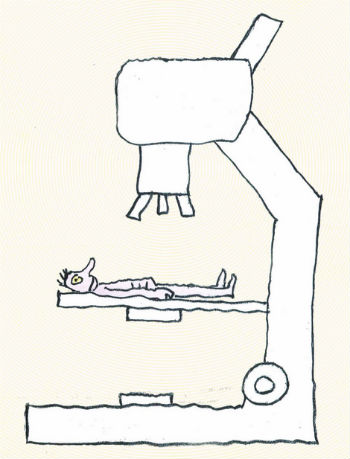
Start early.

Be sure to denigrate medical students whenever possible. Even if they’ve come to the profession later in life and have accomplished all kinds of amazing things personally and professionally (which don’t count, of course, since those are other professions) they don’t know squat about medicine and you do. Make sure to emphasize their ignorance and inexperience at every turn, because it’s the only way to prove that you know more than they do, which of course means that you’re a better person than they are. The fact that as a group they’re all at the very top of their peer group in motivation and intelligence is irrelevant.Continue reading…

Clinical Man *

By CLIFTON MEADOR

Pharos Cover Art

In 1994, I recorded a fictitious interview with the person whom I imagined to be the last well person on earth. (1)  I mistakenly thought well people were disappearing and I wanted to call attention to their disappearance. I missed the big picture and now want to correct my misconceptions. Well people are not disappearing; instead, a new species of man is emerging:  homo clinicus.

An evolution of the symbiotic relationship between man and medicine has been going on for some time. Lewis Thomas deserves the credit for an early spotting of the new species, first observed in America. He called our attention to this phenomenon in the 1970s.

Nothing has changed so much in the health-care system over the past 25 years as the public’s perception of its own health. The change amounts to a loss of confidence in the human form. The general belief these days seems to be that the body is fundamentally flawed, subject to disintegration at any moment, always on the verge of mortal disease, always in need of continual monitoring and support by health-care professionals. This is a new phenomenon in our society.

Continue reading…

Got an Infection? Good Luck Finding an ID Doctor

By PHILIP LEDERER

Phil LedererBOSTON, Ma. — It was Christmas Day. I was on call at the hospital and was waiting for my wife and 6-week-old son to come so we could eat lunch together. She was bringing kimbap, sweet potatoes, and avocados. But then my pager buzzed.

On the phone was a hospitalist physician.

“Is this ID? We have a new consult for you,” she said. “This man has a history of dementia. For some reason he has a urinary catheter to empty his bladder. We gave him an antibiotic, but now his urine is growing a resistant bacteria.”

I sighed. Yet another catheter associated urinary tract infection.

I walked up the stairs to his hospital room. He was bald, thin, and sitting alone in bed. The peas and fish on his tray were untouched. There were no gifts or tree in his room. I washed my hands, put on gloves and a yellow isolation gown, and introduced myself.

“How are you?”

“Ok, I guess,” he replied.

“Do you know where you are?”

“I’m not sure.”

“You are in the hospital. Do you know what day today is?”

Continue reading…

A Checklist For Surviving Academic Medicine

By MARTIN SAMUELS

flying cadeucii

  •  Decide who you are and don’t kid yourself
  •  Don’t bluff; the triple (quadruple) threat is an illusion
  • Know your subject; teaching is not a trick; you must have something real to transmit
  • Don’t replace substance with gimmicks (e.g. fancy powerpoint)
  • Simulated patients produce simulated doctors and de-professionalize students
  • Respect your teachers but don’t believe in the Days of the Giants; they have feet of clay
  • Don’t become “one of them.”
  • Develop a reputation beyond the local environment
  • Train people, but remember that some will not respect you (remember Bouchard)
  • Stand proudly for clinical excellence
  • Write briefly, simply and parsimoniously (remember Babinski)
  • Be a professional
  • Don’t be an asshole
  • Don’t bullshit

Abstracted from the “Academic Medicine Survival Guide” Martin Samuels, MD. The Health Care Blog. March 2015.

Academic Medicine Survival Guide

By MARTIN SAMUELS

The History of the Problem 

Martin SamuelsThe European University (e.g. Italy, Germany, France, England) descended from the Church. The academic hierarchy, reflected in the regalia, has its roots in organized religion.

The American University was a phenocopy of the European University, but the liberal arts college was a unique American contribution, wherein teaching was considered a legitimate academic pursuit.  Even the closest analogues in Europe (the colleges of Cambridge and Oxford) are not as purely an educational institution as the American liberal arts college.

The evolution of American medical education (adapted and updated from: Ludmerer KM. Time to Heal, Oxford University Press, Oxford, 1999) may be divided into five eras.

I.  The pre-Flexnerian era (1776- 1910) was entirely proprietary in nature. Virtually anyone with the resources could start a medical school.  There was no academic affiliations of medical school and no national standards.

II. The inter-war period (1910-1945) was characterized by an uneasy alliance between hospitals and universities.  Four major models emerged.  In the Johns Hopkins model, led by William Osler, the medical school and the hospital were married and teaching of medicine took place at the bedside. The Harvard model in which the hospitals grew up independently with only a loose alliance with the medical school, represented a hybrid between pre- and post-Flexnerian medical education.Continue reading…

Do Value-Based Payments Lead to Higher Doctor-Satisfaction Scores?

By JACK COCHRAN & CHARLES KENNEY

Jack CochranRecently we wrote a blog post promoting the benefits of shifting from fee-for-service to value-based payments. We praised the recent decision by leaders at the U.S. Department of Health and Human Services (HHS) to accelerate that shift, and we were then and remain convinced this shift paves the way for better, more affordable care.

There were some strong reactions to the post.

Some people think capitated payments have been discredited, others believe the change from fee-for-service will change little. One physician told John Irvine, editor at The Health Care Blog, that he got the impression from our post that we were saying value-based payments would make physicians lives easier. “Really?” Irvine’s doctor friend said. “You’re making my life easier? Prove it.”

How Will the Practice of Medicine Change?

We didn’t actually use the word easier in the post though we did say that “increasingly, physicians seek liberation from the constraints of fee-for-service in order to focus on the overall health of their patients. Value-based payments allow doctors to do exactly that.” So we definitely hear what Irvine’s friend is saying — and we understand his frustration. Has there ever been a time when so many physicians have been worn thin — angry with the direction of our health care system?

Irvine invited us to respond to his friend and we thought we would do so by soliciting the thoughts of Scott Young, MD, executive director of Kaiser Permanente’s Care Management Institute and associate executive director for Clinical Care and Innovation at The Permanente Federation.

“Easier?” said Dr. Young. “No, value-based payments don’t make doctors’ lives easier. But I think it does make the practice of medicine more rewarding and fulfilling.”

Continue reading…

Why Data Handoffs Matter

By JORDAN SHLAIN

jordan shlainChief information officers (CIOs) and chief medical information officers (CMIOs) have spent the better part of two decades on a quest for interoperability; yet, their Achilles heel lies in the “information” part of their titles. If information is the sole beacon of efficiency and value, the invaluable contours of human suffering, personal preferences and humanity itself are lost.

Information is the first step to developing knowledge and understanding, but what physicians and patients rely on in the real clinical setting, rife with changes, are knowledge, understanding and empathy. The cold, hard calculus of a=b does not always apply when dealing with people because they are much more complex and complicated than binary machines with screens. If it were so easy, there would be no problem reaching 100% compliance with medication or a plan of action.

Sadly, all data lives in a database; which might as well be called a wait-a-base; after all, the data just sits there and waits for someone to look at it.

The fundamental problem with today’s information architecture is that all data are not created equal. Data, information and knowledge degrade with each new doctor that becomes involved. In addition, systems design lacks an understanding of how the human computer works in the context of illness, anxiety or uncertainty. Healthcare is a people business in need of data, not a data business in need of people. Data are the means; people are the beginning and the end.

Continue reading…

Race, Ethnicity and Patient Engagement

Michael Millenson

By MICHAEL MILLENSON

A few years ago, I was upgraded to First Class on a flight from California back to Chicago. Not long after I settled in, a tall, muscular man easily four inches taller than me walked up to my aisle seat in the first row and prepared to sit by the window.

I envisioned him spending hours hemmed in by the bulkhead and offered to switch places. We began to talk, and soon he shared that his seatmates often hesitate to engage him in conversation. Women and even some men will turn or stiffen in their seats in order to send a clear body-language message.

That’s what happens when you’re a large, physically imposing black guy. People make assumptions. When it comes to patient engagement, we often make assumptions, too.

We minimize the influence of race, gender and ethnicity, or we confuse it with socio-economic status. We assume that “people like us” have communication preferences like us. We downplay the doctor-patient relationship and overemphasize technology.

Race and Ethnicity Matter

In truth, race and ethnicity matter as much in medicine as in the rest of the society. For example, whites, African-Americans and Latinos share the same expectations of their physicians, a study in Health Services Research found, but “patients from different racial and ethnic groups report differing experiences…when using well-validated measurement tools.” Translation: the perception reflects reality.

Continue reading…

One of Those Patients

By ROB LAMBERTS

“Dr. RobI’ve been getting winded lately.”

He’s a middle-aged man with diabetes.  This kind of thing is a “red flag” on certain patients.  He’s one of those patients.

“When does it happen?” I ask.

“Just when I do things.  If I rest for a few minutes, I feel better.”

Now the red flag is waving vigorously.  It sounds like it could be exertional angina.  In a diabetic, the symptoms of ischemia (the heart not getting enough blood) are atypical.  It’s the pattern of symptoms that is the most important, and to have exertional shortness of breath which goes away with rest is a pattern I don’t like to hear.

What he needs is a stress test – more specifically in his case, a nuclear stress test (because his baseline EKG is abnormal).  But there’s a problem: he has no insurance.  A nuclear stress test will cost thousands of dollars.

I can refer him to the hospital, but I know the financial situation he and his wife face.  They have no money because of a chronic pain problem he has.  He hasn’t worked in several years, but hasn’t ever been able to get disability either (“I tried, but was denied three times”).  Without insurance he’s not able to get his problem fixed, so he’s disabled.  But he can’t get disability, so he can’t get insurance to get his problem fixed and no longer be disabled.

But the problem on hand is this: he needs a test he can’t afford.

There are many folks out there in this same situation.  It may not just be the people with no insurance, and it may not even be people who don’t have money.  In fact, my own family is facing this same problem.  Multiple family members (myself included) need dental work done.  Some need it done badly, yet we don’t yet have the money to pay for it.  So we wait for the money to show up while the problems gets worse.

Continue reading…