Categories

Category: Medical Practice

A Response to Steven Brill

By ROBERT PEARL

Robert PearlAs CEO and Executive Director of The Permanente Medical Group at Kaiser Permanente, I have been following with interest the exchange between Malcolm Gladwell and Steven Brill, prompted by Gladwell’s critique of Brill’s book (America’s Bitter Pill).  Gladwell accurately points out that the solution to the problems of the American health care system that Brill puts forth in the book are very close to the structure of Kaiser Permanente.  We provide world class hospital and ambulatory care to millions of Americans through our dedicated, physician-led Permanente medical groups, and pay for it through the not-for-profit Kaiser Foundation Health Plan.

Brill dismisses Gladwell’s criticism explaining that “Kaiser Permanente is not the same because it doesn’t have a monopoly, or oligopoly power, in any of its communities. It’s not a teaching hospital. It doesn’t have the network of high-quality doctors, or isn’t perceived to, like New York Presbyterian has in New York or the Cleveland Clinic has in Cleveland.”Continue reading…

Why Technology May Not Fix The Medication Adherence Problem

By DAVID SHAYWITZ

Shaywitz of Eldred

I wish I could assign Lisa Rosenbaum’s characteristically wonderful essay in the latest New England Journal of Medicine to every twentysomething programmer in Silicon Valley planning to disrupt healthcare based on his uninformed interpretation of the problem to be solved.

Consider – as Rosenbaum does – the problem of medication adherence.  As many as half the Americans prescribed medications don’t take them as recommended, even after a heart attack – despite very strong evidence of benefit in this context (namely, the prevention of a second heart attack).

At first blush, this seems like a perfect opportunity for a smart app, or a clever pill case that monitors usage and reminds forgetful patients to take their next dose.  In fairness, for many patients, such technological innovation might prove impactful. Yet what Rosenbaum (a cardiologist) captures in her piece are the many reasons why patients, in the real world, deliberately choose not to take their medicines – even after a heart attack.

Some patients begin with an intrinsically negative view of medicines, and consequently tend to exaggerate potential side effects, and underestimate the likely benefits.  Other patients choose not to take medicines because they don’t like to be reminded that they are sick – each pill taken to stay healthy paradoxically reinforces the concept that they are ill. Of course, many patients avoid medications because of the view that drugs are chemicals and therefore “unnatural” — in contrast to vitamins, or herbal remedies, which presumably are made only of organic goodness.

Still other patients subscribe to the view that “if it ain’t broke- don’t fix it,” and prefer to avoid medications when (as in the case of preventive care) the benefit is often imperceptible.  (There seems to be less discussion of non-adherence in the context of oxycontin, for example.)

Continue reading…

“I Smoke and I Am Not Going To Quit. My Physician Says I Need a CT scan. Do I?”

By ROBERT MCNUTT

Screen Shot 2015-01-09 at 8.51.43 AM

Case:

I get asked by many who smoke or who have just quit smoking for help making the decision to have/not have a CT scan to screen for lung cancer. The man responsible for the question above had been smoking his entire life, and, at age 62, he raised the question.

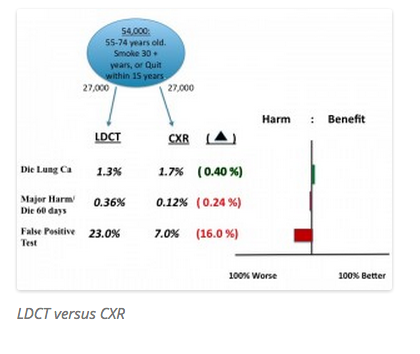
Screening is the term used when tests are done for patients without symptoms. The hope of screening is that a test will find lung cancer (or any other clinical situation for which screening tests are considered) early in the course of the condition so treatment may be beneficial. In the study above, 87 fewer people of the nearly 54,000 in the study died of lung cancer in the LDCT arm. In addition, the number of people dying of other conditions beside lung cancer was fewer (1526 died of other conditions in the LDCT group and 1557 in the CXR group). I did not present this data on the figure as the difference is small and it is unclear why LDCT would reduce other reasons for dying.

The harm of screening, as discussed in earlier blog posts, is that some people will have a positive test and not have cancer. This can cause worry, but in this clinical situation, additionally, the abnormalities found by the test are located in the lung. Getting to these lesions to provide assurance that cancer is not present may be dangerous and costly, and in this study, more people did die early in the LDCT arm.

Since I believe only patients can decide for their tests/treatments, a person would have to trade-off the potential 0.4% added chance of not dying of lung cancer in the future against the potential 40 fold greater chance of a false positive finding and a potential 0.24% added chance dying early or having a major complication by following a LDCT strategy.Continue reading…

Does Restricting Physician Duty Hours Improve Patient Care?

By RICHARD GUNDERMAN

GundermanDo physicians in training take better care of patients or perform better on their exams when their work hours are restricted?  Two recent studies in the Journal of the American Medical Association suggest that the answer is no.  In one, patients of surgery residents showed no difference in morality or postoperative outcomes after duty hour restrictions were implemented.  Their test scores did not improve either.  In the other, hospitalized Medicare patients being cared for by physicians working shorter hours experienced no improvement in mortality or readmission rates.

US resident duty hour restrictions were born in 2003, when the ACGME, the organization that accredits medical residency programs, capped the work week at 80 hours.  It also mandated that residents have 10 hours off between duty periods and a 24 hour limit on continuous duty, with 1 day in 7 free from patient care.  In 2011, the organization revised its policy, further restricting the total number of continuous duty hours for physicians in the first year of training to 16.

How could well-intentioned attempts to ensure that hardworking young physicians get sufficient rest fail to benefit patients?  To begin with, simply restricting duty hours does not guarantee that residents will use their extra off-duty time to sleep.  They might, for example, use it to study, exercise, or socialize.  It is also possible that the outcomes being assessed by these studies are influenced by so many factors that merely changing duty hours is insufficient to cause a change.  Yet if such changes do not benefit patients, how strong is the case for their implementation?

Some educators worry that duty hours restrictions are undermining the quality of medical education.  For example, a survey of surgery program directors published last year showed that 21% believe that residency graduates are unprepared for the operating room, 30% believe they cannot independently remove a gallbladder, and 68% believe they cannot perform a major procedure unsupervised for more than 30 minutes.  Another survey showed that 38% of residents themselves lack confidence in their preparation even after 5 years of training.

Continue reading…

The Anesthesiologist’s Story: New Details Emerge In the Joan Rivers Case

By KAREN SIBERT

Screen Shot 2015-01-04 at 9.08.12 AM

New York Post reporter Susan Edelman revealed on January 4 the name of the unfortunate anesthesiologist allegedly present on August 28 at Yorkville Endoscopy, during the throat procedure that led to the death of comedian Joan Rivers. She is reported to be Renuka Reddy Bankulla, MD, 47, a board-certified anesthesiologist from New Rochelle, NY.

Having her name made public will be a nightmare for Dr. Bankulla, as investigators will certainly target her role in Ms. Rivers’ sedation and the management — or mismanagement — of her resuscitation.

When the news of Ms. Rivers’ cardiac arrest and transfer to Mt. Sinai Hospital became public, many of us guessed that there might have been no qualified anesthesia practitioner — either anesthesiologist or nurse anesthetist — present during the case. The gastroenterologist and then medical director of the clinic, Dr. Lawrence Cohen, argued famously that the sedative propofol, which Ms. Rivers received, could be safely given by a registered nurse under his supervision, and that no anesthesiologist is necessary.

However, with the publication of the Centers for Medicare & Medicaid Services (CMS) report of September 5, it became clear that an anesthesiologist was definitely present. The anesthesiologist was identified only as “Staff #2″ in the report. She was interviewed by the CMS surveyors four days after the event, but said she was “advised by her legal representative not to discuss the case.”

Key pieces of information about what happened still haven’t been made public. Nonetheless, the surveyors gathered enough information to reach this conclusion:  “The physicians in charge of the care of the patient failed to identify deteriorating vital signs and provide timely intervention during the procedure.”

By any standard of care, the anesthesiologist clearly would be one of the physicians in charge.

Continue reading…

Like Air Traffic Control For Healthcare

By THCBist 

flying cadeuciiIn December THCB asked insiders and pundits across health care to give us their armchair quarterback predictions for 2015.  What tectonic trends do they see looming on the horizon?  What’s overrated?  What nasty little surprises do they see lying in wait? What will we all be talking about this time next year?  Over the next week, we’ll be featuring their responses in a series of quick takes.

Jacob Reider MD, Former Deputy National Coordinator, HHS

As care providers increasingly embrace shared risk payment models, we will see a rapid growth of interest in care coordination and health IT tools that support shared decisions.

a)     Care Coordination.  While this remains a bit of a buzz word, the need for a toolset that helps a community of clinicians care for a group of people in a coordinated manner is obvious to anyone who has been on either end of the stethoscope.  The current health IT tools and processes weren’t developed for this purpose – and therefore do a terrible job of it.  2015 will see the emergence of technology and services that help teams identify and maintain individual patient goals, optimal pathways toward those goals, and then manage the participants toward shared success.  Think of this as “air-traffic control” for health care. If we know where we’re going.  This toolset (and the humans who use it) can help make sure everyone arrives safely.

b)     Do we know where we’re going? Have we made the right diagnosis?  If so – do we have the right treatment plan?  Clinical decisions need to be shared between care providers, patients, family members and other participants.  2015 will see the next step in the evolution of traditional provider-focused clinical decision support (CDS) tools toward tools that also offer research-based personalized care guidance.  This patient’s unique needs can be defined, understood by all parties, and then acted upon.  If care coordination is air-traffic control, perhaps this personalized decision support will be the Waze for health care.  Like Waze, this will take years to reach the mainstream, but when it does, none of us will leave home without it.

It’s Official: Aledade ACOs Up and Running

By FARZAD MOSTASHARI

Farzad MostashariWe launched Aledade on June 18th, and by the end of July we had recruited 80 primary care physicians in 4 states to join us in creating the very first Aledade ACOs. We have been work together ever since- but haven’t been able to talk about our wonderful practices until the official notification from CMS that came today.

We are thrilled to announce that beginning January 1, our two newAledade ACOs will be taking accountability for the care of over 20,000 attributed Medicare patients, and stewardship of nearly a quarter of a billion dollars of health care expenditures each year. We’re building a new delivery system on the foundation of trust between patients and the physicians who have been caring for them in their communities for decades, and enabled and accelerated with cutting-edge technology and analytics.

One ACO will operate in the state of Delaware, in close collaboration with our physician partners and our field team, Quality Insights of Delaware. Our second ACO, the Primary Care ACO, will take the same model spanning three states — New York, Maryland, and Arkansas, where we are also working with local partners like the Arkansas Foundation for Medical Care. Our hand-picked ACOs physician partners are some of the most capable and inspiring primary care physicians in the country. They are leaders in their local, state and national physician associations; they are pioneers of Meaningful Use and Patient Centered Medical Homes; they are much-decorated top doctors in quality; but most of all, they are the pillars of their communities.Continue reading…

Competing With Urgent Care

By MARC-DAVID MUNK

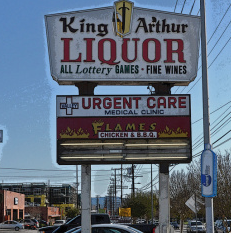
Screen Shot 2015-01-02 at 8.08.19 AMAbout seven years ago, the California Healthcare Roundtable and HealthAffairs sat down to prepare a white paper on the emerging “phenomenon” of urgent care centers, and what it might mean for primary care. At the time the group couldn’t agree that urgent care was a “disruptive” innovation, but it seemed clear to all participants that it represented a threat to primary care: The rise of UC, the group noted, would lead to 1) less preventive care and 2) concentrate acuity in primary care clinics. They wrote: “[Urgent care] means fewer patients per day, a higher intensity environment for providers, and potentially lower reimbursement.”

In particular, the group couldn’t understand if patients were choosing to leave primary care because they didn’t value having a PCP, or if they were settling for the inherent limitations of UC because cost and convenience outweighed its disadvantages.

 Seventy-five percent  [of UC customers] are women ages 28 to 42 and their children. Some hypothesize that this consumer group thinks of its health care relationships differently than do people of the baby boomer generation and older. The younger cohort often has no “medical home,” while baby boomers and older people tend to view the primary care physician as the center of their medical care. Discussants concurred that what the data do not reveal, however, is whether the medical “homelessness” of this younger group and its high relative use of retail clinics reflect how these consumers want to receive their care or is instead merely their experience (or is a function of the fact that they have fewer chronic conditions and thus need less care and care coordination).

Since the roundtable in 2007, there has been a flood of urgent care centers with ongoing rapid growth. The American Academy of Urgent Care estimates that there are around 9300 UCs nationally. Across the country, clinics are sprouting like flowers, sometimes fueled by private equity investors, but often by hospitals and health systems who are reflexively installing UCs in repurposed strip malls, sometimes without a clear strategy other than “keeping market share” in an otherwise low margin business.

The reasons for growth, according to the American Academy of Urgent Care? Primarily extended hours (as compared to primary care) and better wait times and lower prices than the ED.

As the private-equity fueled urgent care bubble expands, here’s my prediction on how this all plays out: Don’t bet the farm on UCs being the final answer to the consumer’s search for value. For all of UC’s utility, it’s also possible that urgent care may just get out- maneuvered by the next generation of primary care.

Continue reading…

Has Med School Changed For the Better?

By KARAN CHHABRA

karan chhabraEvery third-year has heard it.

“…When I was in your position, I was taking 24-hour calls every other night. If my resident was there, I was there….”

We’re regaled about the glory days, without shelf exams, without phlebotomists, and—by god—without those work-hour restrictions. The days when medical students wouldn’t dare ask their residents for help, or residents their chiefs, or chiefs their attendings, and so on. I hear a bit of romance: the heroism of providing total patient care, exactly when the patient needed it, unfettered by handoffs or outside interference. I envy the skill required to practice medicine almost-literally in one’s sleep.

As the veteran doc continues his (yes, usually his) soliloquy, he may admit that it wasn’t the safest model for patients, or the most humane for trainees. He may today be a better doctor for it, but he’s a bit ambivalent about whether it should remain exactly the same today. Presumably he wasn’t alone, because since the good ol’ days, the third year of medical school has morphed into something barely recognizable.

Continue reading…

Do We Need Patient Relationship Management (PRM) Systems?

By JORDAN SHLAIN

jordan shlainAs a primary care doctor in San Francisco and Silicon Valley, I have been searching for the holy grail of patient engagement for over 15 years. My journey began with alpha-numeric pager and a medical degree. I shared my pager number with my patients along with a pledge to call them back within 15-minutes, 24-hours a day. My communications evolved into email and texting, with the predicate that by enhancing communication, I could carefully guide my patients down the byzantine corridors of healthcare – with a high probability we could avoid mistakes – if they would agree to share the ownership of their treatment plan. My life’s work has been where the rubber meets the road; where doctors interface with patients: office, hospital, home or smartphone.

Technology has washed over almost every industry and transformed it, radically. Healthcare is on the precipice of destiny. The wave is here.

Over the past three decades healthcare has lurched from one existential crisis to another; often manifested by an acronym solution: HMO, ACO, PCMH, P4P, PQRS; each a valiant attempt to reign in costs and solve for aligning incentives. However, we can’t have hospitals, doctors, health systems and payers accountable to healthy outcomes if the 300,000,000 people (patients) are not paramount to the equation.

If you haven’t been paying close attention, ‘patient engagement’ is a white-hot topic in healthcare these days. It wasn’t sexy 5 years ago. In fact, at the keynote speech at HIMSS 13 (the national Health IT conference), it was announced that the “The blockbuster drug of the 21st century is Patient Engagement”.

Continue reading…