Categories

Category: Medical Practice

Zen and the Art of Antibiotics

Hans Duvefelt

By HANS DUVEFELT

Jacques Johndreau did not look like his usual self when I saw him in the office a few weeks ago. He looked part retired bank manager and part Disney cartoon chipmunk.

He spoke with hardly any facial movements:

“Holy Boys, my wife said to me this morning, you look like you’ve got the mumps again!”

I was aware that Jacques had an atrophic testicle from catching the mumps as a teenager. This time, it was not likely the mumps, but a bacterial parotitis. He was afebrile, and could open his mouth when asked to. I could not palpate a stone in Stensen’s duct and he didn’t experience any worsening of pain when eating acidic foods, so I wasn’t so sure he had a stone.

This was an early, mild case of parotitis and I thought he had a good chance of beating the infection with oral antibiotics. The majority of these infections are caused by staphylococci, but sometimes gram-negative bacteria are the culprit. Whatever I chose, I needed to consider that Jacques takes a blood thinner, warfarin, which interacts with many antibiotics, particularly ones with gram negative coverage.

I e-prescribed a high dose of Ceftin, or cefuroxime, a second generation cephalosporin with good coverage for both staph and gram-negatives and no effect on warfarin.

Continue reading…

Why I’m Starting a Radically Different Kind of Medical Practice

By ROBIN BERZIN

Screen Shot 2014-12-29 at 11.03.12 AMWe hear a lot about how US medicine is broken, from how much we spend annually ($4 trillion) for unimpressive outcomes, to the growing epidemic of obesity and diabetes, to problematic financial models, to the growing malaise amongst doctors.

Across US health care, a lot of smart people are crafting solutions to these problems, but in my view the reality is that many of them are generating efficiencies on top of a broken product.

The real problem is that conventional primary care as it’s practiced today no longer serves the needs of most people, be they wealthy or under-served, be they patient or provider.

I am starting Parsley Health, a new kind of medical practice that directly addresses these problems, first by providing something called Functional Medicine rather than traditional primary care, and second by providing functional medicine in a tech driven, modern and affordable way.

What is Functional Medicine?

I became a functional medicine doctor because early on I recognized two major limitations of the conventional medicine.

Continue reading…

The Trouble with Home Health Care & Care Coordination

By LESLIE KERNISAN

Leslie Kernisan new headshotHome health care is in many ways a fantastic service, especially for those Medicare beneficiaries who are essentially home bound due to frailty or illness.

But it often feels surprisingly hard to synergize with home health care.

The main problem, as I see it, is that home health care agencies have set themselves up to provide only administratively required communication with the ordering doc. (There are rules governing home health care, you know!)

Now, what I need is clinically relevant communication. As in, how is the patient clinically doing, so that you and I can coordinate our efforts together. This has apparently not been built into the home health care workflow.

And things get even more complicated when it’s a patient in assisted living, because then you have the facility nurse who should be kept in the loop as well.

Right now, I am trying to follow up on an elderly woman who lives in assisted living and has paid in-home aides (which are provided by a separate company).

I referred her to home health care a few weeks ago for help managing her skin. On one hand, she was starting to develop a pressure sore from sitting too much in the same position. And on the other hand, she had a fungal rash in her groin, under her incontinence brief.

I prescribed an antifungal cream to be used twice a day for two weeks.

Now it’s been three weeks, and the pharmacy is requesting a refill.

Well…what’s going on with that rash?

What I want to do is send an email to everyone who is involved and might know something.

Continue reading…

Rediscovering Medical Professionalism

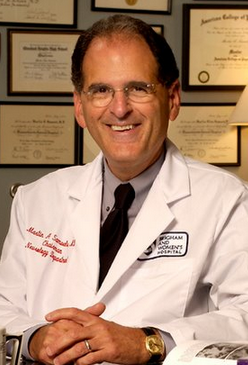
By MARTIN SAMUELS, MD

Martin SamuelsI am a doctor today because of Dr. J.W. Epstein, my pediatrician in Cleveland in the 1950s.   An immigrant from the Nazi terror in Europe, he had trained in Vienna and   spoke English with a Germanic accent.  His house calls are etched permanently in my memory.  His visits were heralded by a fury of activity, led by my mother.  “The doctor is coming!  Put on clean underwear.  Clean the house.”  Water would be set to boil on the stove, in case the doctor should need to sterilize a needle for an injection.  Up would drive his broken-down jalopy, which he would park directly in front of the house.  No need to worry about getting a ticket.  The police knew his car and would never issue a citation to The Doctor.  No one – not the mayor, not the governor, not even Al Rosen, the venerated third baseman for the Indians – would have received such a royal welcome.

In he would come, wearing a suit and hat, carrying a worn black doctor’s bag.  “Mudder, ver is da boy?”  ”He’s in his room upstairs with a rash and sore throat.”  He would put down his bag, sit on my bed, and ask me if the teacher had sent home the homework.  He wouldn’t want me falling behind in my school work.

That might interfere with my becoming a doctor.  Then came the ritual of the examination.  Say aah; schtick out your tongue; take some deep breaths.  “Gut… gut…zounds normal” as he listened with his stethoscope, feeling gently on my belly and then finally tap on some reflexes with his tomahawk hammer.  “Mudder, it’s da measles, plenty of fluids, back to school in a few days.”  “Veel zee you in da office next fall for da usual checkup.”  “Mudder; don’t vorry, it isn’t polio.”  No time for a cup of tea today; too many other house calls for this afternoon and off he would go.  The enormous feeling of relief, transmitted from my mother to me, had me on the mend in no time.

This is what I wanted to do:  be the agent of relief, the repository of medical knowledge, the most respected figure in the community.  Some years later, as a teenager, I was waiting in Dr. Epstein’s office for my annual checkup before school started in September.  I was surrounded by little babies and I realized that I might be growing out of Dr. Epstein.  As he was tapping on my back in the usual reassuring fashion, I said to him,  “How long can you see me as a patient?”  “ Until you’re a doctor.”  How could I fail him?

Continue reading…

The Value of Workplace Health Promotion (Wellness) Programs

By RON GOETZEL

flying cadeuciiThe recent Health Affairs Blog post by Al Lewis, Vik Khanna, and Shana Montrose titled, “Workplace Wellness Produces No Savings” has triggered much interest and media attention. It highlights the controversy surrounding the value of workplace health promotion programs that 22 authors addressed in an article published in the September 2014 issue of the Journal of Occupational and Environmental Medicine titled, “Do Workplace Health Promotion (Wellness) Programs Work?”  That article also inspired several follow-up discussions and media reports, including one published by New York Times columnists Frakt and Carroll who answered the above question with: “usually not.”

There are certainly many points of contention and areas for continued discussion on this topic. It turns out that Lewis et al. and I agree on many things, and there are other areas where we see things differently.Continue reading…

Flu Report: Providers Prescribing Antivirals at Higher Rate

By IYUE SUNG

Screen Shot 2014-12-19 at 11.36.30 AM

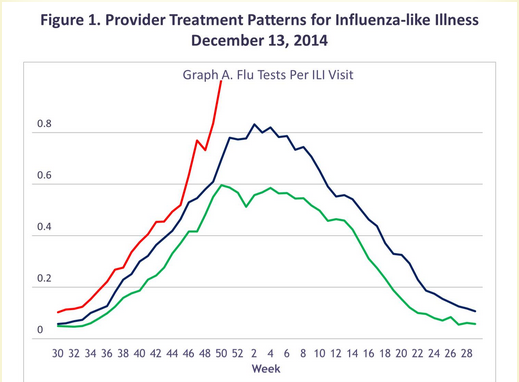
Earlier this week, we reported on the current rates of influenza-like illness (ILI), based on data from roughly one million patient visits on the athenahealth network. That report showed a steep increase in ILI rates for the week ending Saturday, December 13 (see previous post). It’s not certain that this season will be as severe as that of 2012-2013 (data for pediatrics suggests that is a real possibility); however, providers are testing for flu more consistently than previous years, and prescribing antivirals more often.

Our data shows that the number of flu tests ordered, per patient visit in which ILI is diagnosed, has risen each of the past two years (Figure 1, graph A). This season, providers are ordering flu tests at a rate of 0.53 tests per visit with an ILI diagnosis, compared to 0.37 for last season and 0.34 for 2012-2013. (Note: There can be multiple tests per patient visit, e.g. Type A and B.)

Continue reading…

I Have DCIS, Should I Have a Bilateral Mastectomy?

By ROBERT MCNUTT

Bilateral Mastectomy Evidence

Benefit:

There is none. No women with DCIS have been included in a randomized controlled trial.

Harm:

Cosmetic outcomes are unclear; Second operations to fix the cosmetic outcome may be needed, but reasonable estimates for harm and complications do not exist as bilateral mastectomy has not been systematically studied in DCIS. A paper in Annals of Surgery found that out of 600 women at one institution, 42% of 209 women undergoing bilateral mastectomy had complications versus 29% of 391 women undergoing unilateral mastectomy (42-29% = 13%, added harm). Serious complications of bilateral mastectomy occurred in 14%; 4% with unilateral(14-4% = 10%, added harm).

Trade-off:

There is no trade-off between benefit and harm. Since there is no benefit, only harm is possible. Informed medical-decision-making requires a trade-off between added benefit and added harm. This is not the case for DCIS and bilateral mastectomy.

Continue reading…

A Secret Playbook to Torment Doctors

By PETER ELIAS

flying cadeuciiA physician friend commented recently that he was being ‘meeting-ed to death’ and wondered if it was intentional. It turns out, he was on to something.

One of my colleagues has a neighbor whose sister’s piano tuner has a friend whose cousin is married to a nationally respected medical institution’s CEO. We were provided a copy of that institution’s management training course, on the condition that her identity not be revealed.

Here is the section on meetings:

Meetings as a Tool for Physician Control

Meetings are the ideal method for turning actively engaged and therefore troublesome physicians into apathetic sheep who are easy to manage.

Continue reading…

Advice to Vivek Murthy: Be Nonpartisan, Use Common Sense and Move Americans

By SAURABH JHA

Vivek Murthy

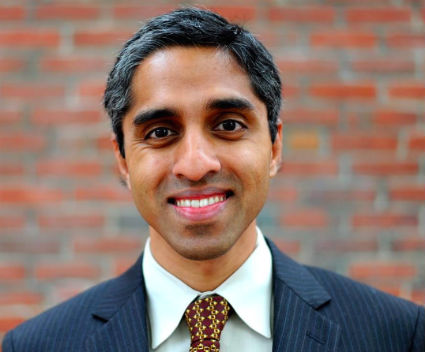
In defiance of dire predictions, children haven’t been sent to workhouses and women haven’t been chained to utensils after the GOP gained strength in the House and the Senate. And Vivek Murthy, the unabashed Obamaphile, was finally confirmed Surgeon General.

To be honest, I always thought the controversy surrounding Murthy’s nomination because of his stance on gun control was rather daft. Stopping doctors from pontificating over guns, such as the Docs versus Glocks legislation, is like banning me from trying to convert Pope Francis to Hinduism. The legislation is a parody not just for its own sake but because what it seeks to prevent is parody as well.

Murthy’s first challenge is to raise the position of the Surgeon General from that tokenism of a career UN bureaucrat to something vaguely useful. Which means Murthy must resist the call of banality, the banality of ideology and the ideology of making all of mankind’s imperfections public health problems.

Continue reading…

#Whitecoats4Blacklives

By ADERINOLA A. ADEJARE

Screen Shot 2014-12-11 at 1.27.35 PMAt 3PM EST on December 10, 2014, medical and dental students at over 70 schools participated in the “National White Coat Die-In.” The event was organized on Facebook and spearheaded by students at University of California, San Francisco (UCSF) School of Medicine who described the event as “a demonstration in response to the events in Ferguson and New York because #BlackLivesMatter.”

Across the country, there have been numerous protests against the grand jury’s decision in Fergurson, Mo. not to indict officer Darren Wilson who shot and killed Michael Brown, an unarmed teenage boy. Similarly, in Staten island, NY, the grand jury decided not to indict officer Daniel Pantaleo who killed Eric Garner, an unarmed black man, using a banned chokehold.

Continue reading…