Categories

Category: Medical Practice

Independent Practice Equals Higher Satisfaction

By TOM GUILLANI

Tom Guillani

Thinking of starting a new practice?  Is the lure of independence calling to you?  There are more reasons than every why independent practice is a great option. Being your own boss is not only easier than it once was, it can actually make you happier.

Independent physicians have many more options available to help them today than they used to. Affordable technology has revolutionized private practice from EHRs to easy-to-use practice management and billing software, adding flexibility to staffing and simplifying paperwork needs. And, the increased availability and ease of outsourcing has further reduced the burden of running your own practice. Physicians can now choose to outsource inbound calls, reminder calls, pre-authorizations, marketing, and of course, billing. In addition, independent providers can transition to new agile practice models such as concierge and hybrid that can offer higher incomes and smaller patient census and reduce some of the headaches associated with traditional practice structures.

Added to the fact that starting and running a private practice is now easier than ever, is the higher level of happiness experienced by independent physicians. In fact, a study done by Medscape in March 2014 reported that 74% of self-employed doctors are satisfied in their practice and that of the physicians who left employment in favor of independent practice, 70% felt happier in their new practice while only 9% were less happy being self-employed. Seventy-four percent of these self-employed doctors also said that their opportunity to practice quality medicine met or exceeded their expectations.

There are many factors contributing to these high satisfaction rates in independent physicians but one of the biggest is the control these doctors have over their practice, their schedule, their treatment of patients, and their destiny. A survey in Hospital Topics on the impact of practice arrangements on physician’s satisfaction backs this up, reporting that physicians who work for HMO’s have much less autonomy and decision-making power than self-employed physicians. And, the report by Health Affairs found that 85% of doctors in private practice felt free to control their schedules compared to only 39% of HMO physicians.

Self-employed doctors also avoided the pitfalls of employment cited by the Medscape study while the doctors working for hospitals and group practices listed administrative headaches, added rules, and a more limited income potential as reasons for dissatisfaction in their careers. It’s easy to see why the 2014 Great American Physician Survey conducted by Physician’s Practice found that over half of independent physicians would do things the same way all over again. This isn’t to say independent providers done have regulatory challenges or administrative responsibilities. However, they have more control over the day-to-day operations and administration, eliminating frustrating bureaucracy.

Better, more affordable, easier-to-use technology, simple outsourcing options, greater autonomy and control, and higher levels of satisfaction…all of these factors make private practice a more attractive option than ever. So, if you are considering starting a new medical practice, now is the time. Just remember, doing it right from the beginning will save you from unnecessary stress, making the process of opening your new practice a much more enjoyable experience.

By joining the ranks of independent physicians, you will be in control of both your practice and your life. You will be free to set your own schedule, manage patient care to your standards, work with a staff of your choosing, and have the final control over your income potential. All new practices will face challenges along the way but you will find a wealth of resources to make your life easier and guide you to success in your new venture.

Tom Giannulli, MD, MS, is the chief medical information officer at Kareo. He is a respected innovator in the medical technology arena with more than 15 years of experience in mobile technology and medical software development. Previously, Giannulli was the founder and chief executive officer of Caretools, which developed the first iPhone-based EHR.


SGR Appeal: Fixing the Present, Setting a Foundation for the Future

By FARZAD MOSTASHARI

FARZAD MOSTASHARI

Farzad MostashariLast week, I was riveted to the deliberations on the Senate floor, as the fate of the Medicare Access and CHIP Reauthorization Act (MACRA – so far, more commonly called the “SGR fix”) was decided. One amendment after another failed to pass; the legislation ultimately passed by a vote of 92-8, and was signed into law shortly thereafter.

To date, much of the coverage of MACRA has focused on how it has fixed the “doc pay” problems of the last 18 years – rescuing us from a yearly round of negotiations about how to temporary avoid painful cuts in Medicare’s physician reimbursement rates.

It’s true that MACRA wiped out (and only partially paid for) the accumulated burden of postponed pay cuts. But it also took a huge step in ending the volume-based “fee-for service” payment system that the pay cuts were trying to restrain in the first place. In a volume-based health care world, the only way for the government and other payers to control runaway medical inflation is to make it harder for doctors to get paid (through rejected claims, paperwork, and prior authorizations), and to reduce the price they pay for each office visit, test, or medical procedure. Providers, paid less and less for each visit and service, can try to maintain their income by further increasing volume — seeing more and more patients in less and less time — or routing patients through increasingly questionable services, tests, and procedures. That is the dysfunctional state of US health care today, with patients caught in the middle of the arms race between those who pay the bills, and those who bill them– collateral damage.Continue reading…

Five Years of Failing Patients

By ANGELO VOLANDES

Screen Shot 2015-04-17 at 7.59.18 PMAlthough this March marked the fifth anniversary of passage of the Affordable Care Act many of its promises to place patients at the center of care remain elusive. No where is this more evident than in the law’s provision to improve shared decision making.

Oftentimes there is more than one reasonable medical treatment to choose from. Shared decision making helps patients partner with health care providers to make more informed decisions about treatments based on patients’ personal beliefs and values and their informed understanding of their medical choices. Frequently, patients are simply told what course of treatment they are to undergo without considering alternatives.

A well-accepted path towards aligning patients’ preferences with medical care is to use decision aids. These tools include written educational materials, informed face-to face encounters, or videos with instructional images that explore different options for care by providing the risks and benefits of interventions and their alternatives, exploring individual values and preferences, and offering testimonials from other patients who have experienced the various choices.

It is an astounding fact that after five years the Centers for Medicare and Medicaid Services (CMS) has certified only a single decision aid. Even in a city infamous for bureaucracy, this is inefficient at best – especially given that the overwhelming number of studies demonstrate that decision aids align medical care with what patients want, while also saving the health care system billions of dollars.

Continue reading…

Time For a Stand Against Misinformation

By SUSANNAH FOX

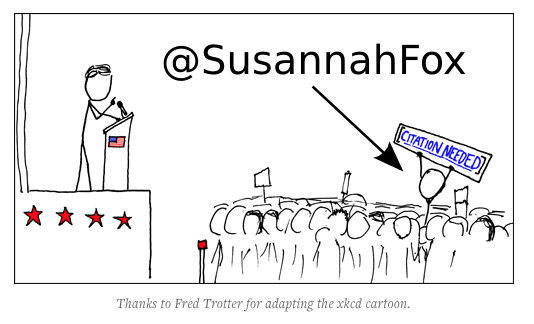
Susannah Fox Cite Me!

Two years ago, I interrupted a speaker at a big health/tech conference, right in the middle of his presentation. I still blush at the memory. But the speaker was citing data — my data—incorrectly and I couldn’t let it pass.

Brian Dolan recently wrote about how he wished he’d spoken up when he heard someone spreading misinformation at a conference:

Unfortunately, about 80 people sitting in the room either accepted this as new information or failed to stand up to correct the speaker. I wish I had pulled a Susannah Fox and done the latter.

He linked to my 2012 post about what happened at Stanford Medicine X.

In that post I asked:

  • What style of conference is the right one for the health/tech field? The TED-style “sage on stage” who does not take questions? Or the scientific-meeting style of engaged debate? Or is there a place for both?
  • Do different rules apply to start-ups? Is it OK to fudge a little bit to make a good point, as one might do in a pitch? Personally, I do not think people are entitled to their own facts. There’s too much at stake.

We can’t let misinformation—or worse—go by without comment.

I think it’s time for more people to speak up in health care.

More pediatricians should express their measles outrage.

More people should chronicle the reality of living with chronic conditions.

More people wearing medical devices should demand access to the data being collected.

More people should speak up about medical errors before—and after—they happen.

Continue reading…

HIMSS 2015: Medicomp’s Dave Lareau

By MICHELLE RONAN NOTEBOOM

Michelle Noteboom: Give me a bit of background on Medicomp and what Medicomp does.

Dave Lareau:Medicomp was founded by Peter Goltra in 1978 and the main mission since its founding was to present relevant clinical information to the physician at the point-of-care so they can document and treat the patient. That’s really the core of what we do. We work with 15 to 20 physicians, most of them board certified in internal medicine, as well their specialty. We have a fairly expansive knowledge editing system, where the physicians work with our knowledge engineers.

So, if you’re thinking about asthma, what are the relevant symptoms, history, physical exam, test, diagnosis, and therapies? If somebody presents with left upper quadrant abdominal pain and nausea and vomiting, what would you be thinking of, and what would you want to document, what kind of test do you want order, what’s your presumptive diagnosis? At the point-of-care we can present the relevant information for documentation given the clinician’s thought process so that we don’t slow them down, we don’t get in their way, let them see more patients. They get all their documentation done and it’s all coded to all the standards. The ICD-9 or 10, as well as LOINC, RxNorm, etc. is in the background, but they’re dealing with something that is fast and familiar. That’s what we do.Continue reading…

Electronic Medical Records May Cast Physicians in Unfavorable Light During Lawsuits

By KEITH L. KLEIN

flying cadeuciiWhile the electronic medical record (EMR) has advantages, it also has introduced liability risks. EMRs can lead to lawsuits or result in a weak defense by casting the physician in an unfavorable light.

EMRs can increase malpractice risk in documentation of clinical findings—copying and pasting previously entered information can perpetuate any prior mistakes or fail to document a changing clinical situation.1 In a study by The Doctors Company of 97 EMR-related closed claims from 2007 to 2014, 13 percent of cases involved prepopulating/copy-and-paste as a contributing factor.2 Copy-and-paste is a necessary evil to save time during documentation of daily notes, but whatever is pasted must also be edited to reflect the current situation. Too often the note makes reference to something that happened “yesterday.”

Checkboxes, particularly those that prepopulate, can be a physician’s nemesis. EMRs have been presented in court that show, through checkboxes, daily breast exams on comatose patients in the ICU, detailed daily neurological exams done by cardiologists, and a complete review of systems done by multiple treating physicians on comatose patients. Questioning in court as to how long it takes to do a review of systems and a physical examination, the patient load of the physician for that day, and how many hours the physician was at work cast doubt on the truthfulness of the testifying physician. A time analysis showed there was no way the physician could have accomplished all that was charted that day, leading to the loss of credibility of that physician in court.

Continue reading…

The Coming Health Tech Disruption

Mark Cuban has been actively commenting in Saurabh Jha’s THCB post about him. We thought this comment was worthy of being a standalone post (and he agreed)–Matthew Holt

By MARK CUBAN

The tech sector will leave people better off at a lower cost. Moore’s law will have its day. But we are 5 years off from minimal impact. 10 years off from Marginal Impact.

In 20 years we will all look back and think 2015 was a barbaric year of discovery.

To give perspective. We pioneered the Streaming Industry TWENTY YEARS AGO. And now we are finally seeing streaming becoming mainstream as a technology but it still cant scale to handle mega live events.

HealthTech will continue to move forward quickly with lots of small wins. It will slow down when there is an inevitable recession in the next 20 years, then jump again afterwards.

In 30 years our kids/grandkids will ask if its true that there were drugstores where we all bought the same medications , no personalization at all, and there were warnings that the buyer may be the one unlucky schmuck that dies from what used to be called over the counter medication.

We will have to admit that while unfortunate it was true. Which is why “one dose fits all ” medications were outlawed in 2040 🙂

By then hopefully we will have a far better grasp on this math equation we call our bodies.

Of course it will be long before then that we make decisions based on optimizing health rather than trying to reduce risk.

The biggest challenge will be training health care professionals.

Medicine today seems to be in that 1980s phase that tech went through where no one got fired for hiring IBM. So IBM got lots of business because it was the safe choice rather than the best choice.

Continue reading…

Training Day

By ROSS KOPPEL & STEPHEN SOUMERAI

Screen Shot 2015-04-06 at 7.20.19 PMDr. Samuels’ day-long training experience is unfortunate, but it’s only the opening chords of a much longer symphony of time commitments required by electronic medical records (EHRs).  Many studies document the extra time that EHRs impose on doctors and patients. Research in U.S. hospitals and medical offices suggest that these systems can add a half-hour or much more time to a day. A study by McDonald et al (2013 JAMA Internal Medicine) found EHRs added 48 minutes/day to ambulatory physicians, and Hill et al found that in a large  community hospital emergency room 43% of all physician time was spent entering data into the EHR. This almost doubled the time spent caring for patients, and tripled the time needed to interpret tests and records. (Annals of Emergency Medicine, 2014).

Some of that extra time is spent with clunky interfaces and  hide-n-go seeking for information that should be immediately available, such as arbitrary or unexpected  presentations of data, e.g., having to find a patient’s history by clicking on her current room number, or lab reports that may be arranged by chronology, by reverse chronology, by the lab company, by the organ system, by who ordered them, or by some informal heading, such as “blood work” or “tests” or “labs.”  Then there’s the constant box clicking (or what clinicians call “clickarrhea”).  EHRs also send thousands of usually irrelevant alerts that desensitize doctors to legitimate clinical recommendations.
Continue reading…

Health Care Ux Design: Crucial But Conflicted

By ANDY ORAM

Screen Shot 2015-04-06 at 1.22.24 PMThe focus on design for health IT at the HxRefactored conference on March 31 raised several tough questions about the hazard-strewn path app developers must travel in that field. My sampling of introductory workshops and afternoon sessions (I unfortunately had the chance to attend only the first day of the two-day conference) brought up many fine design principles, but most of the presenters were general-purpose designers having limited experience in health care. Still, some important distinctions to recognize when entering health IT came up.

One factor making design is so difficult in health care is the vast variety of tasks health care professionals perform. If you’re designing an app to reserve a restaurant table or buy a sweater, how many pathways can a user take? Probably at most a dozen or two. Now think of a hospital ward: one patient whose heart has to be monitored constantly, another who needs regular injections, and yet another whose medication has put her in a delirium that leads her to jump out of bed and wander. Truly, the pathways that a doctor or nurse can take through the health care application verges on the infinite.

Continue reading…

Radiologists vs. Mark Cuban on Don’t Ask / Don’t Tell

By SAURABH JHA

https://twitter.com/mcuban/status/583468799145349120

To his credit, Mark Cuban, engaged on Twitter in response to my post.

Mark, I’m sorry I had to leave Twitter abruptly. My wife threatened to kill me and then divorce me – in that order – if I didn’t get off Twitter instantly and get the groceries.

However, I caught the tail end of the Tweets. I’ll do my best to respond.

1. “Why is this contingency all radiologists?”

Mark wondered why everyone on a thread about overtesting were radiologists. It would be a great question if radiologists, who deal with testing, overtesting, limitations of testing, harms of testing, benefits of testing, appropriateness of testing, in other words the science of testing, would be offering advice on financial planning or offering the White House advice on their ISIS policy.

I can do no better than quote @jeffware.

“Exactly Mark – why are the Drs. who specialize in testing trying to explain the dangers of overtesting?”

That was a rhetorical question. But there are some entrepreneurial radiologists who are licking their lips at the epidemic of overtesting. I can hear them say “Mark and acolytes, bring it on.”

To wit, overtesting is better business for us. So our objection is not financially motivated. Let me make this even clearer. The more blood tests and genomic tests the “must prove that I’m healthy” brigade have, more $$$ for radiologists.

Continue reading…