Categories

Category: Medical Practice

Innovation, Primary Care Style

By DAVID HARLOW

DAVID HARLOW
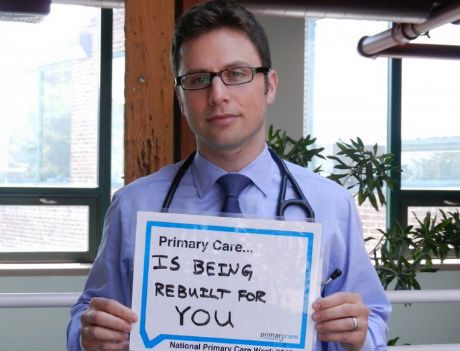
Andrew Morris Singer PCP

On a recent evening at Harvard Medical School, the Primary Care Innovation Challenge and Pitch-Off ,sponsored by WellPoint’s American Resident Project, brought together six finalists, primary care luminaries and trainees, and a host of hangers-on and camp followers for a couple of hours of demos and discussions. The tenor of the evening, which was in many ways a pep rally for primary care – not that there’s anything wrong with that — was best captured by the rhetorical question posed by Asaf Bitton to the primary care practitioners and trainees in the hall, “Are you going to be a playwright or a critic?”

The hoots and hollers in response made clear that these are not your grandfather’s primary care docs. The call to action was echoed by many of the speakers, notably community organizer turned primary care physician Andrew Morris Singer and Dennis Dimitri, both advocating for, well, advocating for primary care.  Bitton’s opening also included the exhortation that proved to be predictive of the winner of the top honors from among the six pitches: Innovation in primary care is not about the technology; it needs to enable better human care.

Continue reading…

Free Medical School?

By JACK COCHRAN & CHARLES KENNEY

UC Riverside Medical Research Building RS

One of the most compelling medical stories in the country is unfolding within the sprawling landscape of inland Southern California. The story centers on the University of California, Riverside School of Medicine where G. Richard Olds, MD, the school’s dean, is taking on one of the uber challenges in health care today: How to get doctors into areas significantly underserved by health care professionals.

The UC-Riverside School of Medicine is in its infancy having welcomed its first class of 50 students just last year. But it has embarked on an innovative program fueled by a passion not only to get doctors into geographic areas where they are most urgently needed, but also to make sure these physicians practice specialties most in demand. “There are 18 new medical schools in the United States and the vast majority are just like existing medical schools,” says Dean Olds. “We are substantially different than most other new schools. We are designed around a unique mission – to try and address the health workforce needs of inland Southern California. We need to train health care professionals who come from backgrounds and communities they will be taking care of.”

Continue reading…

The Ebola Outbreak: The CDC Director’s Guidance for Health care workers

By TOM FRIEDEN

Tom Frieden optimized

There has been a lot of fear about Ebola. The health care workers who care for Ebola patients are right to be concerned – and they should use that concern to increase their awareness and motivation to practice meticulous infection control measures.

Ebola virus is transmitted through direct contact with bodily fluids of an infected person who is sick with Ebola, or exposure to objects, such as needles, that have been contaminated with infected secretions.

Travel from Affected Region

There is a risk for Ebola to be introduced to the United States via an infected traveler from Africa. If that were to happen, widespread transmission in the United States is highly unlikely due to our systematic use of strict and standard infection control precautions in health care settings, although a cluster of cases is possible if patients are not quickly isolated. Community spread is unlikely due to differences in cultural practices, such as in West Africa where community and family members handle their dead.

CDC has advised all travelers arriving from Guinea, Liberia, Nigeria, and Sierra Leone to monitor their health for 21 days and watch for fever or other symptoms consistent with Ebola. If they develop symptoms, they should call ahead to their hospital or health care provider and report their symptoms and recent travel to the affected areas so appropriate precautions can be taken.

Continue reading…

Changing My Mind on SES Risk Adjustment

ASHISH JHA, MD

Ashish JhaI’m sorry I haven’t had a chance to blog in a while – I took a new job as the Director of the Harvard Global Health Institute and it has completely consumed my life.  I’ve decided it’s time to stop whining and start writing again, and I’m leading off with a piece about adjusting for socioeconomic status. It’s pretty controversial – and a topic where I have changed my mind.  I used to be against it – but having spent some more time thinking about it, it’s the right thing to do under specific circumstances.  This blog is about how I came to change my mind – and the data that got me there.

Changing my mind on SES Risk Adjustment

We recently had a readmission – a straightforward case, really.  Mr. Jones, a 64 year-old homeless veteran, intermittently took his diabetes medications and would often run out.  He had recently been discharged from our hospital (a VA hospital) after admission for hyperglycemia.  The discharging team had been meticulous in their care.  At the time of discharge, they had simplified his medication regimen, called him at his shelter to check in a few days later, and set up a primary care appointment.  They had done basically everything, short of finding Mr. Jones an apartment.

Ten days later, Mr. Jones was back — readmitted with a blood glucose of 600, severely dehydrated and in kidney failure.  His medications had been stolen at the shelter, he reported, and he’d never made it to his primary care appointment.  And then it was too late, and he was back in the hospital.

The following afternoon, I spoke with one of the best statisticians at Harvard, Alan Zaslavsky, about the case.  This is why we need to adjust quality measures for socioeconomic status (SES), he said.  I’m worried, I said. Hospitals shouldn’t get credit for providing bad care to poor patients.  Mr. Jones had a real readmission – and the hospital should own up to it.  Adjusting for SES, I worried, might create a lower standard of care for poor patients and thus, create the “soft bigotry of low expectations” that perpetuates disparities.  But Alan made me wonder: would it really?

To adjust or not to adjust?

Because of Alan’s prompting, I re-examined my assumptions about adjustment for SES. As he walked me through the data, I concluded that the issue of adjustment was far more nuanced than I had appreciated.

Continue reading…

Have Doctors Joined the Working Class?

Marx und Engels Alexsander Platz Berlin

By Richard Gunderman, MD

On September 28, 1864, exactly 150 years ago this weekend, the first meeting of the International Workingmen’s Association (IWA) was convened at St. Martin’s Hall, London.  Among the attendees was a relatively obscure German journalist by the name of Karl Marx.  Though Marx did not speak during the meeting, he soon began playing a crucial role in the life of the organization, in part because he was assigned the task of drafting its founding documents.

The work of the IWA and Marx is increasingly relevant to the practice of medicine today, largely because of the rapidly shrinking percentage of US physicians who own their own practices.  This moves physicians into the category of what Marx and his associates called, “working people.”  According to data from the American Medical Association, in 1983 76% of physicians were self-employed, a number that had fallen in 2012 to 53%.  And the trend is accelerating.  It is estimated that in 2014, 3 in 4 newly hired physicians will go to work for hospitals and health systems.

To put this change in Marx’s terms, the rapid fall in physician self-employment means that a shrinking percentage of physicians own what he called the means of production.  In his view, this alienates workers – in this case physicians – from other physicians, themselves, the work they do, and from patients.  Whether we agree with Marx on every point, his writings on this topic provides a provocative perspective from which to survey the changing landscape of contemporary medicine.

Continue reading…

Ask Me Anything with CDC Director Tom Frieden

By THOMAS FRIEDEN

Thomas Frieden, MD

Tom Frieden optimizedThe Ebola outbreak in West Africa is an international public health emergency. As the world responds, there is a risk that American responders working on the ground may be exposed to the virus or become ill. This summer, two American health care workers infected with Ebola while working in West Africa were successfully treated at Emory University Hospital.  Their health care team used the proper infection control practices and there was no transmission of the virus to the health care team or others in the hospital and community.

Now two more American health care workers working in West Africa have become infected with Ebola virus and are being treated in the United States.

CDC has already consulted with state and local health departments on almost 100 cases where travelers had recently returned from West Africa and showed symptoms that might have been caused by Ebola. Of those cases, only eleven of were considered to be truly at risk. Specimens from all eleven patients were tested and fortunately Ebola was ruled out in all cases.

There is understandably a lot of fear surrounding Ebola. The health care workers who might need to care for Ebola patients are right to be concerned – and they should use that concern to increase their awareness and motivation to practice the meticulous infection control measures we know will prevent transmission of the virus.

Continue reading…

It’s a Trade-Off, Stupid.

SAURABH JHA, MD

Screen Shot 2014-09-25 at 10.04.23 AM

An advantage of being a foreigner, or a recent immigrant to be precise, is that it allows one to view events with a certain detachment. To analyze without the burden of love, hate or indifference for the Kennedys, the Clintons or the Bushes. To observe with both eyes open, rather than one eye looking at the events and the other looking at a utopian destination.

The most striking thing I’ve observed in the healthcare debate in the US is the absence of an honest discussion of trade-offs.

I’ve found that “trade-off” carries a sinister connotation in American healthcare parlance. Its mere utterance is a defeatist’s surrender. If optimism is the iron core of the United States, acknowledging trade-offs is her kryptonite.

I was raised in Britain. I learnt to guard optimism with pursed lips. You never knew when it would rain. I also learnt in Britain’s NHS where healthcare resources really are finite, there is a trade-off between coverage and access.

In the discussions preceding the implementation of the Affordable Care Act (ACA) two disparate truths were conjoined by a single solution. The unsustainable trajectory of healthcare spending. And the large number of uninsured population. It was scarcely acknowledged that solution of these problems are inherently oppositional.

This has led to the search for utopian payment models. Fee for service incentivizes physicians towards generously reimbursable services of marginal benefits. Capitated systems dissuade physicians from taking sicker patients.

How about we pay for outcome, value and quality?  Sounds simple enough.

Continue reading…

Will Technology Replace Doctors?

JOE FLOWER

Joe FlowerPut the question in 1880: Will technology replace farmers? Most of them. In the 19th century, some 80% of the population worked in agriculture. Today? About 2% — and they are massively more productive.

Put it in 1980: Will technology replace office workers? Some classes of them, yes. Typists, switchboard operators, stenographers, file clerks, mail clerks — many job categories have diminished or disappeared in the last three decades. But have we stopped doing business? Do fewer people work in offices? No, but much of the rote mechanical work is carried out in vastly streamlined ways.

Similarly, technology will not replace doctors. But emerging technologies have the capacity to replace, streamline, or even render unnecessary much of the work that doctors do — in ways that actually increases the value and productivity of physicians. Imagine some of these scenarios with me:

· Next-generation EMRs that are transparent across platforms and organizations, so that doctors spend no time searching for and re-entering longitudinal records, images, or lab results; and that obviate the need for a separate coding capture function — driving down the need for physician hours of labor.Continue reading…

Should Docs Prescribe Data?

LESLIE KERNISAN, MD

Screen Shot 2014-09-15 at 11.47.58 AM

I’ve always been a little skeptical of the push to get doctors to prescribe apps.

To begin with, it would be awfully easy for us to replicate the many problems of medication prescribing. Chief among these is the tendency for doctors to prescribe what’s been marketed to them, rather than what’s actually a good option for the patient, given his or her overall medical situation, preferences, and values.

Then there are the added complexities peculiar to the world of apps, and of using apps.

A medication, once a pharmaceutical company has labored to bring it to market, basically stays the same over time. But an app is an ever-morphing entity, usually updating and changing several times a year. (Unless it stops updating. That’s potentially worse.)

Meanwhile, the mobile devices with which we use apps are *also* constantly evolving, and we’re all basically forced to replace our devices with regularity.

Continue reading…

PiPS: When Less Is More

By DEBORAH GROSE

Screen Shot 2014-09-23 at 9.42.58 AM

The search for an antidote to the ills of our ailing healthcare system inevitably bumps up against the pervasive mindset that more is better. Each year we develop and prescribe more drugs, more tests, more technology. Yet, despite these investments, more treatment doesn’t always result in better outcomes. Procedures can be invasive or have unintended consequences, medications can have side effects, and tests can be unnecessary. But what is the alternative? As we look to improve quality and reduce cost, less can actually be more.

Results of recent research indicate that there is much to tap into beyond reliance on drugs and other interventions when helping patients heal. For example:

The doctor’s connection with a patient can improve clinical outcomes

In a treatment experiment where the only variable was the quality of the clinician’s engagement with the patient, those in the “higher engagement” group reported much greater relief. 1

Seeing a treatment administered increases effectiveness

Morphine injected directly by syringe has greater pain-killing effects than when added, out of view, to a patient’s IV.

Sugar pills can work as well as “real” medicine 2

In a study concerning migraine, patients reported as much relief after taking a dummy pill labeled as a proven medication as patients who took the proven medication that was labeled as a dummy pill. 3

These occurrences tend to be aggregated under the rubric of the “placebo effect.” Once pigeonholed as a nuisance factor in clinical drug trials, the placebo effect is now the subject of a promising list of studies and experiments in the fields of neurophysiology, psychology, neuroscience, molecular biology, and genetics.

Continue reading…