Categories

Category: Medical Practice

Of PCPs and THC

By ROB LAMBERTS

Screen Shot 2015-07-29 at 10.25.39 AM

The drug test came back abnormal.  There was THC present.  I walked back to Mrs. Johnson and raised my eyebrows.

“What’s wrong?” she asked, not used to whatever kind of look I was giving her.

“Uh, you forgot to mention to me that you smoke weed.”

She blushed and then smirked.  “Well, yes, I guess I forgot to put that down on the sheet.  I don’t do it real often, but sometimes it takes mind off of things.  I just get real anxious about my kids, my husband…and my heart problems. I only smoke one or two a night”

She’s not your usual picture of a pot-head.  She’s in her sixties, has coronary heart disease, irritable bowel, hypertension, is on Medicaid, and is the essential caricature of the the poor white folk who live in the deep south.  And she smokes weed.

I was doing drug testing on her as part of my office policy.  Mrs. Johnson gets 30 Percocet per month, and so clearly poses a high risk of drug trafficking, escalation to PCP, crystal meth, and LSD, and ending up behind bars for the rest of her life.  That’s why I had to test her.  And now I caught her in a lie, trying to cover-up her use of illegal drugs.Continue reading…
The ProPublica Report Card: A Step In the Right Direction

By ASHISH JHA

Ashish JhaLast week, Marshall Allan and Olga Pierce, two journalists at ProPublica, published a surgeon report card detailing complication rates of 17,000 individual surgeons from across the nation. A product of many years of work, it benefitted from the input of a large number of experts (as well as folks like me). The report card has received a lot of attention … and a lot of criticism. Why the attention? Because people want information about how to pick a good surgeon. Why the criticism?  Because the report card has plenty of limitations.

As soon as the report was out, so were the scalpels. Smart people on Twitter and blogs took the ProPublica team to task for all sorts of reasonable and even necessary concerns. For example, it only covered Medicare beneficiaries, which means that for many surgeries, it missed a large chunk of patients. Worse, it failed to examine many surgeries altogether. But there was more.

The report card used readmissions as a marker of complications, which has important limitations. The best data suggest that while a large proportion of surgical readmissions are due to a complication, readmissions are also affected by other factors, such as how sick the patient was prior to surgery (the ProPublica team tried to account for this), his or her race, ethnicity, social supports—and even the education and poverty level of their community.

Continue reading…

After Transparency: Morbidity Hunter MD joins Cherry Picker MD

By SAURABH JHA

Screen Shot 2015-07-17 at 11.09.40 PM

When report cards of performance became available, cardiac surgeons in New York and Pennsylvania avoided high risk patients. Could something similar happen, nationally, after the forthcoming revolution in transparency inspired by Propublica’s data release?

Take two fictional orthopedic surgeons, Cherry Picker MD and Morbidity Hunter MD.

Cherry Picker lives in the Upper East Side of New York. His patients give him great reviews on Yelp. His patients read every comment on Yelp before making any decision. Cherry Picker has a beautiful family. When he smiles, light refracts from his shiny teeth.

Cherry regularly appears on TV. He writes for the sleek, metrosexual publication, FHM. Cherry specializes in knee injuries in weekend warriors. His patients often call him from the ski slopes in Colorado, Whistler and Zermatt. Cherry is good at his craft. But his patients are even better at their craft – post-operative recovery. Cherry doesn’t actively seek such patients. His patients are selected for him by his zip code, reputation, long waiting list and Yelp.

Morbidity Hunter’s real name is Harjinder Singh. He migrated from Punjab and works in a safety net hospital in North Philadelphia. Singh wanted to work in Beverley Hills, but to convert his J1-visa to a green card, he had to work in an area of need. Once he started working, he liked his job. His daughters liked their school and his wife liked the house they bought. Singh doesn’t have shiny teeth. He hasn’t appeared on TV, although his daughters tease that he can play Sonny from Exotic Marigold Hotel.

Singh’s colleagues named him Morbidity Hunter because he operates regardless of how sick his patients are. He never says no. Nearly all his patients are obese and diabetic. The School of Public Health sends students to shadow him to learn about polypharmacy. The hospital went on a spree of hiring hospitalists when Singh started. Continue reading…

Watson will replace me? Not a chance!

By PO-HAO CHEN

Screen Shot 2015-07-16 at 11.29.19 AM

Arthur C. Clark and Stanley Kubrick predicted supercomputers more intelligent than humans.  In 2001: A Space Odyssey, the HAL states, with typical human immodesty, “The 9000 series is the most reliable computer ever made… We are all, by any practical definition of the words, foolproof and incapable of error.” Forty years later, IBM’s Watson pummeled humans in Jeopardy – a distinctly human game.

Watson is a big shot oncology fellow at MD Anderson – he is already impressing nurses and the attendings.  The supercomputer presented patients in the morning rounds, parsed data within seconds, and made few mistakes. The real oncology fellow, the human I mean, flabbergasted by the efficiency of his binary colleague, relayed to the Washington Post, “Even if you work all night, it would be impossible to be able to put this much information together like that.” Watson doesn’t have to worry about duty hour restrictions.

CEO of IBM, Ginni Rometty, claims that Watson 2.0 will interpret medical imaging like a radiologist.  In its third iteration, the supercomputer will “debate and reason.” Why hire radiologists who sap productivity with lunch breaks and sleep?  Watson will never complain about the dearth of vegan food in the cafeteria, never get tired, and – best of all – never whine about Medicare reimbursement cuts.

But forgive me for snoring at night without fear of the Robo-Radiologist. The reasons are simple.

Continue reading…

Physician Accountability Gets a Big Push Forward

By STEVE FINDLAY

Screen Shot 2015-07-15 at 6.23.51 PMDoctors are human. Their talents and skills differ. They make mistakes. And as with every other area of human endeavor: some doctors are really good; some are pretty bad; most are average. If you are over age 50, you’ve likely met an example of all three.

In the past decade there’s more open recognition of this reality and the need to address the failures it creates in medicine and the delivery of care. There’s more willingness now to say out loud that it’s not just poor system dynamics or gaps in planning, knowledge or training leading to poor care and bad results; it’s also the differential skills and ability of the people delivering care.

Continue reading…

Surgical Complication Rates and the New Data Perspective

By JORDAN SHLAIN

jordan shlain

In an age where the importance of data, statistics and predictive modeling win big games for baseball teams and make fat money for high-frequency traders, we are at the dawn of a new age of transparency in healthcare  It behooves every actor, in every sector, to use this new perspective to constructively illuminate best practices and design an infrastructure for true operational, clinical and logistic efficiencies at large scale and the local level – all in the spirit of getting the patient the best outcome.   

Every modern industry uses ‘big data’ to understand  the dynamics of their market landscape. This in turn, enables them to make decisions and develop strategies for gaining market share and building their brands. Fortress medicine has received a shot over the bow regarding the power of this new data perspective and needs to craft visionary, courageous yet mindful strategies that includes the bright light of outcomes into their private practices, clinics and large institutions. Propublica, in a seminal article, Making the Cut, shows us the power of transparency in complications rates during surgery. Doctors and their patients, since the dawn of medicine, have existed in a world without clarity around outcomes – there was not way to meaningfully collect it and analyze it. What Yelp has done for small business and Zagat has done for fine restaurants, CMS just did for the medical profession….and it just might be a needed dose of datacillin to start an honest conversation about what this all means.Continue reading…

Why Health Care Performance Measures Need Their Own Grades

By MATT AUSTIN

Screen Shot 2015-07-13 at 7.04.54 PM

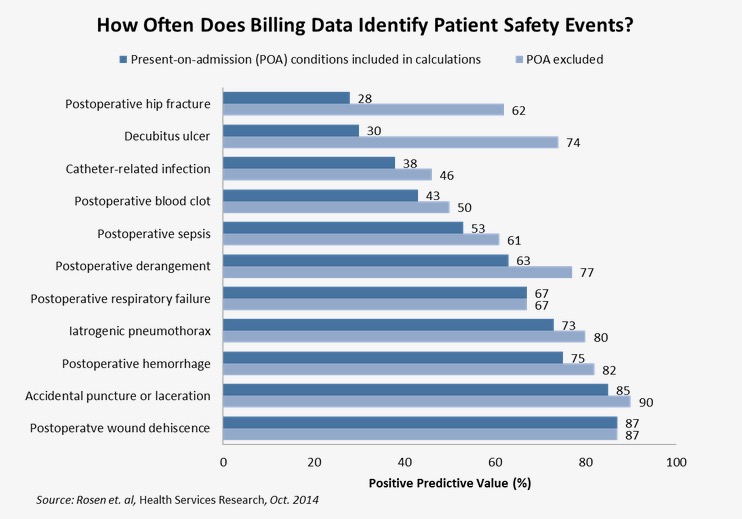
Some measures of health care quality and patient safety should be taken with a grain of salt. A few need a spoonful.

In April, a team of Johns Hopkins researchers published an article examining how well a state of Maryland pay-for-performance program measure for dangerous blood clots identified cases that were potentially preventable. In reviewing the clinical records of 157 hospital patients deemed by the state program to have developed these clots — known as deep vein thrombosis and pulmonary embolism — they found that more than 40 percent had been misclassified. The vast majority of these patients had clots that were not truly preventable, such as those associated with central catheters, for which the efficacy of prophylaxis remains unproven.

These misclassified cases of blood clots resulted in potentially $200,000 in lost reimbursement from the state, which penalizes hospitals when the additional treatment costs related to more than 60 preventable harms exceeds established benchmarks.

Why the discrepancies? The state identified cases of these clots using billing data, which utilize the diagnosis codes that medical billing specialists enter on claims. These data, also known as administrative data, lack the detail that would be available in the actual clinical record, considered by many to be the most trusted source for safety and quality measures.

Continue reading…

Bungled Payments

By PAUL KECKLEY

Paul KeckleyThe proposal involves a five-year bundled payment model across 75 geographic areas whereby hospitals would be eligible for a bonus if their costs and outcomes were optimal or be penalized if not based on results 90 days post-discharge. The agency noted that in 2013, it spent more than $7 billion on hospitalization for these procedures with the payments for hospitalization and recovery ranging widely from 16,500 to $33,000. Comments about the proposal will be received by CMS through September 8, 2015, aiming for implementation January 1, 2016.

Their rationale, according to Secretary of Health and Human Services Sylvia Burwell, in the HHS statement announcing the proposal: “By focusing on episodes of care, rather than a piecemeal system, hospitals and physicians have an incentive to work together to deliver more effective and efficient care. This model will incentivize providing patients with the right care the first time and finding better ways to help them recover successfully. It will reward providers and doctors for helping patients get and stay healthy.”Continue reading…

How Big Data Can Be Used to Improve Early Detection of Cognitive Disease

By CYNTHIA RUDIN

ClockThe aging of populations worldwide is leading to many healthcare challenges, such as an increase in dementia patients. One recent estimate suggests that 13.9% of people above age 70 currently suffer from some form of dementia like Alzheimer’s or dementia associated with Parkinson’s disease. The Alzheimer’s Association predicts that by 2050, 135 million people globally will suffer from Alzheimer’s disease.

While these are daunting numbers, some forms of cognitive diseases can be slowed if caught early enough. The key is early detection. In a recent study, my colleague and I found that machine learning can offer significantly better tools for early detection than what is traditionally used by physicians.

One of the more common traditional methods for screening and diagnosing cognitive decline is called the Clock Drawing Test. Used for over 50 years, this well-accepted tool asks subjects to draw a clock on a blank sheet of paper showing a specified time. Then they are asked to copy a pre-drawn clock showing that time. This paper and pencil test is quick and easy to administer, noninvasive, and inexpensive. However, the results are based on the subjective judgment of clinicians who score the tests. For instance, doctors must determine whether the clock circle has “only minor distortion” and whether the hour hand is “clearly shorter” than the minute hand.

Continue reading…

What the Atlanta HIV Data Tells Us About Public Health in America

By MAITHRI VANGALA

“The night I found out, I slept one and a half hours,” recalls D, a 29-year-old black gay man.

He’s talking about being diagnosed with HIV, the virus that causes AIDS.

“Even though I work in public health and tell people daily that HIV is not a death sentence, that first night that’s all I could think of,” says D. “This has to be wrong, I thought. I work in public health. This can’t happen to me.”

D, who requested anonymity, says he contracted the virus when a condom broke during sex. Two weeks later, he was tested for two sexually transmitted infections (STIs) – chlamydia and gonorrhea – but not for HIV. Shortly afterward, he went back for an HIV test and found out that he had the virus.

Soon after his diagnosis, D moved to Atlanta, which also happens to be the epicenter of a re-emerging national HIV crisis.

Continue reading…