Categories

Category: Medical Practice

What Cardiologists Can Teach Economists

By MICHEL ACCAD

I had the great fortune and pleasure of studying under the late Kanu Chatterjee during my cardiology fellowship at the University of California San Francisco.

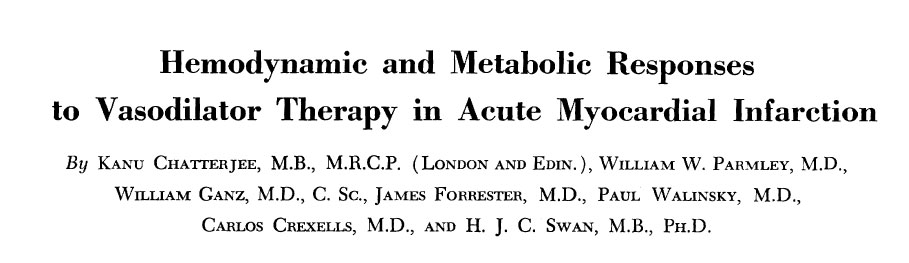
In the early 1970’s, Dr. Chatterjee was among the first to understand the benefits of “afterload reduction” for the treatment of congestive heart failure:

Chatterjee-Circulation

Prior to that time, giving medications that could lower the blood pressure was often seen as heretical.  In fact, during the 1950’s and 1960’s, the treatment of heart failure sometimes consisted in applying measures to raise the blood pressure and increase the work of the heart.

Continue reading…

The “90 Day Contract”

By TERRY M BENNETT

flying cadeuciiAt age 77, having been through all of the fun and games of dealing with the New Hampshire Board of Medicine, a predatory local Hospital CEO, and other adversaries, nothing should surprise me anymore. But, I am surprised that intelligent, well-educated physicians would sign a “welcome aboard” new employee contract, a contract that allows their employer hospital to fire them without stated cause and throw them, literally, out the door using the security guards to do so, and without even time to clean up their offices.

Most doctors, however, are now hospital employees, and have knowingly or unknowingly, signed exactly such a contract.Continue reading…

Scoring the Surgeon Scorecard

By MARK W. FRIEDBERG

Screen Shot 2015-10-13 at 10.03.33 AMMark W Friedberg is a researcher at the RAND Institute and a co-author of the recent RAND analysis of the Surgeon Scorecard. He posted this on THCB in response to Ashish Jha’s post “Misunderstanding ProPublica.”  

I don’t disagree at all with the idea that providers should release their own performance data, to the extent that they have it. Free flow of accurate and understandable performance information is inherently good. If the ProPublica Surgeon Scorecard can create pressure for this to happen, fantastic.

But there is no tradeoff between recognizing the serious methodological problems in the Scorecard, improving the Scorecard, and encouraging providers to release their own data. All three can and should be done simultaneously.

Also, for frequenters of this blog, I think it’s important to clarify a few key things about the “RAND critique” (which I authored with individuals from many institutions, all of whom deserve credit for devoting considerable unpaid time to the effort).

1. Nowhere in the critique do we suggest that ProPublica – or anybody else for that matter – abandon efforts to generate and publicize reports that truly reflect provider performance. Far from it. If you look up the authors of our critique, you’ll see that all of us have devoted substantial time and effort to furthering the science and practice of performance measurement and transparency in health care.

Continue reading…

An Interview with PatientSafe CEO Joseph Condurso

By MICHELLE RONAN NOTEBOOM

An interview with Joseph Condurso, president and CEO of PatientSafe Solutions

Michelle Noteboom: Give me a short overview of PatientSafe and your role in the company.

Joseph Condurso: I’m the president and chief executive officer of PatientSafe Solutions. I joined PatientSafe in 2011 with the focus of taking its skills and its core competencies as a mobile applications provider from the bedside to the enterprise to the home, which is my vision and goal for the company.

We provide a platform for creating and delivering an intelligent interactive workflow solution. We express those workflows through bedside applications that can be executed at the point of care by the frontline care team. We have also been building out an expression of those workflows to enable the patient to engage the care team as they discharge from the hospital and go into their home and into their daily life.Continue reading…

Trauma Room Two

By PHILIP ALLEN GREEN

Screen-Shot-2012-12-14-at-11.05.59-AMSometimes when I am bored, when it is all sore throats and dental pains, when I feel more like I am a social worker and a hand-holder than an emergency medicine physician, I play a game.

I do not look at the chart before I go into a room. I walk in cold. I enter with no idea who is going to be in there or why. In that very first second, before anyone speaks, I try to guess what the story is, who the people in the room are, and why they are in my emergency room.

Here-maybe it would make more sense if I showed you.

I draw back the curtain and step into Trauma Room Two. My eyes scan quickly about, gathering as much information as they can.

There are three people in the room.

For a brief second, I intentionally do not look at the patient lying on the hospital bed, not yet. Two people accompany the patient, a man and a woman. The man sits on a hard plastic chair pushed back against the room’s wall, staring quietly ahead. I start with him. I know if I can just look closely enough, the story is there.

Continue reading…

Measuring ROI: Quantifying the Benefits of an HIE

By INTERSYSTEMS                                  SPONSORED CONTENT

Ruler guy iconHow do you measure the ROI of a health information exchange? For Missouri Health Connection (MHC), the HIE serving Missouri and neighboring states, quantifying that elusive ROI for its participants is now a priority.

If you’re going to the CHIME15 Fall CIO Forum, you can see firsthand the work of our client, Mark Pasquale, President and CEO of MHC.

He has been in the HIE trenches and knows that calculating ROI is critical to winning new participants and physician adoption.  After investing government dollars to create infrastructure and services, HIEs must now demonstrate their value to participants. In this regard, MHC is taking a lead. Pasquale developed a spreadsheet calculator, based on metrics for healthcare costs that an HIE can prevent – numbers he drew from published studies.Continue reading…

Payers Join the Healthcare Team

By ED CHUNG, MD                            SPONSORED CONTENT

Screen Shot 2015-10-12 at 10.08.49 AM

Back when I was in medical training a decade ago, patient rounds were usually conducted by a group of physicians. We’d walk down the ward, visiting patients and scribbling notes as we went. If we were feeling particularly inclusive, we might bring nurses along. But that was as diverse as the care team got. Even the concept of a “care team” was only just starting to take hold on wards where highly complex patients were being cared for.

These days, the picture looks quite different. Now, in addition to doctors and nurses, we have pharmacists, social workers, therapists, nutritionists, and case managers joining us on rounds.Continue reading…

Is ProPublica the Paul Revere of Transparency?

By SAURABH JHA

flying cadeuciiRecently, I was speaking with a “less is more” advocate. He used his superior knowledge of statistics – he had an MPH – to debunk randomized controlled trials. We discussed overdiagnosis, overtreatment, and the shakiness of medical sciences.

We spoke about measuring the quality of physicians. I remarked that quality metrics have as much evidence as Garcinia Cambogia – we had just laughed about Dr. Oz. I expected a chuckle. Instead, he became distinctly uncomfortable and, in a solemn tone, lectured me about the Institute of Medicine (IOM) report, “To Err is Human.”

The physician, a bulldog of evidence-based medicine (EBM), had a blind spot. He ripped cardiologists for overusing pacemakers. He believed in the usefulness of the physician quality reporting system. He disdained big pharma for pushing statins. He was a fan of maintenance of certification. He was at once a raging skeptic and a true believer.

My understanding of statistics is modest compared to his. But I am skeptical by nature. I’m skeptical of many things including (not necessarily in this order): statins in 65-year olds, kumbaya, hellfire, England’s soccer team, quality metrics, screening (much to the chagrin of my radiology colleagues), high priests, middle priests, hard drives spontaneously combusting, and futurists. I’d like to believe this is because I’m a dark knight searching for the truth. The reality is that I’m just a cynical git who was raised in an island where it rains without remorse. My skepticism manages to offend a unique human every day.

Continue reading…

What the World Might Look Like If We Taught Docs How to Hack Spreadsheets

By HAYWARD ZWERLING

Screen Shot 2015-10-11 at 8.15.56 AM

I am an IT geek physician. I have my an EHR which I created and control.

Today, I wanted to understand my diabetic practice a little more, so I dumped all my HbA1c data out of my EHR and into a spreadsheet where I was able to manipulate the data and learn a few things about my practice.

I learned that:

If my patient had a HbA1c ≥ 8, the likelihood that the HbA1c would be < 8 at the next visit is 68%.

If my patient had a HbA1c ≥ 8, the likelihood the HbA1c would be even higher at the subsequent visit is 29%.

If my patient had a HbA1c ≥ 8, the average change in the HbA1c at the next visit was -0.7.

If my patient had a HbA1c < 8, the likelihood that HbA1c at the subsequent visit would exceed 8% would be 15%.

Continue reading…

Shared Baselines as a Guide to Protocols

By PAUL LEVY

Paul Levy 1There have been some interesting and important discussions flying across the web in recent days on the issue of protocols in helping to reduce variation and reduce the incidence of harm to patients.  My mistake in the debate was assuming that medical leaders would be reasonable about how protocols should and should not be used.

A doctor friend, highly committed to patient safety, notes:

My point about the protocols is that I have been chastised for not following them in situations where it was blatantly obvious that they did not apply. (“The protocol is there for a reason.”)

The chastisement comes not from hospital administrators, but from clinician leaders in the doctor’s own department:

We just got another email scolding us for not following the “colorectal pathway” sufficiently. One of the provisions of that pathway, for example, is strict limitation of iv fluids, sometimes difficult to “comply” when patients are severely dehydrated from their bowel preps, particularly the elderly.

The initial goals were to decrease opiate use and decrease PACU LOS, both worthy goals, but we’re all annoyed at being beaten over the head with them and getting our hands slapped if we deviate, even with good reason.

It’s ironic that on the one hand we are extolling the virtues of gene-based individualized therapies, but on the other hand we are trying to pigeon-hole every patient into a standardized protocol.

Continue reading…