Categories

Category: Health Policy

Alice in Healthcareland

By MICHAEL TURPIN

Alice: Cheshire-Puss, would you tell me, please, which way I ought to go from here?

Cheshire Cat: That depends a good deal on where you want to get to.

Alice: I don’t much care where.

Cheshire Cat: Then it doesn’t matter which way you go.

Alice: —So long as I get somewhere.

Cheshire Cat: Oh you’re sure to do that if you only walk long enough.

Lewis Carroll, The Adventures of Alice in Wonderland

2013 has arrived and employers now find themselves on the other side of a looking glass facing the surreal world of healthcare reform and a confusion of regulations promulgated by The Accountable Care Act (ACA) and its Queen of Hearts, HHS Secretary Sebelius. Many HR professionals delayed strategic planning for reform until there was absolute certainty arising out of the SCOTUS constitutionality ruling and the subsequent 2012 Presidential election. They are now waking up in ACA Wonderland with little time remaining to digest and react to the changes being imposed. A handful of proactive employers have begun, in earnest, to conduct reform risk assessments and financial modeling to understand the impacts and opportunities presented by reform. Others remain confused on which direction to take – uncertain how coverage and affordability guidelines might impact their costs.

If reform is indeed a thousand mile journey, many remain at the bottom of the rabbit hole – wondering whether 2013 will mark the beginning of the end for employer sponsored healthcare or the dawning of an era of meaningful market based reform in the US. HR and benefit professionals face a confusion of questions from their companions — CFO’s, CEOs, shareholders and analysts.

Continue reading…

The Fix that Failed

By DR. WES

The new “fiscal cliff” legislation hailed by some as a “one-year doc fix” of the scheduled 26.5% sustainable growth rate (SGR) cut that was scheduled to take effect on 1 January 2013, has passed the Senate and House as part of the American Taxpayer Relief Act ( HR 8 ) goes to President Obama for his likely signature.

But was this “one-year doc fix” really a fix?

Not at all.

In fact, once again Congress has failed to resolve the ever-present sustainable growth rate cuts that repetitively surface year after year by kicking the proverbial can down the road another year.

The cost of the one year patch will be $25.1 billion dollars over 10 years and will be paid for almost entirely by health care cuts in other areas.

  • Hospitals (increasingly doctor-employers now, remember?) will see audits of their billings increase as efforts to recoup some $10.5 billion of “overcoding” charges are seen as the largest source of revenue for the one-year “fix.”
  • Hospitals will also see an extension of lower Medicaid payments to hospitals that treat a high number of uninsured or low-income beneficiaries, known as “disproportionate share hospitals” to find savings of about $4.2 billion.
  • Another $4.9 billion offset will be applied to the lowered bundled payments given for patients with end-stage renal disease – some of the sickest people receiving services from Medicare.

Continue reading…

Health Reform: The Political Storms Are Far from Over

By HENRY J. AARON

The history of president Obama’s health reform bears an uncanny and disturbing similarity to the life cycle of a hurricane. With Sandy fresh in our memory, the similarity is not comforting.
Hurricanes have three phases. The front wall of the storm brings high winds, lightening, and rain. Next, at the hurricane’s center, or eye, the wind drops and the air warms. If one is at sea, the water may turn calm and warm, bringing the illusion that the storm has ended. As the storm moves on, wind and rain return, often with increased force. Those fooled by the calm who leave safe havens may be destroyed by what follows.

The life cycle of a hurricane will bear an eerie similarity to that of health reform. Nearly four years elapsed between president Obama’s initial call for national health reform until the bill became law and the Supreme Court ruled on its constitutionality. The political and legal turmoil was intense and continuous. The process was rancorous and the outcome in doubt from start to finish. It took a bitterly fought presidential election to put an end to this phase of the struggle.

Now, we are in a period of relative calm. The 2012 election settled the immediate fate of the Affordable Care Act (ACA). The candidate who swore to repeal it lost. The ACA was the major domestic legislative achievement of the victorious incumbent president who won reelection. Now, eighteen states are in process of designing rules for health insurance exchanges — the administrative entities that will manage implementation of the new law, the most important provisions of which will take effect one year hence. The other states will either leave implementation entirely to the federal government or share administrative responsibilities with federal agencies.

A huge amount of work remains to be done by October 1, 2013 when people can begin enrolling for insurance coverage in the new exchanges.

Continue reading…

What Does the Dartmouth Atlas Have to Say About the Politics of the ACA?

By ANUBHAV KAUL, PETER BHANDARI, & THOM WALSH

Healthcare reform was a frontline topic during the recent presidential elections. The political warfare and misleading information around the Patient Protection and Affordable Care Act (PPACA), also known as Obamacare, has prevented the public from understanding its intended purpose, and has left many skeptical about its benefits. It is safe to say the general public has little to no idea about the quality of healthcare delivery in their respective regions.

In fact, it is not a far cry to claim that even healthcare professionals might not truly understand the issues facing American healthcare. Thus, most of the public is generally uninformed or misinformed about the population level problems facing the healthcare system. Therefore, it is quite simple for political parties to misguide the public and capitalize on their uninformed perceptions. If the public knew more about the flaws present in the healthcare system, perhaps they would better realize the PPACA is a reasonable start at addressing the failings of our system.

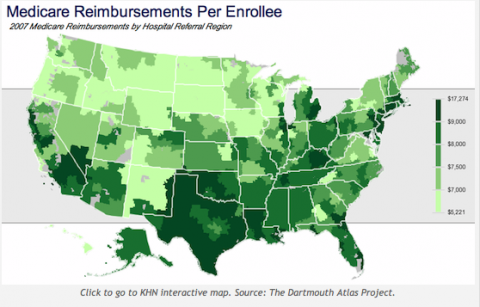
The Dartmouth Atlas Project is an online database which collects Medicare spending and utilization data from around the country. Information gathered from the database has shown immense variation in the way medical resources are utilized by even similar regions, communities, and health care organization. Evidence has repeatedly shown that, from a population perspective, areas that spend more on medical care do not consistently benefit from increased quality of care or patient wellbeing. Variation in the type of care delivered can be attributed to diverse incidence and prevalence of disease severity or the type of care a well- informed patient chooses. Variation in health care delivery is thus omnipresent and expected, because every patient is unique and medical innovation presents a growing number of care options to choose from.

Continue reading…

The Pain Index

By PAUL LEVY

A recent report by the New York Times contained an excellent graphic showing the current percentage of uninsured people in each state.  The range is from a high of 24.6% in Texas to a low of 4.4% in Massachusetts.I have combined this rate with the most recently reported CDC rate of obesity in each state to create what I call The Pain Index.  It is a simple sum of the two numbers. 

The theory behind the total is that obesity is a rough guide for the level of unhealthiness in the population.  My hypothesis is that, when insurance is made available to people, they will use it, roughly in proportion to the degree they are unhealthy.

Yes, I know this is a crude metric, but I think it will be a relatively good predictor of the rate of increase in health care costs in each state over the coming years.  This will show up in the insurance premium rates offered in the health care exchanges and will also affect the need for state appropriations to pay for newly eligible Medicaid subscribers.

States with a Pain Index in the top decile are: Texas, South Carolina, Louisiana, Mississippi, and Arkansas.  Others with scores over 45 are Nevada, Florida, New Mexico, Georgia, Alaska, Oklahoma, North Carolina, Kentucky, Alabama, and West Virginia.

My advice to policy-makers:  Get ready!  My advice to health care CEOs:  This would be a really good time to focus on quality, safety, and front-line driven process improvement as the most effective way to reduce your costs and improve efficiency.

Continue reading…

A Well-Armed and Regulated Citizenry, Led by Heavily-Armed Teachers in Body Armor …

By PETER UBEL

Gun rights advocates are correct: a well armed principal might have reduced the death toll from the tragic elementary school shootings in Connecticut last week.
Gun carrying citizens might also have been able to take down the shooters in Aurora and Virginia Tech. To most people, after all, guns are about self-defense, not about committing crimes. As the old saying goes: “There has never been a mass shooting at a gun show.”

On the other hand, gun control advocates are correct to point out that mentally disturbed people like Adam Lanza would not be able to commit massacres if they were prevented from getting their hands on high-powered, semiautomatic weapons. They are also correct to point out that Americans have staggeringly easy access to weapons that far exceed what any sportsmanlike hunter would use during deer season.

In other words, figuring out what to do in the wake of the Connecticut massacre means recognizing the truth in both of these views. It means considering the possibility that the answer to reducing gun violence is a matter of both having more guns and less.

To understand what I mean by “both more and less,” I offer two analogies: a straightforward one about airport security, and a more unexpected one about breast cancer screening.

Continue reading…

Now Is Not the Time to Talk About Gun Control

By DAVID KATZ

Yesterday was.

There are two reasons not to talk about gun control in the immediate aftermath of the Newtown atrocity, and opposition by the NRA and its adherents is neither of them.

The first is that addressing gun control right after innocents are shot might in some way seem exploitative. The second is that no imaginable degree of stringent gun control could fully exclude the possibility of an unhinged adult shooting a kindergartener.

But both of these objections are as porous as the sands of our shores battered by Hurricane Sandy. And a consideration of those shores readily reveals why.

With regard to exploitation, there was no thought of it as post-Sandy ruminations turned to how we might best prevent or at least mitigate the next such catastrophe. It was not exploitative to look around the world at strategies used to interrupt storm surges, divert floodwaters, or defend infrastructure. Those reflections continue.

Similarly, it’s not exploitative when my clinical colleagues and I speak to our patients in the aftermath of a heart attack or stroke about what it will take to prevent another one. In fact, these exchanges have a well-established designation in preventive medicine: the teachable moment.

It is opportunistic, but in a positive way: There is an opportunity to do what needs to be done. Admittedly, it’s better to talk about preventing heart disease, or the drowning of Staten Island, or of New Orleans, or the shooting of children, before ever these things happen. But the trouble tends to be: Nobody is listening then.

We are constitutionally better at crisis response than crisis prevention.

We’ll get back to the Constitution shortly.

Continue reading…

Ode to Mystery Blob

By JASON FLORES-WILLIAMS

The bartender was a young guy who wanted to go to law school, so I leaned back in my chair and smugly pontificated about the slings and arrows of practicing the law. I can’t even tell you the dude’s name, but it gave me a superior feeling to give him advice. Having taken on a couple of high-profile cases, I’d been on local TV a bit recently, which really gave me license to lay it on thick. I was the center of my own attention, a big man, a rising star on his way to fame and fortune, the essential ingredients of American success.

As the barman poured me my second beer, though, he did a double take and asked me what happened to my eye.

I went to the bathroom and saw the red swelling above my right eyelid. Immediately I notched it up to some mountain allergy. I downed the rest of my beer and went home. The next morning I woke up and the inflammation was about the same, but had spread to my cheek. I needed to be in court that afternoon, so I borrowed my girlfriend’s base makeup to cover the splotches. Outside of wearing makeup, I felt good and strong: a winner sporting a nice tie and a snazzy pocket square.

That night I went to the gym.

Continue reading…

Will You Receive a Tax Credit to Help You Buy Insurance in 2014? How Much?

By MAGGIE MAHAR

Beginning in 2014, millions of Americans will discover that they qualify for subsidies designed to help them purchase their own health insurance. The aid will come in the form of tax credits, and many will be surprised by how generous they are.

Not only low-income, but moderate-income families earning up to 400 percent of the federal poverty level (FPL) – currently $44,680 for a single person and $92,200 for a family of four – will make the cut. Within that group, households bringing in less than 250 percent of the FPL ($27,925 for a single person, $57,625 for a family of four) also will be eligible for help with out-of-pocket costs.

If your boss offers benefits, you won’t qualify, unless …

If your employer offers health insurance you won’t be eligible for a tax credit – though there are two exceptions to this rule:

  • If your share of the premium for your employer’s coverage would exceed 9.5 percent of your income, or
  • If your boss offers a skimpy policy that pays for less than 60 percent of an average worker’s covered benefits, you will qualify for help.

If I qualify, how much will I receive?

The size of the tax credit depends on your income, your age, how many people are in your family, and where you live.

Continue reading…

State-Federal “Partnership” Exchanges: The Rarely Discussed Alternative Option

By NICOLE FISHER

Beginning in 2013, states will begin rolling out health care insurance exchanges as required by the Affordable Care Act (ACA). To this point most legislators, policymakers and health care experts have discussed the state-based and federal insurance exchange options at length. However, there is another form of insurance exchange that states are beginning to explore: the “partnership”.

In a state-federal partnership, states will divide obligations with the federal government. For this partnership model there is no requirement for a 50-50 split of labor, and the states are actually more of a facade whereby the consumers (individuals and employers) merely interact with the state. The federal government, on the other hand, will essentially perform all functions of the exchange management except customer service and plan management. Moreover, states have the choice to run either one or both of those functions. According to former head of insurance exchange planning at HHS Joel Ario, “States that choose this option are ceding the more technical aspects of exchange activity to the federal government but can retain control
of insurer oversight and consumer assistance.”

In the state-federal partnership model, the federal government will operate everything from consumer eligibility and enrollment to financial management and risk corridors. This essentially means that the federal government will take on most responsibility for the exchange, while granting states many of the perks they would receive if they had created a state-based exchange.

Continue reading…

