Categories

Category: Health Policy

How Much are Misaligned Incentives in Health Care Costing Tax Payers?

By ELIZABETH DZENG

On Christmas Eve, I took care of a patient who had just undergone surgery for an infected artificial shoulder. He was to be discharged on intravenous antibiotics three times a day for six weeks. This is a pretty common treatment. Patients are generally able to give themselves this medication with the help of a home care nurse who visits once a week. The total cost of this is approximately $7000 for nursing visits, antibiotics and supplies ($120 per visit for eight nursing visits plus $143 per day for antibiotics)

The social worker informed him that Medicare would not pay for home care nurse visits or supplies. BUT, Medicare pays for inpatient rehabilitation, which he would be eligible for to receive these antibiotics. Given the choice of paying $7000 for home administration versus $0 for inpatient rehabilitation, naturally he chose inpatient rehabilitation.

The problem is, is that his inpatient stay costs taxpayers approximately $21,000. $350 for room and board plus additional costs for antibiotics and supplies, totaling approximately $500 a day. Furthermore, although he was well enough to be discharged home before Christmas, he needed to stay until he could be placed in rehab. Because of holiday scheduling, most rehabilitation facilities were not accepting admissions. Thus, he had to stay in the hospital an extra four days in the hospital over the weekend and holidays. Given that the average cost of a hospital stay is $2338 in Maryland that added an additional $9352 or so of unnecessary expenses.

In sum, because financial incentives encouraged my patient to spend $0 rather than $7000 out of pocket, Medicare spent an unnecessary added $30,000 on his hospitalization and care.

Continue reading…

Delivering Progress. Choosing Wisely.

By AMY ROMANO

Last April, the ABIM Foundation, with Consumer Reports and other partners, drew national attention to overuse of ineffective and harmful practices across the health care system with their Choosing Wisely campaign. As part of the campaign, professional medical societies identified practices within their own specialties that patients should avoid or question carefully. Today, the American Congress of Obstetricians and Gynecologists (ACOG) and the American Association of Family Physicians (AAFP) have joined the campaign, drawing national attention to the overuse and misuse of induction of labor. ACOG and AAFP are telling women and their maternity care providers:

1. Don’t schedule elective, non-medically indicated inductions of labor or cesarean deliveries before 39 weeks 0 days gestational age.

2. Don’t schedule elective, non-medically indicated inductions of labor between 39 weeks 0 days and 41 weeks 0 days unless the cervix is deemed favorable.

(“Favorable” means the cervix is already thinned out and beginning to dilate, and the baby is settling into the pelvis. Another word for this is “ripe,” and doctors and midwives use a tool called the Bishop Score to give an objective measurement of ripeness. Although ACOG and AAFP do not define “favorable,” studies show cesarean risk is elevated with a Bishop Score of 8 or lower in a woman having her first birth and 6 or lower in women who have already given birth vaginally.)

Much work has already been done to spread the first message. Although ACOG has long advised against early elective deliveries, the practice has persisted. But a confluence of recent reforms has made it increasingly difficult for providers to perform elective deliveries before 39 weeks. Quality collaboratives have supported hospitals to implement “hard stops” that prevent these deliveries. Payers have used carrots and sticks to disincentivize them. CMS has funded a national public awareness campaign to reduce consumer demand.

Continue reading…

Rick Scott’s Privatization Experiment in Florida

By ROBERT LASZEWSKI

A million Floridians will now be eligible for Medicaid––the Obama administration is happy about that.

Republican Rick Scott gets to do it his way––in an almost entirely private market.

This from today’s Tampa Bay Times:

His [Scott’s] endorsement of the expansion came hours after the federal government agreed to grant Florida a conditional waiver to privatize Medicaid statewide for the state’s more than 3 million current recipients, more than half of which are children or people under age 21.

Scott has agreed to only a three year trial expansion and the legislature must vote in favor of it––not a certainty. And, the Obama administration is taking some big risks––a five county trial of Scott’s privatization program has had lots of problems.

In prior posts I have said that Republican governors, so adamantly opposed to “Obamacare,” ought to go to Washington and negotiate a deal on Medicaid expansion. If they believe they can manage Medicaid better than the traditional federal route, which is what they claim every time they demand block grants, then they should put a deal on the table. Ultimately, the feds will pay 90% of costs and the state will pay 10% of the cost of the expansion. The Republican governors don’t believe they can save 10% if given more flexibility?

Continue reading…

The IPAB Bomb

By J.D. KLEINKE

How’s this for a bitter pill?

For Republicans looking for cures for Medicare spending growth, one of the best places to look is one of their least favorites: in the legislative pharmacopeia that is Obamacare.

There are many things opponents of President Obama’s health reform law detest, and topping the list is the Independent Payment Advisory Board, or IPAB.

Before we get to the reasons why, it is good to remember that, as sketched into the law, the singular goal of the IPAB is — guess what? — to control Medicare spending growth.

Nothing actually happens under the provision unless (i.e., until) the $525 billion per year program exceeds growth targets, and the earliest any IPAB-directed actions could take effect is 2015. But if everything really is on the table as both sides work to avoid the next in a series of fiscal embarrassments, why not a major dose of economic medicine — properly defined and administered — that is already written into law and embraced by the president?

The biggest obstacle for Republicans is political or, more precisely, optical. Although IPAB’s stated goal is to contain Medicare spending growth, the provision is the embodiment of everything Republicans do not like, not just about Obamacare, but about “Big Government” generally. IPAB is a Board! — sufficient criticism for many — of 15 “bureaucrats” who will operate beyond the reach of Congress or the public. They will make arbitrary decisions about what Medicare will or will not pay for. They will use payment to come between you and your doctor. They will take away your health care!

Maybe so. The IPAB as drafted today is a black box, not a blueprint, a plan to make plans to save money, later. And for critics, black boxes are whatever they want them to be: death panels in drag, roulette wheels for rationing care, medical-industrial phantasmagoria straight out of Kafka and Huxley. Even among health industry supporters of Obamacare — patient advocacy groups, insurers, the major provider and drug lobbies — the IPAB is worrisome because it is all cost-containment mission and few particulars. If done right, it could save not only billions of dollars but thousands of lives from needless and dangerous medical interventions; if done wrong, it could mean arbitrary intrusions into medical care and a death knell for whole spheres of medical innovation.

The need for clarity today about how the IPAB will work years from now is one more reason the White House and Congress can and should mobilize — in the service of deficit reduction — the biggest potential mechanism for Medicare cost containment already written into law. Federal budget negotiators need the vehicle; those rushing to implement Obamacare need to flesh out how the IPAB will work; and those investing — or afraid to invest — in medical innovations need to know what impact IPAB will have on the future of Medicare.

Continue reading…

The Four Things You Should Absolutely, Positively Do For Somebody at Risk of Developing Alzheimer’s

By LESLIE KERNISAN

Do they need a PET scan to confirm the presence or absence of amyloid plaque?

More importantly, would doing such PET scans make meaningful impacts on patients’ health?

Those are the questions that a Medicare expert panel recently considered, and their impression, after carefully reviewing lots of high-quality research, is that we don’t yet have evidence supporting the benefit of using the PET scans. Unsurprisingly, some experts disagree, including a working group convened by the Alzheimer’s Association. This group of experts reviewed the evidence and common clinical scenarios, and concluded that in certain select situations, use of the PET scan would be appropriate. (See their guidelines here.)

As someone who evaluates many memory complaints, I’m certainly interested in Medicare’s inquiry, and in whether they’ll decide to cover the scan. (The NYT’s New Old Age Blog has a nice summary of the debate; a good read if you haven’t seen it yet, esp the comments.)

Also, I blogged last fall about how I thought the new scan could and wouldn’t help clinicians like myself evaluating cognitive complaints, especially in those who likely have early dementia. In particular, I commented on the difficult period of uncertainty that we often go through, as we wait to see if subtle problems progress or not.

Would the PET scan meaningfully help with that period of uncertainty? Hard to say, and it hasn’t yet been tested. I myself think that this period of uncertainty can be pretty hard on families, but measuring this burden is tricky. (Much easier to measure hospitalizations and utilization!)

I also suspect that it’ll be hard to prove benefit from “knowing earlier,” in large part because our healthcare system is currently so poorly equipped to meaningfully help people with a new dementia diagnosis.

Which brings me to the part of this story that has me annoyed.

Continue reading…

Let Them Eat Cupcakes

By KATIE BOOTH

Can the FDA ban cupcakes?

While this may seem like a silly question, the Center for Science in the Public Interest (“CSPI”) has filed a petition with the FDA urging the agency to regulate the amount of sugar (including high fructose corn syrup) in soft drinks. According to the executive director of CSPI, sugar is a “slow-acting but ruthlessly efficient bioweapon” that causes “obesity, diabetes, and heart disease.”

If soft drinks are a problem, surely cupcakes are too. A twelve-ounce can of Coca-Cola contains 39 grams of sugar. A seasonally-appropriate red velvet cupcake from Sprinkles contains 45 grams of sugar—and who can eat just one? National cupcake consumption increased 52% between 2010 and 2011, and U.S. consumers ate over 770 million cupcakes last year. Sugary soft drink consumption, on the other hand, is down 23% since 1998 and 37% since 2000.

While the FDA can’t regulate sugar as a bioweapon, it probably could regulate sugar as a food additive.

Under the Food, Drug, and Cosmetic Act, a food additive is “any substance the intended use of which results or may reasonably be expected to result—directly or indirectly—in its becoming a component or otherwise affecting the characteristics of any food.” This broad definition would include sugar. The FDA does not, however, regulate food additives that are “generally recognized as safe” (“GRAS”). Presumably the FDA considers sugar to be GRAS—for now. Continue reading…

The Founding Fathers Write a Grant Proposal

By JAN MASAOKA

“Just look at this second sentence!” groaned Samuel Adams. “‘We hold these truths to be self-evident . .’ This flies in the face of ‘evidence-based practice’! We’ll never get funded!”

Another delegate had a different complaint: “This mission statement is way too long!” he wailed. “Mr. Jefferson, no one will ever read this ‘Declaration of Independence’ of yours.”

In the meantime, George Washington had been working up a budget for the revolutionary war (earlier called the innovative war). His initial figures were daunting: $37 million would have to be raised by the collaborative, which would need to be matched by $114 million from the states. And of course, they didn’t have a dime (or rather, a shilling).

But let’s go back to the meeting, where they had just decided to give the collaborative a name: the Continental Congress.

Donor Prospecting

The meeting chair pounded his gavel: “Next on the agenda is Fundraising Prospects. Mr. Hancock, your report?”

John Hancock looked up, startled, but recovered his poise: “We’ve developed a list of foundations to approach. Unfortunately, none of them have giving areas that include democratic revolutions, perhaps because there hasn’t been a democratic revolution before. They also want to know who else is funding it, and how we’re going to continue the funding when their grants run out. And several of them aren’t funding right now because they’re doing something called ‘strategic planning.’Continue reading…

Why HHS Created Partnership Exchanges and Why More States Are Choosing Them

By DAN DIAMOND

New Hampshire: We’re in.

North Carolina: We’re not.

The two states on Tuesday were the latest to announce their intentions on the Affordable Care Act’s health insurance exchanges. States have until Feb. 15 to tell HHS whether they’ll retain even some control over the exchanges, or let the Obama administration run the exchanges for them.

And while New Hampshire made clear that it wants to partner with the federal government to launch an insurance exchange, North Carolina backed out of a previous plan to do exactly that.

By Friday, we’ll know where half a dozen other states stand, too.

Background on Partnership Model
The Affordable Care Act didn’t originally spell out the partnership model; under the law, states faced a binary choice of running their own insurance exchanges or punting the responsibility to the government.

But HHS officials realized they needed to tweak the ACA’s approach, as more than 30 states — increasingly led by Republicans, who took over 11 statehouses in the 2010 election — announced they planned to opt out of the exchanges altogether. This would leave HHS officials with “an awesome task in establishing and operating exchanges in [so many] different states and coordinating those operations with state Medicaid programs and insurance departments,” before open enrollment begins in October 2013, Paul Starr writes in The American Prospect.

As a result, the agency in 2011 introduced the partnership model in hopes of shifting some of the responsibility for running exchanges back to the states.

Under the hybrid approach, the federal government takes on setting up the exchange’s website and other back-end responsibilities, while states keep functions such as approving health plans and setting up consumer assistance programs. HHS also hopes that the partnership model will be a path for states that weren’t ready to run their own exchanges to take them over eventually.

Continue reading…

Drugmakers May Win Big in Effort to Curb Gun Violence

By MATT BARRY

Reducing gun violence by increasing access to mental health services may cost billions of taxpayer dollars and give drugmakers that help treat mental illness a revenue windfall. But will it reduce gun violence? The answer is uncertain.

In the wake of the tragic shooting at Sandy Hook Elementary School, there have been repeated calls to increase access to mental health services as a way to reduce gun violence in the U.S., even though the evidence is weak at best that those services actually reduce gun violence.

Absent from these calls to action is any sense of how much that policy would cost. Many argue that any cost is worthwhile if it prevents just one needless death due to gun violence. But we live in austere fiscal times and knowing the price tag before taking action makes sense (click on the image above to enlarge).

A just-published Bloomberg Government Study estimates that the potential impact on the federal deficit due to increased spending on mental health services could exceed $260 billion from 2014 to 2021.

Continue reading…

How to Win Friends and Influence Millennials: Health Exchanges Edition

By MIKE MIESEN

America is only a few months away from Exchange Day—October 1, 2013—when the state and federal health exchanges open up for business. And when they do… well, I’d surprised if a whole lot happens at first; most people assume they open on January 1, 2014. But eventually there will be a flood of people streaming into the exchanges (virtually) to search for health insurance plans, including the Millennials.

Why? A variety of reasons. One is that people like being insured and prefer it to the uncertainty of being uninsured; those previously unable to purchase a policy they could afford now have subsidies to help them do so. Another is that people largely don’t have a choice—forego purchasing health insurance and get fined.

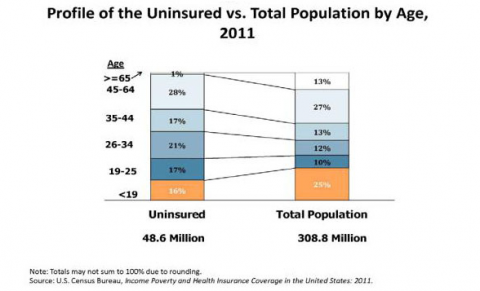
But the bottom line is this: whether compelled to do so by the safe feeling of being insured or the specter of a fine, Millennials are expected to be an enormous group of entrants into the exchanges: while we make up only 22% of the population, we account for 38% of the uninsured in America.

To compound our already-stratospheric opinion of ourselves, we know that the Millennials are a coveted market for health exchange insurers. Face it: you want us. Bad. That’s because we’re relatively healthy, loyal to brands we like that we see as having a positive impact (70% identify as being brand loyal), and we could actually be the first generation to recommend our health insurance plan to others.

So, culling from Millennial research, surveys, and conversations with fellow Millennials, here are a few morsels of unsolicited advice on how to win us over.

Continue reading…