
While my politics are well known to THCB readers, I rarely encourage people to do anything about it–especially in a state where I don’t get to vote, but today is different. Aneesh Chopra is running for Lt Gov in Virgina. He’s the former CTO of the US and a really good guy–who is running based on improving science and technology in a vital state, where the Republicans are literally into trans-vaginal ultrasounds & creationism. To my SF and LA-based friends, you can meet Aneesh at Cigar Bar & Grill on Mon 18th 5.30-7 in downtown SF and in in 1240 Shadow Hill Way, Beverly Hills on Tuesday 19th 7-9pm. This is a chance for the tech community to support one of its own, so I encourage you to go along and write a check. For more information or to RSVP please contact Caitlin Blair at Ca*****@*********va.com or (703) 468-1456, or I’m sure if you show up Aneesh will be happy to see you!–Matthew Holt
The Republican Case For Waste In Health Care
By PHILLIP LONGMAN
Conservatives love to apply “cost-benefit analysis” to government programs—except in health care. In fact, working with drug companies and warning of “death panels,” they slipped language into Obamacare banning cost-effectiveness research. Here’s how that happened, and why it can’t stand.
Why are you reading this when you could be doing jumping jacks?
And how come you’ve gone on to read this sentence when you could be having a colonoscopy?
You and I could be doing all sorts of things right now that we have reason to believe would improve our health and life expectancy. We could be working out at the gym, or waiting in a doctor’s office to have our bodies scanned and probed for tumors and polyps. We could be using this time to eat a steaming plate of broccoli, or attending a support group to help us overcome some unhealthy habit.
Yet you are not doing those things right now, and the chances are very strong that I am not either. Why not?
Matthew Holt on HIBC.tv from HIMSS 2013
THCB founder Matthew Holt is reporting live from HIMSS 2013 in New Orleans. Matthew’s first guest is Ben Chodor of Happtique. We’ll then hear from Matthew on his walking tour of the floor as he drops in on a few companies, including Kareo, CareCloud, Wellness Layers, and more…
Watch the live stream here: http://www.livestream.com/hibc.
How Tech Can Empower Young Adults with ADHD
By GRAEME OSSEY
A recent study by Boston Children’s Hospital and Mayo Clinic found that a staggering 29.3% of children with ADHD experience the disorder well into adulthood. High School and College students with ADHD face the intimidating challenge of entering a less-structured environment upon graduation. While ADHD medicine helps, there is a critical need for technologies that help manage behaviors and encourage medication adherence. The Shire ADHD Transitions Challenge is offering $150,000 in total prizes for technologies that will azid young adults and help them manage the transitions between high-school and college as well as between college and the work force.
Phase I of the challenge focuses on ideation and closes in less than two weeks on March 17, 2013. Five submissions will be awarded $5,000 based on the quality and viability of their idea. Phase I requirements include:
1. Mock-up or drawing of concept
2. 5-page written document explaining the proposed application
Phase II of the challenge will involve the development of working applications proposed in Phase I of the competition. Submissions for Phase II are due August 18th. The top three submissions will receive $100,000, $20,000, and $5,000, respectively.
Join us in finding a solution to this growing problem by spreading the word about the challenge (click to tweet). Learn more about how you can get involved here!
Obamacare In Pictures
By J.D. KLEINKE
A seasoned colleague recently told me that some PowerPoint presentations have no power and make no point.
But sometimes, a picture really is worth a thousand words. Or maybe — in the case of any meaningful discussion of health reform, thanks to its density and complexity — it might be worth 10,000 words. Hence our handy little exhibit.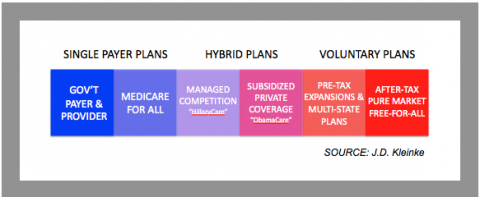
This picture captures the 10,000 words it would require to explain with technical precision where President Obama’s Affordable Care Act fits relative to all health reform plans. It places “ObamaCare” along an ideologically scaled continuum of all serious reform options developed, debated and discarded or ignored since the 1980s.
They are all here: from the single-payer, centrally controlled models popular with those who detest corporations and the influence of money in medicine — two actual, not imagined “government takeovers of health care” — to two free market, laissez-faire models favored by those who detest regulation and the heavy hand of government in medicine.
HiMSS Countdown, with Matthew Holt
By MATTHEW HOLT
Early this week Greg Masters and Pat Salber chatted with me for a fun convo about EMRs, NOLA, HIMSS, and alot more. It’s part of their overall series for the HIBCtv (Health Innovation Broadcast Network Consortium). And be warned they are giving me keys to the car for 90 minutes at HIMSS next Weds! You should be able to click on the player above to hear. If not click to this.
HHS CTO Bryan Sivak on Open Data

By MATTHEW HOLT
[youtube]http://www.youtube.com/watch?v=Y9k_oxi92vY&w=640&h=385[/youtube]
Last week I was in DC and I caught up with Bryan Sivak, a geek’s geek who has migrated from Silicon Valley (via London) to government service first in Maryland and now at HHS. He has a big job there to keep pounding out the open health data drumbeat Todd Park started. And he’ll have at least two big opportunities to do it this spring, first at Health 2.0’s developer conference Health:Refactored in Silicon Valley in May and then at the now 4th annual Health DataPalooza in DC in June.
How Many States Are Really Opting In?
By DAN DIAMOND
 Same story, different week: A governor who opposed the Affordable Care Act changes course and announces plans to opt into the Medicaid expansion.
Supporters of the ACA rejoice, conservatives grumble, and a new number gets tacked on the board — 24 states opting in, at last count.
Yet there’s more to the story than governors’ speeches. In at least eight of those states, lawmakers are warning that they may not go along with expansion plans.
Those legislative logjams — and what governors need to do to circumvent them — vary state by state , but the fights are falling out along party lines.
In Missouri, two GOP-led House committees this week voted down Medicaid expansion plans, despite Democrat Gov. Jay Nixon’s pledge to opt into the measure last year. Republican lawmakers in Arkansas, Montana and Washington have similarly been skeptical of their Democratic governors’ expansion positions. Meanwhile, four GOP governors who have backed the expansion are having difficulty corralling members of their own party.
Now For The Rest Of The Story On Massachusetts Cost Control
By JOSH ARCHAMBAULT
 A bureaucracy-centric governing philosophy is spreading in health care, and with it comes heavy reliance on “experts” to determine how to curb costs outside the normal legislative and democratic process. This was embodied at the national level by the Affordable Care Act (ACA), and most recently at the state level in a new Massachusetts growth-capping law. (Supporters refer to the law as cost control and payment reform or Health Reform 2.0; the legal name is Chapter 224 of the Acts of 2012).
The new Massachusetts law was discussed by Mechanic, Altman and McDonough in a past Health Affairs issue, and on the blog by Turnbull and Lee. Yet, the unintended consequences of using this method to reform health care have not been fully explored.
What’s In The Law?
Promising savings of $197 billion over 15 years, Chapter 224 sets a cap on statewide health care spending growth by tying it to state growth, enforced by a flat $500,000 civil penalty if health care entities don’t meet reporting deadlines or take reform efforts seriously enough. The law grants strict preference to alternative payment methods (capitated or bundled payment contracts) and accountable care organizations (ACOs).
Praying For Obamacare to Fail
By J.D. KLEINKE
 “Make it work.”
This advice on health reform to Democrats earlier this month illustrates that President Clinton knows what the opponents of Obamacare also know: success is the best political revenge.
As the health reform law moves off the drawing board into the real world, its opponents are doing their best to make it not work — by shifting their energies from fulminations about the boogeymen they imagine in the law to hampering, complicating or outright obstructing its implementation.
For openers, half the states have announced they will probably not expand their Medicaid programs under the law — though there have been defectors, most notably Florida. This will leave a large segment of the uninsured priced out of even the subsidized insurance markets created under Obamacare, while adding enormous complexity and uncertainty for small businesses and multi-state employers who want to comply with the law and cover their lower-income workers.
The same states, more or less, are also refusing to establish health insurance exchanges — online marketplaces where small businesses and individuals can purchase private health insurance — the fulcrum of the law’s provision for those not covered by Medicaid. As of last Friday’s deadline, 24 states and the District of Columbia were going ahead with exchanges and 26 were not.



