Categories

Category: Health Policy

More Signs of Rate Shock and Awe

By ROBERT LASZEWSKI

Last week, I reported on my informal survey of health insurance companies and their estimate for how much rates will rise on account of the Affordable Care Act (“Obamacare”).

Today, there are press reports quoting the CEO of Aetna with their estimate. The Aetna estimate is worse than mine.

From Bloomberg:

Health insurance premiums may as much as double for some small businesses and individual buyers in the U.S. when the Affordable Care Act’s major provisions start in 2014, Aetna Inc. (AET)’s chief executive officer said.

While subsidies in the law will shield some people, other consumers who make too much for assistance are in for “premium rate shock,” Mark Bertolini, who runs the third-biggest U.S. health-insurance company, told analysts yesterday at a conference in New York. The prospect has spurred discussion of having Congress delay or phase in parts of the law, he said.

“We’ve shared it all with the people in Washington and I think it’s a big concern,” the CEO said. “We’re going to see some markets go up as much as as 100 percent.”


Continue reading…

Repairing ObamaCare

By JOHN GOODMAN

In the aftermath of the recent election, virtually all commentators were quick to conclude that ObamaCare has been saved. The health reform law can now go forward and Republicans are powerless to stop it.

The trouble is: ObamaCare is a deeply flawed piece of legislation. Its defects are so huge that Democrats are going to want to perform major surgery on it in the near future, even if the Republicans stand by and twiddle their thumbs.

That raises this question: What changes need to be made in the legislation to turn it into a health reform that solves existing problems without creating even more serious new problems? Here are six essential short term fixes:

Subsidize all insurance the same way. The way the government subsidizes health insurance under the current system is arbitrary and unfair. Employees with employer-provided insurance get that benefit tax free — a subsidy that is worth almost half the cost of the insurance for middle-income families. However, there is almost no subsidy available for people who must purchase insurance on their own. They must pay taxes on their income and then buy the insurance with what’s left over.

Under ObamaCare the subsidies become even more arbitrary. Although the new law creates generous tax credits for low and moderate income families who must buy their own insurance in newly created health insurance exchanges, the subsidy in an exchange can be as much as $12,000 higher than the same family will get if the same insurance is obtained through an employer!

Continue reading…

Patient Politics: the PCORI Puzzle

By MICHAEL L. MILLENSON

The new Patient-Centered Outcomes Research Institute (PCORI) has been asking different stakeholders about the most important issues to address with the hundreds of millions of dollars the quasi-governmental group will shortly be doling out in grants. Not surprisingly, the stakeholders have been more than happy to respond.

PCORI’s most recent day of dialogue, which I attended as a representative of the Society for Participatory Medicine (SPM), was characterized by genteel civility and a big question mark: “Is PCORI serious about transforming health care?” When I asked directly, I didn’t get much of an answer. The reason, I suspect, goes to PCORI’s origins. It is the offspring of a shotgun marriage between goo-goos and pinky-ringers, and no one is quite sure yet what this child will be once it grows up.

Let me pause here a moment to parse the political shorthand. “Goo-goos” are “good government” types, the kind of folks who trumpet the need for transparency in government or better public transit. Goo-goos, seeing the half trillion dollars or so of waste in U.S. health care system, called for a new national organization to carry out comparative effectiveness research in order to help Americans get the most value for our money.

The goo-goos pointed out that our current regulatory structure is designed to ensure that treatments are safe and effective, not compare them. Nor does the private sector have much incentive to pay for comparative studies that may undermine products currently selling quite nicely, thank you.

Continue reading…

The Great Influenza of 2013?

By DAVID KATZ


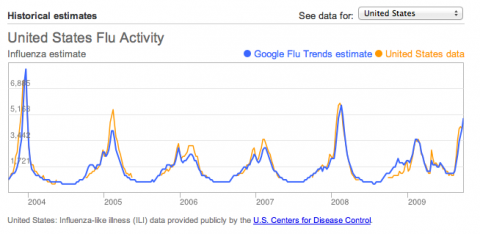
The CDC has noted an early and nasty start to the flu season. Perhaps their own website has caught it, because as I’m writing this, the whole thing is down. Assuming it recovers, I will insert relevant links per routine. Otherwise, I wish it well, and leave you to find your way there on your own.

It’s a bit soon to say, but the virus and the outbreak pattern at this point seem to resemble those of the 2003-2004 flu season, in which nearly 50,000 Americans died. At least two children have already died of flu complications this fall.

This is not the sort of stuff a public health physician can ignore.

So, I recently noted on LinkedIn andTwitter that I’ve been vaccinated — as I am every year — and recommend this year’s vaccine, which appears to match the prevailing viral strain quite well, to everyone else. I promptly got comments back from naysayers, including at least one self-identified microbiologist, who noted he never got vaccinated, and had “never gotten the flu.”

I believe him. But this is like that proverbial “Uncle Joe” everyone knows, who smoked three packs a day and lived to be 119. It could happen — but I wouldn’t bet the farm on it. Uncle Joe is that rare character who somehow comes away from a train crash with a minor flesh wound. The rest of us are mortal.

But there is something more fundamentally wrong with the “I’ve never gotten the flu, and therefore don’t need to be vaccinated” stance than the Uncle Joe fallacy. Let’s face it — those who were ultimately beneficiaries of smallpox or polio immunization never had smallpox or polio, either. If they ever had, it would have been too late for those vaccines to do them any good.

Continue reading…

Health Insurance Exchanges Will Transform Health Care. Magically Increase Transparency. Improve Access. And Maybe Even Lower Costs. But Only if We Get it Right …

By ANN MOND JOHNSON

NPR ran a story recently about how some retailers are retooling efforts to appeal to consumers in light of increased competition, particularly from online vendors.

Many are striving to be more “customer friendly”; Kohl’s department store was mentioned for adopting a “no questions asked” return policy with the idea that customer loyalty could be enhanced as the retailer made itself easier to do business with.

Comparisons between health care and retail abound, and while we say it is ideal for the consumer experience to be the same in both industries, in fact they are much different. The gap between the two industries was well-illustrated in this video of a shopper in a grocery store. We see them at the counter having their items rung up. But they aren’t told the prices and when they are given the receipt at the end, they’re told the final amount due may actually differ from what they see on the receipt.

Let’s take the analogy a step further: what if the customer expected the same “no questions asked” return policy from Kohl’s? Or a money back guarantee? In health care, only recently has the federal government taken steps to impose financial penalties in instances of poor care (which is the health care system’s equivalent of a “return policy” from providers).

When our team was at Subimo we initially focused on cost and quality (outcomes) information on hospitals. It was clear that – for the same procedures – there were both low cost and high quality providers as well as high cost and poor quality providers. Our efforts with transparency were designed to help people sort through the information so they could make more informed decisions and understand what quality outcomes might mean to them. We knew there was much variation in outcomes with certain procedures (e.g. aortic aneurysm repair) and less variation with others (e.g. normal vaginal delivery). Helping people understand when a poor outcome was more likely to occur helped them with their decisions (and presumably made them better shoppers).

Continue reading…

The (Not So) Affordable Care Act – Get Ready For Some Startling Rate Increases

By ROBERT LASZEWSKI

What will health insurance cost in 2014?

Will the new health insurance exchanges be ready on time or will the law have to be delayed?

There Will Be Sticker Shock! 

First, get ready for some startling rate increases in the individual and small group health insurance marketplace due to the changes the law dictates.In a November 2009 report, the CBO estimated that premiums in the individual market would increase 10% to 13% on account of the health insurance requirements in the ACA. In the under 50 employee small group market, the CBO estimated that premiums would increase by 1% to a decrease of just 2% compared to what they would have been without the ACA. All of these differences in premium would be before income based federal subsidies are applied to anyone’s premiums.

In recent weeks, the Obama administration issued a series of proposed regulations for the health insurance market. Since then, I conducted an informal survey of a number of insurers with substantial individual and small group business. None of the people I talked to are academics or work for a think tank. None of them are in the spin business inside the Beltway. Every one of them has the responsibility for coming up with the correct rates their companies will have to charge.

Hold onto your hat.

On average, expect a 30% to 40% increase in the baseline cost of individual health insurance to account for the new premium taxes, reinsurance costs, benefit mandate increases, and underwriting reforms. Those increases can come in the form of outright price increases or bigger deductibles and co-pays.

Deja Association: The Republican Health Reform Idea Hiding in Obamacare

By JD KLEINKE

If the Administration wants to make good on President Obama’s election night promise to work across the aisle to solve the nation’s problems, a good place to start would be how it implements a key provision of Obamacare – namely, the Republican idea buried in Section 1334.

The Affordable Care Act is a bulging sketchbook of ideas – some old, some new, some borrowed, some not-so-blue – for improving Americans’ access to health insurance. Obamacare’s cheerleaders and naysayers alike will probably be shocked to learn that one of those ideas, both old and borrowed, was formulated more than a dozen years ago by advocates of market-based health reform. Once the cornerstone of President George W. Bush’s and presidential candidate John McCain’s health policy platforms, the “Association Health Plan” – or AHP – lives on today in Obamacare.

This time around, AHPs are called “Multi-State Plans.” As before, they seek to let consumers, the self-employed, and small businesses from across the country band together into groups to buy a health plan from insurers competing across the country. These old-new plans were and are a powerful idea that could shake up local insurance markets, catalyze competition, and significantly reduce costs – if implemented by the Obama Administration as designed by their Republican architects. The original AHPs – also known for a time as “health marts” – were to be vehicles for giving individuals and the smallest groups access to a full range of insurance options, with the same purchasing freedom and bargaining power of large groups and self-insured employers. They also represent the most feasible way to consummate a perennially popular bipartisan idea for health insurance market reform: model private purchasing by consumers and small groups after the highly successful federal employees health benefits program.

With critical mass, these old-new plans would consolidate the large, chaotic mess at the long end of the insurance market – the tens of millions of individuals, self-employed folks, family businesses, and small groups suffering from the highest costs, lowest medical coverage ratios, and least affordable premiums. Why? Because this end of the market isn’t much of market at all, but hundreds of local markets with limited choices and 50 different sets of rules and regulatory processes.

Continue reading…

Inside Baseball: Getting the Federal Exchange Right

By ROBERT LASZEWSKI

The Obama administration just released another set of regulations, the “Draft Notice of Benefit and Payment Parameters for 2014.”

Among many other things in the 373 pages, they have announced their proposed assessments to cover the cost of running the federal exchange.

In order for the feds to administer the new insurance exchanges, they have proposed a fee of 3.5% of premium on each insurance policy sold in the exchanges (page 224).

This from the Kaiser Foundation 2011 “Primer” on Medicare:
“The costs of administering the Medicare program have remained low over the years––less than 2% of program expenditures.”

Many times over the years I have heard from advocates of a single-payer Canadian-style health plan that Medicare proves the federal government can do it cheaper than the private sector and should therefore take it all over.

So much for the notion that the feds are the model of insurance efficiency.

Under the new health care law’s Minimum Loss Ratio (MLR) provisions, insurance companies are limited to no more than 20% of premiums for expenses in the small group and individual markets.

Continue reading…

Trust But Verify: Why CMS Got It Right on EHR Oversight

By ASHISH JHA

Yesterday’s New York Times headline read that “Medicare Is Faulted on Shift to Electronic Records.”  The story describes an Office of Inspector General (OIG) report, released November 29, 2012, that faults the Centers for Medicare and Medicaid Services (CMS) for not providing adequate oversight of the Meaningful Use incentive program. Going after “waste, fraud, and abuse” always makes good headlines, but in this case, the story is not so simple.

For those not intimately familiar with the CMS policy, in 2009, Congress passed the Health Information Technology for Economic and Clinical Health (HITECH) Act.  The program, administered through CMS and state Medicaid programs, created financial incentives for doctors (and other eligible professionals) and hospitals to adopt and “meaningfully use” a certified electronic health record (EHR).  To receive financial incentives, which began to be paid in May 2011, doctors and hospitals “attest” that they have met the meaningful use requirements, providing an affirmation for which they are held legally accountable.

The process works as follows: health care providers visit a CMS website, register, and enter data demonstrating that their EHRs are “certified” and that they met each of the individual requirements for meaningful use. Then they attest that that all the data they entered is true.  For example, a physician might have to report, to meet just one of the 20 meaningful use measures, how many prescriptions she wrote over the past 90 days, and how many she wrote electronically.  My conversations with colleagues suggest that it can take a lot of time for providers to gather all the data they need to “attest” to meeting Meaningful Use.  Then, CMS runs logic checks to ensure that the numbers entered make sense and, if there are no errors, they cut the provider a check. Through September, 2012, CMS paid out about $4 billion in incentives to 82,000 professionals and more than 1,400 hospitals.

Continue reading…

THCB Calendar Dec. 18 — Donald Berwick: Is a Bright Future for Health Care Possible?

Donald Berwick, M.D., Former President and CEO, Institute for Healthcare Improvement; Former Administrator, Centers for Medicare and Medicaid Services.  The second annual Lundberg Institute Lecture welcomes Dr. Berwick, who studies the management of health care systems with emphasis on using scientific methods and evidence-based medicine and comparative effectiveness research to improve the tradeoff among quality, safety and costs.

Event Description: In the ongoing difficult transition to the Obama health plan, Dr. Berwick’s analysis of these issues has been resisted, and even distorted, by some political opponents in the current public debate. Dr. Berwick concludes that “Any health-care funding plan that is just, equitable, civilized and humane must, must redistribute wealth from the richer among us to the poorer and the less fortunate. Excellent health care is by definition redistributional.” Also, hear Dr. Berwick’s ideas on how true delivery system reform – changing care to better meet the needs of patients, families and communities – provides a sensible and effective alternative to the much-feared threat of rationing of care. Click here for more information and to purchase tickets.

MLF: Humanities
Location: SF Club Office
Time: 5:30 p.m. networking reception, 6 p.m. program
Cost: $20 standard, $8 members, $7 students (with valid ID)
Program Organizer: George Hammond
Also know: In association with The Lundberg Institute

Continue reading…