Categories

Category: Medical Practice

Not Knowing What You Don’t Know

By LUCY E. HORNSTEIN

“The more you learn, the more you realize you don’t know.”

You will hear this statement not just from physicians, but from lots of other folks engaged in scholarly work of all stripes. That’s because it is not merely true; it is a deep and universal truth that permeates all of mankind’s intellectual endeavors.

The implication of this for the practice of medicine is that a little knowledge can be very dangerous.

What do I, as a fully trained, extensively experienced primary care physician bring to the evaluation of patients who seek out my care that cannot be matched by so-called “mid-level providers” (PAs and NPs)? It is not (always) my knowledge, but rather the experience to know when I do not know something. In short, I know when to ask someone else’s opinion in consultation or referral.

I had a scary experience lately with a PA who didn’t even know what she didn’t know (and who still probably doesn’t realize it.)

The patient had been bit on the hand by a cat. I saw the injury approximately 9 hours after it had occurred. The patient had cleaned it thoroughly as soon as it had happened, and by the time I saw it, it was still clean, bleeding freely, not particularly red or swollen, and only a little painful. Still; cat bites are nasty, especially on the hands. Therefore I began treatment with oral amoxicillin-clavulanate, and told the patient to soak it in hot water several times a day.

Six hours later (after one oral dose of antibiotic) the patient called me back: the wound was now much more painful, red, swollen, and there were red streaks going from the hand all the way up to his elbow. Frankly, I was a little puzzled. He was already on antibiotics; the single dose probably hadn’t had enough time to make much of an impact. And yet the infection was clearly progressing.
Continue reading…
When Technology Understands What People Want From Healthcare, Our System Has A Chance

By JORDAN SHLAIN

As a primary care doctor in San Francisco and Silicon Valley, I have been searching for the holy grail of patient engagement for over 15 years. My journey began with an alpha-numeric pager and a medical degree. I shared my pager number with my patients along with a pledge to call them back within 15-minutes, 24-hours a day. My communications evolved into email and texting, with the predicate that by enhancing communication, I could carefully guide my patients down the byzantine corridors of healthcare – with a high probability we could avoid mistakes – if they would agree to share the ownership of their treatment plan. My life’s work has been where the rubber meets the road; where doctors interface with patients: office, hospital or smartphone.

Technology has washed over almost every industry and transformed it, radically. Healthcare is on the precipice of destiny. The wave is here.

Over the past three decades healthcare has lurched from one existential crisis to another; often manifested by an acronym solution: HMO, ACO, PCMH, P4P, PQRS; each a valiant attempt to reign in costs and solve for aligning incentives. However, we can’t have hospitals, doctors, health systems and payers accountable to healthy outcomes if the 300,000,000 people are not paramount to the equation.
Continue reading…

What Will Tomorrow’s Doctor Look Like?

By LESLIE KERNISAN

“What does the 21st Century Physician look like?”

Lisa Fields (@PracticalWisdom) cc’ed me on a tweet about this; it’s the featured question at www.tomorrowsdoctor.org, an organization founded by three young professionals who spoke at TEDMED last year.

I’ll admit that the question on the face of it struck me as a bit absurd, especially when juxtaposed with the term “tomorrow’s doctor.”

Tomorrow’s doctor needs to be doing a much better job of dealing with today’s medical challenges, because they will all be still here tomorrow. (Duh!) And the day after tomorrow.

(As for the 21st century in general, given the speed at which things are changing around us, seems hard to predict what we’ll be doing by 2050. I think it’s likely that we’ll still end up needing to take care of elderly people with physical and cognitive limitations but I sincerely hope medication management won’t still be a big problem. That I do expect technology to solve.)

After looking at the related Huffington Post piece, however, I realized that this trio really seems to be thinking about how medical education should be changed and improved. In which case, I kind of think they should change their organization’s name to “Next Decade’s Doctor,” but I can see how that perhaps might not sound catchy enough.

Continue reading…

HIV Messenger Baby

By J.D. KLEINKE

“Your baby did not die for nothing,” Rebekah said, looking up at the monitor so Kim would not see her tears. “Your baby was a messenger to us.”
This is how a friend who specializes in high-risk obstetrics attempts to comfort a grieving patient when she delivers a stillborn baby, as portrayed in my novel Catching Babies.

This bedside homily is small succor in the face of unspeakable devastation. But the idea that one family’s heartbreak will contribute to medical research and in some remote but real way help spare families in the future is often the only comfort an OB/GYN or nurse-midwife has to offer.

Which is all the more reason to celebrate this week’s tremendous news about HIV: this time, the messenger baby lived.

According to reports, an infant was born in Mississippi with the virus that causes AIDS, given aggressive doses of the anti-viral medications known to contain — not cure — the disease, and is now disease-free at two-and-half years old. It is the second known “cure” of an HIV-positive patient, and there are no words to describe how exhilarating it feels to read or type those words for anyone who came of age during, or lost friends to, the ugly and terrifying scourge of AIDS.

So take a moment to savor it. A baby with HIV has been cured. No viral load. Disease-free. Yes!

Continue reading…

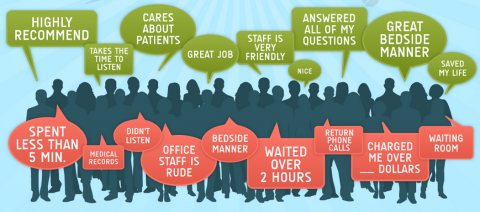
Most Online Patient Reviews Rate Doctors Highly. Really.

By JERRY LIN


In a world increasingly dominated by social media, doctors are becoming more concerned about managing their online reputations. Some doctors have even resorted to making their patients sign a gag order before treatment. Despite all the controversy, medical professionals need not fear online reviews: sites like Yahoo! Local and Insider Pages show that the majority of patients rate their doctors 5 out of 5.

At DocSpot, we help patients search across hundreds of different websites to find a doctor who meets their individual needs (for example if they need a primary care doctor who specializes in managing diabetes, or an experienced psychiatrist who accepts Aetna).

Continue reading…

Ruling Out the Wrong Diagnosis

By PETER PRONOVOST

Although misdiagnosis may kill up to 80,000 annually—more people each year than firearms and motor vehicle accidents combined—you won’t find it on the list of the country’s leading causes of death.

Most Americans don’t realize how frequently well-meaning medical providers get it wrong. Just last year Johns Hopkins researchers found that one in 12 ICU patients die from something other than what they were being treated for. Aside from a handful of instances covered by the national media, misdiagnosis hasn’t received much attention from the public or the medical community. One such tragedy is the death of Rory Staunton, a 12-year-old boy who was treated for an upset stomach and dehydration instead of sepsis, a severe response to infection that requires immediate treatment with antibiotics. To make a complex diagnosis like sepsis, a doctor may need to assess a couple dozen different factors.

One solution is to arm clinicians with better problem-solving tools and improved IT systems to help them identify possible diagnoses faster and more accurately, especially for conditions that are commonly confused or missed altogether. This week at Johns Hopkins, a team of researchers shared some promising results about a new way for emergency medicine doctors to accurately detect stroke in patients with dizziness.

Continue reading…

The Radical Rethinking of Primary Care Starts Now

By DAN DIAMOND

In November 2008, the New England Journal of Medicine convened a small roundtable to discuss “Redesigning Primary Care.”

U.S. primary care is in crisis, the roundtable’s description reads. As a result … [the] ranks are thinning, with practicing physicians burning out and trainees shunning primary care fields.

Nearly five years out — and dozens of reforms and pilots later — the primary care system’s condition may still be acute. But policymakers, health care leaders and other innovators are more determined than ever: After decades where primary care’s problems were largely ignored, they’re not letting this crisis go to waste.

Ongoing Shortage Forcing Decisions

The NEJM roundtable summarized the primary care problem thusly: Too few primary care doctors are trying to care for too many patients, who have a rising number of chronic conditions, and receive relatively little compensation for their efforts.

Continue reading…

Trickle Up Economics

By ROB LAMBERTS

It’s been a month since I started my new practice. We are up to nearly 150 patients now, and aside from the cost to renovate my building, our revenue has already surpassed our spending. The reason this is possible is that a cash-pay practice in which 100% of income is paid up front has an incredibly low overhead. My admitted ineptitude at financial complexity has forced me to simplify our finances as much as possible. This means that the accounting is “so simple even a doctor can do it,” which means I don’t need any front-office support staff. I don’t send out bills because nobody owes me anything. It’s just me and my nurse, focusing our energy on jury-rigging a computerized record so we can give good care.

Our attention to care has not gone unnoticed. Yesterday I got a call from a local TV news reporter who wanted to do a story on what I am doing. Apparently she heard rumor “from someone who was in the hospital.” I was the talk of the newsroom, yet I’ve hardly done any marketing; in fact, I am trying to limit the rate of our growth so I can focus on building a system that won’t collapse under a higher patient volume. I explained this to the disappointed reporter why I was not interested in the interview by telling her that I left my old practice because I needed to get off of the hamster wheel of healthcare; the last thing I want to do now is to build my own hamster wheel.

Continue reading…

Really Big New Thing

By MIKE MIESEN

“Will Accountable Care Organizations (ACOs) work?”

That question has been thrown around for years, serving as fodder for Twitter-fights, myriad health care blog posts, and hours of beer-soaked barroom debates (if you’re shameless as I am). Adding to the discussion are Clayton Christensen, Jeffrey Flier, and Vineeta Vijayaraghavan (or CFV, as I’ll refer to them), of Harvard Business School, Harvard Medical School, and Innosight fame, respectively.

In a recent Wall Street Journal article, they answer the question with a resounding “No.” But, in doing so, they treat ACOs and other health care delivery mechanisms – part of what I’ll call the “New New Thing in Health Care” – as mutually exclusive. Contra CFV, ACOs may help spur the exact disruptive innovation in health care that Christensen is known for discussing.

Continue reading…

Did Massachusetts Health Care Reform Hurt Access To Care For the Previously Insured?

By ASHISH JHA

In 2006, Governor Mitt Romney signed Chapter 58 of the Acts of 2006 entitled “An Act Providing Access to Affordable, Quality, Accountable Health Care.” It has been described by many names, including Massachusetts Healthcare Reform (MHR), Romneycare, or simply, as the template for the Affordable Care Act. The goal of the act was straightforward: to ensure near-universal access to health insurance for citizens of the Commonwealth of Massachusetts. The bill quickly led to insurance expansion: by 2010, 94.2% of adults under 65 had health insurance, an 8 percent increase over the 86.6% in 2006. By all accounts, the goals of insurance expansion were met.

But the bill has not been without controversy. There have been two main concerns: first, that the bill did too little to control rising healthcare costs. The cost crisis led to the 2012 bill that many refer to as “Mass Health Reform 2.0” – formally called Chapter 224 of the Acts of 2012. Its focus is to curtail healthcare spending, and while reasonable people have reasons for skepticism about the likelihood of success, that’s a topic for another day.

Continue reading…

