Categories

Category: Medical Practice

Six Awkward Concerns in My OpenNotes

By LESLIE KERNISAN

I found out this past weekend that the VA will be making clinician progress notes available for patients to view on the MyHealtheVet portal. In other words, the VA is going OpenNotes. (Note: I was a primary care provider in geriatrics clinic at the San Francisco VA from 2006-2010.)

My first reaction was to be impressed by this bold progressive move.

My next reaction was to feel mildly relieved that I’m no longer a PCP there.

Now, it’s not because I’m against transparency in healthcare, or am suspicious of patient engagement, or feel that patients shouldn’t see their health information without the assistance/gatekeeping/interference of a clinician. Far from it.

It’s because in my own VA practice caring for WWII vets, I used to frequently document certain concerns that would’ve been a bit, shall we say, awkward for the patient to see. Reading about these concerns would’ve quite possibly infuriated the patient, or the caregivers, or both.

So whew, I find myself relieved that I don’t have to figure out how to document (or not document?) these concerns.

Instead, I’ll get to see how my friends at the VA handle these issues.

Wondering what they are? Ok, I will tell you but shh … don’t tell my elderly patients that I may be considering these topics as I care for them.

Six awkward concerns in geriatric primary care practice

· Possible dementia. As a geriatrician, I focus on an age group that has a high incidence of dementia. Which means that when someone starts to tell me odd stories (concerns related to poison are a popular theme, as well as reports that someone is stealing things repeatedly), I start wondering about possible dementia. Ditto if he or she starts floundering with the medications, or starts having other difficulties with IADLs.

Why it’s awkward: Patients and families really hate it when I bring up the possibility that there might be dementia. Many find the possibility of a disease such as Alzheimer’s truly terrifying, both because it’s perceived as a terrible disease, and because they worry about having to leave their homes or otherwise losing their independence. Note that if I’m considering the possibility of dementia, I usually let the patient know during the visit.


Continue reading…

What the Story of a Famous Little White Pill Says About How Medical Research Works

By JOHN H. SCHUMANN

Twenty-five years ago this month, the New England Journal of Medicine published a special report on something that’s become medical gospel:

Aspirin.

That’s right. Not as in “take two and call me in the morning,” but in the realm of the randomized double-blinded placebo-controlled trial. Or what we generally consider the gold standard of evidence in medical research.

If you’ve often heard that bit of jargon but always wondered why it’s so exalted, break it down:

  • randomized: the assignment of the treatment (aspirin) or placebo (‘inert’ sugar pill) is not given in any planned sequence.
  • double-blinded: neither the researchers nor the subjects know who is taking what (everything is coded so that analysts can find out at the end).
  • placebo-controlled: the study compares the treatment against placebo to see if it’s helpful or harmful.

Even though acetylsalicylic acid’s properties as a pain reliever and fever reducer had been known in the time of Hippocrates, it was in 1899 that Bayer first patented and marketed what came to be known as aspirin worldwide.

A mere 89 years later, researchers from the “Physicians Health Study” did something unusual. Citing aspirin’s “extreme beneficial effects on non-fatal and fatal myocardial infarction”–doctor speak for heart attacks–the study’s Data Monitoring Board recommended terminating the aspirin portion of the study early (the study also was looking at the effects of beta-carotene). In other words, the benefit in preventing heart attacks was so clear at 5 years instead of the planned 12 years of study that it was deemed unethical to continue blinding participants or using placebo.

Continue reading…

Heroes and Villains

By ROB LAMBERTS

“Lance Armstrong is a bad guy who has done some very good things.”

These are the words of a sports radio personality I listened to yesterday. He was obviously commenting on the confession (to my pal Oprah) by Armstrong about his use of performance enhancing drugs. The sportscaster, along with many I heard talk on the subject, were not as upset by the fact that Armstrong used the banned substances, or his lies on the subject, but the way he went after anyone who accused him of what turned out to be the truth. Armstrong used his position of fame and power, along with his significant wealth, to attack the credibility of people in both the media and in the courtroom. The phrase, “he destroyed people’s lives” has been used frequently when describing his reaction to accusations.

It’s a horrible thing he did, and shows an incredibly self-centered man who thought the world should bend to his whim. It’s more proof to the adage: absolute power corrupts absolutely.

But simply dismissing Lance as a cad or a horrible person would be far easier if not for the other side of his life. In his public battle against cancer, he inspired many facing that disease to not give up their battle. Even for those who eventually lost, the encouragement many got from Armstrong’s story was significant. On top of that, the Livestrong foundation did much to raise money and awareness for cancer and for other significant health issues. This foundation exists because of the heroic story of Lance’s successful battle to beat cancer, as well as his subsequent cycling victories. Whatever the lies he told in the process, he did beat cancer and he did win the Tour de France multiple times.

Continue reading…

Connecting Medical Devices and Their Makers

By PETER PRONOVOST

Today, an intensive care unit patient room contains anywhere from 50 to 100 pieces of medical equipment made by dozens of manufacturers, and these products rarely, if ever, talk to one another. This means that clinicians must painstakingly review and piece together information from individual devices—for instance, to make a diagnosis of sepsis or to recognize that a patient’s condition is plummeting. Such a system leaves too much room for error and requires clinicians to be heroes, rising above the flawed environment that they work in. We need a heath care system that partners with patients, their families and others to eliminate all harms, optimize patient outcomes and experience and reduce waste. Technology must enable clinicians to help achieve those goals. Technology could do so much more if it focused on achieving these goals and worked backwards from there.

This week marks a step that holds tremendous promise for patients and clinicians. On Monday the Masimo Foundation hosted the Patient Safety Science & Technology Summit in Laguna Niguel, California, an inaugural event to convene hospital administrators, medical technology companies, patient advocates and clinicians to identify solutions to some of today’s most pressing patient safety issues. In response to a call made by keynote speaker former President Bill Clinton, the leaders of nine leading medical device companies pledged to open their systems and share their data.

Lack of interoperability between medical devices plays no small role in the 200,000 American deaths caused by preventable patient harm each year, such as in the case of 11-year-old Leah Coufal. After undergoing elective surgery, Leah received narcotics intended to ease her pain.

When Leah received too much medication, it suppressed her breathing, eventually causing it to stop altogether. Had she been monitored, a device could have alerted clinicians when Leah’s breathing slowed to a dangerous level.

But as we know, clinicians are busy and unfortunately don’t always respond to alarms from bedside machines. If a machine measuring her breathing had been linked with the device delivering her medication, it could have automatically stopped the drugs from infusing into her blue, oxygen-deprived veins.

All of this is possible today; technology is not a barrier. Until now, the only thing that’s stood in the way is a lack of leadership and a lack of willingness for device manufacturers to cooperate.

Continue reading…

Finally. Hard Evidence Against the Autism Epidemic?

By NEUROSKEPTIC


No one disputes that diagnosed rates of autism have increased enormously over the past 15 years or so, around the world. However, other people write it off as essentially a cultural phenomenon: we’re getting better at detecting the disorder and more willing to label kids as having it.

I subscribe to the latter view, but there’s very little hard evidence for it. To prove that diagnostic changes have occurred, rather than a true increase in autism, you’d have to know what would have happened to today’s kids, say, 20 years ago. Would they have been diagnosed? We have no way of knowing. At least not until someone invents a time machine.

However, a new study just out offers a valuable new perspective on the debate: Spatial clusters of autism births and diagnoses point to contextual drivers of increased prevalence.

According to authors Soumya Mazumdar and colleagues, there’s a zone of high autism prevalence in California, areas where kids aged 0-4 years old are more likely to be diagnosed with the condition. The epicentre is L.A.; there’s actually three overlapping hotspots centred on Santa Monica, Alhambra and North Hollywood.

In these clusters, autism rates are between 2 and 6 times higher than the rest of the state.

Continue reading…

The Nursing Shortage Myth

By DAVID WILLIAMS

For years we’ve read that the US faces a looming shortage of nurses. Shortfalls in the hundreds of thousands of nurses are routinely predicted. These predictions have been good for nursing schools, which have used the promise of ample employment opportunities to more than double the number of nursing students over the last 10 years, according to CNN.

Yet somehow 43 percent of newly-licensed RNs can’t find jobs within 18 months. Some hospitals and other employers openly discourage new RNs from applying for jobs. That doesn’t sound like a huge shortage, then does it?

But the purveyors of the nursing shortage message have an answer for that. Actually two answers: one for the short term and another for the long term. The near term explanation is that nurses come back into the workforce when the economy is down. Nurses are female and tend to be married to blue collar men who lose their jobs or see their hours reduced when the economy sours, we’re told. Nurses bolster the family finances by going back to work –or they stay working when they were planning on quitting. There’s something to that argument even if it’s a bit simplistic.

The longer term argument is that many nurses are old and will retire soon, just when the wave of baby boomers hits retirement age themselves and needs more nursing care. Don’t worry, the story goes, there will be tons of jobs for nurses in the not-too-distant future. This logic comes through again in CNN’s story:

Demand for health care services is expected to climb as more baby boomers retire and health care reform makes medical care accessible to more people. As older nurses start retiring, economists predict a massive nursing shortage [emphasis mine] will reemerge in the United States.

Continue reading…

Mobilizing Data for Pressure Ulcer Prevention

By HEMALI THAKKAR & MEL MEDER

Developers, you have a chance to improve the care that over 2.5 million people receive annually for pressure ulcers. Join the ‘Mobilizing Data for Pressure Ulcer Prevention Challenge’ by creating a mobile application to innovate how healthcare teams use patient data. The winner will receive $60,000 plus a conference exhibition opportunity.

Currently, patients may receive care for pressure ulcers from several providers, but their data does not travel with them, creating a barrier to effective coordination of care. Nurses, working with clinical and technical specialists, have developed a foundational model to capture and communicate information about pressure ulcers in a standardized way. By applying this model, evidence-based documentation can be compared and shared between different health care systems to improve quality outcomes in pressure ulcer care.

The Office of the National Coordinator for Health IT (ONC), in collaboration with the Department of Veterans Affairs, Kaiser Permanente, and the American Nurses Association, is sponsoring a challenge to implement this model in a mobile health app. Development of an app that implements standards for documenting health information about pressure ulcers will facilitate meaningful information exchange, simplify continuity of care, and improve the patient experience while reducing health care costs.

Continue reading…

Accidental Tourist: Visiting the Bumrungrad Hospital in Bangkok

By JEFF GOLDSMITH


There’s been a lot of recent speculation that more Americans will be taking their elective medical problems overseas. In 2008, Deloitte’s Center for Health Solutions estimated that 750 thousand Americans travelled overseas for medical care in 2007, and forecast a eight-fold increase by 2010 In a 2009 update, Deloitte found that the 2008 financial crisis devastated overseas medical travel, but still forecast 1.6 million US citizens going abroad for medical care in 2012.

Among overseas medical destinations, no facility is mentioned more than Bumrungrad (last syllable rhymes with “hot”) Hospital. Bumrungrad is a privately owned but publicly traded 550 bed acute care hospital in central Bangkok. On a recent trip to Thailand, I stopped at Bumrungrad to find out what all the shouting was about and was really impressed with what I saw.

Bumrungrad’s CEO is a courtly, silver-haired Virginian named Mack Banner, who spent most of his career in the US investor-owned sector. Though the hospital was founded in 1980, it moved into its new facility in 1997, just in time for the Asian financial crisis. The facility was Joint Commission (International) certified in 2002, and one fifth of its physicians are US Board certified in their respective specialties.

In 2008, the hospital opened a beautiful 21 story Clinic building next door, housing 30 specialty clinics and most of its medical staff. Bumrungrad’s Clinic Facility is Mayo-esque, enabling patients with particular specialty problems to be worked up, evaluated and cared for on a single floor. The hospital subsequently renovated its inpatient rooms, which resemble those of the Asian-themed Washington DC Park Hyatt in elegance. The hospital is a sunny, happy place, with apparent high morale and very high service standards. English is spoken widely throughout the hospital.

Continue reading…

Five Lessons in Transparency from Cleveland Clinic CEO Toby Cosgrove

By DAVID WHELAN

Cleveland Clinic is the health care industry trailblazer when it comes to publishing its clinical outcomes. As discussed in this earlier story (“How To Report Quality To The Public”), the Ohio hospital system annually publishes Outcomes Books that detail the clinical performance of each of its departments.

If you doubt this is radical, go to your local hospital’s Web site. See if it publishes how many patients died during heart surgery last year.

At Cleveland Clinic that number is easy to find. The hospital performed 459 bypass surgeries and only three patients died in the hospital. That is about a third the rate of deaths recorded at other hospitals for the same procedure.

Yet Cleveland Clinic does not only publish data that casts itself in a favorable light. In the third quarter of last year, 3% of bypass patients had strokes after their operations, when that number should have been around 1%.

I called the hospital’s corporate office to find out more about the history of the Outcomes books, how they affect hospital operations, and if there were lessons to share. I asked to speak to the de facto “Chief Transparency Office” and assumed I’d be directed to a middle manager working in the office of public affairs or marketing.

Instead, I soon found myself on the phone with the CEO. It turns out that Delos “Toby” Cosgrove, who runs the $6 billion health system, is also the organization’s unofficial transparency officer. He was the guy who developed the Outcomes Book concept in the first place.

Continue reading…

Progress

By ROB LAMBERTS


Finally.

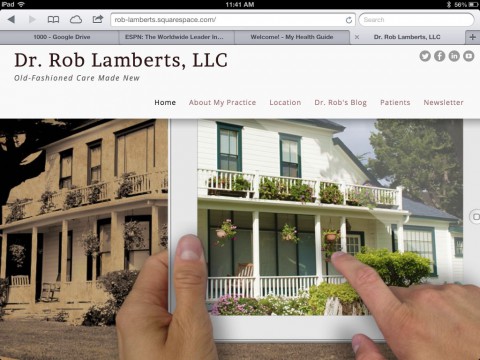
I can finally see progress in what I am doing.  Above is a photo of the front page of my new practice website (visit http://doctorlamberts.org).

There still is a little “Lorem ipsum” here and there – like having labels you missed on a shirt you are wearing – but I am very happy with the look.  The pictures of the sepia photos with the iPad making it color were the genius of my web developer (with some suggestions from me), giving a perfect image of the use of technology to accomplish “old-fashioned care made new.”

I’ve spent good portion of the past few days writing the content (replacing most of the “Lorem ipsum”).  Of what I’ve written, the strongest was in the section “Why It’s Different,” where I compare life in a traditional practice to what I intend to do.  Here are a few examples:

“I Need an Appointment”

Traditional Practice

· Call the office, hear a message about calling 911, get placed on hold or leave voice message (after navigating automated attendant).
· Get called back to find out the reason for your appointment.
· Appointment is made around what is open for the doctor.
· Take time away from your schedule to meet doctor’s schedule.

Our Practice:

· Log on to portal and directly make your own appointment to fit your schedule.
Or
· Call the office and tell a human being that you need an appointment.

Continue reading…