Categories

Category: Medical Practice

Why Texting Public Health Messages Is a Brilliant Idea. Except When It’s Not…

By JOHN S. WILSON

A new service has partnered with a Los Angeles school district – the second largest in the country – to not only deliver STD results by text message, but also to promote the idea children share their “status” as easily as they share the highlight of their day on Facebook. But when it comes to children having sex, it’s never quite that simple now is it?

Qpid.me is the brainchild of Ramin Bastani and operates from the following premise: “We believe that sharing is a good thing and that it can lead to better sexual health decisions, more (safe) sex and fewer STDs.” Bastani went on to tell CNN in an interview: “If it’s cool for a beauty queen to share her STD status [Qpid.me’s celebrity sponsor is Tamie Farrell, Miss California 2009], then maybe kids will start to think it’s cool to share their own results. We want to normalize the idea of sharing your status.”

The process is fairly straightforward. Qpid.me requests patient test results from health clinics (with patient permission, of course) then transmits those results via text, email, and provides access to their online site. The concept of delivering STD results electronically is not necessarily new, or controversial. The danger lies in convincing children there are no concerns about sharing such private information among peers who may not respect their privacy, or, worse may shame them for contracting curable diseases.

Continue reading…

The PCORI Patient Engagement Awards: A Call for Proposals

By ANNE C. BEAL, SUSAN SHERIDAN, & SUZANNE SCHRANDT

One of our core beliefs at PCORI is that patients, clinicians, and other front-line caregivers, and others across the healthcare community have the potential to become valued and real partners in the patient-centered outcomes research (PCOR) we support. We practice what we preach in the requirements we place on applicants for our funding and the way we evaluate their proposals.

So we’re pleased today to announce the latest example of how we’re making that principle real – a new funding program called the PCORI Engagement Awards and the first funding opportunity under this program, the Pipeline to Proposals Award.

Listening to our stakeholders

We got the idea for the Engagement Awards program last October, during our first patient engagement workshop. We asked workshop participants to provide input into how we can better serve and connect with patients and the communities interested in being involved with rigorous PCOR– which is, comparative clinical effectiveness research focused on and guided by the needs and concerns of patients. The response was a clear and broad expression of passion, expertise, and willingness within the patient and broader healthcare community to help us pursue this approach to research. The question was how best to do it.

engagement-awards-graphic

From that discussion was born our Engagement Awards program, which is designed to leverage the community’s passion and expertise by offering targeted funding to dozens of groups of patients, providers and other healthcare community stakeholders interested in supporting the expansion of high-quality, useful PCOR and the implementation of its results.

Our philosophy is that, when the research process incorporates the perspectives of the entire healthcare system and focuses on the questions important to patients and those who care for them, the results are far more likely to be meaningfully incorporated into clinical decision-making and practice.

The Engagement Awards program will have three distinct categories:

  • Knowledge Awards, which will fund activities such as background papers, landscape reviews, and development of mechanisms to share research results.
  • Continue reading…

Building Cost and Quality Into the Electronic Medical Record

By HAYWARD K. ZWERLING

Trends in US healthcare expenditures are financially unsustainable (1). I would like to propose two tweaks of the healthcare delivery process that may, in a small way, help rectify this problem.

Although there is a widespread impression that health information technology (HIT) will eventually “bend” the cost curve and put healthcare spending on a sustainable course, there is, as of yet, little data that convincingly supports this hypothesis (2).

Kaiser Permanente is a large, integrated healthcare delivery system which has invested heavily in HIT. George C. Halvorson, the chairman and CEO of Kaiser Permanente appears to have concluded that this investment will not solve the healthcare cost issue, when he was quoted in the New York Times (3/20/13) as stating “We think the future of health care is going to be rationing or re-engineering.”

Because HIT, as currently implemented, will probably not solve the healthcare cost problem, I would like to suggest a minor “re-engineering” of the electronic health record user interface which may help bend the cost curve.

At every office visit, the physician must make a myriad of decisions which incrementally effect the nation’s total healthcare expenditures. For example, the physician will have to decide which medicine to prescribe, and which radiology study or laboratory test to order.

In many situations, there is more than one acceptable choice. The physician’s ultimate decision will integrate their understanding of the disease process, the treatment’s side effect profile, their familiarity with the treatment options, patient preferences and many other variables.

I would suggest that every time a physician is about to order a test or a prescription, the cost of the test or prescription should be displayed to the physician. In the same vein, whenever a computer displays a test result, the cost of the test is immediately available to the reader. This information could then become an additional factor that the physician may choose to integrate (or ignore) at the moment when he/she is about to commit the patient and society (which is now paying >50% of all healthcare bills) to another healthcare expenditure. In terms of a risk/benefit analysis, I can see little downside to providing this cost information to physicians.

Continue reading…

What the Khan Academy Teaches Us About What Medical Education Will Look Like Ten Years From Now

By MICHAEL PAINTER

From SFO, I carefully followed my Droid Navigator’s directions off Highway 101 into a warren of non-descript low-slung office buildings—non-descript except for the telltale proliferation of Google signs and young adults riding colorful Google bikes.  I drove around to the back of several of those complexes and finally found the correct numbered grouping.  It really could have been any office or doctors’ office complex in the U.S.  The Khan suite is on the second floor.  There’s a simple brass plate saying “Khan Academy” on what looked like oak double doors. I let myself in and immediately encountered a large, central open space—with long dining tables, food, an ample sitting area with couches conducive for group discussions—and a friendly greeting by programmers and staff.  Oh, and computers—there were lots of computers.  As far as I could tell, nobody had their own office—though maybe Sal does.  Everyone was also open, friendly and passionate about the great work happening there.

After some trial and error, Rishi and I found an unused office and huddled around his Mac for a Google Hangout interview with a Bay Area reporter about the Khan/RWJF health care education project.  Later, I met with Shantanu, the Khan COO and former “math jock” high school friend of Sal, as well as Charlotte, external relations, and Matt, software engineer. They’re all long termers at Khan—that means they’ve been there for about two years.  Overall, the energy was pretty electric.  One other small thing—do not be fooled—these incredible people are, how should I put it—ferociously—intense and focused.

Pioneers in flipping the med school classroom

The next morning, Rishi and I met at Stanford Medical School—in the Li Ka Shing Center for Learning and Knowledge—an enormous and beautiful building off Campus Drive near the hospital that did not exist back in my days as an earnest Stanford law student.   We were there to observe some pioneers in medical education attempt to use Khan-like videos to flip the medical school classroom.  This work at Stanford is part of the current Khan Academy and RWJF collaboration. We’re trying to understand what happens when a medical school attempts to use the Khan-style videos to change the classroom interaction.

Continue reading…

#Dataviz + #Design + #Diabetes: The Beginning

By JOYCE LEE

I love interactive data visualization (#dataviz).  It is one of the things that I definitely wanted to explore when I came out to the Bay Area on sabbatical, because I believe that it has great potential for helping both patients and clinicians with diabetes management.  The sheer volume of numbers available for this disease is overwhelming; we need #dataviz tools that can help us achieve greater understanding and make actionable clinical decisions to improve health.

This is what we usually see in clinic: numbers written down on a piece of paper.

Yes there are computer systems that link to blood glucose meters, but there are a number of complexities with the downloading of blood sugar numbers in clinic (which deserves an entire blog post sometime in the future).

You can see there is some visual analysis and annotation that we do perform, albeit primitive.  The circles represent high blood sugars (>150 mg/dl)and the triangles represent low blood sugars (<70 mg/dl). This is almost better than the cave painters don’t you think?

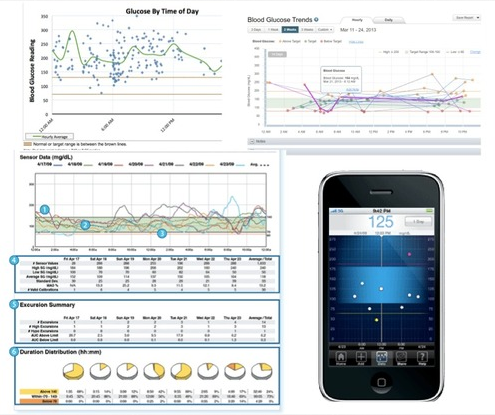
But even the minority of patients who download their BS to the computer, are viewing dashboards like this.

Pie charts, need I say more? I can extract some useful insights from these charts, which improve over the previous one I showed, but a few things strike me: (1) some of the scatter plots overlay weeks of data, which I don’t find helpful because you can’t tell how BS on a given day are responding and relate them to life events; (2) some visualizations show a lot of numbers in many of the sections, and it just becomes onerous to go through them and find trends; (3) many provide statistics (area under the curve, MAD%) which I think only a minority of families and children really understand; (4) although some of the software programs do provide interactivity and let you see the data at different time scales (day, week, month), if you change to a different view, you are stuck trying to remember in your head what you saw on a previous screen because you can’t see the multiple levels at once; (4) finally, I find that the user interface and design could use major improvement.

Continue reading…

Guahao: VC Fantasy. Online Appointment Registration System for China’s 700 Million Internet Users

By BRADLEY HOATH


The promising platform is called Guahao (挂号网) and it claims to be China’s largest online appointment registration system.  With a national network of nearly 4,000 hospitals, 600 being Level-3 hospitals, and over 300,000 specialists, it is hard to dispute it’s size.*  Guahao began development in Shanghai 2010 in collaboration with the Chinese Health Education Network, Fudan Hospital and Healthcare Management Co., and the Chinese Hospital Association, and later expanded nationally.  Guahao attempts to alleviate the bitterness patients endure during a typical hospital visit.

*It should be known that there are actually several online appointment registration systems in China; However, most are small, regionally splintered and have questionable legitimacy.  Guahao is by far the largest and most well supported system in China.

China historically has not had a call-ahead appointment scheduling system.  Patients throughout China have long lamented the country’s hospital queuing system, or the lack thereof.  Patients arrive at the hospital, literally take a number, and wait for their turn – sometimes for over 24 hours.  It is not uncommon to see throngs of patients and their family members outside of the hospital, camping out in makeshift beds to see a physician.  A lack of appointment system puts pressure on the hospital’s health workers.  Patient scheduling provides predictability of patient flow and allows for more efficient allocation of healthcare resources.  Not to mention it makes for a much more patient-centered approach to healthcare delivery.

Continue reading…

When Is It Appropriate to Ignore an Advance Directive? Is It Ever Appropriate to Ignore a Patient?

By Eric Widera, MD

An 85-year-old woman with moderate Alzheimer’s disease who enjoys walking in her nursing home’s garden with her walker has fallen and broken her hip. An advance directive signed by the patient states a preference for “Comfort Measures Only,” and specifically states that she does not want to be transferred to the hospital. The physician believes that surgery would provide long-term pain relief and the chance to maintain some mobility.

What do you do? How do you reconcile her previously expressed hypothetical wishes in an Advance Directive with what is now a rather unanticipated scenario?

In a paper published recently in JAMA Internal Medicine, Alex Smith, Bernard Lo, and Rebecca Sudore developed a 5-question framework to help physicians and surrogates through the decision making process in time like this. The framework proposes 5 key-questions to untangle these conflicts:

  1. Is the clinical situation an emergency?
  2. In view of the patient’s values and goals, how likely will the benefits of the intervention outweigh the burdens?
  3. Continue reading…

The Patient Explanatory Model

By NAMRATHA KANDULA

In The Birth of the Clinic, Foucault describes the “clinical gaze,” which is when the physician perceives the patient as a body experiencing symptoms, instead of as a person experiencing illness. Even in the era of the biopsyschosocial model, the physician’s perspective is largely through a biomedical lens where biology and behavior cause disease.

In contrast, what I hear from patients is that health and illness are not merely the end results of individual biology and behavior. What people believe and experience when they are ill is usually something far more complex, deeply interconnected with their daily lives. And research shows the way people think about health influences whether they are receptive to health information, willing to change health behaviors or take medications, and even whether or not their health improves. But how are physicians, who are able to spend less and less time with patients, supposed to expand their clinical gaze to include the patient’s health beliefs and perspectives?

Psychiatrist and anthropologist Arthur Kleinman’s theory of explanatory models (EMs) proposes that individuals and groups can have vastly different notions of health and disease. Kleinman proposed that instead of simply asking patients, “Where does it hurt,” the physicians should focus on eliciting the patient’s answers to “Why,” “When,” “How,” and “What Next.”

Kleinman suggests the following questions to learn how your patient sees his or her illness:

1.         What do you think caused your problem?

2.         Why do you think it started when it did?

3.         What do you think your sickness does to you?

Continue reading…

What Do Patients Really Think? A Report From the Third Annual Health Privacy Summit

By ANDY ORAM

Health reform activists and privacy mavens have been at loggerheads for years. Those touting health reform complain that an oversensitivity to privacy risks would hold back progress in treatments. Running in parallel but in the opposite direction, the privacy side argues that current policies are endangering patients and that the current rush to electronic records and health information exchange can make things worse.

It’s time to get past these arguments and find a common ground on which to institute policies that benefit patients. Luckily, the moment is here where we can do so. The common concern these two camps have for giving patients power and control can drive technological and policy solutions.

Deborah Peel, a psychiatrist who founded Patient Privacy Rights, has been excoriated by data use advocates for ill-considered claims and statements in the past. But her engagement with technology experts has grown over the years, and given the appointment of a Chief Technology Officer, Adrian Gropper, who is a leading blogger on this site, PPR is making real contributions to the discussion of appropriate technologies.

PPR has also held three Health Privacy Summits in Washington, DC, at the Georgetown Law Center, just a few blocks from the Capitol building. Although Congressional aides haven’t found their way to these conferences as we hoped (I am on the conference’s planning committee), they do draw a wide range of state and federal administrators along with technologists, lawyers, academics, patient advocates, and health care industry analysts. The most recent summit, held on June 5 and 6, found some ways to move forward on the data sharing vs. privacy stand-off in such areas as patient repositories, consent, anonymization, and data segmentation. It also highlighted how difficult these tasks are.

Continue reading…

60% of Massachusetts Doctors Will Not Meet State Electronic Record Mandate

By JOSH ARCHAMBAULT

Putting aside a lengthy discussion over the merits of and cost saving potential of EMRs for a minute, comes this gem from the land of not so well thought out policy making…

In 2010, the Massachusetts Legislature passed a law requiring that, as a condition of licensure starting in 2015, Massachusetts physicians must demonstrate proficiency in the use of electronic health records, computerized order entry, e-prescribing, and other forms of health information technology.

Last year [ in chapter 224], the Legislature amended that statute to state that physicians must “demonstrate the skills to comply with the ‘meaningful use’ requirements.” There was no further language to explain the intent or scope of that amendment.

Given that even the most optimistic forecast holds that only 12,000 eligible providers in Massachusetts would achieve Meaningful Use certification by 2015 (more than 30,000 physicians hold a Massachusetts license), the MMS is committed to ensuring that the statute is interpreted broadly, and does not unintentionally disenfranchise thousands of physicians, thereby creating an extreme health care access issue.

-Massachusetts Medical Society

So 60% of doctors are projected to be non-compliant?!? I guess a doctor shortage will take on a whole new meaning in the state.

This is what happens when you pass major policy bills in  14 hours without anyone reading the whole thing first, but I digress…

This issue prompted a recent call to action from a local doctor in North Chelmsford, Dr. Hayward Zwerling.

Josh Archambault is director of health care policy at the Pioneer Institute in Boston (www.pioneerinstitute.org), publisher of “The Great Experiment: The States, The Feds and Your Health Care.”