Categories

Category: Medical Practice

From the Case Files of the Robert Wood Johnson University Hospital, Dec 2015

By JAMES SALWITZ

May 30-8:12pm: 27 yo teacher, Pam S., is out for her evening run. The delicious evening air fills her nose and lungs. She feels strong, healthy, and alive.

May 30-8:13pm: Pam pushes up a gentle hill. She feels sudden and severe pain, as if stabbed deep by a flaming splinter.  Pam stops, almost falling.  She struggles the mile home. The searing throb begins to fade. A long hot shower gives some relief.

June 3-5:45am: The torment progressed through the weekend and curled around pillows, drenched in sweat, she has not slept all night.  As traces of sunrise light frame her bedroom window, she decides to get medical care.

June 3-9:22am: Pam tells her story to her Primary Medical Doctor (PMD) and is examined.  Her pain is intense with any movement and he is worried. He orders blood work, pain medication and calls an orthopedic surgeon. The PMD completes his history and physical report, as well as his differential, in his Electronic Medical Record (EMR).  The note is transmitted instantly to the surgeon.

June 3-9:59am: STAT blood work is drawn at a lab down the street.

June 3-10:37am: Pam picks up the pain medication.

June 3-11:25am: The orthopedic surgeon reads the PMD’s note, listens to Pam’s story and examines her.  He orders an emergency MRI.

Continue reading…

Calling All Patients: Blue Button Patient Co-Design Challenge

By PAT SALBER

June 3rd was the kick-off for an amazing Challenge – the Blue Button Patient CoDesign Challenge.  Developers everywhere are being invited by the Office of the National Coordinator to develop apps and other tools to use patient data, acquired via the Blue Button. You might be thinking: why is that so amazing?  Because the entire Challenge has been designed to actively involve the ultimate users of the tool – patients. Imagine that!

Here are the details:

http://www.health2con.com/devchallenge/blue-button-co-design-challenge/

From now until June 11th, patients (which includes almost all of us) are invited to go to Health Tech Hatch to post their ideas about how they want to see their data used to create tools that they can use themselves or with their doctors. There are already over 50 ideas already posted, which include:

  • Please help my wife manage our children’s immunizations
  • A tool that simplifies the management of chronic multiple conditions,
  • Make my prescription management stink less (my favorite)

Continue reading…

Data Points: Scope of Practice. When You Get Right Down To It, We’d Rather See a NP/PA Than Wait …

By MIKE MIESEN

In my last  post on California and Texas’s imminent expansion of their scope of practice regulations, I didn’t cover one important question: what do patients actually want?

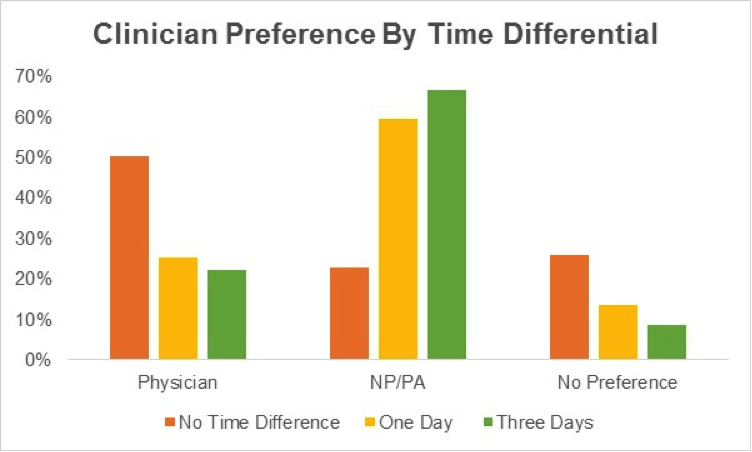
Fortunately, a study just released in Health Affairs looked into it, and the results are clear: many patients want to be seen by nurse practitioners (NPs) and physician’s assistants (PAs) – especially if it allows them to be seen sooner.

To be clear: generally, Americans still prefer being seen by a physician. But preferring a NP/PA – or “not having a preference” between a NP/PA and a physician – is a big deal; it insinuates that, for certain ailments, the public views a NP/PA as just as effective a clinician. That has significant repercussions for how care is delivered, particularly for young people and underserved populations.

The researchers conducted a survey that focused on three different scenarios to judge patient preferences: a straight-up comparison of preference for physicians vs. NPs/PAs; a scenario where a patient could see a NP/PA today vs. a physician tomorrow for a minor ailment; and a scenario where a patient could see a NP/PA today vs. a physician in three days for a minor ailment. Continue reading…

An Anesthesiologist Thinks Out Loud

By SHIRIE LENG

Anyone who has read my work knows that articles like the one written in the New York Times on Sunday by Elisabeth Rosenthal will immediately get a response out of me.  If you haven’t read it, here’s the link.

Where do I start with this???  I’m going to let Ms. Rosenthal tell you about how many unnecessary colonoscopies we do.  I’ll let her tell you how much more it costs here than anywhere else.  I will address the anesthesia bit.  Let me tell you a little story.  When I was a baby anesthesiologist my hospital sent anesthesiologists “downstairs” to do anesthesia for GI procedures maybe once a week for a few hours.

This was in 2004 or so.  Now we send three board certified anesthesiologists to various GI units every day all day.  We do maybe 25 cases a day on average.  Now, some of this is due to the aggressive expansion of the advanced GI procedures unit as well as the addition of an outside private group that was recently folded into the greater hospital system.  It’s also because we’re there.  It’s no accident that as soon as we committed troops to the GI battle all of a sudden everybody needed anesthesia.

The NYT article uses Dierdre Yapalater as an example, a healthy 60-something.  Putting aside the ridiculous cost for the overall procedure, she was billed $2,400 for anesthesia.  But she didn’t need anesthesia.  There is absolutely no reason for her to have an anesthesiologist involved for that case.  None.

Anesthesia care used to be limited to very sick patients, not because they are harder to sedate (they’re actually often easier) but to monitor them closely because of their tenuous physiologic status.  Now everybody is getting it.  Why did she get anesthesia, why did the anesthesiologist give it, why does insurance pay for it?

Continue reading…

A SEC for Health Care?

By PETER PRONOVOST

If you have ever tried to choose a physician or hospital based on publicly available performance measures, you may have felt overwhelmed and confused by what you found online. The Centers for Medicare and Medicaid Services, the Agency for Healthcare Research and Quality, the Joint Commission, the Leapfrog Group, and the National Committee for Quality Assurance, as well as most states and for-profit companies such as Healthgrades and U.S. News and World Report, all offer various measures, ratings, rankings and report cards. Hospitals are even generating their own measures and posting their performance on their websites, typically without validation of their methodology or data.

The value and validity of these measures varies greatly, though their accuracy is rarely publically reported.  Even when methodologies are transparent, clinicians, insurers, government agencies and others frequently disagree on whether a measure accurately indicates the quality of care. Some companies’ methods are proprietary and, unlike many other publicly available measures, have not been reviewed by the National Quality Forum, a public-private organization that endorses quality measures.

Depending where you look, you often get a different story about the quality of care at a given institution. For example, none of the 17 hospitals listed in U.S. News and World Report’s “Best Hospitals Honor Roll” were identified by the Joint Commission as top performers in its 2010 list of institutions that received a composite score of at least 95 percent on key process measures. In a recent policy paper, Robert Berenson, a fellow at the Urban Institute, Harlan Krumholz, of the Robert Wood Johnson Foundation, and I called for dramatic change in measurement.  (Thanks to The Health Care Blog for highlighting this analysis recently.)

We made several recommendations, including focusing more on measuring outcomes such as mortality and infections rather than processes (e.g. whether patients received the recommended treatment) or structures of care (e.g. whether ICUs are staffed around the clock with critical care specialists). We urged that measures be at the organization level rather than clinician level, to reflect the fact that safety and quality are as much products of care delivery systems as of individual clinicians. We propose investments in the “basic science” of measurement so that we better understand how to design good measures. You can read these and other recommendations in the analysis.

Continue reading…

The Doctor is Viral

By ROB LAMBERTS

A post I wrote nearly three years ago has recently gone viral, bringing tens of thousands of readers and a huge number of comments.  It’s a letter I wrote to my patients who do something that all but guarantees a bad relationship with many (if not most) physicians: they don’t get better. There are basically two responses I get to this post: either readers are grateful to have a doctor admit to our flawed humanity, or they are furious that I would suggest that patients, the ones with the disease, should see physicians as needy and flawed humans and therefore watch how they act around them.  If you haven’t done so, read the comments to this post and hear the deep frustration and anger brought out by a letter that sympathizes with their pain and (apologetically) tries to help.

Amidst the dichotomy of reactions, both of which I understand, is the obvious question: why has a relationship that exists for the purpose of healing and helping become one of frustration and anger?  The corollary to this question is perhaps more important: what can be done to heal this broken relationship? A reader of my last post (about viewing patients from a different perspective) asked me point blank:  ”Dr. Rob, for the 99.999% of us who do not have a primary care doctor who is thinking as progressively as you, what advice can you give so that we can get our doctors to be treating us in the manner in which you are treating your own patients?”

I must admit, I get a bit uncomfortable with this, as it sounds like I am putting myself above my colleagues morally. Ironically, it is my deep understanding of my own huge flaws, coupled with an upbringing that scorned conformity, that rips me away from the survival self-centeredness most docs eventually adopt.  Putting myself on any moral high ground only invites a very public (and deserved) fall back to the low ground I usually inhabit.  No, I’m also not putting myself down out of false-modesty; I’ve made peace with my flaws, embracing them for what they are: a lens with which I can understand my fellow human scum-bags.  Of course, as my best friend (and best man) used to remind me: “remember, I am doctor scum bag to you.”

Now, I don’t lay the whole problem at the feet of the fallen nature of mankind.  I believe that our system of “health care” doesn’t just fail to counter the flaws of our nature, it actively promotes bad relationships.  It does this by:

  1. Reducing patients to “problems.” The payment system requires we use “problem codes” to classify patients and justify visits.  The problem-oriented approach is not just a byproduct of the payment system, though, it is at the very core of medical education.  Despite a 100% ultimate failure rate, we are still taught that death and disease are the opponents we need to outsmart or out-procedure.  Perhaps its analogous to the public infatuation with the tawdry and grotesque (the more gruesome the murder, the more news shows cover it), but we physicians love “interesting cases.”  But nobody ever wants to be an “interesting case.” Ask any of the people who commented on the blog post.  Boring is better.
  2. Continue reading…

The Most Important Thing (code: e.280.11) I didn’t Learn in Med School (code: 780.92)

By JESSICA JOU

Mrs. B was washing dishes in the kitchen when she heard a thump where her twelve-month-old son was asleep. She ran to him and found her son had fallen from a chair (code: e884.2). He was crying (code: 780.92) and visibly shaken, but did not have overt signs of bleeding, bruising, or trauma. She picked him up and immediately brought him to the emergency room. There, he was triaged by the nurse (nursing report #1) and vitals were taken (nursing report #2). Shortly after the mother and son pair settled into the pediatric emergency room, he vomited once (code 787.03).

The emergency medicine residents came by an hour later to conduct a focused interview, and performed a comprehensive physical exam (code: 89.03). He took care to ask at least four elements of the history of present illness that included location, quality severity, duration, timing, context, or associated symptoms from the event. He performed a complete review of at least 10 organ systems and surveyed the patient’s social history (code: 99223). It was decided that the boy was to be observed in the ED for the next few hours for signs of brain injury or concussion.

No labs or imaging studies were ordered. The nurses were instructed to check for vital signs every hour (nursing reports #3,4,5,6). During the observation period, the boy was found to be active, interacting well with mom, hungry, without signs of lethargy or focal neurologic deficits. When the attending physician came by to evaluate and assess the patient, he agreed with the resident’s report and signed the discharge note. The mother was given discharge paperwork and instructions for returning to the hospital if she noticed any new, alarming symptoms.

This is what Kelly, an emergency department medical coder, gathers while reading an ED admission note.  She turns to me and explains that the few lines of attending attestation are the only way the patient can get billed. Kelly types in “959.01” into her software because she memorized the diagnosis code for “head injury, unspecified.” She has been doing this for the last 18 years.

As I listened, she explained that a head injury in a twelve-month-old infant is automatically a level three, so long as the resident documents a review of ten systems, past medical history, and a physical exam. These levels indicate the complexity and severity of the patient’s disease/injury. “It’s all about the documentation,” she says. “If just 9 organ systems instead of 10 are documented,  even a critically ill patient could be down-coded to a level 4.”

Continue reading…

Why Texting Patients Works: The Health Belief Model

By ROSA ARRIAGA

With the rise of cell phone usage, smart and otherwise, many health care providers, researchers and entrepreneurs alike have assumed that this ubiquitous technology can be used to improve health and wellbeing. Entrepreneurs have led the charge and so the common catch phrase “there’s an app for that” underscores the fact that nearly 17, 000 health related apps are available either for free or a small charge for Android or Apple users.  Young people in the US are perhaps the best targets of our mhealth efforts because they are eager users of mobile technology. However two questions arise naturally: 1) does data show that these apps lead to improved outcomes? 2) is there a theory of how we might use cell phones to improve health outcomes?

In a series of studies, we found that simply responding to text messages over a 3-month period led to improved quality of life and pulmonary function in pediatric asthma patients. In both studies, the researchers randomly assigned 30 asthmatic children, 10 to 17 years old, into three groups – a control group that did not receive any SMS messages; a group that received text messages on alternate days and a group that received texts every day. The children that received messages everyday between two scheduled appointments had the improved psychological and physical outcomes. Thus, our data does indicate that cell phones can be used effectively to improve health outcomes.

Perhaps more compelling is that we may have evidence of a possible mechanism that can lead to improved outcomes. The Health Belief Model is a cognitive theory of behavior change that espouses the notion that a critical pillar of behavior modification is that the individual must make the connection between the severity of the symptoms and the disease itself. In the case of asthmatic patients, we found that many times they attributed their symptoms to other causes. For example, they would say that they couldn’t exercise in the afternoon because they had a heavy lunch or that they couldn’t sleep the night before because they had seen a movie that had made them anxious— rather than attributing these symptoms (inability to exercise or sleep) to their asthma. The Health Belief Model also places value on acquiring knowledge about the disease. Thus, we sent patients texts messages that either asked about symptoms they had experienced or about asthma myths. Thus, our studies also indicate that improving symptom awareness and knowledge about their disease led them to have better medication adherence which in turn led to improved health outcomes.

Continue reading…

Why Is the Doctor Angry?

By JAMES SALWITZ

I had a patient this week that really screwed up his medical care when he experienced a predicted side effect of curative chemotherapy.  Despite clear instructions and access to every number my partners, my staff and I have, including office, triage, cell, and answering service, he did not reach out.  Day-by-day he lay in bed, as he grew weaker and multiple systems failed.  No one contacted me.  Finally, he sent an email to a doctor 3000 miles away, in California.  That doc forwarded the email to me.  I sent the patient to the hospital.

Did we rush to the emergency room, to salvage his life?  Of course.  Were there innumerable tests, complex treatments, multiple consults and an ICU admission?  You bet.  Did I patiently explain to him what was happening?  Yes.  Did I look him in the eye and tell him that I was upset, that he had neglected his own care by not reaching out and in doing so he violated the basic tenants of a relationship which said that he was the patient and I was the doctor?  Did I remind him what I expect from him and what he can expect from me?  You better believe it, I was really pissed!

The practice of medicine for most doctors is fueled by a passion to help our fellowman.  This is not a vague, misty, group hug sort of passion.  This is a tear-down-the-walls and go-to-war passion.  We do not do this for money, fame, power or babes; we do this because we care.  Without an overwhelming desire to treat, cure and alleviate suffering, it would not be possible to walk into an oncology practice each morning.  Therefore, just as we expect a lot of ourselves, we darn well expect a lot out of our patients.

Continue reading…

Does It Matter Where You Die?

By COLIN SON

Injury to the brain continues to be a unique thing in medicine. These injuries are scary and unfamiliar to many health care providers. There is a finality to them. Their consequences are hidden a little bit; the asystole is easy to figure in the emergency room but the suppression and brain death isn’t something so easily recognized.

They’re what you might imagine, along with polytrauma, as poster child conditions for tertiarization and transfer to a higher level of care.

In truly catastrophic injury to the brain however, I’m not sure that’s a good thing.

My institution has had a small discussion lately on just what ethics and the law requires of us as a place with full neuro specialty coverage.

I’ll make up an example:

A 61 year old man comes into a small community hospital’s emergency room. He was found down at home by his wife and last seen normal four hours previously. He wouldn’t wake up and he was breathing slowly and shallowly. The ambulance crew intubated him. In the emergency room his pupils are large and don’t react to light and he doesn’t do anything when the doctor hurts him. He’s in a very deep coma. If the physician working the emergency room felt comfortable doing a brain death exam, which he doesn’t, the patient might have some very primitive reflexes left but his condition is very serious.

Continue reading…