Categories

Category: Medical Practice

The New HPV Guidelines. Balancing Benefits and Harms of Cervical Cancer Screening

By MARGARET POLANECZKY

It’s fitting that this year’s ACOG meeting was held in New Orleans, because navigating the 2013 ASCCP Pap Smear Management Guidelines presented there feels like trying to make my way through the Mississippi bayou. The guidelines include 18 different algorithms encompassing almost any combination of pap and HPV abnormality we docs are likely to encounter among our patients.  But all tributaries lead to the same place, where we achieve optimal reduction in cervical cancer with minimal harm.

Cervical cancer prevention is a process with benefits and harms. Risk cannot be reduced to zero with currently available strategies, and attempts to achieve zero risk may result in unbalanced harms, including over treatment. …optimal prevention strategies should identify those HPV-related abnormalities likely to progress to invasive cancers while avoiding destructive treatment of abnormalities not destined to become cancerous. Adopted management strategies provide what participants considered an acceptable level of risk of failing to detect high-grade neoplasia or cancer in a given clinical situation.

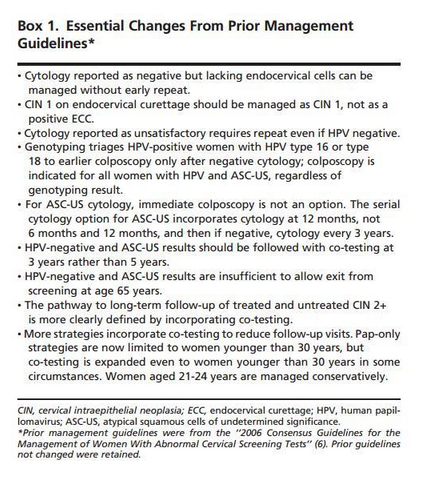
I’m not even going to try to spell out everything in the guidelines, which come from the American Society of Colposcopy and Cervical Pathology (ASCCP), except to say that they represent further movement away from aggressive screening and treatment of pap smear abnormalities, especially in younger women, in whom treatment carries small but real childbearing risks. The guidelines are increasingly reliant upon HPV testing to determine who and how often to screen, and when to treat.  They also acknowledge the role of testing for HPV 16 and 18 as a way to be sure that those women with adenocarcinoma of the cervix (which is less likely to show up as cancer on a pap smear) are identified and treated.

From the guidelines-
Continue reading…

Health Insurance is Wasted on the Young

By KELLY WOOTEN

There has never been a time in my life when I’ve owed a lot of money. That certainly has changed these past two years as my husband and myself find ourselves with medical debt that we may never pay off . As you can guess, we have no health insurance – we can’t afford it and even if we did have an extra $650 a month we couldn’t obtain it due to our pre-existing conditions.

Briefly, I had emergency surgery to remove a cyst on my ovary in 2010, a diagnosis of an auto-immune disease in 2011 and two bladder cancer surgeries in 2012. My husband has had high blood pressure for over 25 years due to a heart defect discovered in his 30’s.

My husband and I live very simple lives and have little debt. For the past 18 years we’ve been self-employed, owning a retail music store, and for many of those years I worked for other companies. Some offered medical coverage, some did not. And for some of those years I was able to offer medical coverage for our few employees which also covered my husband and myself. The group coverage was minimal and started out being affordable but with increases it was impossible to afford for long. I tried catastrophic coverage but that was almost as expensive as regular coverage but with a higher deductible. Of course, neither my husband nor I needed the coverage when we had it! They say youth is wasted on the young. I say health insurance is wasted on the young!

Continue reading…

Live From the Garage

By ROB LAMBERTS

Hi.  It’s me again.  No, I’ve been doing fine; my writing slow-down is not due to calamity, catastrophe, apostrophe, or even syndactyly.  I’ve been working hard, working like a dog.
So, what’s been so all-consuming that I can’t sit down and write? My computer system. I know it may sound nerdy and lame, but I’ve been putting every ounce of my creative energy into building a system. It’s driven by two main things: trying to give the best care I can, and doing so while avoiding personal bankruptcy. Fear of the latter is strong motivation. So I’ve been pouring myself into this task like nothing I’ve done before. My goal is to build a system that will:

1. Organize information. My care will only be as good as the information I have. It should be presented in a way that gives me just the right amount of information, with the ability to get more when I need it.
2. Cope with the flood of incoming information. Take the piles of communications coming in and route it to the proper storage place, use the information to make decisions, communicate it with the patients, and decide on follow-up. This is an enormously difficult task.
3. Integrate with every communication tool possible. Most doctors don’t do this because they rely on office visits for income, and that hinders the care they give. Communication is care, and I want to have good communication that is enlightened by good information.
4. Create a shared medical record with my patients. I am convinced that my patients will get the best care if they have access to their information. But this needs to be done in a way that is both simple and secure. I want “one stop shopping” for people to communicate or look at their records.
5. Keep my books. I don’t want to go bankrupt and don’t want to go to jail for keeping disorganized books. It’s possible to get freed from the fear of Medicare audits, but not from IRS audits.
6. Organize the future. There are far too many missed opportunities for care. Integrated task-management (shared between patient and their care team) is my goal.
7. Grow with me. If I accomplish 1-6, my practice will grow. I don’t want that growth to outpace my system.

So far I’ve been focusing on 1, 2, and 5, with eyes on the rest. I’ve made great progress, but there’s much more needing to be done. My ultimate goal of this is to build working prototypes of both this practice model and the software that will enable it to be more than just a side-show, an alternative for doctors who want to escape. I believe that this is truly better care. It is focused on what the patient wants: to be healthy and to spend as little time thinking about their health care as possible. It’s working so far, but it can be much more than it is now.

Continue reading…

Paying Physicians for Quality: Lessons from Employers

By BILL KRAMER

The House Committee on Energy and Commerce Subcommittee on Health recently held hearings on how to replace the broken sustainable growth rate (SGR) tool for controlling Medicare spending on physician services. I was asked to speak for major employers about their efforts to improve health care quality while containing cost.

Why did the subcommittee invite a business group representative to testify? And why should businesses care about how Medicare pays physicians?

The answer is that employers and the federal government are both major purchasers of health care, and we want government to look to the private sector for ideas to accelerate innovation in how we pay for care. Both public and private purchasers have a stake in building a system based on innovation, value, and measuring what matters.

The Pacific Business Group on Health’s (PBGH) 60 member companies provide health care to 10 million employees and their dependents in all 50 states. For decades, large and small employers alike have been frustrated by the rising costs and inconsistent quality of health care. A major reason for these problems is that the current payment system rewards physicians for more office visits, tests, and procedures, regardless of whether they are needed or result in better health. We need a better, more effective method of physician payment. PBGH members have real-world experience designing and implementing innovations in how providers deliver care and how they are paid for it. Medicare can learn from these efforts to improve quality and control costs.
Continue reading…

The Real Problem with Board Exams-and How to Solve It

By SHIV GAGLANI

This week there’s been a debate brewing about why so many young doctors are failing their board exams. On one side John Schumann writes that young clinicians may not have the time or study habits to engage in lifelong learning, so they default to “lifelong googling.” On the other, David Shaywitz blames the tests themselves as being outmoded rites of passage administered by guild-like medical societies. He poses the question: Are young doctors failing their boards, or are we failing them?

The answer is: (C) All of the above.

I can say this with high confidence because as a young doctor-in-training who just completed my second year of medical school, I’ve become pretty good at answering test questions. Well before our White Coat Ceremonies, medical students have been honed into lean, mean, test-taking machines by a series of now-distant acronyms: AP, SAT, ACT, MCAT. Looming ahead are even more acronyms, only these are slightly longer and significantly more expensive: NBME, COMLEX, USMLE, ABIM. Even though their letters and demographics differ, what each of these acronyms share is the ability to ideologically divide a room in less time than Limbaugh.

This controversy directly results from the clear dichotomy* between the theory behind the exams and their practical consequences. In theory these exams do serve necessary and even agreeable purposes, including:

1)     Ensuring a minimum body of knowledge or skill before advancing a student to the next level in her education,

2)     Providing an “objective” measure to compare applicants in situations where demand for positions exceeds supply.

So apart from the common, albeit inconvenient, side effects that students experience (fatigue, irritability, proctalgia), what are the problems with these tests in practice? These are five of the core issues that are cited as the basis for reformations to our current examination model:

1)     Lack of objectivity. Tests are created by humans and thus are inherently biased. While they aim to assess a broad base of knowledge or skills, performance can be underestimated not due to a lack of this base but due to issues with the testing format, such as duration, question types, and scoring procedure (e.g. the SAT penalizes guessers, whereas the ACT does not). Just as our current model of clinical trial testing is antithetical to personalized medicine (What is a standard dose? Or, more puzzlingly, a standard patient?), our current model of testing does not take into account these individual differences.

Continue reading…

What the EMR Saw

By COUNTRY DOCTOR

Lately, my virtual inbox in our electronic medical record has seen a surge in requests for prescriptions for the vaccine against Herpes Zoster, shingles. This has made me think a lot about our responsibility as physicians to inform patients about the evidence behind our recommendations – but who informs the patients when doctors are kept out of the loop or put under pressure to prescribe without seeing the patient?

What has happened is that our local Rite-Aid Pharmacy started to give these shots, covered by many insurers, but still requiring a doctor’s prescription.

I cannot give the shots in my clinic, because as a Federally Qualified Health Center, we are reimbursed at a fixed rate. The shingles vaccine costs more for us to buy than we charge for an entire office visit. I used to have the discussion about the shot, and would give patients a prescription to take to the pharmacy if they wanted it.

The pharmacy can give the shot at a profit, because it is considered a medication, just like a bottle of Lipitor.

The new system creates a bit of a dilemma for me. I get a message through the pharmacy that the patient wants the shot, and I don’t have the opportunity to sit down and review the effectiveness, side effects and long-term efficacy according to the available evidence with the patient.

For example, the shingles vaccine only cuts the risk of getting shingles in half. This is about the same effectiveness as the flu vaccine, but far less than, say, the vaccine against smallpox, which has now been eradicated.

Most patients are very surprised to hear about the 50% efficacy when I catch up with them at some later date; so many health care interventions are portrayed as both completely effective and absolutely necessary.

I see my role as a primary care physician as a guide and resource for patients, who are bombarded with overly optimistic claims and recommendations by mass media, drug companies and retailers.

Continue reading…

Are Young Doctors Failing Their Boards? Or Are We Failing Them?

By DAVID SHAYWITZ

A short piece in The Health Care Blog  reveals (albeit unintentionally) why so many outside of healthcare think the medical establishment still doesn’t get it.

The post, written by a general internist and residency program director, asked why an increasing number of internal medicine doctors are failing their internal medicine board exams.  The pass rate has reportedly declined over the last several years from 90% to 84%.  (Disclosure: I passed this required test about a decade ago.)

His differential included two possibilities:

(1)    The test is getting harder – The testing agency said this wasn’t the case.

(2)    Millennials lack the study habits of their elders, and have become great “looker-upers.” – The author suggested this was a key factor, and several commentators enthusiastically agreed.

The basic thesis here that in the Days of Giants, doctors worked harder, learned more, and were better.  Nowadays, doctors are relatively complacent, less invested, less informed, and are generally worse – which is what’s reflected on the board exams.

Let me suggest a third possibility – perhaps today’s doctors are providing better care to patients than their predecessors were a generation ago.  Maybe today’s doctors have figured out that in our information age, your ability to regurgitate information is less important than your ability to access data and intelligently process it.  Maybe what makes you a truly effective doctor isn’t your ability to assert dominance by the sheer number of facts you’ve amassed, but rather how well you are able to lead a care team, and ensure each patient receives the best care possible.

In other words, what if the problem isn’t the doctors, who are appropriately adapting, but rather the tests (and the medical establishment), which may not be?

Continue reading…

Can a Portable Hand Sanitizer System Reduce Hospital-Acquired Infections in America’s Hospitals?

By MIKE MIESEN


Ignaz Semmelweiss was laughed out of his Viennese hospital when he suggested that physicians should wash their hands in between conducting an autopsy and delivering a baby.

150 years later, we know just how right he was, but hand sanitation compliance rates at hospitals still hover in the 30% to 50% range. This makes it easy for hospital-acquired infections (HAIs) such as MRSA and VRE to run rampant, a (literally) dirty, not-so-little, and not-so-secret reality for American patients.

A Healthbox-backed startup is trying to change that. SwipeSense, founded in 2012 by Northwestern University graduates Mert Iseri and Yuri Malina, is a system designed to improve sanitation practices in hospitals using portable hand sanitizers and wirelessly-collected data on their use.

The organization wants to help stem the tide of avoidable HAIs. Each year, about 100,000 Americans die from infections they contract during their time in the hospital – more than the number of Americans killed by guns, motor vehicles, and leukemiacombined. In addition to the direct human toll, HAIs cause patient length of stays to increase by 8.0 days in ICUs and 7.4 to 9.4days in acute care wards, taking up expensive capacity and preventing others from accessing needed hospital beds. They’re also expensive, causing an estimated $4.5 to $5.7 billion in excess costs.

Iseri and Malina were inspired to create SwipeSense by a project they did for Design for America, a student group created to catalyze social change using human-centered design (also founded by Iseri and Malina). It took them to Northwestern Memorial University Hospital in their college town of Evanston, Illinois, where they identified two salient issues with hand sanitation: convenience and compliance.

“It’s obvious it’s not the fault of the nurse or physician…it’s something wrong with the system,” Malina told me in an interview. Even though alcohol foam and soap dispensers are ubiquitous in American hospitals, they often aren’t at the immediate point of care: “medical staff need to sanitize four or five times per patient encounter,” Malina said, making proper sanitation an arduous, time-consuming, and unrealistic task. “Our philosophy at SwipeSense is that the right thing to do should be the easiest thing to do… We want to make something that people love.”

Continue reading…

Why Are So Many Younger Doctors Failing Their Boards?

By JOHN SCHUMANN

An interesting conversation recently took place among residency program directors in my field of Internal Medicine.

At issue was the declining pass rate of first-time test takers of the ABIM Certification Exam.

It’s a mouthful to say, but the ABIM exam is the ultimate accolade for internists; one is only eligible to take the exam after having successfully completed a three-year residency training period (the part that includes “internship,” right after medical school).

An easy analogy is to say that the board exam is for a doctor what the bar exam is for a lawyer. The difference is that a doctor can still practice if s/he does not pass–they might be excluded from certain jobs or hospital staffs; but certification, while important, is a bit of gilding the lily. [Licensure to practice comes from a different set of exams.]

There’s no doubt it’s a hard test. I was tremendously relieved to have passed it on my first try. Over the last few years, the pass rate for first time takers has fallen from ~90% to a low of 84%.

It may not seem significant, but for 7300 annual test takers, the difference in pass rates affects about 365 people–or one additional non-passing doctor for every day of the year.

In any event, we program directors have taken note. And the falling pass rate has raised questions:

  • Has the test increased in difficulty? No, says the ABIM.
  • Are the study habits of millennials not up to the level of Baby Boomers and Gen X’ers? Now you may be on to something.

Continue reading…

Getting Back to Normal

By ALLEN FRANCES

We have become a pill popping society. It makes absolutely no sense that twenty percent of our population regularly uses a psychotropic medicine and that the United States has more deaths each year from overdose with prescription drugs than from street drugs.

The causes of excessive medication use are numerous- the diagnostic system is too loose; some doctors are trigger happy in their prescribing habits; the drug companies have sold a misleading bill of goods that all life’s problems are mental disorders requiring a pill solution; and the insurance companies make the mistake of encouraging quick diagnosis on the first visit.

My purpose here is to advise individuals on how best to deal with the risks of overdiagnosis and overtreatment.

Elsewhere I have suggested the things government needs to do. A diagnosis, if accurate, can be the turning point to a much better life. A diagnosis, if inaccurate, can haunt you (perhaps for life) with unnecessary treatments and stigma.

Spend at least as much effort ensuring you have the right diagnosis as you would in buying a house. Become a fully informed consumer, ask lots of questions, and expect clear and convincing answers from any clinician who offers a diagnosis and recommends a treatment. If the diagnosis doesn’t seem to fit, get second or third opinions.

Never accept medication after receiving only a brief diagnostic evaluation, especially if it has been done by a primary care physician who may not be expert in psychiatry and may be too influenced by drug salesmen.

Don’t believe drug company advertisements that end with, ‘Ask your doctor.’ Drug companies profit if they can convince you that you have a psychiatric disorder and need medication. They portray the expectable problems of everyday life as mental illnesses due to a chemical imbalance because this sells pills and makes money- not to help you.

Continue reading…

