Categories

Category: Medical Practice

Still Demanding Medical Excellence

Michael Millenson

By MICHAEL L. MILLENSON

Forget for a moment the familiar scenes of action and outraged reaction that are playing out in our long-running national debate over how best to provide access to health care for every American. Instead, ask one simple question: what happens in the doctor’s office or hospital once access is achieved.

I set out to write a book addressing that question almost twenty years ago. I thought myself well qualified: I’d written about health care for a decade for the Chicago Tribune while receiving various awards and other recognition. But it didn’t take long for a painful realization to set in of how naïve I really was.

Digging through hundreds of studies, articles and other first-hand sources stretching back for decades, I was stunned to discover that repeated evidence of unsafe, ineffective, wasteful and downright random care had had no effect whatsoever on how doctors treated patients. Literally none. Moreover, the few professionals who understood this truth couldn’t talk about it in public without endangering their careers or engendering vitriol from peers.

Fortunately, I had no academic or clinical career to imperil. In the conclusion to Demanding Medical Excellence: Doctors and Accountability in the Information Age, I gave vent to anger and indignation. I wrote:

From ulcers to urinary tract infections, tonsils to organ transplants, back pain to breast cancer, asthma to arteriosclerosis, the evidence is irrefutable. Tens of thousands of patients have died or been injured year after year because readily available information was not used ­– and is not being used today – to guide their care. If one counts the lives lost to preventable medical mistakes, the toll reaches the hundreds of thousands.

The only barrier to saving these lives is the willingness of doctors and hospital administrators to change.

Demanding Medical Excellence came out in October, 1997. What progress has been made since then, and where we have fallen short? I address that question in a short article, “The Long Wait for Medical Excellence,” in the October, 2013 issue of Health Affairs. The purpose of this blog entry is to recap some of what’s said there (for you non-subscribers) and to add a few impolite observations that don’t jibe with the rules of a peer-reviewed journal.

Continue reading…

HealthcareDIY: An Old Idea Made New

By JANE SARASOHN-KAHN

My wisest and longest-time friend in health care, Jane Sarasohn-Kahn has a new project, new research and a new website called HealthcareDIY out today. I encourage all of you to look around her new site and consider the stories she is telling, as they matter to all of us.–Matthew Holt

We’re DIY’ing home renovations, photo development, music playlists, personal financial management, and travel reservations. Increasingly, we’re also DIY’ing health. Think: Maker Faire-Meets-Health.

My thinking about HealthcareDIY was first inspired by my mother Polly, who died 34 years ago this month. She was my first role model for an engaged patient. When she was diagnosed with Hodgkins lymphoma in 1971, there was no internet for her to tap into for a patient network, a clinical trial, or a directory of oncologists or centers of excellence that were Top Doctors for treating the condition.

Polly did, however, absorb the books of Adelle Davis and her Let’s Get Well series on nutrition and health. Polly’s good friend, a librarian with whom she worked, tapped into the Index Medicus on her behalf and retrieved abstracts of articles on blood cancers that he printed out from the microfiche. Polly partnered with her doctor, an internist with a keen interest in hematology, for her care. She also had a huge and diverse social network (offline, of course) that surrounded her with a whole lot of love. Her M.O. was informed by Dr. Bernie Siegel, who started Exceptional Cancer Patients in 1978 and evangelized about patient engagement, living fully with cancer, and dying in peace, which she did, in October 1979.

Among many legacies Polly left me was her can-do attitude when faced with a six-month-prognosis upon diagnosis with Hodgkin’s. Mom worked full-time until the last two years of her life, wore beautifully tailored clothes and put on lipstick every day, and project-managed her health through eight years of treatment: primarily, radiation and blood transfusions. Polly figured out how to take control where she could, and she did it with grace, humor and sheer human will.

She DIY’d her health given the resources she had at-hand between 1971 and 1979: books, cassette tapes, in-person support groups, medical journals in print, a specialist and internist, and lots of love.

In the three decades since Polly’s death, two seismic forces have structurally changed consumers in America: the Great Recession beginning in December 2007, and the near-universal use of the internet in health. Ogilvy’s report, Eyes Wide Open, Wallet Half Shut, found two countervailing forces re-shaping U.S. consumers: re-trenching and re-imagining. On the retrenching side of behavior, people began to do more binging: in media consumption, drinking, and eating.

On the re-imagining front, some people looked to re-invent themselves, reconnect with others, and re-train to re-tool careers. This group of people has sought to be more active and more deliberate, and accept more complexity in daily living. These people are more mindful, more frugal, and open to trading down. 9 in 10 use coupons, shop at discount stores, and buy more store brands and generics.

For this latter group, Ogilvy said, “Self Reliance is the new insurance policy,” with a group ethos believing that, “Americans need to be strong, get their house in order, and protect themselves,” per the report.

That’s where HealthcareDIY comes into play.Continue reading…

The Next Great Cure? A Cancer Doctor Explains Why He Supports the Affordable Care Act

By JAMES SALWITZ

What do Louis Pasteur, Jonas Salk, Sigmund Freud and Barack Obama have in common?  They all championed controversial medical revolutions and if not for their bravery in the face of conflict, billions would have died.

Sterilize instruments to kill invisible bugs? Inject disease particles to build immunity?  Look into our subconscious to explain everyday behavior?  Give basic healthcare to everyone?  Ludicrous.  That is why we named these advances after these men.

As an oncologist who has seen the fatal cost of our patchy, imbalanced and unfair healthcare system, I have to be at very least hopeful about ObamaCare; AKA the Affordable Care Act (ACA).  The list of benefits is so vast that whatever glitches happen along the way, I know that cancer patients will be helped:

-No pre-existing condition exclusion: So the 31-year-old programmer with Stage 1 breast cancer can change jobs without losing insurance.

-Healthcare coverage by parents until their child is 26: So families will not lose their homes paying for Hodgkin’ s disease in a 22-year-old.

-Guaranteed payment by insurers for patients entering experimental trials: So patients with any insurance can be involved in research, and everyone benefits from the latest advances.

-Free healthcare screening: So that my 58-year-old neighbor with a family history of colon cancer gets routine exams and life saving colonoscopies.

-Uniform healthcare insurance standards: So that the 45-year-old man with stomach lymphoma I saw last week, does not have to suffer and die because his employer brought a health policy, which excluded chemotherapy.

Continue reading…

With CDC Seasonal Flu Data Unavailable, An Electronic Medical Record Offers a Glimpse of Early Activity Levels

By IYUE SUNG

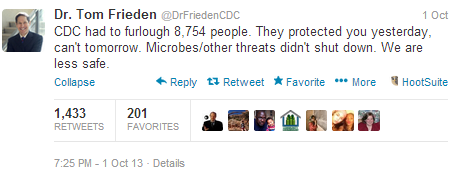
As Washington remains deadlocked on the implementation of the Affordable Care Act, the US government’s shutdown has resulted in the furlough of nearly 70% of the Centers for Disease Control‘s (CDC’s) workforce. CDC Director Tom Frieden recently shared his thoughts in a tweet. We agree whole-heartedly.  Although it’s all too easy to take the CDC staff for granted, they are the frontline sentinels (and the gold standard) for monitoring disease outbreaks.  Their ramp-down could have serious public health consequences.
We are particularly concerned about the apparent temporary discontinuation of the CDC’s flu surveillance program, which normally provides weekly reports on flu activity. Although flu season typically begins in late fall, outbreaks have occurred earlier in previous years. In 2009, flu cases started accumulating in late summer/early fall.  And given the potential for unique variants, such as the swine or avian flu, every season is unpredictable, making the need for regular CDC flu reports essential. We therefore hope to see the CDC restored to full capacity as soon as possible.

In the meantime, we would like to help by sharing data we have on communicable diseases, starting with the flu.

Because the athenahealth database is built on a single-instance, cloud-based architecture, we have the ability to report data in real time. As we have described in earlier posts, the physicians we serve are dispersed around the country with good statistical representation across practice types and sizes.


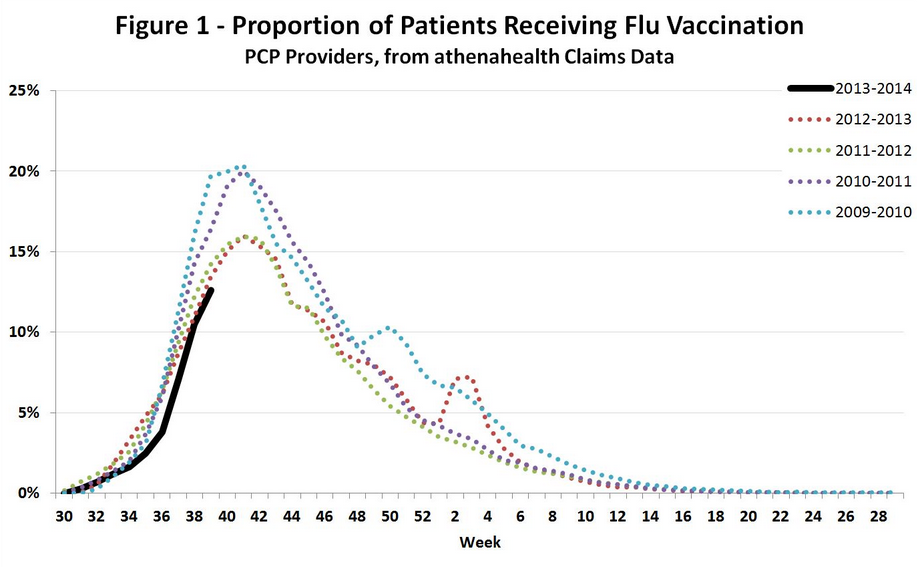
To get a read on influenza vaccination rates so far this season, we looked at more than two million patients who visited a primary care provider between August 1 and September 28, 2013 (Figure 1).  We did not include data on vaccinations provided at retail clinics, schools or workplaces.

This year’s rates are trending in parallel to rates over the last four years, and slightly below those of the 2012-2013 season. However, immunizations accelerate when the CDC, and consequently the media, announce disease outbreaks and mount public awareness campaigns.

Continue reading…

Who Knew That Blood, Sweat and Tears Could Start a Health Care Revolution?

By PETER H. DIAMANDIS

The staid world of diagnostic testing is about to undergo a major disruption with huge advances in sensors and sensing technologies that live in or on our bodies, within our homes and offices, and even within our computers and networks.

Today we’re witnessing a massive shift in who will collect and control diagnostic and other health information. For the first time, as people and patients, we will have control over what we measure, when we measure it, and who has access to our personal data. This is made possible by a new generation of revolutionary biosensors that contain the power of clinical lab instruments in packages that are light, small, wireless and highly efficient.

This is a new world of sensors: they can be body-attached, monitor our immediate personal environment, or even work as pure software apps that extrapolate data from our health records. Using simple, non-invasive methods to take samples of tiny amounts of blood, traces of skin tissue, breath droplets or an image of the inner eye are just some of the new methods emerging. It is exciting to consider that several of these multifunctional sensors, working in concert with powerful mobile handhelds, offer us extraordinary data collection and diagnostic tool sets that will put us in touch with our health in ways never imagined before.

These advances in health sensing, available any time and anywhere, are game changing. A continuous stream of personalized health data will transform how doctors interact with their patients to address and solve health challenges. More importantly, it puts patients at the center of the care process. Personalized data means that specific therapies or drugs will be more effectively delivered and controlled, allowing doctors to fine-tune treatments and watch incremental physiological changes as they occur.

This technology will also disrupt the clinical diagnostics business by moving testing from specialized (and expensive) labs to pharmacies and then ultimately to our homes.

Continue reading…

My Worst Night as a Doctor

By ROB LAMBERTS

My worst night as a doctor was during my residency.  I was working the pediatric ICU and admitted a young teenager who had tried to kill herself.  Well, she didn’t really try to kill herself; she took a handful of Tylenol (acetaminophen) because some other girls had teased her.

On that night I watched as she went from a frightened girl who carried on a conversation, through agitation and into coma, and finally to death by morning.  We did everything we could to keep her alive, but without a liver there is no chance of survival.

Over ten years later, I was called to the emergency room for a girl who was nauseated and a little confused, with elevated liver tests.  I told the ER doctor to check an acetaminophen level and, sadly, it was elevated.  She too had taken a handful of acetaminophen at an earlier time.  She too was lucid and scared at the start of the evening.  The last I saw of her was on the next day before she was sent to a specialty hospital for a liver transplant.  I got the call later that next day with the bad news: she died.

The saddest thing about both of these kids is that they both thought they were safe.  The handful of pills was a gesture, not meant to harm themselves.  They were like most people; they didn’t know that this medication that is ubiquitous and reportedly safe can be so deadly.  But when they finally learned this, it was too late.  They are both dead.  Suicides?  Technically, but not in reality.

For these children the problem was that symptoms of toxicity may not show up until it is too late.  People often get nausea and vomiting with acute overdose, but if the treatment isn’t initiated within 8-10 hours, the risk of going to liver failure is high.  Once enough time passes, it is rare that the person can be cured without liver transplant.

According to a recent ProPublica investigation, acetaminophen overdose is the #1 cause of liver failure in the US. And  between years of 2001 and 2010, 1567 people in the U.S. were reported to have died by accidentally overdosing.

Continue reading…

After the Navy Yard Shooting: A Call to Action On Mental Illness

By JEFFREY A. LIEBERMAN


The Navy Yard shooting in Washington, D.C. has once again confronted us with the issues of guns and mental illness, but what we really should address is the inadequacy of mental health care in the United States. Since 2009 there have been 21 mass shootings and the perpetrators in over half of these were suffering from or suspected to have a serious mental illness like schizophrenia, bipolar disorder and depression. (The other killers with no signs of mental illness were ideological zealots, disgruntled employees and disaffected loners.)

After each incident there is a great hue and cry, and calls for action but no substantive action is taken. Our reflexive approach has repeatedly failed to provide care in a timely fashion to individuals in need. As a country, we continue to ignore the growing public health need for greater access and a more proactive approach to mental health care. It is time that we say enough is enough and do something to prevent future tragedies.

When you strip away the hype and politics, the causal factors in these horrific incidents are clear and solvable. Yet we’ve lacked the social and political will to fashion and apply the solution.

The plain truth of the matter is that we do not provide adequate services to the 26% of the U.S. population with mental illness. The scope of and access to mental health services available to most people are limited and fragmented. Moreover, insurance coverage is all too often lacking and discriminatory. Consequently, we do not provide the level and quality of care of which physicians and health care providers are capable. It is the equivalent of knowing that a woman has breast cancer but not offering the indicated treatment options of surgery, radiation and chemotherapy. The result is that many people go untreated or inadequately treated.

Continue reading…

What Kind of Ancestor Will You Be?

By JACK COCHRAN

Is excellent good enough?

As physicians, we are trained to diagnose and treat disease. We dedicate ourselves to searching for cures and perfecting procedures that will restore the health of our patients. Over the last 50 years, we’ve made some remarkable progress. We’ve reduced the death rate from heart disease by 32.5% with a better understanding of primary and secondary prevention and advances in treatment. We’ve made similar progress in cancer care with better treatment options through radiation, surgery, chemotherapy, and genomics. We’ve changed an HIV diagnosis from a hopeless death sentence with limited treatment options to a manageable, chronic condition.

These truly excellent accomplishments in medicine have been life-changing for millions of people. But is excellent good enough?

While we have made great strides in clinical care, the American dream is faltering. Americans are more obese, more medicated and more in debt than at any other time in the history of our nation. One-third of our nation’s total health-care spending, about $750 billion per year, is wasted on unnecessary treatments, redundant tests, and uncoordinated care [1]. Health Care Reform will have limited impact on this waste. While the rate of increase of health care spending has slowed in recent years, the United States still spends 2.5 times more than most developed nations on health care [2]. U.S. health care spending is on track to reach $4.8 trillion in 2021, almost 20% of our gross domestic product [3].

Continue reading…

New Interventions Needed to Halt the Growth of “Superbugs”

By BRAD SPELLBERG

How do you tell the family members of a critically ill patient that their loved one is going to die because there are no antibiotics left to treat the patient’s infection?  In the 21st century, doctors are not supposed to have to say things like this to patients or their families.

Ever since the discovery of penicillin in 1940, patients have expected a pill or an intravenous injection to cure their infections. But our hubris as a society with respect to antibiotics has been exposed by the rise of antibiotic-resistant “superbugs.”

The Centers for Disease Control and Prevention (CDC) recently issued a new study, entitled “Antibiotic resistance threats in the United States, 2013,” reporting that at least 2 million people become infected with bacteria that are highly resistant to antibiotics and at least 23,000 people die each year as a direct result of these infections. These estimates are highly conservative.  Many more people die from other conditions that were complicated by an antibiotic-resistant infection.

Meantime, we have ever-decreasing new weapons to wage the war against such infections because the availability of new antibiotics is down by more than 90% since 1983.

Interventions are needed to encourage investment in new antibiotics, to prevent the infections in the first place, to slow the spread of resistance and to discover new ways to attack microbes without driving resistance.

A major reason for the “market failure” of antibiotics is that they are taken for short periods of time, so they have a lower return on investment than drugs that are taken for years (such as cholesterol-lowering drugs).  The Food and Drug Administration can help reverse the market failure by adopting new regulatory approaches to encourage development of critically needed new antibiotics.

Continue reading…

Why Can’t We Do Better Than This?

By HARLAN KRUMHOLZ

Is there a patient who goes through a hospitalization who does not have stories to tell about the obstacles, errors and indignities that they endured? I just wonder sometimes.

A family relative was hospitalized this week with a stroke at a hospital a few hours from me –and his experience left me demoralized about medicine.

Joe (not his real name) is an 82 year old grandfather, father, husband and one of a kind. He has a scraggly beard and ponytail. He possesses an artistic spirit, but is punctual to a fault – always early, never late. He has an integrity that is rare these days, which led to a loyal following in business and life. And yes, he is devoted to his family.

On Tuesday, he developed some difficulty with his balance. His wife of over 60 years was worried and brought him to the doctor.  That is when the issues began.

Issue #1. His doctor fit him into her schedule and recognized the possibility of the early signs of stroke and sent him for an MR imaging study of his brain. And she also gave him an aspirin, which he promptly took. The problem is that the MR study revealed a small bleed in his brain – and the last thing you want to give someone bleeding in his brain is an aspirin because it can cause more bleeding.

Issue #2. At one of the nation’s most reputable New England hospitals he was evaluated in the Emergency Department and admitted to the hospital. He is brought upstairs to the stroke ward fairly late and he is exhausted. Even later he is told that he must have a CT scan of the brain.

He is stable. His symptoms are not changed. Nevertheless, someone orders a CT scan. There was no discussion about whether he should have the scan with Joe’s family; they were told he needed to have one. After the scan, his family is told that the scan will not be read until the morning when the radiologist arrives. They push and are told that the technician looks at the scan and would let someone know if it looked abnormal.

They push a little more and ask that they speak to someone who is managing his case. A resident arrives and tells them that there is nothing alarming. The family asks if it will be compared with the scan from earlier in the day  (as that was the reason they took the scan 6 hours later) and are told that scan hasn’t been uploaded yet, even though it was with Joe’s records when he was in the Emergency Department.

They ask the resident to retrieve it from the emergency room and make the comparison. Finally they are told that the Radiologist in the ER reviewed it – but when they ask who reviewed it, they are not told a name.

Continue reading…