Categories

Category: Medical Practice

The ePrognosis App: How Calculating Life Expectancy Can Influence Healthcare Decision-Making

By LESLIE KERNISAN

Last month an intriguing new decision support app launched, created by experts in geriatrics and palliative care. It’s meant to help with an important primary care issue: cancer screening in older adults.

Have you ever asked yourself, when considering cancer screening for an older adult, whether the likely harms outweigh the likely benefits?

Maybe you have, maybe you haven’t. The sentence above, after all, is a bit of wonky formulation for the following underlying questions:

  • How long is this person likely to live, given age and health situation?
  • Given this person’s prognosis, does cancer screening make sense?

The first question seems like one that could easily occur to a person — whether that be a patient, a family member, or a clinician – although I suspect it doesn’t occur to people perhaps as often as it should.

As for the second question, I’m not sure how often it pops up in people’s minds, although it’s certainly very important to consider, given what we now know about the frequent harms of cancer screening in the elderly, and usually less frequent benefits.

Furthermore, there is abundant evidence that “inappropriate” cancer screening remains common. “Inappropriate” meaning the screening of people who are so unwell and/or old that they’re unlikely to live long enough to benefit from screening.

For instance, one astounding study found that 25% of physicians said they’d order colon cancer screening for an 80 year old with inoperable lung cancer. So it’s clear that improving the decision-making around cancer screening would help improve healthcare safety, quality, and value.

Continue reading…

Think You’re Young and Invincible? You’re Young, Yes. Invincible? Maybe Not.

By KATHLEEN REARDON

Life was getting underway the day I found a suspicious lump. My first book had just been published and was being received well in my field. I was traveling and speaking about a new research project. The phone kept ringing and there was little time to think.

I figured that was the reason why my weight was falling. It was one of those good side benefits of a busy schedule. Why worry about a pea-sized lump? Lots of women have those and they turn out to be nothing. Coincidentally, that was exactly what my gynecologist said it was: nothing but a cyst.

Two more visits to that doctor resulted in him telling me that, at my age and with my family history, there was nothing to worry about and I should get on with life. He refused my request for a mammogram, suggesting that I should relax. I gave relaxation a try until a friend told me, “You look bad. If you don’t go see your GP for another opinion, I’m not going to talk to you.” There were dark lines under my eyes and I was becoming tired and downright skinny. I took her advice. It was cancer.

When I read about young people declining to sign up for health insurance, I remember back to that time. Sure, it’s great to be young. One of the best things is thinking you have a long time before you need to worry about your body giving you major problems. And isn’t life a gamble anyway?

I’m sure many young people reason this way and to some extent they’re right. Having spent a significant part of my career studying how people reason about health, it’s no surprise to me that weighing the odds causes a good many of us to take risks.

Yet, there is no such thing as a “young invincible,” the term currently bandied about to describe adults under the age of 35.

It’s not their fault if the system is unresponsive when they attempt to learn their insurance options. But it is their responsibility, to themselves and their families, to make sure that if something does go wrong — as it often does — their insurance will afford them the care that could save their lives.

Continue reading…

Worldone+Sermo’s next steps

By MATTHEW HOLT

Worldone+Sermo is the combination created last year of physician research company Worldone Interactive and the physician community Sermo. Sermo was an early Health 2.0 favorite that somewhat lost its way with both its early business model and a dive into politics, but behind it was an interesting experiment in clinical crowdsourcing.

Peter Kirk is the CEO of the combined business and I spoke to him in advance of his appearance at Health 2.0 Europe today in London. What’s clear is that Sermo is both poised to expand internationally and going to grow as a serious platform for clinical exchanges among professionals Watch the interview above to learn much more.

And one charity Sermo is supporting, called Floating Doctors, is showing really innovative use of the platform to help patients in very remote regions get expert diagnoses. The second video is well worth watching and gives a great example of the iConsult product. And if you are in London today, Peter will tell you more!


The Statinization of America

Vik KhannaTom EmerickAl Lewis

By VIK KHANNA, TOM EMERICK, & AL LEWIS

On November 12, 2013, the American Heart Association (AHA) and the American College of Cardiology (ACC) disrupted the cardiovascular disease (CVD) universe by issuing four new guidelines.  The guidelines depart from past efforts because the relevant federal agency, the National Heart, Lung, and Blood Institute (NHBLI), did not lead development.  NHBLI now ‘sponsors’ guideline development, but has deferred actual writing and publication to private groups.

No word on when long-awaited companion blood pressure guidelines will emerge.  If the blood pressure guidelines look anything like these cholesterol guidelines, then all rational arguments about cost containment will effectively come unhinged.

The guideline release was well orchestrated, not unexpected in organizations so well-funded by the pharmaceutical companies.  They are the population that stands to benefit the most from what Alan Cassels, author of Selling Sickness and Seeking Sickness, which both seemed to anticipate moves like this, calls “statinization.” Fortunately, not everyone was drinking the “treatment today, treatment tomorrow, treatment forever” Kool-Aid; contrarian physicians believe that the guidelines simply lowered the therapeutic bar without clear evidence that doing so will improve outcomes, an ironic observation given that this is supposed to be about primary prevention.

The contrivance of simply altering a definition and having the subsequent area under the curve of healthy people who require treatment expand to include, oh, say 30 million more Americans is a merger-and-acquisition coup for pharma that would make Gordon Gekko blush.

Lowering the therapeutic bar will increase health care spending as physicians write more prescriptions and see more patients more often, certainly to monitor liver health, and probably for the side effects that cause double digit percentages of patients to stop and are routinely underreported in studies sponsored by the industry.

It also gives patients false security by promoting the belief that the heartily recommended drugs – statins – will provide a “cure,” a clinical get-out-of-jail-free card, which will surely diminish enthusiasm for lifestyle-based approaches to prevention that are free but unfortunately not reimbursable.  And, as Abramson and Redberg note in their New York Times essay, the enunciated strategy will require perpetual treatment of 140 people to forestall 1 heart attack.  Many of these people will now live long enough to experience “disease substitution,” allowing them to die of cancer or dementia.

The most important element of the new guidelines, however, is the shift away from pursuit of hard targets (get total cholesterol below 240 and LDL below 180) to a risk-based approach (for people without clinically evident disease), in which the therapeutic goal is to medicate non-diseased adults aged 40 to 75 who have an estimated 10 year risk of developing heart disease greater than 7.5% (down from 10% risk over 10 years).  Overall, this necessary and overdue shift properly emphasizes CVD risk as a constellation and exposes our cultural tendency to seek or initiate treatment because of a single adverse attribute, which has led us to waste a fortune chasing clinical ghosts.

Continue reading…

My Wife Has Cancer. I Need to Know: Will She Have Insurance On January 1st?

By TONY JEWELL

On February 16 of last year, I was in a New Orleans hotel room preparing for a meeting when my wife Becky called and said simply, “I have cancer.”

We knew it was possible, but that didn’t in any way lessen the impact of those three words.

I have cancer.

Everything that was right and comfortable was in that instant washed away by a million questions with no answers. At a time when we needed nothing more than certainty and clarity, there was only confusion and doubt.

Upon landing in Philadelphia hours later, I called to see how she was doing with her newly diagnosed breast cancer. Feeling numb, I managed to make one other call soon after landing. Not to friends. Not to family. Instead, it was to our insurance company.

That’s right: Other than my wife, the one person I most wanted to speak to in the world was a Cigna call center operator.

We hadn’t even had a chance to meet with her oncologist to discuss potential courses of treatment, but we had questions because we had recently changed our plan to carry higher out-of-pocket costs and lower deductibles. We needed answers to those questions so we could go about worrying about more important things.

What procedures are covered? Are the doctors at the cancer center in plan? What is the maximum out of pocket? What other limits should we know about?

A 15-minute conversation later, we were comfortable that insurance wouldn’t be an issue and had a decent understanding of what our share of the costs would be. At a time of absolute fear and confusion, our insurer provided a moment of comfort and clarity.

That is the kind of financial and emotional stress that millions of people face every day in the United States. That is also the kind of financial and emotional security the Affordable Care Act was supposed to provide — especially to those who currently lack health insurance. Continue reading…

When Is Closing an Ongoing Clinical Trial a Betrayal of Participants?

By CYNTHIA CHAUHAN & MARY LOU SMITH

We have become aware of several instances of precipitous and, in our view, egregious and unjustified closures of on-going clinical trials in which a substantial number of patients were already participating in investigational efforts, some involving biopsies for research purposes.

These closures raise serious ethical issues for the research community. We will discuss those issues and some possible changes in how trials are conducted to address the problem. It is our premise that closing on-going clinical trials without scientific, efficacy, or safety justification is an abhorrent affront to all participants in clinical research as well as a fundamental betrayal of the trust that motivates patient participants to enroll in clinical trials.

Cancer patients who accept the risk of an investigational drug are true partners in bringing new agents to market. They hope they will benefit but, regardless of personal benefit/response, they hope the researchers will learn something to help other patients. Patients participate in clinical research for multiple reasons but, particularly in the case of agreeing to undergo mandatory research biopsies, do so because the research has the potential to improve the care, treatment approach, and standards for cancer patients.

They engage in a relationship with researchers based on their trust in the integrity of the researchers and the system within which the researchers work. Any cavalier approach to the commitment patients make to research is indefensible and particularly reprehensible when participants undergo internal organ biopsies.

Violating the trust of these patients also violates the trust the patients place in the investigators, undermining patient confidence in and availability for research. That trust and any violation of it are deepened when the researcher is also a given patient’s treating oncologist.

It is with good reason that human beings who enroll in clinical trials are called participants, not subjects. A participant is one who takes part in something—an active, volitional partner or colleague. A subject is one, mouse or human, who is under the power or authority and at the incontestable will of another or others. That difference between a participant and a subject is significant and germane to this discussion of when and why it is or is not appropriate to close a clinical trial.

Continue reading…

New York’s Digital Health Revolution

By DAVID WHITLINGER

There’s a quiet revolution going on in New York State. While the national debate continues about Obamacare and how to reduce healthcare expenditures, New York has already taken action. Thanks to a significant investment in technology and operational capacity, New York State is building a digital network of electronic medical records that will literally transform how patient care is provided and deliver major cost savings.  It’s called the Statewide Health Information Network of New York or SHIN-NY.  And, it puts New York State far out ahead of all other states when it comes to Health IT.

In a tech-savvy world, consumers want healthcare to be as easy to manage as banking, shopping and all their other utilities. They want to be involved and proactive about their own health.  In fact, a recent survey indicated that 41% of consumers said they would switch doctors if theirs did not use electronic medical records.  Now, the SHIN-NY will give patients safe and secure access to all of their records, eliminating the hassle of faxing medical records between providers, remembering their health histories and keeping track of prescriptions.

Physicians and healthcare providers will be able to make better, more informed medical decisions for their patients.  They will be able to reduce medical errors, avoid potentially harmful drug interactions and avoid duplicative or unnecessary lab and radiology tests that can add excessive cost to patients and insurance providers. Importantly, it will allow doctors to collaborate so they can coordinate care for patients that have more than one condition and see multiple physicians.

Nowhere will this be more important than in the Medicare and Medicaid population.

Continue reading…

Hyperdiagnosis: The Wellness Industry Doubles Down on Overdiagnosis

Vik KhannaAl Lewis

By AL LEWIS & VIK KHANNA

By now we are all familiar with the concept of overdiagnosis, where “we” is defined as “the readers of THCB and a few other people whose healthcare literacy is high enough to know when not to seek testing and/or when not to automatically believe the test results.”

The rest of the country hasn’t gotten the memo that, quite counter-intuitively, many suspected clinical problems should simply be left alone.  Many insignificant conditions get overdiagnosed and subsequently overtreated, at considerable cost to the health plans and risk to the patient.

For more information on that we  refer you to the book Overdiagnosed.   The thesis of that book is that insured Americans are far more likely to be harmed by too much care than too little.

Rather than use its resources and influence with human resources departments to mitigate overdiagnosis, most workplace wellness companies have opted for the reverse, taking overdiagnosis to a level which, were they physicians billing the government for this work, could cost them their licenses and possibly their freedom.   Instead, they win awards for it.

We call this new plateau of clinical unreality “hyperdiagnosis,” and it is the wellness industry’s bread-and-butter.  It differs from overdiagnosis four ways:  It is pre-emptive.  It is either negligently inaccurate or purposefully deceptive.  It is powered by pay-or-play forfeitures.  The final hallmark of hyperdiagnosis is braggadocio – wellness companies love to announce how many sick people they find in their screens.

1. Pre-Emptive

Most cases of overdiagnosis start at the doctor’s office, when a patient arrives to join the physician in a generally good faith search for a solution to a manifest problem.  The patient comes in need of testing.   By contrast, in hyperdiagnosis, there is neither a qualified medical professional providing adult supervision nor good faith.  The testing comes in need of patients, via annual workplace screening of up to seventy different lab values.  Testing for large numbers of abnormalities on large numbers of people guarantees large numbers of “findings,” clinically significant or not.  It is a shell game that the wellness vendor cannot lose.

2.Inaccurate or Deceptive

Most of these findings turn out to be clinically insignificant, no surprise given that the US Preventive Services Task Force recommends annual screening only for blood pressure, because otherwise the potential harms of screening outweigh the benefits.  The wellness industry knows this, and they also know that the book Seeking Sickness:  Medical Screening and the Misguided Hunt for Diseasedemolishes their highly profitable screening business model.   (We are not cherry-picking titles here—there is no book Hey, I Have a Good Idea:  Let’s Hunt for Disease.)  And yet most wellness programs require annual screens to avoid a financial forfeiture.   This includes the four programs covered on THCB this year — CVS, Nebraska, British Petroleum, and Penn State.

Those four programs and most others also obsess with annual preventive doctor visits.  Like screening, though, annual “preventive” visits on balance cause more harm than good, according to academic and lay reports.  The wellness industry knows this as well.  We have posted it on their LinkedIn groups, and presumably they have also access to Google.  They addressed the data by banning us from their groups.

3. Pay-or-play forfeitures

Because of the lack of value, the inconvenience, and privacy concerns, most employees would not submit to a workplace screen if left to their own devices.  The wellness industry and their corporate customers “solve” that problem by tying large sums of money annually — $600 for hourly workers at CVS, $1200 at Penn State and $521 on average – to participation in these schemes.  Yet participation rates are still low.  At Penn State, for example, less than half of all employees got screened despite the large penalty.

Continue reading…

How Many Patients Did We Hurt Last Month? Learning (But Not Too Much) From The Best Hospitals

By ASHISH JHA

I was recently chastised by a colleague for being too negative in one of my pieces on hospital care. His is a remarkable story of what happens when things go well, and it has made me think a lot about why, in some places, things seem to work while in others, not so much.

He told me how a few months ago, soon after returning to Boston from a trip to China, he had started feeling short of breath. When his cardiologist convinced him to be evaluated, he found himself at the Beth Israel Deaconess Medical Center (BIDMC), arriving in the ER late one evening.  He was triaged within minutes, had an EKG within 15 minutes, at which time comparisons were made to previous EKGs.  After ruling out a heart attack, his ER physicians quickly ordered a CT Angiogram.

That test, completed within an hour of his initial arrival to the ER, revealed the reason for his shortness of breath:  he had a large saddle pulmonary embolus.  He was started immediately on IV heparin and sent quickly to the ICU, experiencing essentially no delay in care.  He spent three days there and reports receiving care that was attentive, expert, and consistently of the highest quality.  Even after discharge, he received two nursing visits at home to ensure he was doing OK.  In discussing his experience, he repeatedly emphasized the fantastic communication and teamwork that he witnessed.  Weeks after discharge, he continues to get better and feels the benefits of the excellent care he received.

This is the story we all hope for.  And when I heard it, I have to say that I wasn’t surprised.  There’s something about the BIDMC that’s unusual.  Of the 4,500 hospitals that report their mortality rates to Medicare’s Hospital Compare website, only 22 (less than 0.5%) have better than predicted  mortality rates for all three reported conditions:  heart attack, congestive heart failure, and pneumonia.  And, we know that the combined performance on these three conditions is remarkably good at predicting hospital-wide outcomes, including outcomes for pulmonary embolism.

If you are a patient and care deeply about good outcomes, BIDMC seems to be a good place for you.

So what’s so special about them?  What do they do that’s different?  I don’t know, specifically, all of their tactics, but I have some guesses about what seems to differentiate high performing institutions from the rest.  And in a word, it’s leadership.  BIDMC has had two CEOs over the past few years, and both of them have been unusually committed to achieving high quality care.  That commitment translates into real activities that make a big difference.  Let me divert us with a story of what this might actually mean.

A few years ago, I was working on a strategy for improving the quality and safety of VA healthcare.  As part of this effort, I called up senior quality leaders of major healthcare organizations across the nation.  One call is particularly memorable.  Because I promised anonymity, I will not name names but this clinical leader was very clear about his responsibility: every month, he met with his CEO, who began the meetings with three simple questions: “How many patients did we hurt last month? How many patients did we fail to help? And did we do better than the month before?”

The CEO and the entire hospital took responsibility for every preventable injury and death that occurred and the culture of the place was focused on one thing: getting better.  When I looked them up on Hospital Compare, they too had excellent outcomes and they regularly get “A” ratings for patient safety from the Leapfrog Group.

Continue reading…

So, You Need Knee Replacement Surgery…

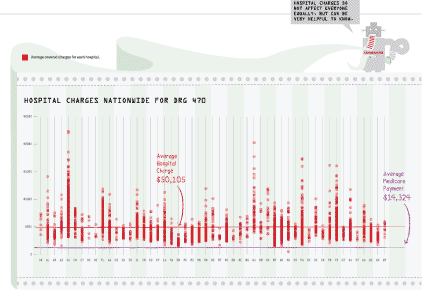
The Health 2.0 Developer Challenge team recently caught up with the 1st place winner of the RWJF Hospital Price Transparency Challenge (Static Visualization Category), Imaginary Office. Their winning submission, lead by Esther Chak and Mary-Jo Valentino, is an excellent visualization of recently released CMS charge data that helps consumers make a more informed decision when choosing a hospital to receive knee surgery.

Check out what they built and the thought process behind creating the winning submission!

HT: Tell us about Imaginary Office and your larger mission.

Imaginary Office (IO): Imaginary Office is a collaborative graphic design and communications studio founded by the two of us, Mary-Jo Valentino and Esther Chak. We design and develop print and web media for clients who need to communicate complex content — for example, the science behind ocean conservation, the feeling of a piece of classical music, or the effectiveness of public schools. We have been lucky to work with clients whose missions we support, from sustainable seafood, to clean water, to arts education.

HT: Why did you choose to participate in the RWJF Hospital Price Transparency Static Visualization Challenge?

IO: Our motivation to clarify some aspect of the healthcare or health insurance experience stems from a medical emergency that Mary-Jo had a few years ago. It was a wake-up call to both of us to take healthcare and insurance coverage more seriously. But, it’s not easy to understand—for us or for anyone, really.

As self-employed designers we had been following the healthcare reform journalism pretty closely. We clicked through many online articles and eventually stumbled upon a mention of the RWJF Challenge. That was the catalyst to realize an infographic that we had kept in the back of our minds since Mary-Jo’s medical emergency. The RWJF Challenge gave us an opportunity to develop the idea and share the outcome with an audience.

Continue reading…