This episode of the THCB Gang included regulars Grace Cordavano (@GraceCordovano) , Deven McGraw (@HealthPrivacy), Ian Morrison (@seccurve), and special guest patient entrepreneur Robin Farmanfarmaian (@Robinff3). We talked about patient experiences, the state of play in health care business, and about new technologies and more. And after tomorrow it gets preserved as a podcast on Itunes & Spotify Enjoy! – Matthew Holt
Health in 2 Point 00, Episode 137| $10M in Seed Rounds, AI & Chatbots, and a New Meditation App?
Today on Episode 137 of Health in 2 Point 00, Jess questions if “Jack in the Bean Stalk” is actually abut how VCs are growing into the health tech space. Listen to Jess’s take on the comparison as she asks me about Sprout getting $10M in a seed round to grow its Autism platform, Gyant securing $13.6M to improve its AI & Chatbot functions for providers, Meditopia receiving $15M for its medication app, Caption Health raising $53M to help people conduct ultrasounds, and Kind Body raising $32M for its fertility care platform. Enjoy! — Matthew Holt
Collective State Action Is Needed to Fight This Pandemic Right Now

By KEN TERRY
As COVID-19 cases soar across the country, the federal government has lost control of the situation. Amid the Trump Administration’s happy talk and outright dismissal of the crisis, the U.S. is experiencing a forest fire of contagion and hospitalizations, and an upsurge in COVID-related deaths has already begun.
Other countries like Taiwan, South Korea, Germany, Australia and New Zealand have controlled their outbreaks, which is why their COVID-19 infections and deaths have been minimal or trending downward in recent months. To replicate those nations’ strategies of testing, contact tracing and quarantining, the U.S. Congress would have to appropriate about $43.5 billion, according to one estimate. But as we know, Senate Republicans won’t pass such a bill without Donald Trump’s prior approval—and that’s unlikely as long as his main focus is on reopening the economy.
We can hope that electoral victory by the Democrats in November will change this equation, but Joe Biden won’t take office until January if he wins. Meanwhile, the coronavirus is chewing up America. We can’t afford to wait six months to blunt the impact of this horrible disease. However, there is a solution that doesn’t depend on federal leadership: states can form compacts that would form the basis for collective action to get us out of the trap we’re in.
Interstate compacts are very common in the U.S. Various pacts cover everything from clean water and clean air to medical licensure, mental health and interstate transportation. For example, under the Middle-Atlantic Forest Fire Protection Compact, which includes Ohio, West Virginia, Virginia, Pennsylvania, New Jersey, Delaware, and Maryland, member states assist one another in fire prevention and suppression and firefighter training.
Continue reading…Healthcare Should Get Into Some #GoodTrouble
By KIM BELLARD

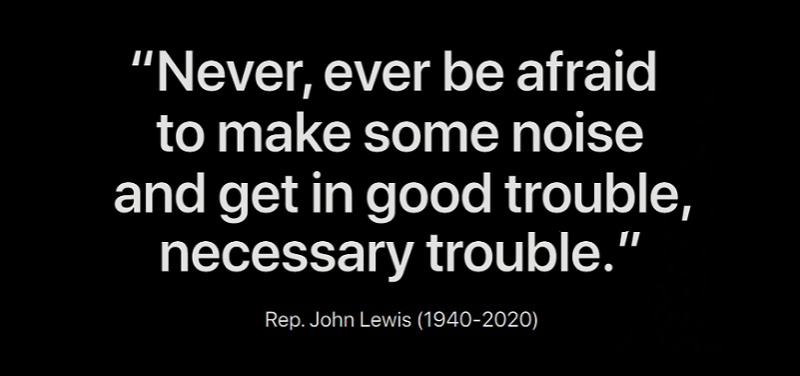
As hopefully most of you know, Rep. John Lewis, civil right icon and longtime member of Congress, died this past Friday. Rep. Lewis was often described the “conscience of Congress” – perhaps a low bar in today’s Congress but important nonetheless — for his unwavering commitment to social justice. I have always been struck in particular by one of his quotes:

Rep. Lewis must have been heartened by the fact that, in 2020, plenty of people are, indeed, making noise and getting into good trouble, necessary trouble over issues that he cared deeply about, like Black Lives Matter and voting rights. There are others who are better able to write about those people and that trouble. So I’d like to talk about his call to action with respect to healthcare.
If you are working today in healthcare — especially in the United States — or, for that matter, someone getting healthcare or having a loved one get it, then you should be making some noise and getting into good trouble, because our healthcare system most definitely makes it necessary.
It should come as no surprise that we’re not very happy with our healthcare system, rating it lower than do citizens in most other developed countries. And for good reason: it’s the world’s most expensive while delivering sub-par health results and leaving tens of millions without financial protection. Even our physicians don’t like it. Even our latest, best effort for improving the sorry state of our healthcare system — the Affordable Care Act – is under risk of repeal due to a lawsuit brought by 18 states and backed by the Trump Administration.
Every day, too many of us suffer in the healthcare system, ranging from waits to indignities to critical mistakes, and some face financial ruin due to the care — whether good or bad. Most of us suffer in silence, or only complain to our friends and family. We don’t see a lot of mass protests about the pitiful state of our healthcare system, and I have to wonder why.
We have to stop being so passive.
Continue reading…Everyone has a role to play: Reducing your child’s risk of developing food allergies
By RUCHI GUPTA

The average American elementary school class includes two students living with one or multiple food allergies. That’s nearly six million children in the United States alone. And these numbers are climbing. There was a staggering 377 percent increase in medical claims with diagnoses of anaphylactic food reactions between 2007 and 2016, two-thirds of these were children.
As parents, we want the absolute best for our children. For many years, guidance around food introduction was unclear. Parents were told that babies, and especially those considered at risk for food allergies, should avoid some allergy-causing foods such as peanuts until they were three years old.
But thanks to ongoing research from our nation’s top allergists and immunologists, we are beginning to learn more and more about food allergies, including what new and expecting parents can do to reduce the risk of their children developing food allergies. In fact, studies now show that introducing a variety of foods early is the best course of action and has been shown to reduce the occurrence of certain food allergies like peanuts for many children.
For instance, the partially FARE-funded Learning Early About Peanut Allergy (LEAP) study showed a remarkable 80 percent reduction in peanut food allergies in high-risk infants who were exposed to peanut foods at a young age. Shortly after LEAP, there was the Enquiring About Tolerance, or EAT, study. This project, led by top medical researchers at Kings College London, found significant reductions in allergies to both peanut and egg after introducing small amounts of the foods into infants’ diets. The LEAP-on study soon followed, and had the same children from the original LEAP study remove peanut from their diets for 12-months. The results showed that they maintained their tolerance to peanut, indicating early introduction to babies can result in long-lasting protection from peanut allergy.
Continue reading…The Trump COVID Legacy: Bad Timing. Lots of Questions. Few Answers.
By MIKE MAGEE
What a strange irony. Trump decides, full-bravado, to challenge China to a trade war just months before China unwittingly hatches a virulent pandemic that collapses our deeply segmented health care system and our economy simultaneously. And rather than cry “Uncle”, our President then fires the WHO just as their experts are heading to China to attempt to unravel the mystery of COVID-19.
With the ongoing, cascading catastrophe of Trump’s mishandling of COVID-19, it is easy to lose sight that the next pandemic (fueled by global warming, global trade, and human and animal migration) is just around the corner. And we haven’t even begun to nail down the origin story of this one.
Unraveling the transmission trail requires international cooperation. As one expert recently noted, “Origin riddles for other new infectious diseases often took years to solve, and the route to answers has involved wrong turns, surprising twists, technological advances, lawsuits, allegations of cover-ups, and high-level politics.”
What we do know is that there are originators, intermediate hosts, and human super-spreaders….and COVID-19 appears to have begun in China. These are not new insights. We’ve seen this playbook before.
Continue reading…The 2020 Pandemic Election
The 2020 US election will be vicious, with a nasty pandemonium following a nasty pandemic.

By SAURABH JHA
When the COVID-19 pandemic is dissected in the 2020 presidential election debates, Donald Trump will be at a disadvantage. The coronavirus has killed over 100,000 Americans and maimed thousands more. The caveat is that deaths per capita, rather than total deaths, better measure national failure, and by that metric the US fares better than Belgium, Italy and the United Kingdom. New York City owns a disproportionate share of the deaths, but this hyperconnected megapolis is an outlier whose misfortunes can’t be used to draw conclusions about administrative competence for the country as a whole.
Nevertheless, even after introducing nuance, the numbers aren’t flattering. President Donald Trump may claim that the US dodged the calamity predicted by the epidemiological models, which foretold millions of deaths. To be fair, we don’t know the counterfactual — Jeremiads aren’t verifiable. The paradox of successful mitigation is that we can’t see the future we dodged, precisely because we avoided it.
Reducing the death count logarithmically, rather than merely arithmetically, won’t be celebrated because as bad as the worst case scenario could have been, the situation still looks awfully bad. Many still disbelieve the high death toll predicted by epidemiologists early on, particularly Trump supporters who believe the response to the virus, specifically the economic shutdown, has been criminally disproportionate. One can’t simultaneously believe that COVID-19 is no more dangerous than the seasonal flu and that Trump saved millions from the coronavirus. The constituency that acknowledges the lethality of COVID-19 and credits Trump for decisive action against it is small.
Triangle of Incompetence
Trump’s challenger, former Vice President Joe Biden, will charge that fewer Americans would have died had the Trump administration acted earlier. Trump may be accused of having blood on his hands, but such rhetoric is unnecessary. Biden’s team can simply show a montage of Trump’s bombast where he downplayed COVID-19’s lethality, dismissed doctors’ concerns about the shortage of personal protective equipment or exaggerated how well the US was containing the pandemic. Incidentally, the most iconic picture of the administration’s scornful indifference is the current vice president, Michael Pence, visiting a hospital without a mask, surrounded by health-care workers wearing masks.
Continue reading…We Are in Store for the Greatest Change to Our Health Care System Since the Affordable Care Act. Here’s Why.
By LOGAN CHO

The COVID-19 pandemic has been harsher and lasted longer than many of us would have predicted. While our media has been inundated with updates on death tolls and economic depression, there has been little conversation of healthcare beyond the era of COVID-19. The first question that we ask when we hear of deaths: was it COVID? We have grown to expect the primary cause of death to be of coronavirus. But the impact of COVID-19 will extend beyond the individual, effecting fundamental and long-lasting change to our healthcare system.
By this point, it is clear that the public health ramifications are reaching well beyond the physical impacts of the virus. Social isolation, economic depression, soaring unemployment, and mandated closures all contribute to the adversity that we have had to face – notwithstanding the explosive, ever-present sociopolitical climate of a pandemic that is killing Black Americans at a rate almost three times that of whites. This hardship will likely last for months more.
A recent Kaiser Family Foundation publication found that half of the public have skipped or postponed medical care due to the pandemic, with one-fourth reporting worse health as a result. Many of these people do not plan to receive the care they need within the next three months. The public is simultaneously reporting declines in mental health. Furthermore, over 30% say they have had difficulty paying for household expenses, like food, rent, and medications. The figures are disproportionately damning among Black and Hispanic populations.
Taken together, the inaccessibility of medical care, deteriorating mental health, increasing poverty, worsening access to nutrition, and host of other challenges present a dark, impending storm. Cancer, diabetes, and other chronic diseases will all be rearing their untreated heads post-pandemic. Communities and policymakers must therefore act quickly and decisively to heal not only a sick population, but a fraying social fabric.
Continue reading…A Conversation with John Ioannidis
By SAURABH JHA
The COVID-19 pandemic has been a testing time for the already testy academic discourse. Decisions have had to be made with partial information. Information has come in drizzles, showers and downpours. The velocity with which new information has arrived has outstripped our ability to make sense of it. On top of that, the science has been politicized in a polarized country with a polarizing president at its helm.
As the country awoke to an unprecedented economic lockdown in the middle of March, John Ioannidis, professor of epidemiology at Stanford University and one of the most cited physician scientists who practically invented “metaresearch”, questioned the lockdown and wondered if we might cause more harm than good in trying to control coronavirus. What would normally pass for skepticism in the midst of uncertainty of a novel virus became tinder in the social media outrage fire.
Ioannidis was likened to the discredited anti-vax doctor, Andrew Wakefield. His colleagues in epidemiology could barely contain their disgust, which ranged from visceral disappointment – the sort one feels when their gifted child has lost their way in college, to deep anger. He was accused of misunderstanding risk, misunderstanding statistics, and cherry picking data to prove his point.
The pushback was partly a testament to the stature of Ioannidis, whose skepticism could have weakened the resoluteness with which people complied with the lockdown. Some academics defended him, or rather defended the need for a contrarian voice like his. The conservative media lauded him.
In this pandemic, where we have learnt as much about ourselves as we have about the virus, understanding the pushback to Ioannidis is critical to understanding how academic discourse shapes public’s perception of public policy.
Continue reading…And We Thought Pandemics Were Bad
By KIM BELLARD
Those of us of a certain age, or anyone who loves classic movies, remember the famous scene in “The Graduate” when Benjamin Braddock is given what is intended as a helpful clue about the future. “Plastics,” one of his father’s friends says. “There’s a great future in plastics.”
Well, we’re living in that future, and it’s not all that rosy. Plastics have, indeed, become an integral part of our world, giving billions of us products that we could never otherwise have or afford. But our future is going to increasingly be driven by an unintended consequence of the plastics revolution: microplastics.
And that’s not good.
Microplastics are what happens to plastic after it has gone through the wringer, so to speak. Plastic doesn’t typically decompose, at least not in any time frame we’re capable of grasping, but it does get broken down into finer and finer particles, until they reach microscopic levels (thus “microplastics”). We’ve known for some time that plastics were filling our landfills, getting caught in our trees and bushes, washing up on our shorelines, even collecting in huge “garbage patches” in the ocean. But it wasn’t until more recently that we’ve found that plastics’ reach is much, much broader than we realized, or could see.
The ocean full of microplastics, and fish are as well. They’re in our drinking water. Indeed, “There’s no nook or cranny on the surface of the earth that won’t have microplastics,” Professor Janice Brahney told The New York Times.
Dr. Brahney was coauthor on a recent study that found microplastics were pervasive even in supposedly pristine parts of the Western U.S. They estimated that 1,000 tons of “plastic rain” falls every year onto protected areas there; 98% of soil samples they took had microplastics. Dr. Brahney pointed out that, because the particles are both airborne and fine, “we’re breathing it, too.”
Continue reading…