Categories

Category: Health Policy

How Traditional Health Records Bolster Structural Racism

By ADRIAN GROPPER

As the U.S. reckons with centuries of structural racism, an important step toward making health care more equitable will require transferring control of health records to patients and patient groups.

The Black Lives Matter movement calls upon us to review racism in all aspects of social policy, from law enforcement to health. Statistics show that Black Americans are at higher risk of dying from COVID-19. The reasons for these disparities are not entirely clear. Every obstacle to data collection makes it that much harder to find a rational solution, thereby increasing the death toll.

In the case of medical research and health records, we need reform that strips control away from hospital chains and corporations. As long as hospital chains and corporations control health records, these entities may put up barriers to hide unethical behavior or injustice. Transferring power and control into the hands of patients and patient groups would enable outside auditing of health practices; a necessary step to uncover whether these databases are fostering structural racism and other kinds of harm. This is the only way to enable transparency, audits, accountability, and ultimately justice.

A recent review in STAT indicates that Black Americans suffer three to six times as much morbidity due to COVID-19. These ratios are staggering, and the search for explanations has not yielded satisfying answers.

Continue reading…

Will the Public Health Emergency Policy Changes for Telehealth & Remote Monitoring Stick?

By JESSICA DAMASSA

With about one month left on the existing 90-day Public Health Emergency that’s eased regulations and improved reimbursement to help make telehealth, remote monitoring, and other virtual care services easier for providers to implement and patients to use, health tech companies across the US are wondering what it will take to make these changes permanent. One of digital health’s few ‘DC Insiders,’ Livongo Health’s VP of Government Affairs, Leslie Krigstein, gets us up-to-speed on what’s happening on Capitol Hill and what we can expect moving forward. What changes will (literally) require an Act of Congress? And what can be handled by HHS and CMS? From codes and co-pays to e-visits and licensing, Leslie breaks it down and tells us whether or not we can continue to expect a ‘health tech-friendly’ agenda in Washington DC.

TikTok Teen’s Time

By KIM BELLARD

I knew about TikTok, but not “TikTok Teens.”  I was vaguely aware of K-Pop, but I didn’t know its fans had common interests beyond, you know, K-Pop.  I’d been tracking Gen X and Millennials but hadn’t really focused on Gen Z.  It turns out that these overlapping groups are quite socially aware and are starting to make their influence felt.  

I can’t wait for them to pay more attention to health care.  

This is the generation that has grown up during/in the wake of 9/11, the War on Terror, the War on Drugs, the 2008 recession, the coronavirus pandemic, and the current recession — not to mention smartphones, social media, online shopping, and streaming.  Greta Thunberg is Gen Z, as is Billie Eilish, each of whom is leading their own social movements.  This generation has a lot to protest about, and a lot of ways to do it.

They were in the news this past weekend due to, of all things, President Trump’s Tulsa rally.  His campaign had boasted about having a million people sign up for the rally, only to find that the arena was less than a third filled.  An outdoor rally for the expected overflow crowd was cancelled.  

It didn’t take long for the TikTok Teens/K-Pop fans to boast on social media about their covert — to us older folks — campaign to register for the rally as a way to gum up the campaign efforts.  Steve Schmidt, an anti-Trump Republican strategist, tweeted: “The teens of America have struck a savage blow against @realDonaldTrump.”

Continue reading…

Health in 2 Point 00, Episode 128 | Proteus, Walmart, Kyruus, Headspace and CareAcademy

On Episode 128 of Health in 2 Point 00, Jess and I talk about Proteus filing for bankruptcy, Walmart buying the tech from CareZone for prescription drug management for an unconfirmed $200 million, Kyruus raising another $30 million for referrals and scheduling for large health systems, Headspace raising another $47.7 million, and CareAcademy raising $9.5 million in a Series A to provide online training for professional caregivers for seniors. —Matthew Holt

THCB Spotlights: Allison Martin, UDoTest and Rahul Dubey, AHIP

This is one of the more unusual videos I’ve done as a THCB Spotlight. I’ve been advising Allison Martin at UDoTest for a while. Meanwhile, I met Rahul Dubey when he was running innovation at AHIP. Then I saw his name all over Twitter and everywhere else because he had let a large number of protesters into his house as the police violently broke up a BLM protest earlier this month. What I didn’t know was how well they knew each other, but I got them together late last week and it made for a fascinating conversation about society, health care, and the future. —Matthew Holt

A Missed Opportunity for Universal Healthcare

Connie Chan
Phuoc Le

By PHUOC LE & CONNIE CHAN

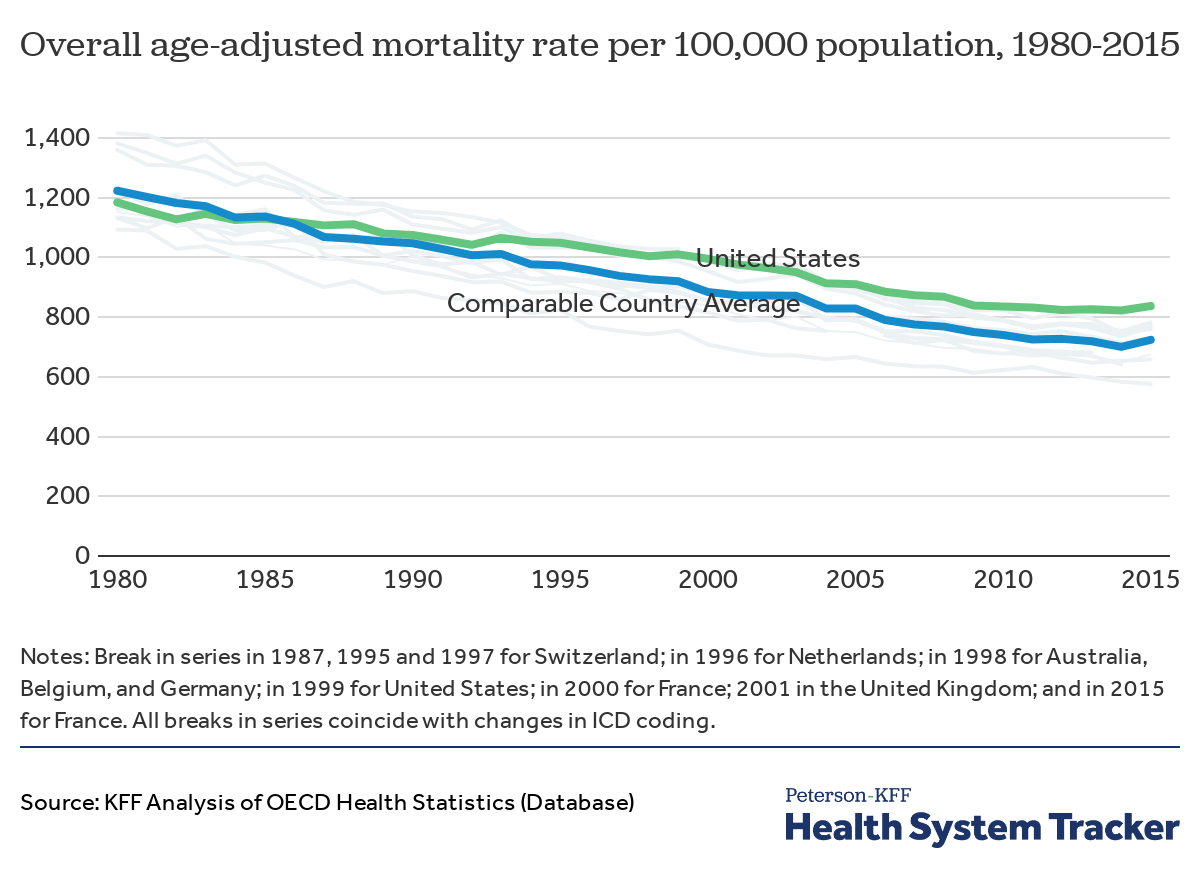
The United States is known for healthcare spending accounting for a large portion of its Gross Domestic Product (GDP) without yielding the corresponding health returns. According to the Center for Medicare and Medicaid Services (CMS), healthcare spending made up 17.7% ($3.6 trillion) of the GDP in the U.S. in 2018 – yet, poor health outcomes, including overall mortality, remain higher compared to other Organization for Economic Cooperation and Development (OECD) countries. According to The Lancet, enacting a single-payer UHC system would likely result in $450 billion in savings in national healthcare and save more than 68,000 lives.

Figure 1. Mortality rate in the US versus other OECD countries.

The expansion of Medicaid under the Patient Protection and Affordable Care Act (ACA or Obamacare) was not the first attempt the United States government made to increase the number of people with health insurance. In 1945, the Truman administration introduced a Universal Health Care (UHC) plan. Many Americans with insurance insecurity, most notably Black Americans and poor white Americans, would benefit from this healthcare plan. During this time, health insurance was only guaranteed for those with certain jobs, many of which Blacks and poor white Americans were unable to secure at the time, which resulted in them having to pay out-of-pocket for any wanted healthcare services. This reality pushed Truman to propose UHC within the United States because it would allow “all people and communities [to] use the promotive, preventative, curative, rehabilitative and palliative health services they need of sufficient quality…, while also ensuring that the use of these services does not expose the user to financial hardship.”

Continue reading…

Defund Health Care!

By KIM BELLARD

In the wake of the protests related to George Floyd’s death, there have been many calls to “defund police.”  Those words come as a shock to many people, some of whom can’t imagine even reducing police budgets, much less abolishing entire police departments, as a few advocates do indeed call for.

If we’re talking about institutions that are supposed to protect us but too often cause us harm, maybe we should be talking about defunding health care as well.  

America loves the police.  They’re like mom and apple pie; not supporting them is essentially seen as being unpatriotic.  Until recent events, it’s been political suicide to try to attack police budgets.  It’s much easier for politicians to urge more police, with more hardware, even military grade, while searching for budget cuts that will attract less attention.  

It remains to be seen whether the current climate will actually lead to action, but there are faint signs of change.  The mayor of Los Angeles has promised to cut $150 million from its police budget, the New York City mayor vowed to cut some of its $6b police budget, and the Minneapolis City Council voted to “begin the process of ending the Minneapolis Police Department,” perhaps spurred by seeing the mayor do a “walk of shame” of jeers from protesters when he would not agree to even defunding it.  

Continue reading…

Health in 2 Point 00, Episode 126 | A triple-episode ft. Bigfoot, Tictrac, Lifestance & many more

Today on Health in 2 Point 00, there’s been so much movement in digital health funding this week that we have a triple-episode. Bigfoot Biomedical raised $55 million in a Series C, Tictrac raised $7.5 million for employee wellness, Lifestance Health raised a whopping $1.2 billion, Maven acquired Bright Parenting, Higi raised $30 million, Bright.md raised $16.7 million, Tia raises $24 million, Doktor.se raising €45 million, Orbita raised $9 million, Curatio’s undisclosed A, Siren raised $11.8 million, 100plus raised $15 million, Ubie raised $18.7 million, Change Healthcare acquired 2 different companies—PDX for $208 million and ERX for $213 million, and special funds by Andreessen Horowitz and Softbank supporting founders of color. —Matthew Holt

We Can’t Breathe

By KIM BELLARD

I was wondering what might crowd COVID-19 off the news.  The historic economic devastation caused by it has been subsumed into it, just another casualty of the pandemic.  In better times, perhaps SpaceX’s efforts would inspire us.  But, no, it took the police killing of yet another person of color to take our attention away.  

Now, let me say right off that I am not the best person to discuss George Floyd’s death and the woeful pattern it is part of.  I have certainly been the beneficiary of white male privilege.  I’ve never been unjustly pulled over or arrested.  I haven’t taken part in the protests.  But people like me need to speak out.  Writing about anything else right now seems almost irresponsible.  

OK: you’ve seen the video. You’ve heard Mr. Floyd protest that he can’t breathe, that the officer was killing him.  You’ve seen other officers stand by and not do anything — some even assisting — even as bystanders pleaded for them to let Mr. Floyd breathe.  It’s disturbing, it’s distressing, and it’s nothing new.  

I saw a video from one of the resulting protests where another officer restrained a protester — a black man, of course — in exactly the same way, although in this case another officer eventually moved the officer’s knee off the protester’s neck.  He’d learned what that video looked like.

There now have been protests in over 140 U.S. cities, with the National Guard mobilized in almost half the states.  Most protests have been peaceful, but there has been looting and there have been shootings. It’s a level of civil unrest not seen since the 1960’s.

And we thought it was bad when we just wanted the grocery stores to have toilet paper again, when wearing a mask was considered a hardship.

Continue reading…

The Lack of Persuasion as a Failure Against COVID-19

By RAFAEL FONSECA

Reopening safely out of the current pandemic ought to be done via persuasion, not coercion.

It has been more than five months since the world first learned about COVID-19. Models predicted a sharp increase in the number of cases, and a seemingly high likelihood the pandemic would overwhelm our hospitals. These models were often inaccurate, and we have all come to learn about the imprecision of epidemiological prediction.  Nevertheless, the infection is far worse than anyone initially accepted – becoming a staple of our generation. Fearing uncountable deaths and the possible need to prioritize resources for those affected, initial government measures were put in place to curtail the spread of the virus. Images of the Lombardic tragedy compelled all to stay in place and wait for the storm to pass, and with few exceptions most complied. Realizing the gravity of the situation, governments gradually implemented measures to prevent infections.  With some vacillation, we evolved from travel restrictions, to social distancing, shelter in place and universal mask use.

As the pandemic ensued, we watched the horror stories taking place in New York City and Boston. Even while we are in the midst of the so-called first wave, with thousands of deaths per day, many have started to wonder how long society will remain isolated and locked. Politicians look to experts for recommendations regarding policies that might save lives, and for the most part they have complied. However, as the weeks ensue, we see growing jobless claims, lines for food banks, and impatience.

This brewing impatience is a response to an unknown future dictated by the vagaries of nature and the lack of a coherent strategy to resume a life with a resemblance to normal. The public searches for guidance from federal agencies, state governments, and health authorities. A lack of clear direction from these institutions has heightened this anxious impatience. Additionally, the conversation is now ideological, with an almost Manichaean division between those wanting to save lives more so than the economy, and vice versa, creating cartoons of opposing perspectives.  Even for those recognized as  accomplished, dissenting from orthodoxy is punished severely. In the background, the public’s patience is running thinner.

Continue reading…