Categories

Category: Health Policy

Value-based care – no progress since 1997?

By MATTHEW HOLT

Humana is out with a report saying that its Medicare Advantage members who are covered by value-based care (VBC) arrangements do better and cost less than either their Medicare Advantage members who aren’t or people in regular Medicare FFS. To us wonks this is motherhood, apple pie, etc, particularly as proportionately Humana is the insurer that relies the most on Medicare Advantage for its business and has one of the larger publicity machines behind its innovation group. Not to mention Humana has decent slugs of ownership of at-home doctors group Heal and the now publicly-traded capitated medical group Oak Street Health.

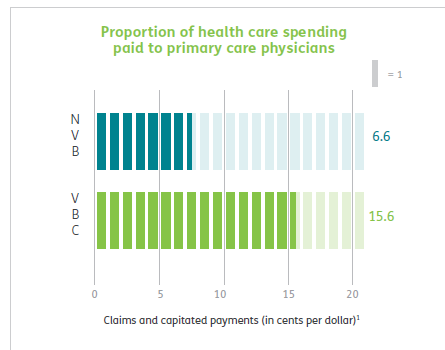
Humana has 4m Medicare advantage members with ~2/3rds of those in value-based care arrangements. The report has lots of data about how Humana makes everything better for those Medicare Advantage members and how VBC shows slightly better outcomes at a lower cost. But that wasn’t really what caught my eye. What did was their chart about how they pay their physicians/medical group

What it says on the surface is that of their Medicare Advantage members, 67% are in VBC arrangements. But that covers a wide range of different payment schemes. The 67% VBC schemes include:

  • Global capitation for everything 19%
  • Global cap for everything but not drugs 5%
  • FFS + care coordination payment + some shared savings 7%
  • FFS + some share savings 36%
  • FFS + some bonus 19%
  • FFS only 14%

What Humana doesn’t say is how much risk the middle group is at. Those are the 7% of PCP groups being paid “FFS + care coordination payment + some shared savings” and the 36% getting “FFS + some share savings.” My guess is not much. So they could have been put in the non-VBC group. But the interesting thing is the results.

Continue reading…

New Technologies Drive Cost Growth Over Time

By KEN TERRY

(This is the eighth and final installment in a series of excerpts from Terry’s new book, Physician-Led Healthcare Reform: a New Approach to Medicare for All, published by the American Association for Physician Leadership.)

Medical technologies include drugs, devices, tests, and procedures. Considered as a whole, these technologies are the key driver of growth in health costs, according to Georgetown University professor Gregg Bloche and his associates.

Bloche, et al., view insurance coverage as the chief enabler of these technological innovations. In a 2017 Health Affairs Blog post, they said, “Drug and device developers, clinical researchers, and their financial backers anticipate coverage for new tests and treatments with little concern for whether they add substantial therapeutic value, and they make research and development decisions accordingly.”

In an interview, Bloche further explained, “If you’re a technology developer, you can reasonably anticipate that if your product achieves a low but significant health gain, insurers are going to be under pressure to pay for it.”

Insurers do cover most new drugs, although they may make it difficult for patients to access the ones that they deem to be low-value, notes Peter Neumann, director of the Center for the Evaluation of Value and Risk in Health at the Institute for Clinical Research and Health Policy Studies at Tufts Medical Center in Boston.

Continue reading…

Biden’s Nov 9th speech: “Don’t you force me to pass Medicare 4 All”

By MATTHEW HOLT

The new Supreme Court, in all likelihood including just nominated Justice Amy Coney Barrett, will be hearing the California v Texas suit against the ACA on November 10th, seven days after the election. The lower courts have already ruled the ACA unconstitutional. Some hopeful moderates among my Democratic friends seem to believe that the justices will show cool heads, and not throw out the ACA. But it’s worth remembering that in the NFIB vs. Sebelius decision which confirmed the legitimacy of most of the ACA back in 2011 all the conservative justices with the exception of John Roberts voted to overturn the whole thing. With Ginsburg being replaced by Barrett there’s no reason to suppose that she won’t join Thomas, Alito, Kavanagh & Gorsuch and that Robert’s vote won’t be enough to stop them this time. The betting odds must be that the whole of the ACA will be overturned.

There is nothing the Democrats can realistically do to prevent Barrett filling RBG’s seat on the court, but assuming Biden wins and the Democrats take back the Senate, the incoming Administration can give the Supremes something to think about regarding the ACA. I would not suggest this level of confrontation before the election but, if Biden wins, the gloves must come off.

Assuming he wins and that the Dems win the Senate, this is the speech Biden should give on November 9th. (The TL:DR spoiler is, “Keep the ACA or I’ll extend Medicare to all ages”)

“I’m directing this speech to an extremely select number of people, just the Supreme Court Justices appointed by Republican Presidents. It is obviously no secret that we have political differences on many issues and we find ourselves in the strange situation in which I am the incoming President with an incoming Democratic Senate majority and yet you are considering overturning the signature bill of the administration in which I was Vice-President. You may recall that at the time of its signing I told President Obama that it was a “big f****** deal”  and, although many of my colleagues in the more progressive wing of the Democratic Party have criticized the ACA since its passage, it turns out that I was right. 

I am not referring here to the apoplexy that the ACA created amongst the Republican Party including not only the current and outgoing President but also almost all Republican members of Congress between 2010 and 2018. Instead I’m referring to the ACA’s impact on the nation and its health care system. 

Since 2010 there have been many changes to the way our nation’s health care system operates; almost all of them have their roots in the ACA. 

First, the ACA gave access to health insurance coverage to many people who had great trouble getting it before. That includes young people moving between their parent’s home, college and getting into the workforce; small business owners; freelance workers; the unemployed; people with low incomes; and people with underlying “pre-existing” health conditions. I remind you that due both to the pandemic and changes in our economy, there are many, many more of these people now than there were in 2009. 

Before the ACA these people were either not well served by the private health insurance industry or literally were unable to buy coverage at all. This not only caused extreme personal and financial suffering and in some cases death to the people affected, but also impacted the economy. It restrained innovation and entrepreneurship, and it meant that the participants in the health care system–including very many well meaning clinicians and provider organizations–had to play very inefficient games in order to try to provide those people with much-needed care, which drove up the cost of care to everyone else. Warren Buffet calls that the tapeworm in the US economy.

The ACA changed this in two main ways.

Continue reading…

It’s complicated. A deep dive into the Viz/Medicare AI reimbursement model.

By LUKE OAKDEN-RAYNER

In the last post I wrote about the recent decision by CMS to reimburse a Viz.AI stroke detection model through Medicare/Medicaid. I briefly explained how this funding model will work, but it is so darn complicated that it deserves a much deeper look.

To get more info, I went to the primary source. Dr Chris Mansi, the co-founder and CEO of Viz.ai, was kind enough to talk to me about the CMS decision. He was also remarkably open and transparent about the process and the implications as they see them, which has helped me clear up a whole bunch of stuff in my mind. High fives all around!

So let’s dig in. This decision might form the basis of AI reimbursement in the future. It is a huge deal, and there are implications.


Uncharted territory

The first thing to understand is that Viz.ai charges a subscription to use their model. The cost is not what was included as “an example” in the CMS documents (25k/yr per hospital), and I have seen some discussion on Twitter that it is more than this per annum, but the actual cost is pretty irrelevant to this discussion.

For the purpose of this piece, I’ll pretend that the cost is the 25k/yr in the CMS document, just for simplicity. It is order-of-magnitude right, and that is what matters.

A subscription is not the only way that AI can be sold (I have seen other companies who charge per use as well) but it is a fairly common approach. Importantly though, it is unusual for a medical technology. Here is what CMS had to say:

Continue reading…

Congress Is Getting the Transition to Alternative Payment Models Wrong

By TAYLOR CHRISTENSEN

Alternative payment models (APMs) are a hot topic these days, and everyone seems to agree that we need to transition toward them and away from fee for service (FFS). But how should we do it?

First, let’s think about this task as government policy makers would think about it.

They would probably start by saying, “We need to find a way to give incentives to providers and payers to try out these different APMs.” This would be fairly easy to do through Medicare, so they would create some Medicare APM programs and structure them in a way that makes the benefits of joining large enough that lots of providers will want to participate.

And for the sake of uniform provider incentives, they would also want to encourage private insurer-provider diads to start using APMs, preferably ones as similar to the Medicare APM programs as possible. And so they would probably have to offer private insurers and/or providers money to do so.

Continue reading…

Now Is Not the Time to Forget About the AIDS Epidemic

By SOMA SEN

I keep hearing the voices of colleagues and friends that have been part of the AIDS epidemic compare it to the current COVID-19 pandemic. In fact Dr. Kathy Creticos, Director of Infectious Disease at Howard Brown Health spoke about the politicization of both the pandemics. 

“Here we are in 2020 with this disease that kills people, that we don’t have any treatments for, that we really don’t understand the full manifestation and presentation biology of the virus,” Creticos said In the final segment of an interview with Contagion during International AIDS Society (IAS) AIDS 2020 Virtual Sessions. “We’re really dealing in the same situation as in the HIV epidemic.” 

Her words make me reflect on the levity with which the Raegan administration treated the AIDS epidemic and it’s parallel to the Trump administration’s treatment of the current pandemic. However, she makes an important distinction between the two when she says, “I think a lot of it has to do with the fact that COVID affects everybody, but HIV was certainly perceived as not affecting everybody.”

As an Asian American researcher with more than 15 years of experience in this area, whenever, I bring up the issue of the scourge of HIV/AIDS in our community, the common response both from inside and outside the community is “It’s not a problem in this community.” 

Continue reading…

THCB’s Bookclub, September 2020 – NEO.LIFE

By JESSICA DAMASSA & MATTHEW HOLT

The THCB Book Club is a discussion with leading health care authors, which will be released on the third Wednesday of every month.

This month we hosted Jane Metcalfe (Founder of NEO.LIFE) to talk about her 2020 book NEO.LIFE. You can get a copy of it here!

NEO.LIFE is a very unusual book. It’s over 25 very short chapters (ranging from 1 page to 78) which include interviews, concepts, art, science, science fiction, and one short story. All from different authors or groups of authors that are all edited into place by Jane Metcalfe and Brian Bergstein.

The topic is the future of humans! And the loose focus is on biotech, human engineering, and well watch along and get a copy!

You can see the video below (and the podcast version will be in our iTunes & Spotify channels very soon).

In October the THCB BookClub will feature Mike Magee’s book, Code Blue.

Hospitals Must Give Up Power to Save Healthcare

By KEN TERRY

(This is the sixth in a series of excerpts from Terry’s new book, Physician-Led Healthcare Reform: a New Approach to Medicare for All, published by the American Association for Physician Leadership.)

As hospital systems become larger and employ more physicians, healthcare prices will continue to rise and independent doctors will find it harder to remain independent. Hospitals will never fully embrace value-based care as long as it threatens their primary business model, which is to fill beds and generate outpatient revenues. To create a viable, sustainable healthcare system, the market power of hospitals must be eliminated.

Federal antitrust policy is not adequate to handle this task. Even if the Federal Trade Commission had more latitude to deal with mergers among not-for-profit entities, the industry is already so consolidated that the FTC would have to break up health systems involving thousands of hospitals. Such a gargantuan effort would be practically and legally unfeasible.

All-payer Systems

 The government could curtail health systems’ market power without breaking them up. For example, either states or the federal government could adopt “all-payer” models similar to those in Maryland and West Virginia. Under the Maryland model introduced 40 years ago, every insurer, including Medicare, Medicaid, and private health plans, pays uniform hospital rates negotiated between the state and the hospitals.

Continue reading…

Will COVID-19 Force The South To Finally Confront Structural Racism Within Their Medicaid Programs?

By MIKE MAGEE

If you would like to visit the meeting place of America’s two great contemporary pandemics –COVID-19 and structural racism – you need only visit America’s Nursing Homes.

This should come as no surprise to Medical Historians familiar with our Medicaid program. Prejudice and bias were baked in well before the signing of Medicaid and Medicare on July 30, 1965.

President Kennedy’s efforting on behalf of health coverage expansion met stiff resistance from the American Medical Association and Southern states in 1960. Part of their strategic pushback was the endorsement of a state-run and voluntary offering for the poor and disadvantaged called Kerr-Mills. Predictably, Southern states feigned support, and enrollment was largely non-existent. Only 3.3% of participants nationwide came from the 10-state Deep South “Black Belt.”

Based on this experience, when President Johnson resurrected health care as a “martyr’s cause” after the Kennedy assassination, he carefully built into Medicaid “comprehensive care and services to substantially all individuals who meet the plan’s eligibility standards” by 1977. But by 1972, after seven years of skirmishes, the provision disappeared.

Continue reading…

Patient Identity and Patient Record Matching

By ADRIAN GROPPER & DEBORAH C. PEEL

September 4, 2020

Thank you, ONC for the opportunity you gave me to speak in June. Also, thank you for the format of your August meeting where the Zoom chat feature offered a wonderful venue for an inclusive commentary and discussion as the talks were happening. Beats lining up at the microphone any day.

Here is a brief recap of my suggestions, in no particular order:

Continue reading…