Categories

Category: Health Policy

The 2020 COVID Election

By KIM BELLARD

Many believe that the 2020 Presidential election will be a referendum on how President Trump has handled the coronavirus pandemic.  Some believe that is why the President is pushing so hard to reopen the economy, so that he can reclaim it as the focal point instead.  I fear that the pandemic will, indeed, play a major role in the election, but not quite in the way we’re openly talking about.  

It’s about there being fewer Democrats.

Now, let me say right from the start that I am not a conspiracy believer.  I don’t believe that COVID-19 came from a Chinese lab, or that China deliberately wanted it to spread.  I don’t even believe that the Administration’s various delays and bungles in dealing with the pandemic are strategic or even deliberate.  

I do believe, though, that people in the Administration and in the Republican party more generally may be seeing how the pandemic is playing out, and feel less incentive to combat it to the fullest extent of their powers.  Let’s start with who is dying, where.

Continue reading…

Post-Pandemic Solutions: A Public Option for Universal Healthcare

By ROSEMARIE DAY

As the coronavirus pandemic overtook the tail end of the Democratic primary season, attention rapidly shifted from examining the nuances of the differences between the candidates’ healthcare platforms to simply demanding a response to the pandemic. Beyond addressing the immediate crisis, however, lie many questions about the weaknesses of our current healthcare system, and how we will address them in the long run.  These questions should be at the forefront of voters’ minds as we head into the election this fall. 

One of the major weaknesses in our system is that we do not have universal healthcare. Importantly, virtually all of the Democratic candidates called for making healthcare a right in the U.S. This is a key first step toward universal healthcare.  Their approaches to achieving this varied, however. Bernie Sanders and Elizabeth Warren called for “Medicare for All,” but most of the other candidates, including Joe Biden, have pushed for some kind of public option. The public option has faced criticism that it will simply maintain the status quo. This criticism inspired me to write this blog, because a large-scale public option program could actually help to reshape the US healthcare system and result in improvements in access to care in this country, ultimately getting us to universal healthcare.

Continue reading…

Health in 2 Point 00, Episode 124 | Omada Health, Meru, Noom, and Alike

Today on Health in 2 Point 00, Jess asks me about Omada Health raising $57 million and then spending $30 million acquiring Physera, Holmusk raising $21.5 million, digital mental health company Meru raising $8.1 million, Noom partnering with LifeScan for digital diabetes care and Alike raising $5 million.—Matthew Holt

It’s Not About Tradeoffs

By MICHEL ACCAD

It is tempting to oppose the harmful effects of COVID-related lockdown orders with arguments couched in terms of trade-offs. 

We may contend that when public authorities promote the benefits of “flattening the curve,” they fail to properly take into account the actual costs of imposing business closures and of forced social distancing: The coming economic depression will lead to mass unemployment, rising poverty, suicides, domestic abuse, alcoholism, and myriad other potential causes of death and suffering which could be considerably worse than the harms of the pandemic itself, especially if we consider the spontaneous mitigation that people normally apply under the circumstances.

While I have no doubt that lockdown policies can and will have very serious negative consequences, I believe that the emphasis on trade-offs is misguided and counterproductive.  It immediately invites a utilitarian calculus: How many deaths and how much suffering will be caused by lockdowns?  How many deaths and how much suffering will occur without the lockdowns? How exactly are we to measure the total harm?  What time frame should we consider when we ponder the costs of one option versus the other?

Continue reading…

Building an Intake Valve for New Ideas

By SUSANNAH FOX

Imagine this: You and your colleagues know there are problems to be solved. You have resources to offer, such as funding, access to experts, and publicity. 

You are pretty sure there are people with great ideas out there, asking questions, defining the scope of the problems you care about, seeing things that you can’t see. Some people are even forging ahead, developing solutions on their own, but you don’t know how to connect with them.

You need an intake valve for new ideas, a honeypot to attract problem-solvers. So you launch a prize competition. 

If you have escaped all the buzz around prize competitions and grand challenges over the last decade or so, don’t worry. KidneyX has a wonderful FAQ, including:

What is a prize competition?

A prize competition is a method of problem-solving that describes a problem (usually to the general public) and offers a prize or prizes to whoever comes up with the best solution(s). Prize competitions are a good way to attract ideas and skills from a wide range of fields.

I served as a volunteer judge for the KidneyX Patient Innovator challenge and was bowled over by the creativity of the submissions, both those who won and those who did not. It reminded me to welcome people into the health innovation conversation who may not think of themselves as inventors, but who deeply understand the community at the center of a crisis. The “need-knowers” as Tikkun Olam Makers call them.

Continue reading…

Keep Petri Dishes in the Lab

By KIM BELLARD

COVID-19 is changing the landscape of our healthcare system, and, indeed, of our entire society, in ways that we hadn’t been prepared for and with implications that we won’t fully grasp for some time.  As we grapple with how to reshape our healthcare system and our society in the wake of the pandemic, though, I worry we’re going to focus on the wrong problems.  

Take, for example, nursing homes, prisons, and the meatpacking industry.  

Anyone who has been paying attention to the pandemic will recognize that each of these have been “hot spots,” and have been called “petri dishes” for coronavirus (as are cruise ships, but that’s a different article).  These institutions aren’t the only places where masses of people congregate, but they seem to do so in ways that create fertile territories for COVID-19.  And that’s the problem.

We knew early on that nursing homes were going to be a problem.  We knew COVID-19 was a problem in Wuhan, but that was far away — until a few cases emerged in late February in a skilled nursing home in King County, Washington.   We know now that these were not the first cases, nor the first deaths, but we were stunned by how quickly it spread in that facility.  By mid-March experts were already calling nursing homes “ground zero,” and that has been proven right.  

It is now estimated that as many as a third of all U.S. coronavirus deaths have come from nursing home residents or workers.  That is (as of this writing) almost 30,000 deaths, and over 150,000 cases.  

Continue reading…

How to Manage Patients in Quarantine, Smartly

By MATTHEW HOLT

Smart Quarantine as the next step to combat COVID-19

As the nation and the world grapple with the impact of the COVID-19 pandemic, there is growing consensus among experts that we need a sustainable system of specific lockdowns, social distancing, and extreme resource provision in terms of labor, ventilators and PPE to arm hospitals and health providers as they deal with the onslaught of patients. Even while some American states start to slowly open up, we need a system that can manage COVID-19 over the coming months and years–especially if this Fall brings a second wave.

Writing in the NY Times on April 7, Harvey Fineberg and colleagues summarized an as yet overlooked issue. There are many patients who may or do have COVID-19, but are not sick enough to need hospital care, or who have been discharged from hospitals. We need to keep these patients away from hospitals but if they shelter in place in their household there is a high risk they will infect their families or housemates. This likelihood is even higher if they are homeless,  incarcerated, or living in other group arrangements.

Instead of sheltering in place at home Fineberg and colleagues suggest those patients enter “smart quarantine” in temporary isolated accommodation, such as hotels or college dormitories, where they can be looked after by medical teams and tested semi-regularly. But whether they are at home or in temporary accommodation, leaving those patients with minimal support to be tested at the end of 14 days is not enough. A significant proportion of them will develop COVID-19 and some of those are going to be admitted to hospital. In addition several patients have been discharged from hospital, but still need to be monitored. We are going to need to be able to closely monitor a significant number of people even while the majority of them will need relatively limited amounts of care.

The good news is that we have had a couple of decades of development of the technologies and services required to both care for and monitor these patients, while keeping the main resources such as ventilators for those in hospitals. Pulling together available technologies and services, we will be able to quickly and accurately manage these patients, ensure their best outcomes, and spare scarce hospital resources. There are seven main components of this process, which I am calling “smart care in quarantine.”

The Process

Upon either a positive test for COVID-19 or a suspicion of those symptoms awaiting testing, patients can be admitted to isolation at home or in, say, empty hotels. 

1. Monitoring equipment. Patients can be given FDA regulated monitoring devices which will work using bluetooth and WiFi (or 4G cellular). The main monitoring tools required are:

  • Pulse Oximeters
  • Thermometers
  • Stethoscopes (with acoustic recording)
  • Weight Scales
  • Video & audio via iPad, phone or computer
Continue reading…

We Need to Fix COVID-Damaged Care Sites and Give the Country Better Care and Universal Coverage in the Process

By GEORGE HALVORSON

The COVID crisis has shown us clearly that major portions of the American care system are extremely dysfunctional and some are now badly broken. We need to put in place a cash flow for American health care that can help our care sites survive and ultimately thrive, and we need to put that approach to save the sites in place now because a vast majority of hospitals and medical practices are badly damaged and some are financially crippled and even destroyed by their response to the crisis.

We have learned a lot in the COVID crisis that we need to use now in building our next steps and our collective response to the crisis.

The COVID crisis has shown us all that our care sites do not have good patient data, do not have good patient linkages, usually do not have team care of any kind in place, and most are so dependent on current piecework fee volumes from patients that they quickly collapse financially when that volume is interrupted.

We should be on the cusp of a golden age of care delivery that uses all of the best patient support tools to deliver continuously improved care — and we now know that the piecework way we buy almost all of our care today will keep that golden age from happening for the vast majority of American patients for the foreseeable future until we change the way we buy care.

We need to buy care in a way that both requires the use of those tools and rewards caregivers and care teams when they use them.

We need a dependable cash flow for care to anchor that process.

We are unlike most of the rest of the industrialized world in not having a dependable cash flow now to buy care. We rely on a hodgepodge and mishmash of unlinked, unaligned and uncoordinated payment sources now and that lack of coordination in payment creates a vast and damaging lack of coordination in the delivery of care.

We can make a huge improvement in that entire process and we can give our health care system a stable and functionally useful future cash flow by becoming a much more highly skilled purchaser of coverage and care. We need a flow of money to make that happen.

We actually can create that flow relatively quickly and fairly easily by imposing a payroll tax on every employee that exactly copies the approach we use now for our Social Security payroll tax process and then using that money in a health care purchasing pool to buy health coverage for every person who is not on Medicaid.

The numbers work.

Continue reading…

The Problem With “Herd Immunity” as a COVID-19 Strategy

By E-PATIENT DAVE DEBRONKART

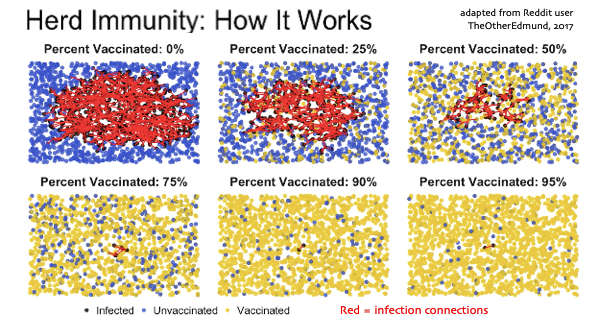
Caution: This post is not a prediction. It’s just a tutorial about the concept of herd immunity, with an eye to why it’s probably not an approach the US wants to take in solving the complex problems we’ve gotten ourselves into with COVID-19.

Click this graphic to go see a six second animation of these images, created in 2017 by Reddit user TheOtherEdmund. You many need to watch a few times. Get a feel for the differences in what happens in the different blocks, and come back to discuss:

This weekend I’ve labored to understand this concept, which first came to my ears regarding coronavirus in March, when British prime minister Boris Johnson proposed it as a possible approach for Britain to take: let the virus take its course, and they’d end up with “herd immunity,” and that would be the end of that.

In my unsophisticated knowledge “herd immunity” meant “you let the weak cows die, and the rest of the herd will be fine.” And in fact in April a Tennessee protestor held up a sign saying “Sacrifice the Weak – Reopen TN.” (It’s not clear whether the sign was mocking or real (Snopes), but it illustrates the point.)

Continue reading…

The False Choice Between Science And Economics

By DAVID SHAYWITZ

As the nation wrestles with how best to return to normalcy, there’s a tension, largely but not entirely contrived, emerging between health experts—who are generally focused on maintaining social distancing and avoiding “preventable deaths”—and some economists, who point to the deep structural harm being caused by these policies.

Some, including many on the Trumpist-right, are consumed by the impact of the economic pain, and tend to cast themselves as sensible pragmatists trying to recapture the country from catastrophizing, pointy-headed academic scientists who never much liked the president anyway.

This concern isn’t intrinsically unreasonable. Most academics neither like nor trust the president. There is also a natural tendency for physicians to prioritize conditions they encounter frequently—or which hold particular saliency because of their devastating impact—and pay less attention to conditions or recommendations that may be more relevant to a population as a whole.

Even so, there are very, very few people on what we will call, for lack of a better term, “Team Health,” who do not appreciate, at least at some level, the ongoing economic devastation. There may be literally no one—I have yet to see or hear anyone who does not have a deep appreciation for how serious our economic problems are, and I know of a number of previously-successful medical practices which are suddenly struggling to stay afloat amidst this epidemic.

Continue reading…