Categories

Category: Medical Practice

Who Gets Autism?

By NEUROSKEPTIC

The paper is from Leonard et al and it’s published in PLoS ONE, so it’s open access if you want to take a peek. The authors used a database system in the state of Western Australia which allowed them to find out what happened to all of the babies born between 1984 and 1999 who were still alive as of 2005. There were 400,000 of them.

The records included information on children diagnosed with either an autism spectrum disorder (ASD), intellectual disability aka mental retardation (ID), or both. They decided to only look at singleton births i.e. not twins or triplets.

In total, 1,179 of the kids had a diagnosis of ASD. That’s 0.3% or about 1 in 350, much lower than more recent estimates, but these more recent studies used very different methods. Just over 60% of these also had ID, which corresponds well to previous estimates.

There were about 4,500 cases of ID without ASD in the sample, a rate of just over 1%; the great majority of these (90%) had mild-to-moderate ID. They excluded an additional 800 kids with ID associated with a “known biomedical condition” like Down’s Syndrome.

So what did they find? Well, a whole bunch, and it’s all interesting. Bullet point time.

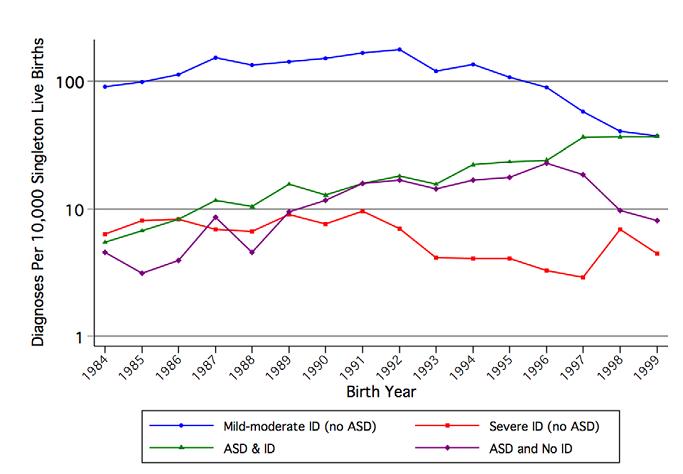
  • Between 1984 to 1999, rates of ID without ASD fell and rates of ASD rose, although there was a curious sudden fall in the rates of ASD without ID just before the end of the study. In 1984, “mild-moderate ID” without autism was by far the most common diagnosis, with 10 times the rate of anything else. By 1999, it was exactly level with ASD+ID, and ASD without ID was close behind. Here’s the graph; note the logarithmic scale:
Continue reading…

The Kübler-Ross Model of EHR Adoption

MARGALIT GUR-ARIE

By MARGALIT GUR-ARIE

For over a hundred years the paper chart has been a trusted partner and best friend to many physicians and nurses. The paper chart was born the day a new patient walked into the office, a pristine, crisp and neatly color-coded folder, with just the right markings in carefully shaped calligraphy on its covers. As the years went by, the paper chart grew in size, acquired meaning and wisdom, and like most of us, became a bit tattered around the edges and heftier in the middle. It felt good to hold the elderly paper chart in your hands and its voluminous physical presence inspired confidence and trust. The paper chart is dead. In some places the paper chart’s pages are still turning slowly, but we all know its long, productive life has come to an end and someone should pull the plug and call it. Or do we?

In 1969 Elisabeth Kübler-Ross proposed a 5 stage model for typical grieving behavior. The various reactions from the clinical community to the apparent demise of the paper chart exhibit almost textbook adherence to the Kübler-Ross model, with each clinician advancing through the five stages of grief at his/her own pace*.

Denial – This is a joke. These people don’t understand medicine and this entire Obamacare thing will soon go away and we’ll return to normalcy. My practice is doing just fine on paper and my patients get all this fancy medical home care right here and always had. They actually get better care. Besides, I have patients to see and I am too busy to tinker with these fads that come and go every five years or so.Continue reading…

The New Cost-Conscious Doctor

JANE SARASOHN-KAHN

By JANE SARASOHN-KAHN

Doctors practicing in the U.S. are becoming increasingly conscious of the increasing costs of health care. Most consider themselves cost-conscious, and are considering the impact of their practice patterns — in terms of prescribing medicines, tests, and procedures — on the nation’s health bill. In fact, most physicians feel they have a responsibility to bring down health costs.

This perspective on physicians comes from the survey report, The new cost-conscious doctor: Changing America’s healthcare landscape, from Bain & Company, published in March 2011. Bain spoke with over 300 U.S. physicians to assess their perspectives on managing costs, drug and device usage, and standardized care protocols.

The top-line finding is that, regardless of physician demographic — whether male or female, salaried or productivity-based, specialist or generalized, urban or rural, young or mature, doctors uniformly see that they must change clinical practice patterns to accommodate the realities of health economics.Continue reading…

Are Decision Support Tools Turning Doctors into Idiots?

By DAVID WILLIAMS

A HealthLeaders article by Gienna Shaw notes that some physicians are reluctant to use computerized decision support (CDS) tools because they fear losing the respect of patients and colleagues. There’s some evidence to support this concern:

In one [study], even tech-savvy undergraduate and graduate computer science students preferred physicians who rely on intuition instead of computer aids.

“Patients object when they ask their doctor a question and then she or he immediately types in the question into their laptop and then reads back the answer. It gives patients the feeling that they just paid a $25 copay to have someone Google something for them,” [study author James] Wolf says.

Shaw argues that this is a transient phenomenon in any case because soon everyone will use CDS as payers demand it and the tools get built in to electronic medical records in a way that’s invisible to patients. She’s probably right, but she’s sparked some interesting thoughts.Continue reading…

And the Worst Health Care System in the World Is…

By EVAN FALCHUK

The United States, of course.

Oh, no, wait, it’s Canada.

Actually, I think it could be Germany.

Geez, now I think it might be the UK.

You could go on and on like this.  But you know what?

No matter how good or bad your system is, there are certain universal truths.

Here are four of them that might make you look at global health care a little differently.

First, health care is getting more expensive, all over the world.  A new study by the global consultant, Towers Watson (disclosure: Towers Watson is a Best Doctors client) found that the average medical cost trend around the world will be 10.5% in 2011.  In the advanced economies costs will rise by an average of 9.3%.  While Americans tend to think of rising medical costs as a uniquely American problem (they’ll rise by 9.9% here), it’s just not true.  Canadian costs will rise by 13.3%.  In the UK and Switzerland, they will increase by 9.5%, and in France by 8.4%.

Continue reading…

Primary Care Revolt: Replace the RUC

By RICHARD REECE, MD

An under-the-radar revolution is going on out there. It is a revolt of primary care physicians against the AMA and CMS. It is a request for parity with specialists. It is a movement to replace how primary care practitioners are paid.

Why the revolt against the AMA and CMS? Because primary care doctors yearn to correct myths about primary care vis-à-vis specialists, and because they believe, by altering how the AMA and CMS pay doctors, health costs can be brought down, and primary care can be re-invigorated. Health systems with a broad primary care base have lower costs. In the U.S., two-thirds of doctors are specialists, and one-third are in primary care, the reverse of most nations, which have 50% or lower costs.

In the early 1990s, the AMA formed the Relative Value Scale Update Committee (RUC), which specialists now dominate. RUC sets payment codes for doctors. Since RUC’s inception, the payment differential has been growing between primary care doctors and specialists, so much so that the typical primary care doctor now makes only 30% of what an orthopedic surgeon makes. On average, primary care incomes are 50% of those of specialists.Continue reading…

Patient-Driven Care Instead of Patient-Centered Care

By PAUL LEVY

After being part of a discussion at the Institute for Healthcare Improvement today, I have decided to change my profile, above, from this:

Advocate for patient-centered care, eliminating preventable harm, transparency of clinical outcomes, and front-line driven process improvement.

To this:

Advocate for patient-driven care, eliminating preventable harm, transparency of clinical outcomes, and front-line driven process improvement.

What I am suggesting is that clinicians should do their best to collaborate with patients to understand their needs and desires and to jointly design plans of care that are as consistent as possible with those needs and desires.Continue reading…

Stubborn

By LISA SUENNEN

This week I had the occasion to be at UCLA for a very interesting meeting (more on that in a future post).  As I arrived at LAX to return my rental car, I drove past a huge billboard at the corner of 96th Avenue and Airport Blvd (just across from the Renaissance Hotel)  that made me do a double take.  The billboard, said in gigantic white letters on a red background:  “This year thousands of men will die from stubbornness.”

Naturally, my first thought was this:  Why thousands? If men can die from stubbornness, aren’t they all doomed?  If stubbornness is the proximate cause of death, we are looking at a wipe-out of society on a pretty imminent basis.  The bad news:  no more future generations.  The good news:  no one will hassle us women about buying too many shoes and all the top-paying private equity jobs will soon be available.

So figuring that I had misread this billboard, I actually made a U-turn and drove past it again (not sure what made me do it:  alarm or wishful thinking). What I noticed on my second pass was the very fine print, which said, “Learn the preventative medical tests you need. AHRQ.gov.”

The billboard is apparently part of an U.S. Government Agency for Healthcare Research and Quality Department ad campaign targeted to get men to stop avoiding the doctor and to go and get the medical screening tests recommended each year, such as those for cholesterol, diabetes, high blood pressure, cancer and other illnesses.Continue reading…

Did Nine Patients Have to Die?

By MICHAEL KIRSCH

Recently, nine patients died in Alabama when they received intravenous nutrition that was contaminated with deadly bacteria. This type of nutrition is called total parenteral nutrition, or TPN, and is used to nourish patients by vein when their digestive systems are not functioning properly. It is a milestone achievement in medicine and saves and maintains lives every day.

What went wrong? How did an instrument of healing become death by lethal injection? What is the lesson that can emerge from this unimaginable horror?

This tragedy represents that most feared ‘never event’ that can ever occur – death by friendly fire. No survivors. Contrast this with many other medical ‘never events’ as defined by the Centers for Medicare and Medicaid Services, such as post-operative infections, development of bed sores in the hospital or wrong-site surgery. Under the ‘never events’ program, hospitals will be financially penalized if a listed event occurs. Many physicians and hospitals are concerned that there will be a ‘never events’ mission creep with new outcomes added to the list that don’t belong there. Medical complications, which are unavoidable, may soon be defined as ‘never events’.

Do we need a new category of ‘never ever ever events’ to include those that lead to fatal outcomes?

The facts of the Alabama deaths have started to emerge.  Apparently, a water faucet in the pharmacy was contaminated. Protocols and processes are violated every day in all spheres of professional life; and we usually get away with them. The absence of serious consequences breeds complacency, which is shattered by an occasional tragedy. Isn’t it after a horrible traffic accident that a local government decides to erect street lights that were requested by local residents for years? I read earlier today that the Federal Aviation Administration is requiring extensive inspections of a few hundred airplanes when small cracks were discovered in a few of them. This followed a near disaster when a 5 foot hole burst open in the roof of an airplane during flight. The plane landed and all survived. Of course, a very different outcome was possible.

Continue reading…

When Projects Fail, Should We Fault the Technology?

By JOSEPH KVEDAR, MD

Last weekend, I saw the film “Up In The Air.”  Ok, so I am a few months behind in my movie viewing.  That is what the Netflix lifestyle does for you.  There is an interesting connected health analogy running through the film and I want to explore it with you in this post.

George Clooney plays the lead character and he spends a lot of time on airplanes.  His company outsources corporate downsizing and his job is to travel the country showing up at a firm to give the bad news to the employees that are being let go.  A much younger woman, who is up and coming at his company, comes up with the brilliant idea of communicating to each individual losing his/her job by videoconference (in the movie, it looks quite a bit like Skype).  The idea is to save on travel costs by having folks like Clooney communicate by video all over the world without leaving their desks.

We first watch Clooney’s character object to the idea.  He believes the idea will never work, claiming that there is a fine art to firing people and you can’t do it over the Internet.  We then watch them perform pilot tests (they are on site at a company being downsized, but do the firings from a different room via video).  In the end, it does not work.   The last scene of the movie is about him being told he must get back on an airplane and travel to a site to practice his craft.  Video just doesn’t cut it when you are getting fired.

Those of you who have been part of connected health program adoption will see the obvious parallels.Continue reading…