Categories

Category: Medical Practice

Save Money on Medical Costs – Get Your Old Medical Records

By DAVIS LIU

There are many tips to saving money on medical costs like asking your doctor only for generic medications, choosing an insurance plan with a high deductible and lower monthly premiums, going to an urgent care or retail clinic rather than the emergency room, and getting prescriptions mailed rather than go to a pharmacy.

How about getting your old medical records and having them reviewed by a primary care doctor?  It might save you from having an unnecessary test or procedure performed.

Research shows that there is tremendous variability in what doctors do.  Shannon Brownlee’s excellent book, Overtreated – Why Too Much Medicine Is Making Us Sicker and Poorer, provides great background on this as well as work done by the Dr. Jack Wennberg and colleagues on the Dartmouth Atlas. Some have argued that because of the fee for service structure, the more doctors do the more they get paid.   This drives health care costs upwards significantly.  Dr. Atul Gawande noted this phenomenon when comparing two cities in Texas, El Paso and McAllen in the June 2009 New Yorker piece.

Between 2001 and 2005, critically ill Medicare patients received almost fifty per cent more specialist visits in McAllen than in El Paso, and were two-thirds more likely to see ten or more specialists in a six-month period. In 2005 and 2006, patients in McAllen received twenty per cent more abdominal ultrasounds, thirty per cent more bone-density studies, sixty per cent more stress tests with echocardiography, two hundred per cent more nerve-conduction studies to diagnose carpal-tunnel syndrome, and five hundred and fifty per cent more urine-flow studies to diagnose prostate troubles. They received one-fifth to two-thirds more gallbladder operations, knee replacements, breast biopsies, and bladder scopes. They also received two to three times as many pacemakers, implantable defibrillators, cardiac-bypass operations, carotid endarterectomies, and coronary-artery stents. And Medicare paid for five times as many home-nurse visits. The primary cause of McAllen’s extreme costs was, very simply, the across-the-board overuse of medicine.

Doctors apparently seemed to order more tests.  Patients, not surprisingly, agreed.  After all, without adequate medical knowledge or experience, how sure would you be if a doctor recommended a test and you declined?Continue reading…

How the Veterans are Winning the War

By PAUL LEVY

At a seminar last night at the Center for Public Leadership at Harvard’s Kennedy School, one of the students asked a question along the lines of, “How do you know when you have done too much with regard to transparency?” My answer was that the question presupposed the wrong approach to transparency, that it was being driven by the CEO without proper attention to the efficacy and appropriateness of what was being measured and disclosed. Instead, I suggested that it should be driven by the leadership of the organization, but based on metrics that were viewed as useful and appropriate by the clinical staff. In such an instance, transparency serves the function laid out by IHI’s Jim Conway, as summarized here in an article discussing the BIDMC experience:

[P]ublic reporting created what management guru Peter Senge calls creative tension, a key in getting an organization to change. Announcing a daring vision — the elimination of patient harm — combined with honestly publicizing the problems, fuels improvement, he said.

I expressed the concern last night that the general recalcitrance of the medical profession about engaging transparency will inevitably lead to fiats about disclosure from government regulatory agencies. The problem with those fiats is that they will be grossly constructed and force hospitals and doctors to focus on the wrong things, in a manner not consistent with widely established principles of process improvement. (See, for example, this approach in Maryland.)

Now comes the Veterans Administration, proving the case with panache! You may recall my complimentary post on the VA back in January. Thomas Burton’s article this week in the Wall Street Journal — “Data Spur Changes in VA Care” — documents this in more detail. Some excerpts:

Hospitals serving U.S. military veterans are moving fast to improve care after the government opened a trove of performance data—including surgical death rates—to the public.

The information was released at the urging of VA Secretary Eric K. Shinseki. Among other things, it presents hospitals’ rates of infection from the use of ventilators and intravenous lines, and of readmissions due to medical complications. The details have been adjusted to account for patients’ ages and relative frailty.

“Why would we not want our performance to be public? It’s good for VA’s leaders and managers, good for our work force, and most importantly, it is good for the veterans we serve,” Mr. Shinseki said in an emailed statement.

At VA hospitals in Oklahoma City and Salem, Va., the rate of pneumonia acquired by patients on ventilators was shown last fall to be significantly higher than the national VA average. The Salem hospital says a relatively low number of patients on ventilators skewed its infection rate higher, but staff members at both facilities say the numbers prompted action.

Seeing the data helped, says the Salem hospital’s chief of surgery, Gary Collin, because “you can become kind of complacent.”Continue reading…

Accountability? Heaven forbid!

PAUL LEVY

By PAUL LEVY

At a recent talk, Dartmouth’s Elliott Fisher facetiously remarked that we cannot yet be sure whether accountable care organizations (ACOs) will actually be accountable, caring, and organized. Well, if some providers have their way, they certainly won’t be accountable.

This story by Jordan Rau in the Washington Post relates comments being made as Medicare writes its rules governing the ACOs. Here are some quotes:

[S]ome prominent doctor and hospital groups are pushing for features that some experts say could undermine the overall goal – improving care while containing costs. They’re seeking limits on how the quality of their care will be judged, along with bonus rules that would make it easier for them to be paid extra for their work and to be paid quickly.

Here’s the one I like best:

The Federation of American Hospitals, representing for-profit facilities, goes further, urging that ACOs be allowed to choose their patients. “Providers are better positioned than CMS to determine which of their patients would be appropriate candidates,” the federation wrote.

So, we are happy to be held accountable, but only if we get to choose which patients are part of our network.

Continue reading…

Does My Doctor Trust Me (and Does It Matter)?

By JESSIE GRUMAN

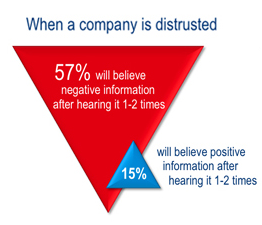
Source: The Edelman Trust Barometer 2011

Members of the  American public are frequently surveyed about their trust in various professionals.  Doctors and nurses usually wind up near the top of the list, especially when compared to lawyers, hairdressers and politicians.  Trust in professionals is important to us: they possess expertise we lack but need, to solve problems ranging from the serious (illness) to the relatively trivial (appearance).

How much professionals trust us seems irrelevant: our reciprocity is expressed in the form of payment for services rendered or promised, our recommendations to friends and families and repeat appearances.

So I was surprised to read an article in the Annals of Family Medicine describing a new scale to measure doctors’ trust in their patients.  This scale, based on input from focus groups and validation surveys of physicians, was developed for research purposes on the grounds that trust is a “feature of the clinician-patient relationship that resonates with both patients and clinicians.”

Hmmm. I hadn’t really thought about trust being a two-way street in my relationship with the doctors and nurses who take care of me.  But given the push for us patients to become actively engaged in our health care, it’s not surprising that questions would arise about how dependable we are as partners. And it is a sign of the times that as clinicians increasingly face incentives to deliver evidence-based medicine and are held accountable for our health outcomes, our trustworthiness as partners has become professionally, if not economically, important to them.

While this new scale is only a research tool, its creation nevertheless raises interesting questions about how traditional notions of trust in medicine are changing in the new clinician-patient relationships that the media urges us to forge. So let’s examine it as a reflection of the idea of physicians’ trust in their patients.

Here are nine of the 18 items of the trust scale.   Clinicians are asked:Continue reading…

Oregon Death with Dignity Act vindicated

To no one rational’s surprise, a study confirms that those few Oregon patients (400 over 10 years) who chose legal physician assisted suicide in case of terminal illness had a better quality of death than those who didn’t. Sadly because those attacking it aren’t rational, this won’t end the debate–but if you’re terminally ill you have better choices in Oregon (and Washington & Switzerland).

The Cost of Apples

By SAMUEL YANG

Up until last May, my experience of medical costs was limited to the $100 per month premium I contributed towards my employer-sponsored insurance and the nominal co-pays associated with well-child checkups and generic prescriptions. There was never any hesitation in seeing a doctor or filling a prescription. That all changed when went I back to school.

I blindly signed up for the school-recommended family insurance and naïvely assumed myself, my wife, and my two young children would receive whatever health care we needed at a relatively small co-pay. The upfront premium of $10,000 was high, but I believed that this would cover whatever life threw at us. However, two experiences woke me up from my ignorance: my wife’s endoscopy and a visit to the pediatrician.

In July, my wife was sent by her doctor to get an endoscopy to determine the cause of her stomach pain. In the weeks following her procedure, we started receiving statements from our insurance company.

The statements declared that we were responsible for the full amount. We received the following explanation from our insurance company, “We don’t cover preexisting conditions.”

As we argued with the insurance company, the hospital bills started trickling in: $1200 from the outpatient center, $200 from our family physician, $400 for the anesthesiologist and $200 from the lab. We received six bills demanding $2600 for one procedure. As I examined the bills I was shocked by the redundancy—why is the cost for the anesthesiologist not included in the outpatient center bill? Why do I need to pay my family physician twice (the initial visit and the follow-up) for a procedure she ordered us to do? Besides feeling hung-out-to-dry by my insurance company, I felt taken advantage of by the medical system. It seemed as if everyone in that hospital wanted to include something for our visit. Continue reading…

A Normal Pregnancy Is a Retrospective Diagnosis

By J.D. KLEINKE

The names in this article have been changed to protect the privacy of all individuals involved.

If every medical specialty has its homily for indoctrinating new members, “a normal pregnancy is a retrospective diagnosis” is the cynical soundbite for obstetrics. It is a patronizing and alarmist statement, meant to distance weary practitioners, terrify patients, silence objections from families, and establish the first defensive perimeter in the legal fortress that defines obstetrical practice in the US.

It is also the perfect, if inadvertent expression of how little obstetricians really know – and how limited the specialty is in its ability to test and expand that knowledge – thanks in part to the visceral fear inspired in patients by statements like “a normal pregnancy is a retrospective diagnosis.”

This homily serves as the opening taunt to one of the more quietly rebellious obstetrician/gynecologists (OB/GYNs) in my new book, Catching Babies. For reasons I’ll explain momentarily, the book began as an expose of the practice of high-risk obstetrics, but it quickly morphed into a novel, an ensemble drama about the brutalization of OB/GYNs during their residency training.

Continue reading…

A Growing Chorus on the RUC

By BRIAN KLEPPER

Yesterday on Kaiser Health News, Barbara Levy MD, the Chair of the AMA’s Relative Value Scale Update Committee (or RUC), published a glowing defense of the RUC’s activities. Her article extols the work of the 29 physician volunteers who, “at no cost to taxpayers…generously volunteer their time,” “supported by advisers and staff from more than 100 national medical specialty societies and health care professional organizations.” She fails to mention that the physicians’ and organizations’ efforts to craft the RUC’s recommendations have direct financial benefit to the physicians, specialty societies and health care professional organizations whose representatives dominate the RUC proceedings.

She points to the openness and transparency of the RUC’s proceedings, noting that “the general public is able to comment on individual procedures, and processes are in place to ensure that input from all stakeholders is considered by CMS. Finally, the AMA ensures transparency of the process, making the data and rationale for each RUC recommendation publicly available.” This, from an immensely influential Committee that refuses to share the identities of its members except by their societal affiliation, that keeps its proceedings private, and that can not be observed except by an invitation from the Chair. If anything, the RUC’s goings-on have been secretive and opaque. Go into any health care professional audience and ask, as I have, for a show of hands of people who know what the RUC is. It has been virtually unknown except in wonkiest circles.

Dr. Levy also points out that, in Medicare’s budget-neutral environment, hard decisions have to be made, and that in 2006, $4 billion – a little more than  one percent of that year’s Medicare allocation – was transferred to primary care. The clear implication is that this came at the expense of specialists. But she conveniently ignores the vast majority of coding valuations that have increased specialty income while strangling primary care. (More comprehensive background on the RUC, including articles by the AMA that describe the RUC’s perspective in detail, may be found here.)

Dr. Levy’s article presumably responded to a growing chorus of recent voices that have detailed the RUC’s disastrous impact on American health care, beginning most recently last October with a Wall Street Journal expose by Anna Mathews and Tom McGinty, and an explanation in the New York Times by Princeton health care economist Uwe Reinhardt. With David Kibbe MD, I wrote about this topic on Kaiser Health News in January, calling on the American Academy of Family Physicians (AAFP) to abandon the RUC. Then Paul Fischer MD joined in with his Family Physician’s Manifesto. All this work built on the foundation of many health care professionals – John Goodson, MD; Robert Berenson, MD; Thomas Bodenheimer, MD; Roy Poses, MD to name a few – who have carefully documented the biases and excesses that have been wrought by the RUC’s shadowy process.Continue reading…

A Patient is Not a Shunt

By EVAN FALCHUK

Some people may tell you that health care IT will solve many of the quality and cost problems in health care.

I don’t believe them.

I know a 70-year old man named Carlos (not his real name) who was hospitalized following a bout of hydrocephalus.  Hydrocephalus is a build-up of fluid in the skull, which affects the brain.  Among other things, people with hydrocephalus can be confused, irritable, and nauseous.  Carlos had all of these symptoms.

Carlos’ problem was fixable by inserting a special kind of drain in his head called a “shunt.”  This kind of shunt is, essentially, a series of catheters that runs from the brain into the abdomen, and which drain the excess fluid.  You can’t see it from the outside, so it’s meant to stay inside of you for a very long time.

For a week after Carlos’ shunt was installed, his symptoms completely disappeared.  But they soon started to re-emerge.  Worried, his family took him to the hospital.  Doctors found that his hydrocephalus was back – the shunt wasn’t draining properly.  They admitted him to the hospital, and the next day they put in a new shunt.  The surgery went well.

Continue reading…

Primary Care Workforce Situation: Not Hopeless

By DAVID E. WILLIAMS

I sometimes observe that the only sector of the economy as messed up as health care is higher education, where the US has some great institutions but where costs are incredibly high and have been rising relentlessly for long periods of time. These two dysfunctional systems intersect in multiple places, one of which is the cost of medical school and its impact on the physician workforce.

One of the reasons the cost of health care is so high in the US is the overemphasis on specialists vs. primary care relative to other advanced countries. That overemphasis is a result of multiple factors, including a reimbursement system that favors procedures and the prestige associated with specialties. But another significant factor is the cost and financing of medical school. Average debt levels for graduating medical students are around $150,000. Combine that with leftover debt from college and it’s easy to get up into the $200,000 range. That’s a big nut to pay off in primary care where typical compensation is $150,000 per year or so.

That large debt level certainly encourages graduating medical students from going into primary care. My guess is it also deters some would-be primary care physicians from going to medical school in the first place.Continue reading…