
Categories

Category: Medical Practice

My Own Story of ALS

By AL LEWIS

I would like to introduce our newest regular contributor, Al Lewis. Some of you might recall him from his guest-postings, sometimes offensive, usually controversial but always based on both fifth-grade arithmetic and principles of economics, two subjects that he respectively took in fifth grade and taught for two years at Harvard.

Al is asking for a tiny bit of help from us, which is to go to his ALS site and “like” it and maybe add a facebook comment.   He is trying to get CMG Marketing (the official licensing contractor for Major League Baseball) to sell Lou Gehrig jerseys to raise money and awareness for ALS.  Increasing the popularity of that site increases the likelihood of his getting CMG’s attention with his fundraising idea. –  Matthew Holt

It occurred to me that I have yet to post my own story in detail, and some of you asked me to do that after seeing my wedding photo.

Janet and I had dated for a while, and though we had broken up, we had become more like “besties” when she started to feel that something was amiss.  I (and other close friends) took her to several doctors to try to discern what was wrong.   I know many of you experienced the same thing with your loved ones, where you had to visit multiple doctors before getting a diagnosis.   Then came the day — and no doubt you had a similar day too — when you finally get the definitive diagnosis.  The Mass General neurologist, Dr. Cros, had very thoughtfully scheduled this visit as the last one of the day, so that the four of us there could be in his office into the evening, asking questions, holding back tears, cross-examining him to make sure we hadn’t overlooked any possibility for treatment, even something in early-stage clinical trials, with mice even.

After that, we went about our lives.  Of course I continued to be supportive as best friends would be.  But I couldn’t stand to watch her deteriorate in front of me like this.     At one point her condition had declined so much that at her health club (Mt. Auburn) where she had been a member of for 20 years, someone asked what was wrong.  About a day after I told the person at the front desk, the manager wrote back and said he was going to comp her membership for the rest of her life.Continue reading...

One Clue to Why Health Care Costs are So High?

By DAVID WILLIAMS

I often hear from hospitals that they’re being squeezed greatly on cost and not getting paid enough by government and private payers. I have some sympathy for this argument, but on the other hand somehow this country outspends every other country by at least two to one, and hospitals are a big part of the reason.

So what gives?

An article in yesterday’s Wall Street Journal (One Way for Hospitals to Cut Costs of Tests), reporting on an Archives of Surgery study, provides part of the answer.

Making physicians aware of the costs of blood tests can lower a hospital’s daily bill for those tests by as much 27%, a new study suggests.

Researchers simply told the doctors what things cost.

“There was no telling anyone when, or when not, to order a particular test,” says Elizabeth Stuebing, a study co-author…

But she says it shows what can happen merely by giving physicians information they don’t usually have. “We never see the dollar amount of anything,” Dr. Stuebing says. “The first week I stood up and said that in the previous week we’d charged $30,000 on routine blood work and I could hear gasps from the audience.”

The situation doctors are in today is sort of like being sent to a store and told to get what they need, but not paying for the goods and not  knowing the prices of the items or even which items are expensive and which are cheap. That’s certainly a formula to run up the bill, even if inadvertently –which is what the “gasps from the audience” indicate.

The experiment was analogous to putting prices on the items in the store, but still letting the shopper buy whatever they thought they needed. That’s a step in the right direction but not exactly draconian from a cost control standpoint! (Of course there are some cost control measures hospitals impose centrally, which is different from my shopping analogy.)

I have mixed views on whether physicians should be exposed to what things cost. Pricing in hospitals is not like pricing in stores, because “charges” are often a small fraction of what’s ultimately reimbursed. I don’t know that I want doctors making tradeoffs based on faulty data or an incomplete understanding of patient preferences.Continue reading…

The System Firsthand

By BRAD FLANSBAUM

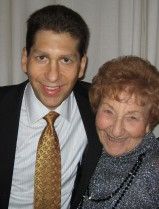
Grandma and me

Grandma is 93.  The matriarch of my family is in worsening health, and her decline is difficult to observe.  We all experience the travails of the US health care system at some point, and in my family’s case, ours is no exception.  The stress on my mom and aunt is considerable, and my grandmother is increasingly alarmed at her frailty and poor memory.

Through July of 2010, she was independent.  She walked daily, traveled, drove (that is another story), and enjoyed her brainteaser and crossword puzzles.  By all accounts, she was happy, albeit with the usual pangs of age.  She took no medication.

Last summer that changed when she fell and underwent a 3-day hospital stay.  Her memory was not the same and her gait was unsteady thereafter.  It was a minor stroke.

After discharge, her functional status worsened, and the vicious cycle we all witness as docs—setback beget setback—reared its head.

My mom sold the house, and grandma moved into an assisted living facility, a lovely place, but it was not home.  Her refrains, “the food and company are lousy, and I am depressed and lonely,” along with an assortment of other issues —all upsetting, given the vitality of this woman until recently—presented and intensified.  Relocation trauma is a known condition, but one you would differentiate only if you witnessed it firsthand.  I am now familiar with a (new) geriatric term.Continue reading…

When It Comes to Patient Safety, Caution Isn’t a Four-letter Word

By JORGO CHATZIMARKAKIS

Around the world and now in the United States, there is a broadening discussion of how best to proceed down the path of approving and getting to market medicines called biosimilars.  Biosimilars are non-identical copies of next generation medicines known as biologics.  As the U.S. begins establishing new guidance for biosimilars, regulators and legislators should look to the European Union model on guidance policy and approve these important, often life-saving, drugs when they are proven to be safe for the patients they are intended to heal.

There is justified debate and concern both here in the EU and other nations on how best to introduce biosimilars into the marketplace.  We know from the science, that it’s immensely more difficult to  produce a biosimilar than a generic version of a traditional drug.  And with this increased difficulty, comes increased risks to patients in the form of efficacy and drug-to-drug interactions.  However, by adding biosimilars to the treatment regimen, we can hope to see long-term therapy at the lower costs that biosimilars may be able to provide.  This is important to every country struggling to meet the demands of an aging population and rising health care costs.

As policymakers this dilemma is made easier because our focus must always be on patient safety.  Citizens trust that their nation’s regulatory bodies are looking out for their best interests and doing their due diligence to ensure a safe drug supply.  So patient safety is our starting point, our ending point, and our path along the way.Continue reading…

A New Norm for Hospital Operations

By CHARLIE EVANS

Since the passage of the Patient Protection and Affordable Care Act (PPACA), I have had the opportunity to engage a wide variety of colleagues, policymakers, and noted health care thinkers about the effects of health care reform on hospitals.  With the hindsight of over 30 years managing hospital operations, I have developed the strong belief that if hospitals are to improve significantly the systemic delivery of care we must commit to making bigger changes than may seem reasonable.  Moreover, hospital administrators entering the field will do well to consider changes of this scale as the “new norm” that will likely govern the industry for the next several decades.

Proposed reforms, like Medical Homes, Accountable Care Organizations and bundled payments, have consumed much of the focus since passage of PPACA, yet they will not be enough to achieve the national goal of high quality, low cost care.  Many progressive organizations have been successfully utilizing variations of this payment methodology and these delivery systems for extended periods of time, but there is little evidence that national adoption of these delivery systems alone will produce the results the country needs.  To have a substantial impact on slowing the growth of care delivery costs we must make a giant leap forward in everything from design of facilities to the processes that govern care delivery to how we utilize information technology.

With more than 5,000 hospitals operating in the country, the thought of altering the fundamental operating design of hospitals may seem to be unreasonable.  However, if we are to design a health system for the 21st century then let’s begin from the ground up.  The industries that produce the best quality products most efficiently today do not use production facilities designed and built 30-50 years ago.  They have recognized the need to streamline facilities so that products move through the operational cycle more quickly; sub processes efficiently contribute to the overall system aim; and information technology delivers a snapshot of any component of the business on demand and in real-time.

Can our most modern hospitals do that? Overwhelmingly the answer is no.  Those who say that we are diagnosing and treating people, not creating widgets, miss the essential truth that if we decrease the waste and inefficiency in hospitals, we can free doctors and clinicians from unnecessary tasks and give them more time to spend with patients. By embodying proven efficiency practices already established in other commercial sectors, within the clinical processes currently employed in hospitals, we can establish a foundation for total hospital efficiency that will significantly benefit patients and lowers costs.

Continue reading…

Musings on PHRs & Consumer Engagement

By JOHN MOORE

The recent post on Google Health going into the deep freeze has solicited a number of emails, including some from the press. In one of those emails a reporter had spoken to several industry thought leaders to garner their opinions which follow:

Consumers will not sign on to most Personal Health Platforms (PHPs) or services due to the issue of trust.
– Leading researcher and developer of an open PHP.

Provider sponsored PHPs and patient portals will dominate the market for they offer services that patients/consumers want such as appointment scheduling, prescription refill requests, etc.
– Leading CIO who is also actively involved in HIT policy development.

The only people who care about a PHP, PHR, whatever you wish to call it are those who are struggling with a life-changing illness.
– Co-founder of leading site for those with serious illness to gather and share experiences.

Chilmark’s thesis is an amalgamation of the last two statements (we’ll get to the first one shortly).

By and large, people do not care about their healthcare until they have to, either for themselves or a loved one. Even then, if they are very sick, it may be far more than they are capable of to set-up and maintain a PHP. These systems are still far too hard to create and manage, let alone trying to get doctors and hospitals to feed complete records and updates into them in some automated fashion. There may be an opportunity in providing a system for baby boomers to help manage their aging parents health issues from afar. We have yet to find a PHP, PHR, whatever you wish to call it that ideally fits this market need and may be an opportunity for an enterprising entrepreneur.Continue reading…

The Last Best Hope

MARGALIT GUR-ARIE

By MARGALIT GUR-ARIE

According to the recently published CMS Accountable Care Organization (ACO) rules, an ACO needs to care for at least 5000 Medicare beneficiaries. Theoretically, two primary care physicians and a nurse, practicing in a garage, or cottage, in Boonville Missouri (yes, there is such a place), seeing nothing but Medicare folks, could become an ACO. Of course, they would have to set up a business entity with a board of directors, hire a couple of lawyers, several accountants and contract with a hospital or two and a score of specialists, and be ready to accept financial risk for their patients in a couple of years; all this on top of seeing twenty to thirty elderly and complex patients every single day. Nope. Not going to happen.

ACOs are for the big boys, hospitals and/or extra-large multi-specialty groups, to set up, manage and perhaps eventually benefit from. Big systems, as we all know, enjoy economies of scale, are better able to manage and coordinate care, and are therefore uniquely equipped to solve our health care crisis by providing better care at lower costs, and ACOs are just the vehicle by which these systems will be rewarded for all that good work. If you care for people in a small primary care practice, you could bite the bullet and sell out to a large system, or you could retire if you are one of those last standing dinosaurs, or you could become a concierge practice, or you could sit still and watch your practice dwindle and die, or you could buy an EHR, which is the last best hope to keep primary care independent.

Science, the type of science that employs mathematical hypotheses, theorems, proofs and equations, is timidly asserting that the emperor is in need of some serious clothing. A 2009 paper published in a non-medical, non-health care venue, “examines the staffing, division of labor, and resulting profitability of primary care physician practices”. The authors who are researchers from the University of Rochester and Vanderbilt University conclude that “many physicians are gaining little financial benefit from delegating work to support staff. This suggests that small practices with few staff may be viable alternatives to traditional practice designs.” Although I did not check the math, which is extensive, I would have expected that such controversial conclusion would make headline news in health care policy forums for at least two or three days. It did not.Continue reading…

The Hospitalist Field Turns 15: What The Past Says About The Future

By BOB WACHTER, MD

I just returned from the Society of Hospital Medicine’s annual meeting in Dallas. Seeing more than 2,000 hospitalists in one place is remarkable, since I remember the days when we all fit into a mid-sized conference room at a Holiday Inn.

I have clearly assumed the mantle of elder statesman at these meetings. I find this odd, since my idea of an elder statesman is UCSF’s former chair of medicine, Lloyd Hollingsworth (“Holly”) Smith, a man of unbelievable accomplishment and grace. Holly is now in his late 80s, and every year we ask him to say a few words at our department’s annual faculty dinner. Holly is the best after-dinner speaker I know – his comments, always insightful and hilarious, are increasingly peppered with “old guy” references (my recent favorite: “I’ve now reached the age of – when I reach down to tie my shoes, I ask myself, ‘Is there anything else I need to do as long as I’m down here?’ before I get up.”)

I’m not complaining: for the past decade, I’ve had the honor of giving a closing keynote address at the annual hospital medicine meeting. In this week’s talk, I reflected on the history of the hospitalist field, in the 15 years since Lee Goldman and I coined the term in the New England Journal of Medicine.

This kind of reflection is useful because, in a world in which we’re all drinking out of a huge information hose, it’s easy to focus on the short term and lose track of the arc of history. Self-help guru Tony Robbins had it right when he said, “Most people overestimate what they can do in a year, and underestimate what they can do in a decade.” Our 15-year history proves that.Continue reading…

The Dual Online Identities of Physicians

By GLENN LAFFEL

Like everybody else, physicians are expanding their online personal identities. At the same time, they are trying to comply with codes of conduct that help consumers trust them and their profession.

There’s no problem so long as the personal online activities of physicians don’t jeopardize their obligations as professionals, which means that there is a problem, unfortunately.

In a recent study for example, 17% of all blogs authored by health professionals were found to include personally identifiable information about patients. Scores of physicians have been reprimanded for posting similar information on Twitter and Facebook, posting lewd pictures of themselves online, tweeting about late night escapades which ended hours before they performed surgery, and other unsavory behaviors.

As I mentioned Monday, medical students and younger physicians who grew up with the Internet have to be particularly careful, since they had established personal online identities before accepting the professional responsibilities that came with their medical degree.

Medical schools, residency programs and teaching hospitals can help young professionals manage their dual lives online. Some have implemented curricula and policies that foster appropriate use of social media, but surprisingly these programs are not widespread. In a recent study of medical schools that had experienced at least one incident in which a student used social media inappropriately, only 38% had adopted formal policies to handle future incidents. An additional 11% reported they were developing such policies. We can do better than this.

Non-teaching hospitals, CME providers and professional organizations like the American Medical Association can also help providers navigate the online world. The AMA’s recent guide to Professionalism in the Use of Social Media provides helpful guidance in this regard.

Continue reading…

Outrage is Easy. Solutions are Hard.

By MERRILL GOOZNER

The inspector general of HHS reported this week that nearly half of the anti-psychotic drugs fed to the demented elderly in nursing homes are inappropriately prescribed. That’s about one in fourteen nursing home residents.

Forget about cost, which is over a quarter billion dollars a year. “Government, taxpayers, nursing home residents as well as their families and caregivers should be outraged and seek solutions,” wrote Daniel R. Levinson, the HHS I.G. wrote in his letter to Senators Charles Grassley (R-Ia.) and Herb Kohl (D-Wis.), who asked for the report.

Why is this happening? First, the medication patterns of the frail elderly are not monitored by the Centers for Medicare and Medicaid Services, which is afraid of a backlash from Capitol Hill where doctors and nursing home operators fiercely lobby to protect the hallowed doctor-patient relationship. The drug industry has also, in some cases, paid kickbacks to the pharmacy operators in nursing homes.

But at the root of the issue are the doctors who are faced with caring for these patients. Even though clinical trials have shown the drugs are likely to result in earlier deaths for some of these elderly patients, doctors prescribe them to reduce agitation, as Daniel Carlat, a practicing psychiatrist and purveyor of non-industry-funded continuing medical education, told the New York Times. “Doctors want to maximize quality of life by treating the patient’s agitation even if that means the patient will die a bit sooner,” he said.

As someone who watched his father’s decline with dementia over a ten year period (usually from a distance), I can attest that shortening one’s lifespan is not the crucial issue, especially in the last few years when the personality in the shell of the human being that has survived the loss of cognition has largely disappeared. The first question is whether the anti-psychotics are effective in reducing the outbursts associated with severe dementia, and whether those benefits outweigh the side effects (catatonia?). The second question is whether families have been adequately informed about the risks and benefits of this approach. That the drug companies deploy their marketing arms to stoke sales in this situation is outrageous. But even eliminating their right to do so wouldn’t solve the underlying problem.