Categories

Author Archives

John Irvine

After Transparency: Morbidity Hunter MD joins Cherry Picker MD

Screen Shot 2015-07-17 at 11.09.40 PM

When report cards of performance became available, cardiac surgeons in New York and Pennsylvania avoided high risk patients. Could something similar happen, nationally, after the forthcoming revolution in transparency inspired by Propublica’s data release?

Take two fictional orthopedic surgeons, Cherry Picker MD and Morbidity Hunter MD.

Cherry Picker lives in the Upper East Side of New York. His patients give him great reviews on Yelp. His patients read every comment on Yelp before making any decision. Cherry Picker has a beautiful family. When he smiles, light refracts from his shiny teeth.

Cherry regularly appears on TV. He writes for the sleek, metrosexual publication, FHM. Cherry specializes in knee injuries in weekend warriors. His patients often call him from the ski slopes in Colorado, Whistler and Zermatt. Cherry is good at his craft. But his patients are even better at their craft – post-operative recovery. Cherry doesn’t actively seek such patients. His patients are selected for him by his zip code, reputation, long waiting list and Yelp.

Morbidity Hunter’s real name is Harjinder Singh. He migrated from Punjab and works in a safety net hospital in North Philadelphia. Singh wanted to work in Beverley Hills, but to convert his J1-visa to a green card, he had to work in an area of need. Once he started working, he liked his job. His daughters liked their school and his wife liked the house they bought. Singh doesn’t have shiny teeth. He hasn’t appeared on TV, although his daughters tease that he can play Sonny from Exotic Marigold Hotel.

Singh’s colleagues named him Morbidity Hunter because he operates regardless of how sick his patients are. He never says no. Nearly all his patients are obese and diabetic. The School of Public Health sends students to shadow him to learn about polypharmacy. The hospital went on a spree of hiring hospitalists when Singh started. Continue reading…

How Is Health Reform Impacting Insurance Switching Patterns?

Screen Shot 2015-07-18 at 6.56.00 AMAmericans typically don’t switch health insurance, and that has not changed much with healthcare reform. Despite controversy with the converse scenario – the ability to keep the same insurance – and the introduction of health insurance marketplaces, data from ACAView suggests switching behavior has been modest.

For this latest ACAView research, our team set out to determine how the ACA’s insurance coverage expansion has influenced patient behavior in switching insurance coverage. We looked at patients’ switching patterns, and how those have shifted for a subset of patients who have visited primary care providers at the same practice at least once a year between 2013 and 2014 and/or between 2014 and 2015.

Our research revealed five key findings:

In Medicaid expansion states, over 40% of uninsured patients obtained insurance the following year, in both 2014 and 2015. In comparison, in non-Medicaid expansion states, about 25% of previously uninsured patients obtained insurance during the same time periods. Conclusion: Medicaid expansion has allowed a higher proportion of previously uninsured patients in continuous care to obtain insurance.

In Medicaid expansion states, the proportion of commercially insured patients switching to Medicaid coverage – though rare – has doubled. In 2014, 1.2% of commercially insured patients in continuous care switched to Medicaid coverage. Prior to coverage expansion, only 0.6%  switched to Medicaid coverage in the subsequent year. (In 2015, this proportion increased to 1.6%.)

With coverage expansion, the percentage of commercially insured patients who switch coverage the subsequent year has increased: from 15.0% pre-expansion to 18.3% in 2014 and 17.3% in 2015. This may occur because some commercially insured patients switch to plans on the health insurance marketplaces because they are eligible for subsidies.

The switching behavior of people who changed plans or payers had no notable impact on utilization. Whether patients switched commercial insurance plans with the same payer, or they switched payers, there were no clear changes in either visit frequency or relative value units (RVUs) per visit.

Patients with a range of chronic conditions[1] (high cholesterol, hypertension, and diabetes) are less likely to switch insurance coverage. In contrast, patients diagnosed with mental disorders were more likely to receive insurance coverage.

Continue reading…

Watson will replace me? Not a chance!

Screen Shot 2015-07-16 at 11.29.19 AM

Arthur C. Clark and Stanley Kubrick predicted supercomputers more intelligent than humans.  In 2001: A Space Odyssey, the HAL states, with typical human immodesty, “The 9000 series is the most reliable computer ever made… We are all, by any practical definition of the words, foolproof and incapable of error.” Forty years later, IBM’s Watson pummeled humans in Jeopardy – a distinctly human game.

Watson is a big shot oncology fellow at MD Anderson – he is already impressing nurses and the attendings.  The supercomputer presented patients in the morning rounds, parsed data within seconds, and made few mistakes. The real oncology fellow, the human I mean, flabbergasted by the efficiency of his binary colleague, relayed to the Washington Post, “Even if you work all night, it would be impossible to be able to put this much information together like that.” Watson doesn’t have to worry about duty hour restrictions.

CEO of IBM, Ginni Rometty, claims that Watson 2.0 will interpret medical imaging like a radiologist.  In its third iteration, the supercomputer will “debate and reason.” Why hire radiologists who sap productivity with lunch breaks and sleep?  Watson will never complain about the dearth of vegan food in the cafeteria, never get tired, and – best of all – never whine about Medicare reimbursement cuts.

But forgive me for snoring at night without fear of the Robo-Radiologist. The reasons are simple.

Continue reading…

Physician Accountability Gets a Big Push Forward

Screen Shot 2015-07-15 at 6.23.51 PMDoctors are human. Their talents and skills differ. They make mistakes. And as with every other area of human endeavor: some doctors are really good; some are pretty bad; most are average. If you are over age 50, you’ve likely met an example of all three.

In the past decade there’s more open recognition of this reality and the need to address the failures it creates in medicine and the delivery of care. There’s more willingness now to say out loud that it’s not just poor system dynamics or gaps in planning, knowledge or training leading to poor care and bad results; it’s also the differential skills and ability of the people delivering care.

Continue reading…

Surgical Complication Rates and the New Data Perspective

jordan shlain

In an age where the importance of data, statistics and predictive modeling win big games for baseball teams and make fat money for high-frequency traders, we are at the dawn of a new age of transparency in healthcare  It behooves every actor, in every sector, to use this new perspective to constructively illuminate best practices and design an infrastructure for true operational, clinical and logistic efficiencies at large scale and the local level – all in the spirit of getting the patient the best outcome.   

Every modern industry uses ‘big data’ to understand  the dynamics of their market landscape. This in turn, enables them to make decisions and develop strategies for gaining market share and building their brands. Fortress medicine has received a shot over the bow regarding the power of this new data perspective and needs to craft visionary, courageous yet mindful strategies that includes the bright light of outcomes into their private practices, clinics and large institutions. Propublica, in a seminal article, Making the Cut, shows us the power of transparency in complications rates during surgery. Doctors and their patients, since the dawn of medicine, have existed in a world without clarity around outcomes – there was not way to meaningfully collect it and analyze it. What Yelp has done for small business and Zagat has done for fine restaurants, CMS just did for the medical profession….and it just might be a needed dose of datacillin to start an honest conversation about what this all means.Continue reading…

The Hidden Side of Health Care: How Rural Pennsylvania Is Facing and Overcoming Obstacles

 RuralPAHeader-ALV

Although Pennsylvania is the sixth most populous and ninth most densely populated state in the Union, based on information from the United States Census Bureau from 2010 and 2013, it also is home to a significant amount of rural areas. According to the Pennsylvania Rural Health Association, 48 of the 67 counties in the state are classified as rural, and all but two counties have rural areas. Approximately 27 percent of Pennsylvanians lived in rural counties in 2010, The Center for Rural Pennsylvania reports.Continue reading…

What Company Will You Keep? Strategy In Health Care’s New Era

Joe-FlowerHow do you plan? Obviously, you have to. Obviously, you can’t.

For your organization, and for you as a health care leader, the rapid and, at times, chaotic changes in the payment systems, the purchasers’ strategies, your population base, new technological possibilities, and the competitive landscape mean that you must plan for the future and act vigorously to make that future happen — or you fail. At the same time, those very same factors render traditional planning methods irrelevant, impossible, even deadly.

The movie line that comes to mind is, “Forget it, Jake. It’s Chinatown.” But we can’t just forget it. We must figure this out.

Let’s step through it: the shape of the complexity we are dealing with, how the process must change to deal with it. Then we get to a core issue that often gets overlooked: What kind of mind do we need for this new thinking, and how do we cultivate it?

Continue reading…

Why Health Care Performance Measures Need Their Own Grades

Screen Shot 2015-07-13 at 7.04.54 PM

Some measures of health care quality and patient safety should be taken with a grain of salt. A few need a spoonful.

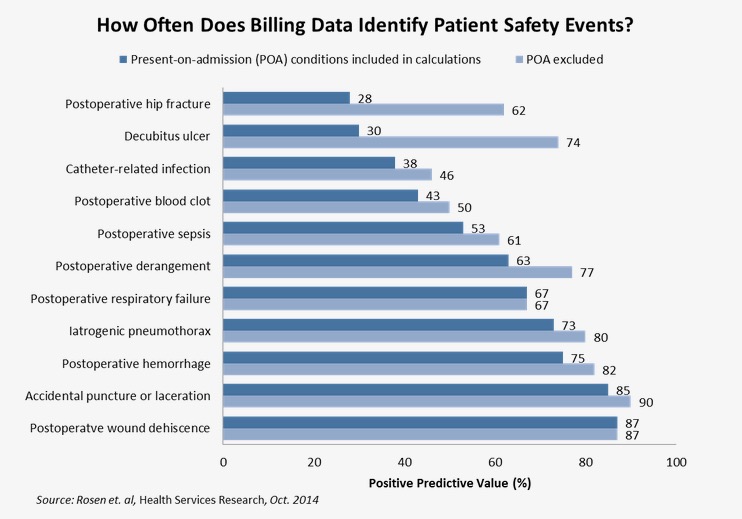
In April, a team of Johns Hopkins researchers published an article examining how well a state of Maryland pay-for-performance program measure for dangerous blood clots identified cases that were potentially preventable. In reviewing the clinical records of 157 hospital patients deemed by the state program to have developed these clots — known as deep vein thrombosis and pulmonary embolism — they found that more than 40 percent had been misclassified. The vast majority of these patients had clots that were not truly preventable, such as those associated with central catheters, for which the efficacy of prophylaxis remains unproven.

These misclassified cases of blood clots resulted in potentially $200,000 in lost reimbursement from the state, which penalizes hospitals when the additional treatment costs related to more than 60 preventable harms exceeds established benchmarks.

Why the discrepancies? The state identified cases of these clots using billing data, which utilize the diagnosis codes that medical billing specialists enter on claims. These data, also known as administrative data, lack the detail that would be available in the actual clinical record, considered by many to be the most trusted source for safety and quality measures.

Continue reading…

Bungled Payments

Paul KeckleyThe proposal involves a five-year bundled payment model across 75 geographic areas whereby hospitals would be eligible for a bonus if their costs and outcomes were optimal or be penalized if not based on results 90 days post-discharge. The agency noted that in 2013, it spent more than $7 billion on hospitalization for these procedures with the payments for hospitalization and recovery ranging widely from 16,500 to $33,000. Comments about the proposal will be received by CMS through September 8, 2015, aiming for implementation January 1, 2016.

Their rationale, according to Secretary of Health and Human Services Sylvia Burwell, in the HHS statement announcing the proposal: “By focusing on episodes of care, rather than a piecemeal system, hospitals and physicians have an incentive to work together to deliver more effective and efficient care. This model will incentivize providing patients with the right care the first time and finding better ways to help them recover successfully. It will reward providers and doctors for helping patients get and stay healthy.”Continue reading…

How Big Data Can Be Used to Improve Early Detection of Cognitive Disease

ClockThe aging of populations worldwide is leading to many healthcare challenges, such as an increase in dementia patients. One recent estimate suggests that 13.9% of people above age 70 currently suffer from some form of dementia like Alzheimer’s or dementia associated with Parkinson’s disease. The Alzheimer’s Association predicts that by 2050, 135 million people globally will suffer from Alzheimer’s disease.

While these are daunting numbers, some forms of cognitive diseases can be slowed if caught early enough. The key is early detection. In a recent study, my colleague and I found that machine learning can offer significantly better tools for early detection than what is traditionally used by physicians.

One of the more common traditional methods for screening and diagnosing cognitive decline is called the Clock Drawing Test. Used for over 50 years, this well-accepted tool asks subjects to draw a clock on a blank sheet of paper showing a specified time. Then they are asked to copy a pre-drawn clock showing that time. This paper and pencil test is quick and easy to administer, noninvasive, and inexpensive. However, the results are based on the subjective judgment of clinicians who score the tests. For instance, doctors must determine whether the clock circle has “only minor distortion” and whether the hour hand is “clearly shorter” than the minute hand.

Continue reading…

assetto corsa mods