Categories

Category: Medical Practice

Pre-Conferences kick off Health 2.0

By MATTHEW HOLT

We were coding up a storm yesterday (Saturday) at the Health 2.0 Developer Challenge Code-a-thon and that goes on today–you can even stop by the PariSoma Loft to see the live judging at 3pm — with $13,000 in prizes on the line.

But the main act is starting up TODAY with 4 fabulous pre-conferences.  Don’t forget these are FREE to anyone registered to attend the main conference and to doctors, patients and employers as appropriate for their sessions. There’s also an Innovation Exchange with the Beacon Communities which has some public availability.

The Pre-Conferences: Patients 2.0 brings together more than 150 patient activists. Doctors 2.0 has several leading physicians on stage and in the audience, and more than 15 demos and active panel discussions. Employers 2.0 has leading employers again on stage and in the audience (Wanna meet Facebook’s head of benefits? -scan the badges!) and more demos than you can shake a stick at–as long as some cool case studies from Pfizer on wellness and Cisco on worksite clinics.Continue reading…

The Math of E/M Coding: When Does 5=1?

By PAUL FISCHER

My typical Medicare patient expects me to deal with 5 or more problems in a single routine visit.  There are usually around 3 old ones (e.g., diabetes, hypertension, hyperlipidemia) and at least 2 new ones (e.g., low back pain, fatigue).  For those who come with handwritten lists, there may be as many as 10, including every health question that has come to mind over the past 6 months (Should I take a holiday off of Fosamax? Should I add fish oil? Do I need another colonoscopy? Is the shingles shot any good?).

Physicians who do procedures get paid for each one done to a single patient on a particular day. Medicare’s rule for this – the Multiple Procedure Payment Reduction Rule (MPPR) – says doctors should be paid 100% for the first procedure and 50% for each subsequent procedure up to 5. However, for those of us whose work is primarily cognitive rather than procedural, there is an important exclusion:  the multiple-payment rule does not apply to E/M codes.  In fact, the definitions of 99213 and 99214 unambiguously state, “Usually the presenting problem(s) are of . . . complexity.” Note the “(s)”! It clearly creates a double standard that favors doing procedures and places thoughtful solving of patients’ problems at a disadvantage.

So in my case, 5 or 10 or more separate patient problems equal one payment. The “(s)” in the AMA’s CPT book is the most outrageous injustice to primary care of this generation.  Because of it, the AMA’s CPT committee is accountable for even more damage to primary care than is their RUC!  Think how different life in primary care would be if the “(s)” were removed and you were paid 50% for each additional patient problem you addressed in a single office visit!

Continue reading…

Why Patient Lab Data Should Be Liberated

By MARYA ZILBERBERG

I am admittedly not an expert on health IT, but I am a firm believer in the empowerment of patients to be the driver of her/his health decision making. So this whole discussion about lab data being available directly to the patient is of great interest to me. But it does seem like yet another instance of the two sides coming together not to listen to each other but to be heard by the other side. And as well know, this works so well for any relationship!

Each side’s view is represented roughly thusly:

Patients These are my data and I have the right to access them as soon as they are available.
Doctors We are worried that the sheer volume, complexity and irrelevance of (much) of the data will make it confusing and unnecessarily alarm the patient

Both arguments are valid, of course. But it is important to ask what lurks below the visible portion of each iceberg.

Let’s take the patient view. Why do I want immediate access to my data? Well, obviously, because it is mine, it represents the results of testing on my body, and the record should belong to me. I should be able to access it freely whenever I damned well please. I am also more than a little exasperated with having to wait sometimes days to hear from my doctor’s office about a result that has been available for a while, but was buried under the reams of paperwork on the MD’s desk or his/her assigning a low priority to my data. And I am most exasperated when my lab results get lost or otherwise never make it to me at all. Perhaps if I have direct and unfettered access, this will make thing more efficient for me as an individual.

Continue reading…

From Couch Potato to Quantified Self

By JOSEPH KVEDAR

I’ve been interested in the growing population of folks who self-track objective data for health purposes.  The phenomenon is referred to either as personal informatics or the Quantified Self.  Both concepts have a following and both are intimately tied into the value of connected health.  Connected Health adds value in two fundamental ways:  self–care and just-in-time care.  In both cases, objective, quantified data is a critical piece of success.   For those individuals who are even a bit motivated to improve their health, quantified, objective information leads to insights that prompt behavior change.

I had a chance the other day to catch up with Gary Wolf, who is one of the founders of Quantifiedself.com, a frequent contributor to the New York Times Sunday Magazine and a Contributing Editor at Wired.  We had an inspiring discussion about the intersections of Quantified Self and Connected Health.

Gary was a bit out of breath, having just wrapped up the first Quantified Self Conference in Mountain View, CA.  Gary was very excited about the conference and its impact.  More than 100 projects were presented, 60 talks were given and more than 25% of participants presented.  When I asked him what was ‘the hook,’ i.e. why is QS taking off so fast, his response was that, “people are reaching the realization/hope that personal data have personal meaning.”  We both agree that the growing interesting in quantification is bringing us beyond the ‘data is geeky’ stage to an era where there is a real movement around the collection of data and the use of that data to gain insight about health and affect behavior change.Continue reading…

Minute Clinics Threaten Doctors: Who Wins?

By MICHAEL KIRSCH

All of us have been to fast food establishments. We go there because we are in a hurry and it’s cheap. We love the convenience. We expect that the quality of the cuisine will be several rungs lower than fine dining.

We now have a fast medicine option available to us. Across the country, there are over 1000 ‘minute-clinics’ that are being set up in pharmacies, supermarkets and other retail store chains. These clinics are staffed by nurse practitioners who have prescribing authority, under the loose oversight of a physician who is likely off sight. These nurses will see patients with simple medical issues and will adhere to strict guidelines so they will not treat beyond their medical knowledge. For example, if a man comes in clutching his chest and gasping, the nurse will know not to just give him some Rolaids and wish him well. At least, that’s the plan.

Primary care physicians are concerned over the metastases of ‘minute-clinics’ nationwide. Of course, they argue from a patient safety standpoint, but there are powerful parochial issues worrying physicians. They are losing business. They have a point that patients should be rightly concerned about medical errors and missed diagnoses at these medical care drive-ins. These nurses, even with their advanced training, are not doctors. It is also true serious or even life threatening conditions can masquerade as innocent medical complaints and might not be recognized by a nurse who treats colds and ankle sprains.

Continue reading…

Ten Years Cancer-Free

By BENJAMIN RUBENSTEIN

I enter the large, dark room, approach the table in the middle, and lie face-down. I bury my head in a pillow and close my eyes. I hear the nurse exit and close the door behind her. The door locks, and the “Radiation” sign illuminates.

I hear the machine turn on and move, get in position, and hover over me. I fidget to get comfortable one last time, and then I do not move. I focus on my breathing and I focus on my muscles not twitching. The energy about to exit the machine over the next ten minutes—the amount in about 180 CT scans—will burn my skin, which is already tomato-red from the previous 24 sessions I’ve had. It will blaze through my intestines, muscles, nerves, and now-dead bone. Most importantly it will annihilate the cancer cells that I believe have already been dead for 11 months. Dead from the first of 14 cycles of chemo. Dead because I felt them burning alive, a pain I will never forget and a pain I wish I hadn’t taken Tylenol to mask.

Minutes later, the machine stops making noise. I hear the nurse open the massive steel door and say that radiation is over. I follow her into the lobby. She says she will miss me, hugs me, and gives me a Hershey’s bar. I am confident that I will never receive another milliliter of chemotherapy. I will never again lie motionless in front of a machine that shoots waves of destructive energy through me. I will never again be termed a “cancer patient”; be seen as the Sick Kid; have another nurse say she will miss me.

It is Friday, September 14, 2001, at 3:40 p.m.. I am a bone cancer survivor, age 17.

Continue reading…

5 Ways You Can Avoid Being Misdiagnosed

By EVAN FALCHUK

Billionaire Teddy Forstmann has apparently been diagnosed with a serious form of brain cancer.  There’s a tragic twist to the story: according to Fox Business News, Forstmann believes that for more than a year, he had been misdiagnosed with meningitis.

ABC News wonders:

How could such a misfortune befall a billionaire —- a man able to afford the best doctors, best technology and the most sophisticated diagnostic tests?

They’re missing the point.  Misdiagnosis happens with shocking regularity – as much as 44% of the time, depending on the illness.

I’m sure that, as with most things, being a billionaire is better.  But as a neurosurgeon quoted by ABC News points out, even for a billionaire, getting the right care is “still a bit of a crap shoot.”

So how can you improve your odds?  Here are 5 tips that work.

1.  Know your family history – and remind your doctor of it. Don’t assume your doctor remembers that time you told him that two of your aunts died of breast cancer, or that your grandfather and father have a history of malformed blood vessels in their brains.  Research studies have shown that a family history may be a better predictor of disease than even genetic testing.  Find out about your family’s medical history, write it down (the Surgeon General has a good on-line tool to help you do this), and make sure your doctor knows about it – especially if you’re sick and they’re trying to decide what’s wrong.

2.  Ask questions.  The typical doctor sees as a many as 40 patients a day, spending 15 minutes or less with each one.  It’s all too easy to be referred to a specialist and start treatment without having all of your questions answered.  But asking questions won’t just make you feel more comfortable – it can disrupt your doctor’s thought process and make him think about your case in a way that may save your life.  Dr. Jerome Groopman, one of the world’s foremost researchers on how doctors think (he’s written the definitive book on it) agrees:

“Doctors desperately need patients and their families and friends to help them think. Without their help, physicians are denied key clues to what is really wrong. I learned this not as a doctor but when I was sick, when I was the patient.”

You can find some useful tips on how to do this at the U.S. government’s web site, called “Questions are the Answer.”

Continue reading…

The Primary Care Revolt

By BRIAN KLEPPER

Last Thursday Anna Wilde Mathews of the Wall Street Journal ran an article detailing the activities surrounding primary care’s gradual awakening and mobilization. With Tom McGinty, Ms. Mathews authored a damning expose on the RUC last October that precipitated our efforts against CMS’ 20 year reliance on the AMA’s RVS Update Committee (RUC) for valuation of medical services.

There is the lawsuit by six Augusta, GA primary care physicians, spearheaded by Paul Fischer MD. (See his most recent article below). The suit claims that CMS’ and HHS’ longstanding primary relationship with the RUC has rendered that panel a “de facto” federal advisory committee. That would make it subject to the management and reporting rules of the Federal Advisory Committee Act  – transparent proceedings, representative composition, scientifically valid methodologies – that attempt to ensure the public over the special interest. The fact that CMS has never required the RUC to adhere to those rules presumably means that the relationship is out of compliance with the law.

The American Academy of Family Physicians (AAFP), after declining to join the suit, issued a series of demands: more primary care seats, a sunsetting of rotating sub-specialty seats, a dedicated gerontology seat, seats for non-physicians like patients, purchasers and economists. The RUC has until March to respond. If they reject the demands, the question is whether the AAFP Board will vote to walk, as David Kibbe and I urged them to do when we began this campaign last January.

Continue reading…

The Doctor is Social

Jane Sarasohn-Kahn

By JANE SARASOHN-KAHN

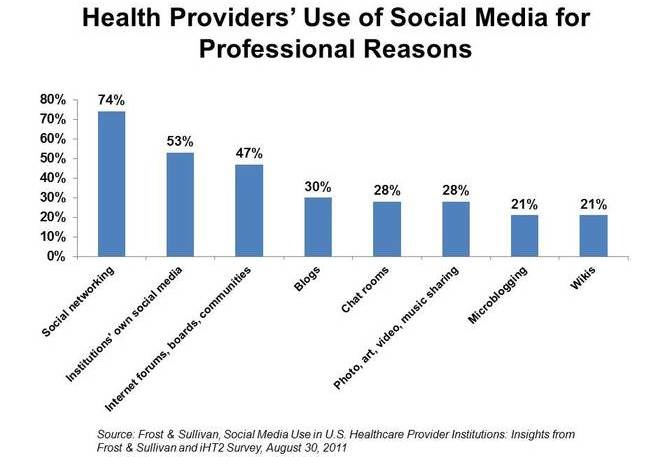
Doctors and hospitals are going social, adopting social media for professional and clinical use, based on surveys conducted in mid-2011 by QuantiaMD and Frost & Sullivan and the Institute for Health Technology Transformation (iHT2).

In Doctors, Patients & Social Media, dated September 2011, QuantiaMD and the Care Continuum Alliance report a high level of physician engagement with online networks and social media. Two-thirds of physicians are using social media for professional purposes, and see potential in the use of these channels to facilitate patient-physician communication. The survey found a cadre of “Connected Clinicians” who use multiple media sites to positively impact patient care. Over 20% of clinicians use 2 or more sites.

Only 1 in 10 physicians is familiar with one or more online patient communities, as the first chart illustrates. Among those who know about at least one community, a majority believe the sites have a positive impact on patients (either very positive or positive in the survey response). This is true across various condition categories, especially for rare diseases, cancers, chronic conditions, maternal and child health, and wellness/prevention. As one physician shared anecdotally, “Patients can share their stories, learn from others, spread knowledge, and instill hope.”

Continue reading…

Another Modest Proposal* – Paying for Physician Training

By PAUL FISCHER

One of the main considerations in physician pay under CMS’ relative value system is the training required to complete a task. This is generally thought to be well understood but is, in fact, a quagmire of controversy.

Take for example the specialty of family medicine compared with dermatology, anesthesiology, or ophthalmology. Family physicians make between 1/2 and 1/3 of what these other specialties make, so one would think that there is a huge training difference. The truth is that each of the four require 16 years before medical school, 4 years of medical school, and 3 years of residency.  The 3 highly paid fields require 1 additional year in a transitional internship.  So the family physician education represents 23/24 or 96% of the length of education required for the others.  Since when is a 4% investment worth a 200% to 300% return?

There are, of course, longer training programs.  Internal medicine fellowships are 2 to 3 years on top of a 3-year residency.  There was a time when this made sense, since the idea was to educate competent general clinicians and then for them to specialize in a narrower field.  Given the limited general physician work of, let’s say, cardiology, one could easily argue that the 3 years of internal medicine training are wasted. Should cardiologists, therefore, be credited with 23 or 26 years of training? It would obviously be more efficient to move these physicians directly from medical school into the cath lab.

There are some physicians who keep going on and on in their training, completing one residency and then another. One fellowship and then another.  CMS must come up with a numerical way to appropriately compensate these individuals for their time, yet discount it for any lack of relevance that their training might have for performing a particular procedure.  Take, for example, the resident who completes his general surgery training then goes on to do a fellowship in vascular surgery, then goes into practice and limits his practice to the laser closure of veins, a technique he learned in a weekend CME meeting.  Should this physician’s income reflect 7 years of training or 3 days?Continue reading…