Categories

Category: Health Policy

Why Explaining the Affordable Care Act Turns Out To Be A Lot Harder Than We Thought It Would Be.

Bauhoff, Carman & Wuppermann

One of the chief aims of the Affordable Care Act (ACA) is the expansion of insurance coverage to individuals who at present either cannot afford it or choose not to purchase it. Unfortunately, many Americans lack the financial literacy needed to navigate the numerous and complex options thrust upon them by the ACA.

The ACA contains a number of mechanisms through which coverage will be expanded, including the individual mandate, the state insurance exchanges, and the expansion of Medicaid.

Yet, while many more Americans will be able to obtain health insurance under the law, the new policies present a complex new choice environment for consumers, one that contains new penalties, new subsidies, and a potentially vast number of plans to choose from.  Successfully navigating these choices requires consumers to be financially literate.

As recognized in research on related areas of financial decision-making – such as retirement planning, investing, and debt – consumers often lack the understanding, ability and confidence to make financial choices that are in their best interest.

To shed light on consumers’ ability to navigate the ACA, we recently examined the distribution of financial literacy by household income.  Our findings were recently posted on the Health Affairs Blog and in a working paper by RAND’s Bing Center for Health Economics.
Continue reading…

Will Obamacare Survive? Nine Key Questions

By ROBERT LASZEWSKI

How did it go? Unavoidably, that will be the big question come Tuesday.

But there will be much more to it than that.

A 180-Day Open Enrollment––Not a One-Day Open Enrollment

What happens on the first day, for good or bad, will constitute only a tiny percentage of the open enrollment period. Consumers will likely visit the new websites many times before they make any decisions, and that is exactly as it should be.

Many of the health plans touted as being low-cost plans are going to be very limited access plans. It won’t be easy for consumers to compare one plan’s provider network to the other. In the best of circumstances, consumers will be confused by what is being offered for some time and will have to make a major effort to make sense of it for themselves.

Let’s not forget, they will be buying something that will cost thousands of dollars––their money or the government’s––and that kind of purchase will never be as simple as going to Amazon and buying a book.

I will suggest that if the local press wants to be helpful they will waste less time asking how things went the first day and more time doing stories on the quality of the various health plans in their local communities––particularly over provider access, which will be the only major product differentiator between health insurance companies.

Will There Be Administrative Problems With the Exchanges?

There already are. And, there will be lots more.

During the last 24-hours I have been told that the information technology testing between insurance companies and the federal government, particularly around the government telling insurance companies who they will be covering, continues to be a real mess.

But whatever obvious problems there are at launch, there will likely be more problems and more serious problems behind the scenes in the lead-up to January 1, the initial problems will be worked out in a few days or a few weeks. Operational expectations are now so low for Obamacare’s health insurance exchanges a small disaster will be considered a political victory.

Continue reading…

Will ACA Implementation Lead to a Spike in Demand for Care?

By DAVID I. AUERBACH

As the Affordable Care Act’s (ACA) exchanges open and Medicaid expansion takes effect, millions of uninsured Americans will gain new coverage. This raises a key question: how are we possibly going to meet the demands of all of these new individuals entering the system? The physician workforce is growing slowly, at best, at a time when an aging population is increasing demand for care.

Predictions include long lines for everyone, rising prices and premiums as physicians are able to command greater market power, and reduced quality of care. Some have recommended additional government funding to help train more medical residents as a response.

But while studies predict ACA implementation will prompt an increase in demand for medical services, there is evidence that the increase in demand will not be as great as the raw number of newly insured Americans might suggest.

The latest CBO forecast projects the reduction in the number of uninsured Americans under the ACA will be 11 million people next year and 24 million by 2016. That’s an increase in the percentage of Americans with insurance of roughly 5% in 2014 and 12% in 2016. If the uninsured used zero health care today, but upon becoming insured used the same amount as a typical insured person, then the increase in demand for care would be the same as the increase in coverage.

In reality, the uninsured use substantial amounts of health care – but only about half the care that the insured use today. One reason is because they are uninsured – paying full prices for care rather than a small copay discourages use. Another reason also explains why many (but not all) are uninsured in the first place: they are healthy and don’t anticipate needing or wanting medical care.

When the uninsured gain coverage, demand does increase, but not dramatically, studies show. Evidence from the Oregon Health Insurance experiment, in which a funding cap forced the state to grant Medicaid coverage to some applicants but not others using a lottery-type system, found that those who did gain coverage increased their use of both hospital and physician care by about one-third relative to controls.

Continue reading…

Disruptive Innovation and the Affordable Care Act

By BEN WANAMAKER

This post highlights the findings of a paper released today by the Clayton Christensen Institute, “Seize the ACA: The Innovator’s Guide to the Affordable Care Act.”

Since its passage in 2010, the Patient Protection and Affordable Care Act (ACA) has been analyzed by experts from nearly every political, economic, and health policy angle possible. Yet in the noisy debate about whether the legislation is good or bad and whether to implement or repeal it, we think there’s something missing: a rigorous but practical discussion of the innovation opportunities created by the legislation and the barriers to innovation it imposes.

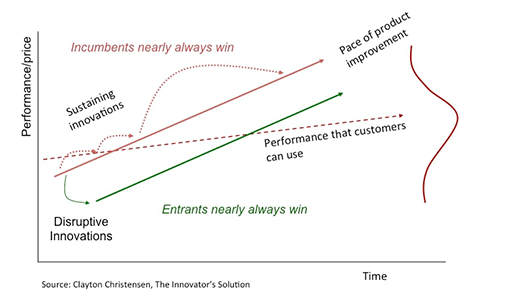
To facilitate that goal, we analyzed the ACA through the lens of the theory of disruptive innovation. First articulated by Harvard professor Clayton M. Christensen, disruptive innovation theory explains how innovations that decrease cost and increase accessibility transform entire industries.

As existing products increase in performance and begin to exceed customer needs (think of next year’s biggest Cadillac model), low-cost, lower-performance alternatives created by new entrants take root in the low end of the market (think of next year’s smallest Kia model).

These new products are initially inferior in comparison to established products, but they become better and better until they “disrupt” and eventually topple larger incumbent competitors.

So how does the ACA affect the pace of disruptive innovation in health care? What opportunities does it create for innovators? What barriers does it inadvertently erect? Here are a few thoughts from our recent paper.

Continue reading…

What Your Employer Is Secretly Thinking As Obamacare Goes Live

By KIP PIPER

Employers face a multitude of challenges under the Affordable Care Act (ACA).  The ACA fundamentally changes the landscape for employer sponsored health insurance, forcing businesses to understand, navigate, and adapt to a quickly changing, highly complex, and still uncertain marketplace for health benefits.  To illustrate this, here are 10 pain points employers face in dealing with Obamacare:

1.  Explaining ACA to Employees, Dependents, and Retirees:
Effective internal communications is a strong indicator of a firm’s financial performance.  Indeed, internal communications is an essential ingredient for an engaged, productive workforce with low turnover.  This is all the more important under the dynamics and complexities of the ACA.

Every employer must be prepared to explain the ACA.  Like it or not, employees will look to their employer to explain the Affordable Care Act, even if the employer is not changing benefits.  Employees have friends and family who will need help understanding Obamacare.  The airwaves, mail boxes, and street corners will be packed with messaging from all angles and interests – some pro, some con, some partisan, some factually wrong, some even fraudulent, much of it confusing, and all of it mind numbingly complex.

This is an enormous new opportunity for employers to beef up their internal communications, demonstrate leadership, and support employees and their families.  This will also serve to boost a company’s external reputation since the help and information provided to employees and retirees will be shared by them with a much wider audience – their parents, children, spouses, siblings, friends, and neighbors.

However, when communicating and educating, given the dynamics and contentious nature of Obamacare, employers must also take into consideration the political leanings of most employees and other key stakeholders, such as the board of directors and state and local leaders.  This is not a factor in most employer benefit issues but the ACA is entirely different.

2.  Making Tough Decisions on Coverage and Benefits:
While making tough decisions on benefits is nothing new for employers, the ACA presents a new set of decision points.  Every business has their own starting point – what, if anything, they were already offering, who they were covering, and how much they were contributing financially to the cost of coverage.

For those employers that were not providing full-time workers with health coverage before, the ACA creates a new pay-or-play decision for those with more than 50 full-time workers.  For every employer, the ACA creates a strong financial incentive to either drop coverage, dial-down employer contributions, or move to defined contribution.

Continue reading…

Did We Get It Right? A Behind the Scenes Look at California’s Healthcare Strategy

By DAN DIAMOND

Back in 2010 — before two elections, before the Supreme Court ruled, before the word “crisis” stopped following the words “California budget” — Kim Belshé settled on a guiding principle: “2014 is tomorrow.”

And now, it almost is.

The Affordable Care Act’s individual mandate takes effect in less than 100 days. The nation’s health insurance exchanges go live next week.

And for nearly a year, Belshé — secretary of the Health and Human Services Agency under former Gov. Arnold Schwarzenegger — was at the center of California’s efforts to begin implementing those Obamacare provisions and many others.

I interviewed Belshé, Schwarzenegger, and nearly a dozen other ex-officials and experts about whether California’s quest to lead the nation on ACA implementation actually paid off — and what it brought the state.

Why California? Why Not?

Every expert suggested that the ACA’s rapid implementation in California could be traced back to Schwarzenegger’s efforts in 2007 and 2008 to enact universal health care.

(And in some cases, even older efforts at reform. “We learned a lot from the 1990s,” says Belshé, noting that failed attempts to create purchasing cooperatives in California helped set the foundation for designing insurance exchanges more than a decade later.)

Although the Schwarzenegger plan ultimately failed, many of its components — from big elements like the exchanges to smaller pieces like guaranteed issue — ended up in the ACA. And because state leaders had already done much of the foundational work, they were better positioned to speedily roll out the national law.

Daniel Zingale, senior vice president of the California Endowment, says that Schwarzenegger’s efforts were a preview of the national ACA battle to come — which meant that many stakeholders in California had already made peace with the law’s key provisions by 2010.

“We’d had our big fights over the individual mandate here” in 2007 and 2008, says Zingale, a former health care aide to Schwarzenegger. “Democrats and labor groups had been through it [and] were ok with it.”

“But the nation hadn’t been through that yet.”

Still, California’s support for Obamacare was hardly assured. As late as January 2010, Schwarzenegger wavered on the ACA — but by April that year, he was the first Republican governor (and one of the first governors in the nation) to throw his support behind the law and begin crafting a framework for implementation.

“It gave us a bit of a head start,” Belshé acknowledges.

Continue reading…

What the SNAP Cuts Actually Mean

By LUA WILKINSON

Last week House Republicans voted to cut benefits to the Supplemental Nutrition Assistance Program, or SNAP, slashing $39 billion in benefits over the next ten years in a vote of 217 to 210. All members of the Democratic caucus voted against the bill, which would affect 4 million people.

In June, fiscal conservatives squashed the Farm Bill that would have cut spending by $20 billion over ten years after determining the decrease was too meager. This new bill is their response to that. If successful, half of the cuts will put a stop to food aid after three months to people between 18 and 50 with no minors living with them if they are unable to find work, a move that makes little sense.

Poverty and health are inextricably linked, and food security plays a central role in this. Not only does poverty affect a family’s ability to buy food, it prevents them from buying healthy food. In the United States, lower income individuals are more likely to be obese, putting a strain on the healthcare system. Currently, beneficiaries of SNAP are eligible for SNAP-Ed, a nutrition education program designed to promote healthy eating on a limited budget. It is unclear how these cuts will affect SNAP-Ed.

African-Americans, no strangers to health inequalities, will be disproportionately affected by this change if successful. A new study shows that 90 percent of African-Americans benefitted from food stamps at one point or another in their lives. One in four African-American households faces food insecurity, and make up about 23% of all SNAP recipients.

Continue reading…

Seriously? Are We Really Going to Re-Legislate Healthcare Reform?

By CHRISTOPHER ROBERTSON

A minority of the Members of Congress are threatening to cause the United States government to default on its debts, unless the majority members agree to repeal or defund the Affordable Care Act, which Congress passed just a few years ago.  There will presumably be some sort of negotiated solution.  I worry that the negotiation range is being defined in a skewed way, between one pole and a moderate status quo, which is already the result of a prior negotiation.  Seems like we have a one-way ratchet here.

My thought:  perhaps the negotiations should go both ways, so that the end-result is more balanced.  What if the Democrats made symmetric threats to cause default, unless:

  • Medicare is expanded to cover all the poor who do not qualify for Medicaid (filling the gap the Supreme Court created in its “coercion” opinion),
  • The Federal government creates a public health insurance option, to compete along with the corporate insurers (which was killed in final negotiations to pass the ACA),
  • The Federal government gets explicit authority to provide insurance subsidies in the health insurance exchanges it sets up for states that have refused, oh and, as a kicker,
  • Ronald Reagan International Airport (DCA) is re-named Jimmy Carter International Airport.

Ok, that last one is silly, but it might make for a fun bargaining chip, since it symbolizes the strategic game that is now being played, as we re-legislate settled questions.  Positional bargaining is not pretty or enlightened, but if these chips can be traded, we might end up in the fallback position of keeping the Affordable Care Act as the negotiated compromise that it already is.  Of course, the ACA is also the default rule, which has a nice double meaning in this context.

Christopher Robertson, JD, PhD is a visiting professor at Harvard Law School,  an associate professor at the James E. Rogers College of Law, University of Arizona, and a research associate with the Edmond J. Safra Center for Ethics at Harvard Law School. He blogs at  the Petrie-Flom Center’s Bill of Health, where this post originally appeared.

Repealing Laws By Defunding Them

By ROBERT REICH

Sunday morning on ABC’s “This Week,” Newt Gingrich and I debated whether House Republicans in should be able to repeal a law — in this case, the Affordable Care Act — by de-funding it. Here’s the essence:

GINGRICH: Under our constitutional system, going all the way back to Magna Carta in 1215, the people’s house is allowed to say to the king we ain’t giving you money.

REICH: Sorry, under our constitutional system you’re not allowed to risk the entire system of government to get your way.

Had we had more time I would have explained to the former Speaker something he surely already knows: The Affordable Care Act was duly enacted by a majority of both houses of Congress, signed into law by the President, and even upheld by the Supreme Court.

The Constitution of the United States does not allow a majority of the House of Representatives to repeal the law of the land by de-funding it (and threatening to close the entire government, or default on the nation’s full faith and credit, if the Senate and the President don’t come around).

If that were permissible, no law on the books would be safe. A majority of the House could get rid of unemployment insurance, federal aid to education, Social Security, Medicare, or any other law they didn’t like merely by deciding not to fund them.

Continue reading…

The Summer of Wellness’s Discontent

Vik KhannaAl Lewis

By AL LEWIS & VIK KHANNA

The series of unflattering articles published in Health Affairs early this year – the first unfavorable press wellness had ever received in a top tier policy journal — turned out to be a harbinger of what became the wellness industry’s summer of discontent.  Perhaps in error, the Journal of Occupational and Environmental Medicine (JOEM) also drifted into the sea of credibility on wellness early in 2013 by publishing a meta-analysis of the industry’s claims of economic success.

The analysis, by researchers at Tufts, destroys the industry mythology of respectability by noting that out of over 2,000 papers published in the world’s medical literature, only 10 (0.5%) are worth discussing and that discussion leads essentially nowhere.  Not surprisingly, like our essays here and in Health Affairs, the Tufts work has been universally ignored by the wellness true believers.

Starting with those articles, and especially over the last four months, those true believers have lost control of the dialog — starting right here with THCB, which gets credit as the first major regular source of objective news not generated by the wellness industry’s propaganda apparatus.

June brought the RAND report, our Wall Street Journal op-ed, and Cracking Health Costs.  Unlike Health Affairs, some HR administrators have actually read those publications.  These developments left them asking uncomfortable questions of an industry that hitherto had filtered the information that its customers received through the JOEM and the Journal of Health Promotion, the industry’s de facto house organs that between them in thirty years have published fewer articles concluding wellness doesn’t work (just that single meta-analysis mentioned above) than Health Affairs has in 2013 alone.

But it wasn’t until July that the wheels fell off the wellness bus, due to four self-inflicted wounds that did more to diminish the industry’s carefully cultivated albeit totally undeserved patina than anything we could have written.    Atoning for its brief foray into accuracy, JOEM published an article showing $20-million in savings for British Petroleum’s (BP) wellness program, 100 times what the vendor, Staywell, claims on its own website to be possible.

Continue reading…