Categories

Category: Health Policy

A Little Advice for the Next National Coordinator

By JOHN HALAMKA

Over the next few months, Jacob Reider will serve as the interim National Coordinator for Healthcare IT while the search continues for Farzad Mostashari’s permanent replacement.

What advice would I give to the next national coordinator?

David Blumenthal led ONC during a period of remarkable regulatory change and expanding budgets. He was the right person for the “regulatory era.”

Farzad Mostashari led ONC during a period of implementation when resources peaked, grants were spent, and the industry ran marathons every day to keep up with the pace of change. He was the right person for the “implementation era”

The next coordinator will preside over the “consolidate our gains” era. Grants largely run out in January 2014. Budgets are likely to shrink because of sequestration and the impact of fiscal pressures (when the Federal government starts operating again). Many regulatory deadlines converge in the next coordinator’s term.

The right person for this next phase must listen to stakeholder challenges, adjust timelines, polish existing regulations, ensure the combined burden of regulations from many agencies in HHS do not break the camel’s back, and keep Congress informed every step of the way. I did not include parting the Red Sea, so maybe there is a mere human who could do this.

What tools does the coordinator have in an era of shrinking budgets?

At present, Meaningful Use Stage 2, ICD-10, the Affordable Care Act, HIPAA Omnibus Rule, and numerous CMS imperatives have overlapping timelines, making it nearly impossible for provider organizations to maintain operations while complying with all the new requirements.

Can resources be expanded?

Continue reading…

How I Learned to Stop Worrying and Love Obamacare

David Dranove

By DAVID DRANOVE

There is an ancient Arabic proverb: “The enemy of my enemy is my friend.” With this in mind, I can’t help but think that whatever Senator and leading Tea Party blowhard Ted Cruz opposes must be good. When Cruz decided to try to shut down America because he opposes Obamacare , well that sealed the deal for me. I say “Obamacare forever.”

Readers know that I think Obamacare has too many rules that create problems for payers and providers alike, and relies on some questionable practices for funding. I don’t like the rush to form ACOs or the lack of serious cost-effectiveness analysis (admittedly a concession to Republicans.) But Obamacare beats the hell (sorry Ted) out of Cruzcare, which, as far as I can tell, goes something like this: “Didn’t put aside enough money for that life-saving operation? Here is a prayer that might help.”

I used to sort of be a Republican. I voted for Bush (I won’t say which one in order to avoid embarrassment) and voted against Obama more than once (living in Illinois I had several opportunities.) And I hate that Obama is playing at President like someone playing poker with a winning hand.

This isn’t supposed to be about which politician claims the biggest pot for himself. But I will take a selfish and somewhat scornful Obama over Ted Cruz and the Tea Cozies any and every day of the week. And I will work to find the best Democratic leaders if all the Republicans can offer is Cruz and his TCs.

Shut down the government to finally fund Medicare and Social Security? Maybe. Shut down the government to achieve a rational tax code? Sure. Shut down the government to balance the budget? Now we are talking. But shut down the government to block the opening of the health insurance exchanges? How absurd!

Continue reading…

How Identity Verification Caused Chaos on the State and Federal Exchanges

By ROBERT LASZEWSKI

We may be getting a better idea why the federal exchange and so many state exchanges aren’t working.

An article in Saturday’s Baltimore Sun, regarding Maryland’s problems, provides insight I have not seen elsewhere:

Problems began immediately after the exchange launched Tuesday, as people tried to create accounts and log onto the site.

State officials blamed the account creation process, in which people were routed to a federal questionnaire to verify their identity. The system, they said, became overwhelmed when so many people tried to access it.

So, it appears all of the exchanges are facing the same bottleneck at the federal level–the identity verification software the feds are running for themselves and the state exchanges.

Then the Sun article provided more insight:

Requiring people to create accounts to access the system may be one of the problems, said Jonathan Wu, co-founder of consumer finance website ValuePenguin, who has a computer science background. Some states, including Kentucky [which as been about the only state running well], let people browse insurance plans without an account, which was only needed to purchase insurance. Kentucky did not have as big a backlog, he said.

“It’s kind of an architectural and software issue,” Wu said. “You are not accounting for how people want to use the system.”

With personal accounts, the computer system has to work harder, storing information about everyone who accesses the website, he said. It also has to repeatedly confirm the identity of the person, which also can bog down the system, Wu said. He noted that all the functions on the website that don’t require an account have run smoothly.

“It has to match your account every step you make,” Wu said. “This causes extra overhead.”

Continue reading…

One Man’s Quest to Sign Up for Obamacare

By TONY JEWELL

image

Day 4:

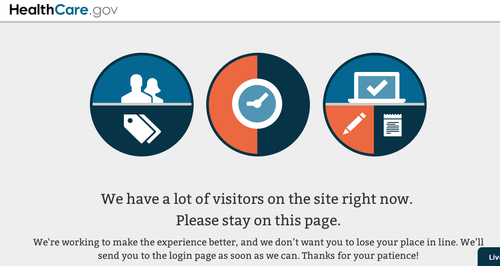
After spending more than two hours in the waiting room, I once again tried to create an account at healthcare.gov so my family could #GetCovered – as instructed by President Obama and Secretary Sebelius.

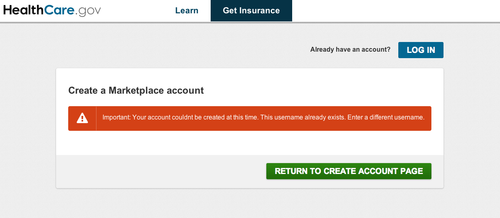
My first attempt at setting up an account today was thwarted when healthcare.gov said the user name I attempted to use was no good:

image

Ack! It says the username already exists? This was the username I had set up on Day One (backstory here), but the system ultimately didn’t recognize it. I feared some other Tony Jewell had used my cleverly placed underscore.

Continue reading…

Affording the Affordable Care Act

By CHRISTINE EIBNER

As enrollment in the Affordable Care Act’s (ACA) new health care markets, or exchanges as they are also known, begins, much of the debate over the law is focused on insurance: Who will get coverage? How much will premiums cost? Should our state expand Medicaid? Yet health insurance is not an end in itself.

The point of insurance is to help people get the health care they need at prices they can afford and, in the event of serious injury or accident, to protect them from catastrophically high medical bills. What often gets lost in the debate is how the new law will affect Americans’ ability to buy health care.

While relatively little will change for most people who already get their insurance through employers, an estimated 49 million Americans will be affected by the new law, either becoming newly insured or changing their source of coverage. How will these changes affect consumer health care spending? Will the Affordable Care Act live up to its name?

Of course, ultimately only time and experience will tell. But in the meantime, the law is being implemented, and policymakers and consumers confronting the new health care market are seeking answers about the law’s likely impact, beyond politicized charges and countercharges about whether it will succeed.

Using the COMPARE microsimulation model, my RAND colleagues and I examined how the ACA will affect spending by consumers who are insured for the first time or who change coverage as a result of the law. Specifically, we looked at out-of-pocket spending (spending at the point of sale — copays, deductibles, and coinsurance, which is the fraction of spending not covered by insurance); total spending on health care, which includes out-of-pocket spending plus insurance premiums; and consumers’ risk of high medical care costs.

The analysis focused on 2016, the first year in which penalties for not complying with the individual mandate will be fully in effect, and considered two scenarios: one in which the ACA is fully in place and another that estimates outcomes without the ACA.

Continue reading…

Reports Suggest Exchange Numbers Are Very Low

By THCBist

“Well, Facebook Wasn’t Built In a Day.” – Unnamed Exchange Developer.

More than 4.8 million users visited Healthcare.gov for the grand opening of the federal health insurance marketplace on Tuesday, according to officials.

It didn’t go quite as planners had hoped. In fact, if there was an unofficial word of the day, it was glitch.

Many users of Healthcare.gov reported long delays and difficulty accessing the federal insurance marketplace,  experiencing “glitches” ranging from error messages to blank pages.  The problems were repeated at state-run exchanges around the country to varying degree, from California to New York.

Pundits like Wonkblog’s Ezra Klein were quick to point out that the political victory the GOP might have gained from the uncertain start was largely lost in the uproar in Washington over the government shutdown, which dominated news reports.

At least one frustrated user chronicled the experience (see related post ‘Descent into Madness: One Man’s Visit to Healthcare.gov, October 1st ). Others took to Twitter to express their outrage or show off their savage or finely-tuned senses of humor.

Users of the federal exchange reported problems including error messages (see above), funky dropdown menu behavior, page freezes, blips, broken links and long page load times — generally either a sign of high volume or inelegantly designed databases.

HHS officials declined to reveal how many people signed up for new insurance plans overall, leading some theorists to speculate that not very many people were able to make it through the process successfully. In point of fact, there were suspiciously few reports of users successfully completing the registration process at all, probably not a very good sign and possibly an indication of a disaster.Continue reading…

How the Federal Government Shutdown Is Hurting Healthcare: Agency by Agency

By THCBist

The shutdown could not stop the rollout of the state and federal exchanges.

That’s because the Obama administration, sensing a political fight in the offing with Republicans, wisely prepaid the bill for the insurance exchanges and other key components of the rollout.

On the other hand, the fiscal standoff is having a very real impact on the infrastructure that supports healthcare across the United States.   Agencies from the Centers for Disease and Control to the National Institutes of Health have seen their money turned off. Others have seen their staffing levels sharply reduced with non-essential employees furloughed.

It doesn’t take a wild imagination to imagine potential deadly consequences if something goes wrong. If for example, flu season strikes early or a drug recall  is needed.  Much of the pain will be felt over time.  As the shutdown drags on, you can expect problems that are brewing under the surface to become much more visible …

Here’s a review of what’s happening:

Centers For Disease Control and Prevention
Funding for monitoring of disease outbreaks turned off. Lab operations sharply scaled back. 24/7 operations center to remain online.  With some scientists predicting a severe 2013-2014 flu season, this is cause for concern …

National Institutes For Health
Enrollment in new clinical trials suspended, impacting thousands of patients suffering from serious diseases. No action on grant proposals. Minimal support for ongoing protocols.

Food and Drug Administration
Food safety inspections sharply cut back. Monitoring of imports eliminated.  Oversight of production facilities curtailed, again potentially an issue with flu season on the way.The good news? Because drug approvals are funded by industry “user-fees” FDA approvals of new drugs will continue.

Centers For Medicare and Medicaid Services
Key ACA related operations intact.  The bad news for docs and patients – claims and payment processing expected to continue but with slower service than usual. With purse strings tight, this is likely to become more of a problem as shutdown drags on. In the unlikely event that a shutdown continues for more than a month, the impact on physician practices could be much more serious.

Continue reading…

Descent Into Madness: An Account of One Man’s Visit to Healthcare.gov October 1st

By TONY JEWELL

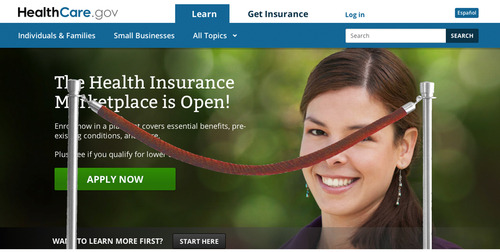
image

As the owners of small businesses, my family has been curious to learn how much insurance would cost us once the Affordable Care Act kicks in – and what our choices of networks, providers and whatnot would be.

With the arrival of the October 1 open enrollment period, my first computer stop was healthcare.gov to begin comparison shopping among the four ACA plans vs. the COBRA plan that we have through the end of 2014.

Here’s how it went:

October 1, 2013

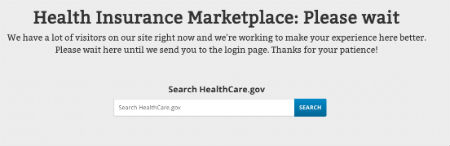
7:30 a.m. – I first encounter the Health Insurance Marketplace waiting room.

7:33 a.m. – The drop-down boxes on the security questions aren’t working.

Continue reading…

I Oppose Obamacare. I Support the Affordable Care Act.

By KENNY LIN

Today, more than three years after being signed into law, and more than a year after surviving a Supreme Court challenge, the Affordable Care Act, more commonly known as Obamacare, finally begins to fulfill its promise. Most of this country has long since taken sides, despite appalling gaps in popular understanding of what the law means, what it does, and what it doesn’t do.

Let me admit that I’ve never had particularly warm feelings toward President Obama. I think his foreign policy is a mess. The trillions in debt that the U.S. has run up over the past 5 years will hurt my generation and future generations, and if Republicans can be faulted for their fantasy that the federal budget can be balanced exclusively through spending cuts, Obama has sustained the Democratic fairy tale that raising taxes on “millionaires and billionaires” is all that is necessary to pay the skyrocketing bills.

On multiple occasions during my time in government, the President had no qualms about squashing science and scientists for political convenience. He is a perpetual campaigner, preferring theatrical gestures to the backstage grunt work of governing. And for all of his rhetorical gifts when preaching to the choir, he’s been one of the least effective persuaders-in-chief to have held the office.

And so, naturally, I oppose Obamacare. I oppose a government takeover of health care that includes morally repugnant death panels staffed by faceless bureaucrats who will decide whose grandparents live or die and make it impossible for clinicians to provide compassionate end-of-life care. I oppose the provision in Obamacare that says that in order for some of the 50 million uninsured Americans to obtain health insurance, an equal or greater number must forfeit their existing plans or be laid off from their jobs.

I oppose the discarding of personal responsibility for one’s health in Obamacare. I oppose Obamacare’s expansion of the nanny-state that will regulate the most private aspects of people’s lives.

It’s a good thing that Obamacare, constructed on a foundation of health reform scare stories, doesn’t exist and never will.

Instead, the Affordable Care Act (which I support) is based on a similar law in Massachusetts that was signed by a Republican governor and openly supported by the administration of George W. Bush. It achieves the bulk of health insurance expansion by leveling the playing field for self-employed persons and employees of small businesses who, until now, didn’t have a fraction of the premium negotiating power of large corporations that pool risk and provide benefits regardless of health status.

Continue reading…

Washington In Crisis: ONC Announces That It Will Not Tweet Or Respond to Tweets During Shutdown

By THCBist

The U.S. government shutdown continues to claim victims.

The latest is HealthIT.gov, the website designed to help doctors and hospitals make the transition to electronic and make better use of health information technology – a key component of Obamacare’s drive to transform healthcare.

The Health Information Technology Office of the National Coordinator posted a brief announcement on the site informing visitors to HealthIT.gov that “information … may not be up to date, transactions submitted via the website may not be processed and the agency may not be able to respond to inquiries until appropriations have been enacted.”

Officials also sent a tweet saying that the ONC regrets to inform us that while the shutdown continues it will “not tweet or respond to tweets.”

This struck THCBist as slightly odd.

After all, if you’re looking for an inexpensive way to communicate with the public in a pinch, Twitter seems like the perfect choice.  We get that government websites are ridiculously expensive things to run. Blogs are considerably cheaper.  Operating a Twitter account — on the other hand — is almost free.  Our brains were flooded with scenarios.  How much could the ONC possibly be spending on Twitter? And for that matter, didn’t the Department of Defense originally invent the Internet to allow for  emergency communication during times of national crisis? Doesn’t a fiscal insurrection by cranky Republicans qualify?

Fallout for the National Health IT Program

While federal officials have issued repeated assurances that the shutdown will not impact the Obamacare rollout, it does look as though there will be a fairly serious impact on the administration’s health IT program.  If HHS sticks to script, only 4 of 184 ONC employees will remain on duty during the shutdown. That makes it sound like activities are going to have to be scaled back just a bit.

If you’re counting on getting an incentive payment from the government for participation in the electronic medical records program, you may be in trouble — at least until the stalemate is settled.  Although ONC has not yet made an official statement,  presumably because the aforementioned Twitter channel has been disabled, leaving the agency unable to speak to or otherwise communicate with the public, going by the available information in the thirteen-page contingency plan drafted by strategists at HHS, it is unclear where the money will come from.

This could be bad news for electronic medical records vendors counting on the incentive program to drive sales as the Obamacare rollout gets officially underway.

Continue reading…