Categories

Category: Health Policy

Will You Be Able to Keep Your Plan? The Economics Behind the Obama Administration’s Latest Problem

By DAVID DRANOVE & CRAIG GARTHWAITE

By now you’ve certainly seen the headlines: “Obama administration knew millions could not keep their health insurance,” or “Report: Millions will lose health plans as ObamaCare takes hold.”

This is not just the rumblings of right wing media outlets or scare tactics, it is now becoming clear that millions of individuals who used to buy their insurance in the individual market will not be able to keep their old plans. As a result of minimum standard for health insurance “quality,” between 50 and 75 percent of existing individual insurance plans will be canceled.

White House Spokesperson Jay Carney said that these cancellations will only affect “substandard policies that don’t provide minimum services.” But again, the devil here is in the undiscussed details. The “minimum services” bar for the Affordable Care Act is actually very high and as a result the new policies that replace those being canceled can be quite expensive.

For people who are in the unsubsidized portion of the exchanges, or even those who qualify for smaller subsidies, these minimum requirements are going to result in large premium increases. While many people might all believe that these individuals be buying better insurance, this is not the argument used to gain public support for the ACA.

We’ve both been vocal in our support of moving people onto the exchanges and away from employer provided coverage. One reason for that support has been that the exchanges allow a far better matching of individual preferences for health insurance and the products that people can purchase. Certainly that was our basis for our strong support of narrow network plans on the exchanges.

Beyond the size of the network, some people don’t want to pay for generous first dollar coverage. Instead, these consumers are willing to exchange lower premiums for higher deductibles or other forms of cost sharing. Others might not be interested in having coverage for every possible service, but instead might opt for a less generous set of benefits.

They will be thwarted by the ACA.
Continue reading…

Questions for Secretary Sebelius

By CHARLES ORNSTEIN

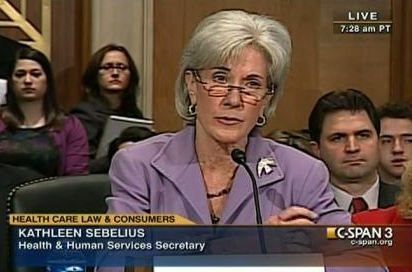
Health and Human Services Secretary Kathleen Sebelius will testify before the House Energy and Commerce Committee this morning. Her testimony comes the week after Healthcare.gov contractors testified before the same committee and a day after the head of the Centers for Medicare and Medicaid Services testified before a different House committee.

Here’s what you need to know.

1. Where to watch the hearing, which began at 9 a.m. EST:

Live coverage via C-SPAN.

2. Read Sebelius’ prepared testimony. Politico calls it more of the same:

Sebelius’s eight pages of prepared testimony for the House Energy and Commerce Committee matches nearly word-for-word testimony delivered by CMS Administrator Marilyn Tavenner to Ways and Means on Tuesday.

In both written statements, the officials acknowledge that the website hasn’t met expectations but say the administration is taking major steps to improve it.

Neither testimony includes an apology for the bungled launch—but Tavenner verbally apologized at the hearing Tuesday morning.

Clay Johnson (@cjoh), who advocates for open source information in the federal government, annotated the testimony on Rap Genius, with questions and comments.

3. Get familiar with the background. Sebelius gave an interview to CNN’s Sanjay Gupta last week in which she had this memorable exchange:

Gupta: The president did say that he was angry about this. I mean do you know when he first knew that there was a problem?

Sebelius: Well, I think it became clear fairly early on. The first couple of days, that —

Gupta: So not before that, though? Not before October 1st?

Sebelius: No, sir.

Gupta: There was no concern at that point here in the White House or at HHS?

Sebelius: I think that we talked about having — testing, going forward. And if we had an ideal situation and could have built the product in, you know, a five-year period of time, we probably would have taken five years. But we didn’t have five years. And certainly Americans who rely on health coverage didn’t have five years for us to wait. We wanted to make sure we made good on this final implementation of the law.

And, again, people can sign up. The call center is open for business. We’ve had 1,100,000 calls. We’ve had 19 million people visit the Web site, 500,000 accounts created. And people are shopping every day. So people are signing up and there’s help in neighborhoods around the country, that people can have a one-on-one visit with a trained navigator and figure out how to sign up. So people are able to sign up.

I wondered at the time if Sebelius’ answer left a little wiggle room. I expect Republicans on the committee will pursue this.

4. Digest media reports. You can definitely expect that Sebelius will be asked about a CNN report yesterday that Healthcare.gov’s lead contractor warned the administrator well before the Oct. 1 launch of major problems. Read the documents.

CNBC suggests these six questions for her:

—What did you know, when did you know it, and who told you?

—Did you ever consider not launching Oct. 1?

—Why has no one been fired?

—What does all this cost?

—What contingency plans do you have?

—What are the enrollment numbers?

TPM offers what it calls seven legitimate questions for her.

And the Washington Post says that “the embattled secretary of health and human services will submit to a quintessential station of the Washington deathwatch.” Gotta love Washington.

Charles Ornstein is a senior reporter at ProPublica and past president of AHCJ. An earlier version of this post originally appeared on his tumblr, Healthy buzz.

Mr. President, I Like My Health Insurance. I’d Like to Keep It. Can You Please Help Me Out?

By ROBERT LASZEWSKI

How many times have I talked about rate shock, the millions of people who would be getting cancellation letters from their current health plan, and the problem of people having to put up with more narrow networks?

And, how many times have those predictions been met by push back and spin: Today’s policies are just junk and people will be better off finding lower cost health insurance under Obamacare.

I have been in this business for 40 years. I know junk health insurance when I see it and I know “Cadillac” health insurance when I see it.

Right now I have “Cadillac” health insurance. I can access every provider in the national Blue Cross network––about every doc and hospital in America––without a referral and without higher deductibles and co-pays. I value that given my travels and my belief that who your provider is makes a big difference. Want to go to Mayo? No problem. Want to go to the Cleveland Clinic? No problem. Need to get to Queens in Honolulu? No problem.

So, I get this letter from my health plan. It says I can’t keep my current coverage because my plan isn’t good enough under Obamacare rules. It tells me to go to the exchange or their website and pick a new plan before January 1 or I will lose coverage.

First, the best I can get in a Blue Cross network plan are HMOs or HMO/Point-of-Service plans. In the core network those plans offer, I would have to go to fewer providers than I can go to now in the MD/DC/VA market. And, the core network has no providers beyond my area. I can go to the broader Blues network but only if I pay another big deductible for out-of-network coverage.

Continue reading…

I Give Up

By TONY JEWELL

Since October 1, I have logged on to various websites across the Internet to book three flights, make hotel reservations in four cities, buy a pair of boots, some t-shirts and a set of nifty retro Mason jars.

What I haven’t bought: health insurance through healthcare.gov.

Nor have I tried, even after being able to (finally) create an account and see the prices on specific plans offered here in South Jersey, after weeks of frustration.

Here’s why: Given my family’s initial experience in setting up an account and the horror stories that continue to pour out day by day, we simply have no faith that the system will work if we attempt to sign up. And, given the bungling to date, we are not confident our insurance will be there January 1 – even if we are able to Whac-A-Mole our way through the registration process.

Think about it this way: If you really need to get to Miami, would you attempt to buy a plane ticket on a sketchy site that may or may not sell you a ticket that may or may not be waiting for you for a plane that may or may not be there when you get to the airport on the travel day?

Of course not. Nor are we comfortable relying on healthcare.gov, 1-800 numbers, navigators or parchment to sign up for health insurance through the federal exchange at this point.

Continue reading…

The Opening Act

By DAVID DRANOVE & CRAIG GARTHWAITE

That past month of debate over the botched launch of the health care exchanges has brought the programming geeks, and their hired mouthpieces, out in the open to defend the indefensible. As painful as this has been for so many Americans, we cannot help but be amused to hear so many commentators doing their best impression of Captain Renault and expressing their shock that the federal procurement system could have produced such an outcome. Of course, most of this is a sideshow, the opening act to an even more serious drama in the making.

Let us be clear from the outset, the rollout of Healthcare.gov is an embarrassment. However, this only becomes a real problem if it dissuades enough people who were already marginal customers with respect to their purchase of health insurance on the exchanges to simply pay the penalty and avoid the hassle of staring at a computer screen, waiting on hold for hours, or refusing to try again once the geeks get this all sorted out.

While the self-appointed technology experts on both sides of the aisle have been debating the causes of the web site debacle, attention has been diverted away from the necessarily frank discussions we must have about the real potential benefits and looming costs of the exchanges.

In a valiant attempt to steer the conversation towards the benefits of the ACA, President Obama held a rose garden press event where he repeatedly claimed that the health insurance on the exchanges is good product. But as is all too often the case, the President talked about the benefits and side stepped the difficult conversation about the costs.

At least he is half right. If they can ever fix the web sites, people with pre-existing conditions who shop on the exchanges will gain access to insurance at a more affordable price. Enrollees may save thousands of dollars. But let’s not kid ourselves.

The exchanges do not reduce the cost of medical care; they only change who pays for it. And we all know who that is.

Continue reading…

Should Sebelius Resign?

By JOHN HUDAK

As Congress begins investigations into the Affordable Care Act rollout and the healthcare.gov flaws, Republicans are calling for resignations as far up as the Secretary of Health and Human Services. The logic goes: if managerial issues were behind failures to test the website component of the federal health care exchange, we need new management.

That concern is a valid one. In the private sector and often times in the public sector, when misakes happen—particularly in an area critical to the executive’s interests—heads roll.

Yet, Kathleen Sebelius will stay, and Republicans have no one to blame but themselves.

Why is this? In an ironic twist of fate the Republican Party’s obsession with filibustering, delaying, or holding executive branch nominations will finally have negative consequences for the GOP instead of the president.

Over the past several years, Republicans in Congress had refused to confirm a director of the Consumer Financial Protection Bureau because they did not like the law that authorized the agency. They refused to confirm nominees to the National Labor Relations Board because of opposition to unions. They put a hold on the chairman of the Federal Communications Commission for fear he may require more transparency in campaign activity. The examples go on.

Why, then, would President Obama remove Secretary Sebelius and nominate a replacement? The HHS Secretary oversees the implementation of the Affordable Care Act. And GOP opposition to CFPB or NLRB or FCC pales in comparison to the visceral and existential contempt the party feels toward Obamacare. Given such opposition, the president would be foolish to make such a change in HHS leadership.

Continue reading…

GOP’s Oddest Obamacare Rejection: “Patient-Centered Healthcare”

Michael Millenson

By MICHAEL L. MILLENSON

The reason that Republicans shut down the federal government, it turns out, was to “restore patient-centered healthcare in America.”

Huh?

As the lead author of a policy paper entitled, “Will the Affordable Care Act Move Patient-Centeredness to Center Stage?” I admit to a certain guilty thrill when I read this precise demand coming as the climax of a letter sent by 80 hard-right representatives to House Speaker John Boehner (R-OH). You don’t get much more “center stage” than shutting off the federal money spigot, which is what the letter – discussed in a recent article in The New Yorker – threatened unless the ACA was defunded.

Having said that, patient-centeredness was a truly odd choice to occupy a central role in the conservative casus belli that ended up disrupting the entire U.S. economy until the right wing finally caved.

To begin with, the term is a minor piece of jargon likely to draw blank stares from pretty much the entire American public. Even for us health policy mavens, the GOP letter linking James Madison on the redress of grievances to defunding Obamacare to a “restoration” of patient-centeredness required major mental gymnastics.

Then there’s the unintentional linguistic irony. The term “patient-centered medicine” originated after World War II with a psychoanalyst who urged physicians to relate to patients as people with physical and psychological needs, not just a bundle of symptoms. “Patient-centered care” further defined itself as exploring “patients’ needs and concerns as patients themselves define them,” according to a book by the Picker/Commonwealth Program for Patient-Centered Care, which coined the term in 1987. Patient-centered care was adopted as a “goal” by the Institute of Medicine, which added its own definition, in 2001.

But here’s where the irony kicks in. Obamacare opponents assert that the ACA undermines the traditional doctor-patient relationship – although I suspect that being able to pay your doctor because you have health insurance actually improves it quite a bit.

Yet in calling for “patient-centered healthcare” instead of the more common “patient-centered care” or even patient-centered medicine, conservatives unwittingly abandoned doctor-patient language in favor of business-speak.

Continue reading…

What’s Next for Healthcare.gov?

By ANEESH CHOPRA

The launch of HealthCare.gov certainly didn’t go as planned. Due to technical errors, millions of Americans were sent to the functional equivalent of a waiting room before they could enter the shopping portion of the site.

Historically, projects of such complexity and demand have encountered early problems yet still often achieve great success. While much of the commentary has focused on coding problems, the site still has the potential to spur innovation — be it public or private —  that will result in quality improvement and lower costs.

For context, the HealthCare.gov site is merely the front door to an incredibly complex technological undertaking tasked with organizing insurance plans, assessing program eligibility, facilitating consumer enrollment, managing financial services, and providing all of the associated customer support.

An estimated 19 million people visited the site through Sunday, and many did so at the same time; at peak periods, there were five times as many simultaneous visitors as had been expected. In rapid response to that surge, the HealthCare.gov team tried to restrict the number of visitors to the area of the site where they could establish accounts and begin shopping.

Naturally, this was not ideal, but it was preferable to the alternative.

When Internet entrepreneurs prepare to launch a new service, they tend to anticipate two scenarios. The first, and worst, is that nobody visits. The other is that too many people do.

Rise of a new platform

Drawing from my experience as CTO in President Barack Obama’s first term, we overcame initial technical challenges in popular programs such as “Cash for Clunkers” or the Post-9/11 GI Bill of Rights for veterans through an analysis of the root cause problems — and a systematic plan to address them.

I’m confident that the HealthCare.gov team will similarly fix the technology with the help of experienced technical talent – in and out of government – to work through its punch list. The site should continue to improve in the weeks ahead, building toward Dec. 15.

But the real story, likely to play out over the coming months, will be its rise as a new platform for innovation – one that will lead to the creation of new private sector services to improve our nation’s health.

Continue reading…

Sorry. Saturated Fat is Bad For You. Or More Accurately — It’s Complicated. Let’s Review the Evidence…

By DAVID KATZ

A commentary in the current issue of the British Medical Journal (BMJ) suggests that saturated fat is not really so bad after all. The article has the media buzzing, with headlines exonerating saturated fat sprouting like mushrooms throughout cyberspace and print media alike. My most recent Google search of “saturated fat” limited to news retrieved 20,000 sites.

Since the new paper is just a commentary — one doc’s opinion — and not a new study, and since this opinion has been asserted many times already, I’m not sure I really get the reaction. But hey, I just work here. Let’s deal with it.

Is it, in fact, time to absolve saturated fat? No, it’s not. But then again, it was never time to demonize it in the first place. I will lay out my case that we are ill-served to think of saturated fat as either scapegoat or martyred saint.

1) Ancel Keys was never really wrong.

The case against saturated fat, its implication in the development of atherosclerosis, inflammation, and chronic diseases, notably heart disease, involves a vast expanse of research over many years by thousands of researchers around the world. But dealing with all of that in this column would be a terrible bother, so let’s just blame it all on Ancel Keys. Keys was certainly among the first to emphasize the association between saturated fat intake and heart disease.

The temptation to absolve saturated fat comes along with a temptation to indict Dr. Keys of crimes against dinner. But, Ancel Keys, while perhaps not quite right, was never really wrong.

Keys looked at rates of disease around the world and correctly noted that heart disease was more common in societies that ate more meat and dairy. His mistake may have been to look past that dietary pattern for the “active ingredient” in it, which led to the convictions of dietary cholesterol, saturated fat, and to a lesser extent overall dietary fat.

There’s much that could be said about this. Whole columns could be written about dietary cholesterol, dietary fat, and saturated fat and ways we went wrong. In fact, I — along with innumerable others — have written just such columns. Simply click the inserted links.

Continue reading…

The 834 Problem

By ROBERT LASZEWSKI

You have probably already heard that Obamacare has as many backroom problems as problems with the front end consumer web enrollment portal.

Insurance companies participating in the new health insurance exchanges are receiving detailed enrollment information for each of the very few people who have successfully enrolled through the 36 federally run health insurance exchanges.

But the problem is that this enrollment is coming from the government with a very high rate of errors––way beyond anything they can handle manually once the real enrollment volume comes in.

So long as each insurance company is receiving only 10 or 20 enrollments a day––that is what they are receiving now––the high error rate enrollments can be fixed with lots of hands-on effort. If the Obama administration fixes the consumer portal before fixing the 834 problem, the insurance companies could begin receiving thousands of enrollments with high error rates every day.

That would bring the insurance company information technology departments to their knees. It would mean lots of new policyholders could have problems getting their bank accounts properly debited, their claims held up, or health care providers refusing to treat them because they aren’t on the list of covered people.

So this is a very big deal.

An 834 transaction is a technical term for exactly how enrollment information is exchanged, in this case, between the federal government and the health insurance companies.

The 834 transaction represents a computer “benefit enrollment and maintenance document.” It is commonly used by employers, unions, government plan sponsors (Medicare Part D, for example), and insurance marketing organizations to enroll members in a health benefit plan. This current version developed out of the 1996 Health Insurance Portability and Accountability Act (HIPAA). So, it has been around for many years.

This process is where the federal government’s backroom has come off the rails and is in need of an urgent fix.

Continue reading…