Categories

Category: Health Policy

Rate Shock vs. Benefit Shock

By ROBERT LASZEWSKI

Will we have rate shock?

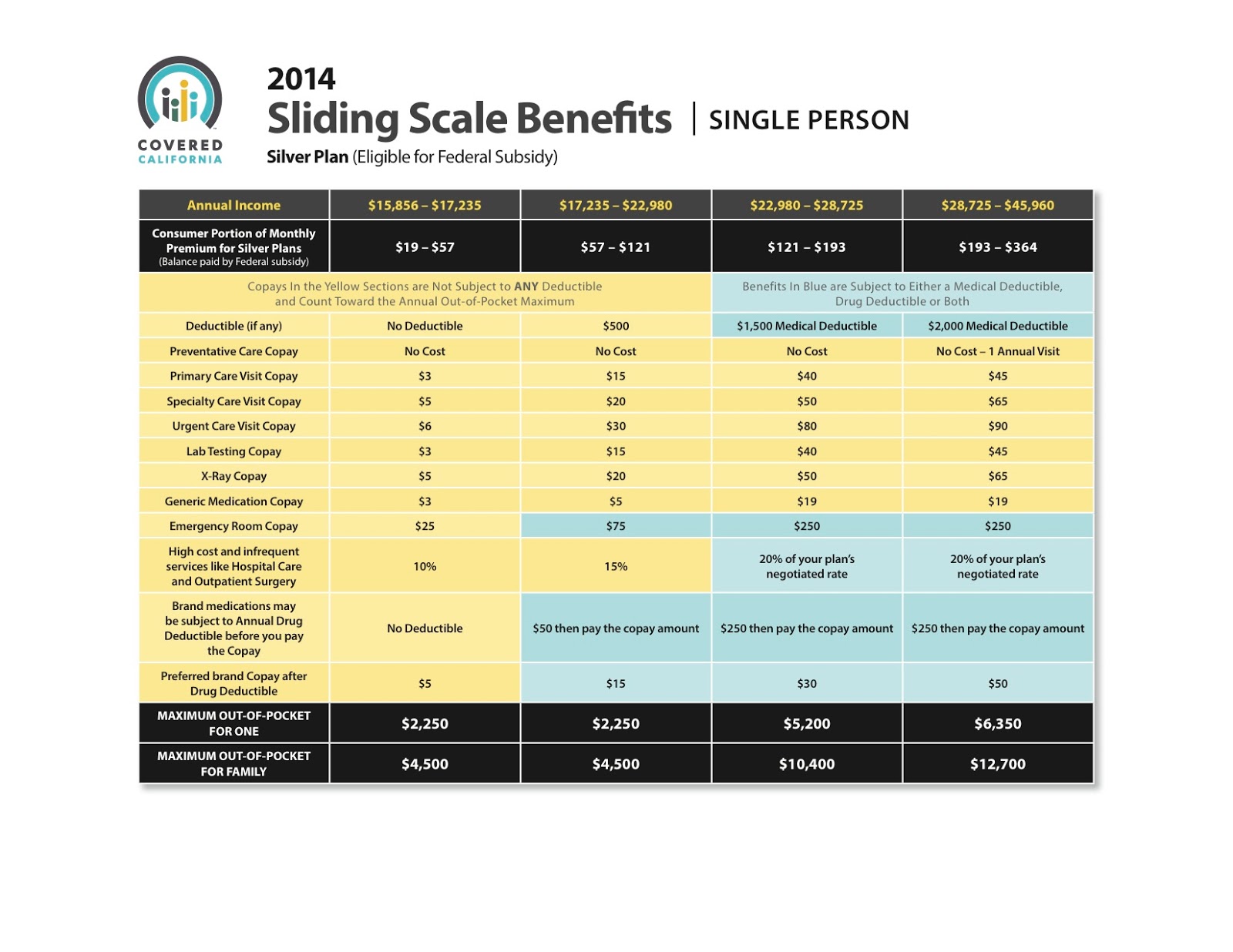
It looks to me like consumers will have a choice when they get to look at the health plans available on the new “Obamacare” health insurance exchanges––rate shock or benefit shock. While there has been lots of focus on the issue of rate shock, I will suggest that just as big an issue may well be benefit shock—that consumers will look at what they will be getting for their premium payments and that they will be surprised at what their out-of-pocket costs will be and before they get anything.

The chart above was prepared by Covered California, the state-run California exchange. This chart does not include specific California plan premiums. What it does show is the net of subsidy cost a single person would pay at the various income points for the second lowest cost Silver plan, as well as the deductibles and co-pays they can expect to see from the standard Silver plan.

While the benefit plan structures may vary a bit from state to state, this gives us a pretty good idea of what consumers can expect in all of the states (click on chart to enlarge).  A single person making $22,980 per year would face a premium, net of subsidies, of $121 per month. That’s pretty good.

Five Reasons the Federal Insurance Exchange Glitch May Not Be That Big Of A Deal. Knock On Wood.

By DAN DIAMOND

The Wall Street Journal broke the news Thursday night that a “pricing glitch” is plaguing the federal health insurance exchange software … with less than two weeks to go before the exchanges are supposed to launch.

Basically, the exchange’s calculator can’t do a pretty important piece of math: How much each consumer will need to pay for his or her specific coverage.

Glitches had been somewhat expected—there had been rumblings of technical problems, despite officials’ public vows of confidence—but it doesn’t make the Journal‘s scoop less of a story. Opponents of Obamacare will use any delay to raise fresh concerns about the law’s implementation, and even the most ardent supporters of the ACA acknowledge that having working software is crucial to a working rollout on Oct. 1.

And what happens to enrollment targets if the glitches aren’t quickly resolved and would-be customers get frustrated and turn away?

There are several potential interpretations and implications here, given that this story is bound up in both politics and policy. From my perch, I’d offer these five quick reactions to the Journal‘s scoop.

1. This news is not a surprise.
When reporting on the ACA’s rollout, especially since the Supreme Court’s ruling last June, officials and analysts kept raising the same question with me: Will the exchanges be ready in time?

  • Keep in mind, the exchanges are intended to combine an unprecedented mix of eligibility verification systems, subsidy calculations, and thousands of insurance products.
  • Add an additional factor—the pace of ACA implementation lagged between 2010 and 2012 because of the ongoing uncertainty over whether the law was even constitutional—and the level of complexity involved in getting the exchanges off the ground really is astounding.

There have been hints that these systems might not be ready. Federal officials announced over the summer that they would scale back the exchanges’ verification requirements until 2015. And the contractors charged with designing the systems might as well be working on the Siberian insurance exchange, given how they’ve ignored media requests.

2. The federal exchange isn’t the only one with glitchy software. State exchanges are having problems, too.
Oregon has already announced that it plans to delay the formal roll-out of Cover Oregon to continue beta-testing, and California (a state that has moved exceptionally quickly to implement health reform) was weighing contingency plans for Covered California, too.

As Caroline Pearson of Avalere Health told me a few weeks ago, “if California’s talking about contingency planning, then we need to acknowledge that any number of state-run exchanges may not be fully operational by Oct. 1.”

However, the federal exchange software takes on extra importance given the sheer number of states (36) and potential customers (32 million uninsured) that will be shopping through its exchange.

Continue reading…

A Troubling Strategy at Health IT Week

By ADRIAN GROPPER

Health IT Week demonstrated a double barrel strategy to segregate patient information from provider information. Providers already have the power to set prices and health IT plays the central role.

By rebranding HIPAA as “Meaningful Consent” and making patients second-class citizens in Meaningful Use Stage 2 interoperability, providers and regulators are working together to keep it that way.

Essential consumer protections such as price transparency or independent decision support are scarce in the US healthcare system. The journalists are shouting from the rooftops.

There’s  $1 Trillion (yes, $3,000 per person per year) of unwarranted and overpriced health services steering the Federal health IT bus with an information asymmetry strategy. Those of us that want to see universal coverage succeed need the information transparency tools to drive for changes.

Here’s how it works: The department of Health and Human Services (HHS) controls the health IT incentives and regulations. HIPAA applies to most licensed health services providers. Laboratories and devices are regulated by Medicare and the FDA.

Unlicensed services offered directly to patients, such as personal health records, web info sites and apps are regulated by the FTC. Separate regulatory domains facilitate the segregation of information and contribute to the lack of transparency by making patient-directed services use delayed and degraded information. This keeps independent advice from FTC-regulated service providers from illuminating the specific abuses.

The segregation of patient information from “provider” information is the current federal regulatory strategy. It’s even more so in the states. By making patients into second-class citizens, the providers can avoid open scrutiny, transparent pricing, and independent decision support.

Federal regulators then create a parallel system where information is delayed, diluted, and depreciated by lack of “authenticity”. This is promoted as “patient engagement”. For regulators, it’s a win-win solution: the providers support the regulation that enables their price fixing and many patient advocates get to swoon over patient engagement efforts.

The proof of this strategy became clear on the first day of Health IT Week – the Consumer Health IT Summit.

Continue reading…

A Dozen Hospitals Are Laying Off Staff and Blaming Obamacare. Don’t Believe Them.

By DAN DIAMOND

Hospitals tend to be among the largest employers in their communities — which means that any individual decision to lay off staff can have an outsized local impact. And taken together, a dozen recent announcements seem to paint an especially dire picture for hospitals (and their communities) around the nation.

For example, NorthShore in Illinois says it will lay off 1% of its workforce. The staffing cuts “ensure NorthShore remains well positioned to deal with the unprecedented changes brought on by the Affordable Care Act,” according to a memo from the health system’s chief human resources executive.

And California’s John Muir Health is offering staff voluntary buyouts ahead of ACA implementation. “We’re being paid less, and we either stick our head in the sand or make changes for the future so patients can continue to access us for their care,” according to John Muir spokesperson Ben Drew.

When Obamacare was being debated in Congress, its opponents tried to tar it with a deadly label: “the job-killing health law.” So is the ACA finally living down to its sobriquet?

Not exactly. While the recent news makes for provocative headlines, the devil’s in the details — and the financial reports.

A Closer Look at Industry Pressures

It’s clear that something is shifting in the hospital market. After years of employment growth, hospitals’ hiring patterns have largely leveled off. Collectively, organizations shed 9,000 jobs in May — the worst single month for the hospital sector in a decade.

Some of those decisions reflect industry-wide belt-tightening, as Medicare moves to rein in health spending by moving away from fee-for-service reimbursement and penalizing hospitals that perform poorly on certain quality measures.

And uncertainty around ACA implementation is trickling down to hospital staffing decisions, economists told  me. Many organizations still aren’t sure how the pending wave of newly insured patients will affect their profit margins, given that many of these individuals may be sicker and will be covered by Medicaid, which reimburses hospitals at lower rates than Medicare and private payers.

Continue reading…

Reforming Health Reform

By ROGER COLLIER

It may say something about expectations for the Affordable Care Act that the simplistic “just repeal Obamacare” cries of Congressional Republicans are starting to be supplemented by proposals for its replacement.

The most detailed so far is from the conservative American Enterprise Institute, which has published an unexpectedly non-doctrinaire study authored by Harvard professor Michael Chernew and seven other respected academics.

It’s far from perfect, but it’s worth reading.

Structural details of the AEI proposal, modestly titled “Best of Both Worlds,” aren’t always clear (page 1 lists four “principles,” page 5 lists five “priorities”, and page 16 lists three “major planks”), but it does attempt a bipartisan approach, combining ideas from left and right.

Some of these ideas have been contained in other proposals, such as those of Wyden and Bennett and Fuchs and Emanuel (which may damn the AEI proposal in right-wing eyes), and most recently in a THCB piece by Martin Gaynor. They include the elimination of the employer coverage tax preference, the provision of “premium support” subsidies for most individuals, and the establishment of a national insurance exchange. Together, they are designed to encourage individual choice and responsibility and to maximize competition between insurers, while removing some of the inequities of the present system (and of the ACA).

The AEI proposal assumes that eliminating the employer coverage tax preference will result in most individuals obtaining coverage through a national exchange, with national regulation of insurance plans. Current Medicaid eligibles will be included, with the replacement of acute care Medicaid funding by subsidies for conventional coverage. All individuals will be able to choose between fully-subsidized “basic plans” and more generous partially-subsidized options, typically with substantial deductibles tied to income and health status. Insurers will be encouraged to offer multi-year coverage and, unlike in the ACA, medical underwriting will be allowed. The only government financing will be for premium subsidies, to be funded by the additional income and payroll tax revenues resulting from elimination of the employer tax preference and by redirecting federal and state Medicaid payments.

Continue reading…

Health Exchange Confusion: Why We’re Getting the IBM Story Wrong

By DAVID WILLIAMS

I was a bit surprised by the front-page headline and accompanying article in the weekend Wall Street Journal (IBM to Move Retirees Off Its Health Rolls). The headline and subtext of the article are that IBM is ending health benefits for retirees, leaving them to fend for themselves. But as I read through the specifics that doesn’t appear to be at all what’s happening. Unfortunately, the article’s main impact is to leave an unduly negative impression of private health insurance exchanges.

Retiree health benefits are a big deal, especially for employees who retire before they reach the Medicare eligibility age of 65. A typical early retiree in his or her 50s will face high premiums in the individual market compared to a younger, and typically healthier, person. If they are among the few whose company provides generous coverage they are very lucky.

[On a side note, life is about to get easier for early retirees who have to buy their own insurance, thanks to Obamacare’s banning of medical underwriting and limits on the ratio of premiums charged to older people versus younger ones.]

When a person turns 65 life gets a lot easier on the health insurance front as the federal government takes over the vast majority of costs. As a result, a retiree on Medicare is much cheaper for an employer to provide health care benefits to, since they are essentially just paying for supplemental coverage.

Continue reading…

The 9th Grade Class Does Obamacare Math (Can Journalists Do the Same?)

Michael Millenson

By MICHAEL L. MILLENSON

Welcome, students, to our special combined 9th grade math and civics class. Today, we’re going to look at the “Cadillac tax” in the Affordable Care Act.

Yes, Mitt, you have a question already? No, no, “Cadillac tax” is just an expression. No one is going to tax your family’s cars, Mitt, I promise.

Paul, you also have a question? I’m sorry, Paul, but if you had done the reading, you would know that the “Affordable Care Act” and “Obamacare” are the same thing. And yes, it is still the law, as I must have told you and your friends 40 times. Now can we get on with the class?

As those of you who did do the reading know, most American workers get their health insurance through their employer. The company, in turn, is allowed to deduct the cost of that insurance from its taxes. If the insurance for workers is very generous, it can encourage people to use too much medical care. This not only drives up costs, but we all pay for it a second time through the tax code. The Affordable Care Act addresses that problem by placing an excise tax on rich benefit plans starting in 2018, which is informally known as the “Cadillac tax.”

Economists of all viewpoints generally agree that an open-ended tax deduction for health insurance encourages overconsumption. What do we call that kind of agreement? Michelle?

No, Michelle, I’m afraid, “liberal conspiracy” is not the answer I was looking for. “Bipartisan consensus” was the correct response.

Rand, you seem quite agitated. Yes? “Government intervention in markets is never the right answer.” OK. Well, Rand, let’s talk about that another time and move on from civics to the mathematics part of today’s lesson. We’ll start with a word problem from the New York Times.

The Times quoted a study from a health policy journal as saying that 75 percent of health plans could be affected by the Cadillac tax over the next decade. That’s a big number, isn’t it?  And the tax itself is 40 percent – another big number. No wonder the story was on the first page of the Business section.

But here are a few other numbers from the same study: just 16 percent of plans are likely be affected by the tax when it starts in 2018 ­– a much smaller number. And the “next decade” the study is talking about starts in 2018. What the study actually says is that by 2029 the tax could reduce benefits for affected plans by 3.1 percent. That’s an even smaller number and even further away.

Class, why would the New York Times emphasize the biggest numbers they could find?

Continue reading…

The Exchanges Won’t Be Ready in Time. And it Probably Won’t Matter.

By DAN DIAMOND

As states race to implement health reform, California doesn’t want to settle for second.

“We don’t want to be a pace car state” when it comes to implementing health reform, state HHS Secretary Diana Dooley told Politico back in January 2011. “We want to be the lead car.”

It’s a metaphor that California leaders have returned to time and again. And to their credit, they’ve often succeeded.

While other states waffled, Golden State officials quickly embraced key Obamacare provisions like expanding Medicaid and creating insurance pools for individuals with pre-existing conditions.

At the same time, lawmakers crafted legislation intended to conform California’s health insurance plans to new standards under the Affordable Care Act.

And Covered California, the state’s health insurance exchange, also has drawn national attention for its speedy implementation. Among the 17 states that opted to run their own exchanges, California has “certainly [been] in the lead on getting their health plan information out … and getting the contracts signed,” Rachel Dolan, who monitors exchange activity for State Refor(u)m, a project of the National Academy of State Health Policy, said.

But the driving metaphor only extends so far.

“I don’t think it’s a race,” Dolan added, cautioning that each state might take unique approaches to exchange implementation — and objectively judging those individual strategies is impossible.

And a more essential issue might be getting lost, amid the growing number of questions over which state exchanges will be open for business on Oct. 1.

“Lots of people are asking about readiness,” said Caroline Pearson, who leads Avalere Health’s efforts to track health reform implementation. “But no one is asking about whether it matters.”

Where the States Stand on Readiness
The sprint to get the exchanges off the ground — which for some states didn’t really begin in earnest until after the Supreme Court’s June 2012 decision to uphold the ACA — has led to repeated delays and ongoing concerns.

Continue reading…

When Opting Out Is Not an Option

By KATHERINE CHRETIEN

Henrietta Lacks did not give researchers permission to take her cancer cells and study them. After she died in 1951, her family was not asked permission as her immortalized cells were used in countless laboratories. This month, the National Institutes of Health finally took a step in righting that wrong, announcing that the Lacks family would help decide who can access Henrietta’s DNA.

Today, getting a patient’s permission, often in writing, is standard in experimental medical research. Well, not always. Currently, there are at least nine ongoing studies involving 62 U.S. cities and towns with a combined population of more than 45 million that do not involve getting permission. They take place during emergencies, such as when ambulances arrive at an accident where patients are too injured to give permission.

For example, imagine this scenario based on a recent study sponsored by the University of Washington. You are involved in a car accident. Paramedics find you bleeding severely. They give you fluids to keep your blood pressure up, but they intentionally give you a bag of fluid that is smaller than the standard. Then they monitor your medical outcome and compare it with patients who received the larger amount of fluids. During the emergency, neither you nor your family know about the study.

Vital research

Research on medical emergencies is vital in determining how to care for people with life-threatening injuries because we often do not have proof that standard methods are the best. People involved should be told that is how their records are being used.

In 1996, the Department of Health and Human Services and the Food and Drug Administration passed regulations allowing research about emergency treatment to occur without permission. For a study to qualify, patients need to have a life-threatening condition, current standards of care must be unproven or performing poorly, and obtaining permission must not be feasible (such as an unconscious patient or a patient whose condition does not allow time for informed consent).

Continue reading…

Data Points: Why Delay of the Employer Mandate May Not Actually Mean That Much

By CARTER PRICE & EVAN SALTZMAN

Last month, the Obama Administration announced that it would delay enforcement of the employer mandate component of the Affordable Care Act (ACA) in part due to opposition from the business community.  Opponents of the ACA cited the delay as evidence that the law was collapsing under its own weight, while ACA proponents downplayed the importance of the employer mandate in realizing the primary objective of the law – extending affordable coverage to millions of uninsured Americans.

Will delaying the employer mandate lead to the ACA’s demise?

Using economic modeling, we have found that the primary goals of the ACA will not be impacted by the delay, but the delay may impact one of the law’s key revenue sources designed to offset the costs of the coverage provisions.

Under the ACA, only firms with 50 or more full-time employees can be assessed penalties for not offering coverage under the employer mandate; small businesses with fewer than 50 employees are exempt.  Furthermore, more than 95% of large firms already offer insurance, implying that only a small pool of firms would need to alter their current benefit offerings to comply with the employer mandate.  Our model estimates that less than 1% of firms, employing about 2% of the workforce, would be penalized for not offering insurance to their workers if the employer mandate is enforced.

In fact, only about 300,000 workers (approximately 0.2% of the workforce) would lose their employer’s health insurance as a result of the employer mandate delay, according to our economic analysis. And many of those losing coverage would be able to get affordable coverage through a spouse, the newly created health insurance exchanges, or Medicaid.  Hence, delaying the employer mandate will have only a nominal impact on the ability of workers and their dependents to obtain health coverage.

Continue reading…