Categories

Category: Health Policy

Why the January 1st Deadline Matters

By Seth J. Chandler

Contrary to the views of some, the number of people who have insurance coverage through the Exchanges as of January 1, 2014, matters to everyone.  It matters because the pool that exists on that date will determine, at least for a while, whether the premiums charged by insurers in the Exchange are likely to be stable and the extent of the federal government’s multiple obligations to subsidize plans purchased on the various Exchanges. It is not as if insurers get a claims paying holiday simply because more and healthier people may enroll later in the year.

It also matters because a major point of the Affordable Care Act was to increase in an efficient and relatively painless way the net number of people who have insurance or social protection against significant illness.  If the numbers in the Exchanges and in the expanded Medicaid program do not way more than offset the number of persons who lose their insurance as a result of the ACA, or if the cost of extending health protection in this fashion proves too high, the ACA will not have accomplished its goals.

Given the chaos that has erupted as procrastination strains Exchange infrastructure and deadlines are repeatedly extended, it is difficult to tell right now whether the ACA is performing as hoped. A few things are clear, however. The first thing is that the Obama administration is not releasing the sort of information from which an objective assessment could be made.

Platitudes such as “Millions of Americans, despite the problems with the website, are now poised to be covered by quality affordable health insurance come New Year’s Day,” from President Obama at his last press conference are just not a substitute for knowing how many people have enrolled in the plans in the various Exchanges, and more importantly, have paid for coverage. What are their ages? How about some real numbers as a Holiday present?

Second, the Obama administration is acting as if a large number of enrollees in the aggregate is the measure of success. This is simply not true. Putting aside the problem of it being paying customers rather than mere enrollment that ultimately matters, meeting or exceeding projections in some states does not compensate for deficiencies in many other states.

Because the pools are state-based, Texas insurers and insureds are not helped if enrollment in New York or Connecticut exchanges ultimately equals or exceeds targets. The insurance market in Texas and many other states will still be unstable with some insurers likely pressing for significant premium increases, contemplating withdrawal from the Exchanges, and demanding larger subsidies from the federal government via Risk Corridors and other programs.
Continue reading…

They’re Not Deadlines. They’re Opportunities …

By DAVID BLUMENTHAL

Confusion about Affordable Care Act (ACA) deadlines is rampant. That’s because there are lots of them and they keep changing. The fact is that some of them matter a lot more than others.

In my view, the BIG deadline is:

MARCH 31, 2014: Under the ACA, all Americans must have health insurance, and this is the latest date you can acquire it if you wish to avoid paying a penalty on your 2014 income tax. Some individuals will be exempt from penalties, including, as of last week, people whose policies were canceled because their plans’ benefits did not meet new ACA standards of adequacy.

Another date that has drawn attention but, in my view, doesn’t matter as much:

JANUARY 1, 2014: This is not a deadline so much as an opportunity. It is the first day, when, if you signed up in time (now December 24 for the federal website, but a few states have later deadlines)—and paid your premium in time (at the administration’s urging, many insurers are allowing a grace period through January 10 for the federally run marketplaces and some states have also moved this date)—you could enjoy the subsidized coverage available under the ACA. But if you miss these so-called deadlines, you still have until March 31 to sign up for coverage to avoid a penalty.

For the millions of Americans who are uninsured, or who could have enrolled in improved insurance through a state or federal exchange, missing these deadlines merely means you failed to make yourself better off as soon as you possibly could. BUT YOU WILL BE NO WORSE OFF THAN YOU WERE BEFORE.

There are also some dates that are consequential, but have received less attention, or have receded from the headlines:

NOVEMBER 2014: This is when the Obama administration promises online enrollment for the Small Business Health Options Program (SHOP) in the 34 states where the federal government is operating the small-business marketplaces for companies with fewer than 50 workers. For now, small businesses in these states can apply via paper application or an insurance broker or navigator.

Online access is available already in most of the 17 states and the District of Columbia that are operating their own SHOP exchanges.

JANUARY 1, 2015: The date by which employers with 50 or more employees will become liable for a tax penalty if they are not offering health insurance that meets minimum standards, and an employee becomes eligible for subsidized private coverage through the marketplaces.

The changing dates associated with the ACA are troubling to some, since they suggest confusion and even mismanagement by the Obama administration. It would obviously be reassuring if every declared date were honored and announced rules and intentions never changed.

On the other hand, I’m doing some long-delayed repairs in my home. The contractor said the work would be done by Thanksgiving, but there were unanticipated problems. We’re hoping now for Christmas.  I’ll be happy if it’s done by mid-January, but the key thing is whether, a year from now, I’m satisfied with the result.

Health insurance is obviously way more important to millions of Americans than any home repair project could ever be. But few things in life go exactly as planned, and it would be totally astonishing if the implementation of massive reforms to a sector accounting for 20 percent of our economy rolled out without a bump or a detour.  We should keep that in mind as we think about those changing ACA deadlines.

David Blumenthal, M.D., M.P.P., is president of The Commonwealth Fund, where this post originally appeared.

The Obamacare Slippery Slope–What’s Your “Hardship?”

By ROBERT LASZEWSKI

As of this morning, here are the new rules.

If you had a health insurance policy that was cancelled, you are now exempt from the individual mandate and its tax penalty should you not decide to buy a replacement policy. In addition, you can now sign up for the very high deductible Catastrophic Plan that was originally reserved only for those under the age of 30.

If you did not have a health insurance policy that was cancelled, you are still subject to the individual mandate and you are not entitled any special treatment toward signing up for the Catastrophic Plan. You must pay the full price for an exchange plan and accept whatever out-of-pocket costs and network limits it might have for the money.

The administration made this change under the “hardship” provisions already part of the law. They have simply defined hardship as having lost your old individual plan and your not being able to find something without it being a “hardship” to purchase, presumably over price or coverage.

This change was brought about when a number of Democratic Senators, some of them facing a tough reelection battle, demanded this concession.

The change was made without consulting the health insurance industry and it was a surprise to them. It is another Obamacare change months after their 2014 rates were set under the presumption all of these cancelled policyholders would be paying a lot more premium into the pool than they pay today.

One has to believe this will not be the last concession to Democrats under reelection pressure.

One has to wonder how this can’t other than undermine further how people feel about Obamacare––particularly its fairness––and taking their “social responsibility” to sign-up seriously.

Continue reading…

What We Don’t Know Can Hurt Us

By DAVID DRANOVE & CRAIG GARTHWAITE

As the health insurance exchanges find their footing and potentially millions of Americans gain access to insurance, this may be a good time to step back and take a longer term view of the ACA. When you get down to it, expanding health insurance coverage was the easiest and least controversial part of health reform. There is no shortage of ways to expand health coverage and almost any credible health reform proposal would have done the job, provided enough money was thrown at the problem.

In designing the ACA, perhaps as a result of political pressure, President Obama opted for a combination of heavily subsidized individual insurance exchanges and generous expansions of Medicaid. Freed from political constraints, he might have instead pushed for the single payer system that many of his most ardent supporters desired. Republicans inclined to expand coverage (at least one of us is proof that unlike the unicorn these do exist) might have pushed for a pure voucher program that harnessed market forces.

All of these options would expand coverage to the degree that policymakers were willing to fund them. So while we congratulate the President for his political success (we doubt the other options could have made it through Congress), it is a simplistic mistake to evaluate the implementation of the ACA by counting the numbers of uninsured or waiting for the monthly updates on the enrollment figures from the exchanges website. Any regulator with a big enough purse can, in the fullness of time, expand access. Frankly, that’s the “easy” part of healthcare reform.

But what about the other elements of the so-called “triple aim” of health reform: cost and quality? You see, while we agree that liberal, moderate, and conservative health reforms can all improve coverage, they each will have very different effects on the other important outcomes. Consider for example the oft-discussed “Medicare for all”; i.e. a single payer system. This would increase access without the messiness of the exchanges. It would also allow the government to flex its monopsonistic muscles and quickly reduce costs – though likely at the expense of quality. In contrast, relying on markets may not reduce costs in the short run, and may not necessarily reward real quality (though it has a better short than single payer in this regard).

Evaluating health reform in the context of the “Triple Aim” is important, but even that approach is not nearly enough. There is a broad consensus among that technological change is the most important long run driver of cost and quality. It follows that the most important element of health reform is its impact on technological change.

To understand how technological change affects all of us, consider the profound impact of the top ten medical advances in the last ten years, as listed by CNN:

1. Sequencing the human genome
2. Stem cell research
3. HIV cocktails
4. Targeted cancer therapies.
5. Laparoscopic surgery

Continue reading…

We Should Be Getting More Data On The Affordable Care Act

By SETH J. CHANDLER

The Obama administration released critical data last week on the aggregate levels of enrollment in the various individual Exchanges.  Most of the journalistic and blogospheric effort in the aftermath has been in trending: do these numbers portend a massive leap forward in Exchange enrollment such that there can be some confidence that the Affordable Care Act will in fact work?

Might this alternatively be some sort of temporary surge that is both too little and too late? All of this analysis is completely fine; I’ve engaged in it myself. But there are other issues that should be examined.

Here are five questions, mostly about data, I’d like to see other journalists or bloggers start to pursue. I’m doing some of it myself, but I would love company.

1. What is the distribution of enrollment among the various metal tiers?

If a lot of people are purchasing the gold and platinum plans, that is a sign that the people signing up have poor health and do not want to pay higher deductibles. This is particularly true if the same pattern exists among the enrollees receiving income-based subsidies: they, after all, are mostly purchasing gold and platinum because they need it, not because it easily accommodates their budget.  If, on the other hand, the distribution is weighted towards the bronze and silver plans, that is some evidence that the people signing up may not be coming as disproportionately from the low or middle expense range.

Unless one’s funds are very limited, it does not make sense for someone who knows they will have high medical expenses to purchase a bronze plan. Disproportionate purchase of gold and platinum policies heightens the potential for adverse selection problems to the extent insurers believed the federal government’s models, which assumed only mild “induced demand” for such policies.

Journalists should also continue pressing at the state and federal level for information on age distribution of enrollees; I can see no legitimate reason to withhold it.

Continue reading…

The Doc Fix Is Real

By BILLY WYNNE

Congress just had an uncharacteristically big week – with significant implications for healthcare policy. It flew by fast and furious, so here we pause to unpack the most significant developments and what they teach us about the future.

1. The Permanent Doc Fix Effort is Real. You have to hand it to the committees of jurisdiction, they have kept their heads down and plugged away all year at permanently repealing the broken Sustainable Growth Rate (SGR) formula that dictates Medicare payments to doctors. They’ve floated new payment methodologies, added policy addressing the package of “extenders” that perennially travels with the “doc fix,” and now all three have successfully completed bipartisan mark-ups of their respective approaches. Furthermore, the three month SGR patch that was included in the budget deal is an implicit endorsement by congressional leadership that there’s actually a chance this could happen in the first quarter of next year.

The next step is to identify savings to pay the roughly $150 billion price tag, which has always of course been the biggest rub. That process is going to take center stage early next year in a “Super Committee-lite” process of negotiating various potential cuts to healthcare programs. The cynics are still betting against it, but we’re closer than we’ve ever been before to replacing the 15+ year-old SGR.

2. The Long-Term Care Hospital Sector Will Never be the Same. In a lesser-noticed component of the three month doc fix patch alluded to above, Congress eliminated the payment differential for LTCHs (pronounced el taks) and regular inpatient hospitals for patients who do not meet clinical complexity criteria. What began as an esoteric exemption for a small handful of hospitals in the early 1980’s and grew to a $6 billion Medicare benefit annually is now going to start to plateau.

The market liked the change, paradoxically, because it was gentler than some bean counters had recommended and gave plenty of time (four years) for sophisticated companies to adjust. But the hot LTCH business just got some pretty cold water poured on it.

3. The Budget Deal Helps Healthcare Programs. The Murray-Ryan agreement to set spending levels for the next two years alleviated some of the impact of the sequester on discretionary spending programs like those at the FDA, NIH and HRSA. This means that funding for new product approvals, clinical research, workforce development programs and some primary care services will be modestly improved in 2014 and 2015.

Continue reading…

The Republican Dilemma

By ROGER COLLIER

What a difference a few weeks make. Just as Republicans were desperately trying to extricate themselves from the fiasco of tying budget passage and debt ceiling legislation to repeal of the Affordable Care Act, the White House came to their rescue with its disastrous healthcare.gov start-up.

It’s now looking like the most egregious healthcare.gov glitches will be fixed by year-end, but with enough problems remaining in 2014 to continue to provide fodder for conservative (and other) critics. Unfortunately for the administration, just as the technical bugs are ironed out the spotlight will move to other aspects of Obamacare.

Premiums are going to take a jump next year, reflecting the lower than projected enrollment by the young and healthy (thanks in part to the healthcare.gov fiasco and the confusion created by Presidential and Congressional attempts to allow non-compliant plans to be extended). There’s a good chance of wholesale cancellations, too, as some insurers take a long look at the unhealthy business they’ve acquired and decide to abandon the exchange market. And it’s almost a given that every other increase in premiums or cut in coverage or cancellation of insurance will be blamed on the upheaval of the Affordable Care Act.

It’s enough to make gleeful Republican leaders believe in the Tooth Fairy.

But will the Tooth Fairy continue to deliver, notably in the Congressional midterms in 2014 and the Presidential election in 2016? The public attention span is notoriously short, and while the current chaos may influence the 2014 midterms, by 2016 the healthcare.gov disaster is likely to be a fading memory. Barack Obama won’t be running for reelection, so harping on the present White House’s incompetence will have limited impact. And while the eventual imposition of IRS fines on those still without coverage will certainly generate a new round of outrage–even assuming the IRS gets the calculations right–Hilary Clinton, or whoever the Democratic candidate turns out to be, will reasonably be able to ask “So where was the Republicans’ better idea?”

Continue reading…

Data Points: More Backroom Chaos and Low State Numbers

By ROBERT LASZEWSKI

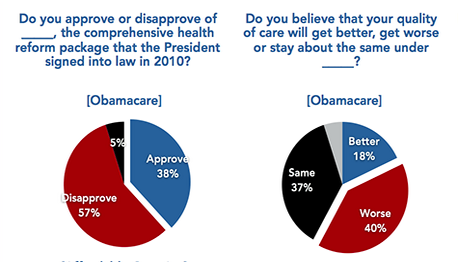
Shifting Millennial Attitudes on Obamacare December 2013.
Harvard Institute of Politics. Dec 4th, 2013. Poll

A few observations after 10 weeks of Obamacare implementation.

The Obama administration released the first two months enrollment figures this week. With HealthCare.gov still struggling in November, the enrollment of 137,000 people in the 36 states was expected. The main event for the federal exchanges will play out in December now that most people can navigate it

What I found notable in the report was the lack of robust enrollment in the states. In states where the exchange has been running at least adequately for many weeks now, the enrollment numbers are far from what I would have expected.

California enrolled 107,000 people in private plans in the first two months. But California has cancelled 800,000 current individual health plans effective January 1––all of whom have to buy a new plan by January 1 or become uninsured. The only place those who are subsidy eligible can get a subsidized plan is in the California exchange.

Continue reading…

It’s Doctors versus Hospitals Over Meaningful Use

By ADRIAN GROPPER

The Massachusetts Medical Society may be the first to notice that Meaningful Use EHR mandates favor large providers and technology vendors. Control over the Nationwide Health Information Network sets the stage for how physicians refer, receive decision support, report quality, and interact with patients. State health information exchanges and policy makers are caught in the cross-fire over health records interoperability. Are the federal regulations over Stage 2 being manipulated to put physicians and the public at a disadvantage?

On Dec. 7, the Massachusetts Medical Society took what might be the first formal action in the nation. A resolution stating:

“That the Massachusetts Medical Society advocate for a more open, affordable process to meet technology mandates imposed by regulations and mandates; e.g., that all Direct secure email systems, mandated by Meaningful Use stage 2, including health information exchanges and electronic health record systems, allow a licensed physician to designate any specified Direct recipient or sender without interference from any institution, electronic health record vendor, or intermediary transport agent.”

Scott Mace’s column Direct Protocol May Favor Large Providers and Vendors is the first to report on this unusual move by a professional society. Full disclosure: I’m a member of the MMS and the initiator of what became this resolution.

Meaningful Use is intended to support health reform by promoting interoperability and innovation in health service delivery. The Affordable Care Act, Obamacare, is fundamentally a free-enterprise model without single payer or even a public option. Obamacare depends on the market for eventual cost controls and sustainability. Meaningful Use is regulation designed to enable market-driven health reform by reducing interoperability barriers.

Although Meaningful Use regulations have already handed out $17 Billion to drive “voluntary” adoption of interoperable electronic health records, meaningful interoperability is still elusive. Meanwhile, the doctors are chafing about Meaningful Use intrusions and policymakers worry that the regulations will actually increase costs.

Continue reading…

November’s Numbers: Sorry. They’re Not Good. They’re Bad. Awful, Actually ..

By SETH J. CHANDLER

The federal government announced yesterday that 137,204 people have selected a healthcare plan through the federal Exchange as of November 30, 2013. The number is an increase over the 29,794 who had done so by the end of October, a month during which the website portal for enrollment, healthcare.gov, was in disarray.

The government reports that 258,497 have now selected a plan through one of the state Exchanges, making a total of 364,682 enrolled. Asked by reporters whether the Obama administration stands by its estimate that 7 million will enroll in individual plans sold on the various Exchanges by March 31, 2013, the day necessary to do so in order to avoid a tax penalty,  Michael Hash, director of the office of health reform in the federal Health and Human Services Department, said that they were “on track, and we will reach the total that we thought.”

The pace of enrollment announced by the federal government today is inconsistent with the claim that its 7 million goal will be achieved. The claim rests on hopes of two surges, one taking place over the next 12 days before the December 23, 2013, deadline for coverage starting January 1, 2014 and a second surge taking place as we approach the end of March at which point, if coverage has not been obtained, many Americans will be hit with a tax penalty.

The magnitude of the surge required strains credulity.  A scenario in which most of  those who wanted coverage have already applied and in which the pace of enrollment stays the same or even sags for lengthy periods as we go forward would appear almost as likely. Plus, it seems unlikely that there will be major enrollment between December 23, 2013, the first deadline, and March 23, 2014, the second deadline. If someone wanted coverage, they would try to get it earlier. What does applying in the middle of February accomplish? Moreover, if, given the unpredictability of human behavior, the surge actually materialized, it might well strain the government’s computer systems.

Continue reading…

