Categories

Category: Health Policy

Could Auto-Enrollment Be the Answer?

By JAAN SIDOROV

Kudos to the New England Journal for providing a tidy summary of the latest Republican healthcare reform proposal. Up until now, your correspondent was only vaguely aware of the GOP’s evolution from the political party of “no” to one of “go,” albeit with lots of caveats.

It seems the Senate Republicans no longer want to repeal Obamacare and are OK with keeping many of its more popular reforms. Instead, they’re focusing on undoing selected provisions, such as repealing the minimum benefit, returning some aspects of medical underwriting and resurrecting the “block grants” for Medicaid.

But one of the more interesting wrinkles in the proposal is “auto-enrollment.”

Those of us from the bygone days of “disease management” may recall the debates over the merits of “opt-in” versus “opt out” participation in our programs. The former required persons to actively chose to be entered into nurse coaching, which had the advantage of committing resources to a highly motivated population. The latter approach assumed all patients with a condition were enrolled and, only if they specifically requested it, would they allowed to stop the coaching phone calls. Unfortunately, “opt-out” usually gathered many patients who never answered the phone and were “engaged” in name only.

Well, the Republicans are apparently proposing that states be allowed to “auto-enroll” persons eligible for premium payment support into an insurance plan or Medicaid without their up-front permission, just like the old “opt-out” disease management days. The tax credit would cover the insurance costs, no bills would be issued to the consumer and voilà! the risk pools would expand. Patient choice would be preserved, because persons could always just say no.

Your correspondent was always of fan of opt-in disease management. Not only were patients who wanted to be in the program more amenable to behavior change, it allowed the program to “flex” the nurses that we needed as the program grew in scope. However, when it comes to insurance, yours truly thinks the Republicans may be onto something with their opt-out insurance approach.

Count your correspondent as a fan.

Jaan Sidorov, MD, is a primary care internist and former Medical Director at Geisinger Health Plan with over 20 years experience in primary care, disease management and population-based care coordination. He shares his knowledge and insights at Disease Management Care Blog, where an earlier version of this post first appeared.
What Extending the Obamacare Cancelled Policy Moratorium Really Means

By ROBERT LASZEWSKI

The administration has confirmed that the individual policies that were supposed to be cancelled because of Obamacare can now remain in force another two years.

For months I have been saying millions of individual health insurance policies will be cancelled by year-end––most deferred until December because of the carriers’ early renewal programs and because of President Obama’s request the policies be extended in the states that have allowed it.

The administration, even today, as well as supporters of the new health law, have long downplayed the number of these “junk policy” cancellations as being insignificant.

Apparently, these cancelled policies are good enough and their number large enough to make a difference come the November 2014 elections.

As a person whose policy is scheduled to be cancelled at year-end, I am happy to be able to keep my policy with a better network, lower deductibles, and at a rate 66% less than the best Obamacare compliant policy I could get––presuming my insurance company and state allow it.

But for the sake of Obamacare’s long-term sustainability, this is not a good decision.

The fundamental problem here is that the administration is just not signing up enough people to make anyone confident this program is sustainable.

Continue reading…

Obamacare’s Payment Pilots Are Struggling To Prove They Work. Here’s Why It’s OK.

By DAN DIAMOND

When Barack Obama was merely a senator running for the White House, he told one physician association, “I support the concept of a patient-centered medical home” and would encourage the model if he ever became president.

Six years later: Mission accomplished.

Nearly 7,000 primary care practices have officially been accredited as PCMHs, and thousands of other providers have adopted some features of medical homes, which use a team-based approach to coordinated care. And while the movement toward medical homes might have evolved without Obama, his health reforms clearly laid the groundwork for rapid adoption.

The only problem? There’s still no clear evidence that the model even works.

A prominent Journal of the American Medical Association study last month found that after three years, one of the nation’s largest medical home pilots didn’t lead to lower costs or significantly higher care quality.

“There are folks who believe the medical home is a proven intervention that doesn’t even need to be tested or refined,” lead study author Mark Friedberg told the Wall Street Journal‘s Melinda Beck. “Our findings will hopefully change those views.”

An accompanying editorial also sounded caution. “It is time to replace enthusiasm and promotion with scientific rigor and prudence,” Thomas Schwenk wrote, “and to better understand what the PCMH is and is not.”

Continue reading…

Metrics: Surprisingly, People Who Were Uninsured Last Year Remain Undecided About the ACA

By KATHERINE GRACE CARMAN

Since mid-December, we’ve brought you the latest data on public opinion of the Affordable Care Act (ACA) from the RAND Health Reform Opinion Study (RHROS), a new way to measure public opinion of health reform. The RHROS allows us to observe true changes in opinion by surveying the same people over time.

The trend of overall stability masking churn in individual opinion that we discussed last week has continued with our latest data. This week, however, we delve deeper to look at differences in opinion between two groups: those who had insurance in 2013 and those who did not.

Understanding how the ACA impacts these groups differently is particularly important. While the ACA is currently changing the landscape of health insurance, its impact should be especially pronounced for Americans who lacked access to insurance through their employer or government programs in 2013.

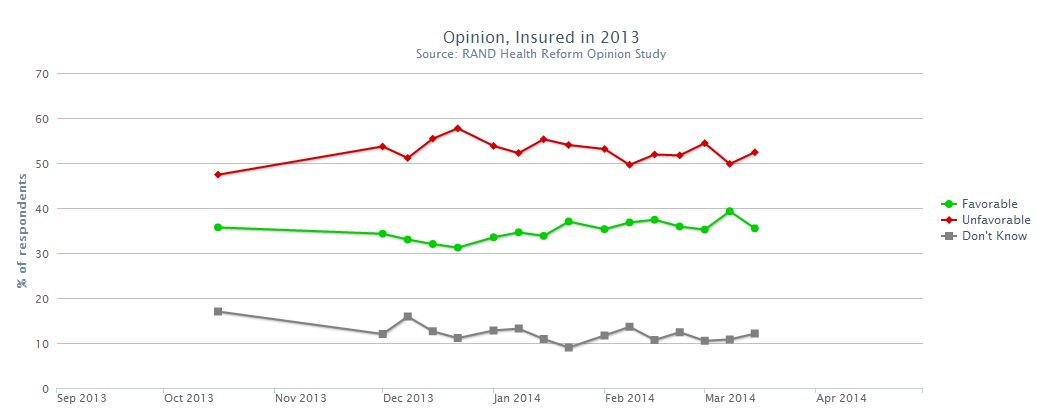
The following graph illustrates the opinions over time of all individuals who had insurance, regardless of the source.

This includes those who had coverage through their employer, purchased it on the private market, or received it through a variety of government programs, such as Medicare and Medicaid.

This group represents about 85 percent of the overall sample.

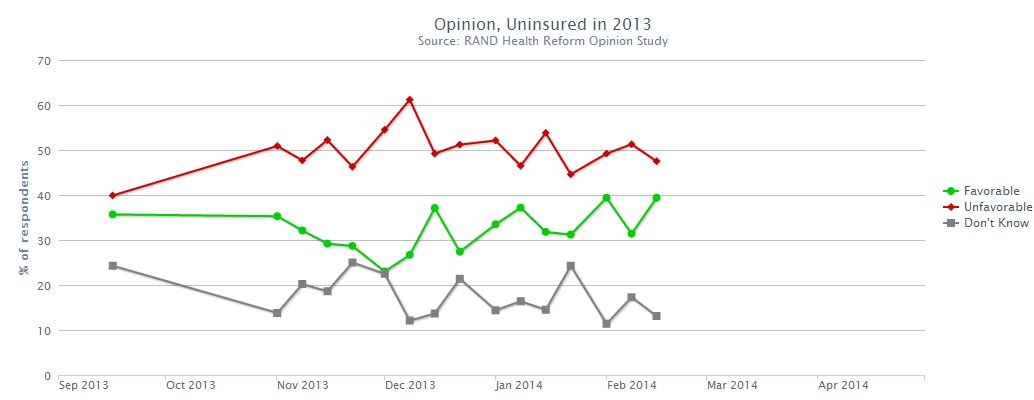
This graph shows opinion of the ACA among those who were uninsured in 2013:

At first glance, what’s striking about these two graphs is how similar they are—more on that in a moment—but there are actually some very important differences.

Continue reading…

The Weightlessness of Obamacare

By J.K. WALL

So many old rules in health care and insurance no longer seem to apply.

I keep stumbling upon situations, where, what used to be up is now down and what used to be down is now up.

No one seems to know for sure how things will settle out under the new reality created by Obamacare and the even more unpredictable reactions to the law by health care companies, employers and, most especially, you and me.

I’ve started using the term “weightlessness” to describe this state we’re in. Picture the astronauts on the international space station, floating through a room, flipping at will, as likely to settle on a wall or on the ceiling as on the floor.

That’s what life is like under Obamacare now—for physicians, hospital administrators, insurance executives, benefits brokers and employers.

Here are a few examples:

1. I wrote last week about how a chunk of workers, even at large employers with generous benefits, would actually get a better deal on health insurance from the Obamacare exchanges than from their employers. So their employers are starting to consider whether they should deliberately make health benefits unaffordable for those low-wage workers, so they can qualify for Obamacare’s tax-subsidized insurance.

That could be good for both employers and employees. The effect on taxpayers, which would switch from granting a tax credit to employers to instead granting it to the employees, is unclear.

2. Even though insurers were certain that price would be king on the Obamacare exchanges, that hasn’t led most customers to buy the plans with the cheapest premiums. As I wrote Friday, 76 percent of those shopping on the exchanges in my home state of Indiana have picked the higher-premium silver and gold plans, with only 24 percent picking bronze plans.

“There are a few geographies where we believe we are gaining share despite lower price competition which points to the value of our local market depth, knowledge, brand, reputation and networks,” WellPoint Inc. CEO Joe Swedish said during an January conference call with investors.

It’s possible that’s a result of older and sicker patients being the earliest buyers on the exchange, and that as healthier people buy coverage, they’ll gravitate to the low-cost bronze plans. But that hasn’t happened—which, as I wrote on Friday, has proved wrong hospitals’ concerns about the super-high deductible bronze plans.

Continue reading…

In Defense of the Defense of Mammograms

By SAURABH JHA

To the two certainties of life, death and taxes, add another two: mammograms and controversy surrounding mammograms.

The Canadian National Breast Screening Study (CNBSS) has reported results of its long term follow-up in the BMJ: no survival benefit of screening mammograms.

To paraphrase Yogi Berra “it’s mammography all over again.”

Is the science settled then?

No.

Before I wade further it’s important to understand what is implied by “settling the science.”

Einstein said “no amount of experimentation can prove me right; a single experiment can prove me wrong.”In physical sciences a theory need only be disproven once for it to be cast aside. Heliocentricity cannot coexist with Ptolemy’s universe. The statement “all swans are white” is disproven by a single black swan.

What do we do with the studies that showed survival benefit of screening mammograms? Why does the CNBSS not close the debate over mammograms, like Galileo did with celestial egocentricity?

The simple and simplistic answer is because there are powerful advocacy groups, special interests; the pink-industrial complex who have a vested interest in undermining the science.

But that lends to conspiratorial thinking. Special interests cannot undermine Maxwell’s equations or Faraday’s laws just because they do not like them.

The testability of Maxwell’s equations is inherently different from verifying that screening mammograms increase life expectancy. We must acknowledge two types of science; the former, physical science, a hard science; the latter, a hybrid of biology and epidemiology, soft science.

Soft science is a misnomer. There is nothing soft about performing a randomized controlled trial (RCT), the methodological gold standard; in ensuring factors that falsely augment or attenuate impact of screening mammograms are evenly distributed, data reliably collected, cause of death accurately recorded and correctly inferred. But the human factor and all its inevitable foibles are unavoidable in soft sciences.

Continue reading…

PCMH Certification and Designing the Perfect Car

Hans Duvefelt

By HANS DUVEFELT

The Porsche Citroen 911Our clinic is now a Certified Patient-Centered Medical Home. The whole process leading up to this reminds me of one of my favorite subjects – buying cars. Specifically, buying cars based on technical specifications in color brochures. It takes real, on-the-road experience to know if a car is right for you.

When I moved to this country in 1981, I bought a 1980 Chevrolet Citation. Back in Sweden I had owned a Volvo wagon, but secretly admired the front-wheel-drive SAAB 900. Once in America, I figured I’d buy American. My wife’s relatives sent me car brochures to help me prepare for my choice of car.

The Citation sounded like America’s answer to the SAAB: a front-wheel-drive car with a powerful engine, quirky interior and a hatchback design. A car magazine at that time ran a comparison test between the Citation, the SAAB 900 and one of the German sports sedans, and the Citation almost won. I pretty much walked onto a used car lot and bought a silver Citation with red vinyl seats.

What does this have to do with PCMH certification?

Well, I bought a Citation based on a checklist of features that on paper made it look comparable to a SAAB. Once I owned it, I noticed the cracks between the door panels, the uneven paint and the awkward positioning of the controls, some of which felt like they could break if I wasn’t careful.

Not long afterward, I found myself hitting the front bumper on the pavement in sharp turns; I heard the rear shock absorbers snoring on dirt roads; I watched the dashboard dry out and crack in the temperate Maine summer weather, and I realized with the first frost that my car did’t have a rear defroster, and it never seemed to warm up in the winter.

Continue reading…

Please Don’t Feed the Morons!!

By DAVID KATZ

With the exception of rare and particularly bleak days, I don’t tend to think of myself as a moron — nor, as far as I can tell, do those who know me well and love me. I will hazard a guess that neither you nor those who love you think of you as a moron, either.

So let’s be bold, proffer one another the mutual benefit of any disparate doubts, and declare: We are not morons!

I propose, then, that this be the year we stop ingesting as if we were. Still with me? Let’s find out.

On the matter of morons, I think they are very much the exception rather than the rule. I have met a lot of people over my years. I’ve taken care of many patients over decades and come to know their intimate thoughts as the privilege of doctoring uniquely allows and requires. So I know firsthand that most of us are endowed with our fair portion of both sense and sensitivity. Formal education, the color of a collar, degrees and credentials don’t distinguish us nearly as much as some might like to think. In most ways that matter, most people have that practical brand of folksy wisdom and intelligence that serve most handily on any given day.

And yet, as a matter of routine we are fed a steady diet of both food and food for thought as if we were abject morons. That’s how it’s served to us — but of course, only we get to decide whether or not to swallow such insalubrious slop. It’s a New Year, and time for new chances. Here’s our chance to stop the slop.

On the matter of common sense, I have been driven many times over the span of my career to lament the fact that it isn’t nearly common enough. But as just noted, I think it really is — in most areas. We apply it routinely to finances, home care, our careers and our families. We just turn it off when captivating promises about effortless weight loss, miraculous vitality, or age reversal waft our way. The result, of course, tends to be that even as we get fatter, sicker and older, we get poorer — spending our sensibly earned money on a senseless parade of false promises.

Continue reading…

Don’t Be Fooled, Prospects for Long-Term SGR Fix Still Dim

By BILLY WYNNE

In light of Thursday’s bicameral, bipartisan release of a Medicare physician payment policy to permanently replace the Sustainable Growth Rate (SGR) formula – an achievement to be celebrated in its own right – some are seeing momentum toward passage of such a deal before the current doc fix  expires on March 31.

But the scope of what the committees issued Thursday represents as much of a step back as a step forward, at least relative to their aspirations and timeline for accomplishing them.

Once the appointment of Senator Baucus to be Ambassador to China was announced, the committees agreed to make it “as far as they could” toward a comprehensive SGR replacement policy prior to his confirmation, including identifying offsets to pay for the $125-150 billion (over 10 years) bill. For those who missed it, Senator Baucus was confirmed on Thursday.

Only in the past week did the key committees acknowledge that achieving agreement on offsets by this deadline was unattainable, but finalization of the so-called “extenders,” a hodge podge of Medicare payment plus-ups and other polices perennially included with the doc fix, was still the goal.

(Recall that the Senate Finance Committee passed an SGR replacement bill with extenders in December, but their House counterparts have yet to do so.)

In negotiations on that extenders element, House Republican leads reportedly would not agree to include beneficiary-oriented policies, such as funding for outreach to Medicare enrollees regarding low-income subsidy programs and for Family-to-Family Health Information Centers.

While some Democrats involved in the talks may have been inclined to make this concession, others sharply objected, scuttling a deal on this front and demonstrating the difficulty of compromise on this relatively non-controversial topic.

Furthermore, and has always been the assumption, identifying offsets for the package continues to be an exponentially heavier lift than any other aspect of the process. On that front, the key camps have outlined their broad parameters for what they might accept.

House Republican leads desire and likely require meaningful cuts to ACA-related spending as well as a substantial balance of Medicare beneficiary-impacting cuts, such as those relating to premiums and coinsurance.

Continue reading…