Categories

Category: Health Policy

Virginia Should Take Obamacare’s Money

By ROBERT LASZEWSKI

flying cadeuciiIn September 2012, I said that Republican governors should be expanding their Medicaid programs under Obamacare.

I argued that Republicans have long called for state block grants and the flexibility to run their own Medicaid programs in what are the state “laboratories of democracy.”

I made the point that, given the then recent Supreme Court decision enabling states to opt out of the expansion, the Obama administration would be hard pressed to deny any reasonable proposal from Republican governors.

If Republicans really believed in state responsibility and flexibility for how they run their Medicaid programs, this was the opportunity to prove it. (See here.)

Since then, a few Republican governors have taken that tack and the Obama administration has been very cooperative and flexible.

This is a good place to recognize outgoing HHS Secretary Sebelius for her leadership by being willing to work with state Republicans in order to get millions of people covered who wouldn’t be getting coverage otherwise.

Good faith Republican Medicaid proposals have led to good faith responses from Sebelius’ Department of Health and Human Services (HHS) and a few done deals and other deals still in the works.

Many Republicans have said that Medicaid is not sustainable and that the feds could well cut the new Obamacare funding in future years. Sebelius responded by giving these governors an out if funding were to be cut.

Of course Medicaid is unsustainable, that’s why the states should be given the autonomy to run their own plans and deal with these challenges in any number of different ways the country can learn from.

Continue reading…

It’s Raining Cataracts, Hallelujah

By SAURABH JHA

flying cadeuciiCMS released new data, shrouded thus far in needless secrecy: how much it pays individual physicians.

Unlike the Shroud of Turin, no one will question its authenticity. But authenticity doesn’t guarantee the data won’t intrigue, confuse, anger, perplex, confound and burn a few innocents at the stakes. That is before we conclude that more research is needed, or more colloquially stated, we still don’t have a clue.

Medicare bounty hunters, the modern day witch finders, are licking their lips for their share of the looted spoils. Academic researchers will be dissecting both wings of the bell-shaped curve of variation in payment to set the next battle between good and evil. But all eyes (pun intended) are upon Florida; specifically one particular provider.

The provider, an ophthalmologist, (you can look up the name) billed CMS for $21 million.

CMS paid ophthalmologists $ 5.6 billion. That’s more than the GDP of Burundi. CMS paid over a billion dollars for treatment of macular degeneration with Lucentis (Genentech).

Take a deep breath now. The treatment of one organ in over 65 year old American citizens is equal to the GDP of one African nation. Gini would have turned beetroot with embarrassment.

Diabolical? Scandalous? Shocking? Surprising?

None of the above, actually. If you think about it.

As we age, and age we do thanks to our lives being constantly “saved” by prevention, regulation and cures, arteries harden, brain atrophies and bones thin. And eyesight falters. Lens fog. Macula degenerates, reducing central vision making it difficult to read.

As we age, we consume more medical services. Yes, take that as an economic truism. And no, I’m not applying for membership of the Death Panel.

Here’s the thing. It’s nice to be able to see when you’re 75. It’s also nice to see when 85, and damn essential when 90.

Otherwise you might trip over the walking stick, fracture the neck of the femur, develop a clot in the deep veins, then a clot in the pulmonary arteries, then a raging pneumonia in ICU, followed by septic shock and a cardiac arrest. Then perhaps you may rest in peace. But not before a few interns have fractured half a dozen ribs during a well-intentioned but hopelessly misguided cardiopulmonary resuscitation that family members lobbied for to assuage their guilt for never visiting you in your nursing home.

Continue reading…

ACA Signups hit 7.5 million. Sebelius Steps Down. Mathews-Burwell to Lead HHS.

By THCBist

Screen Shot 2014-04-11 at 1.01.04 PM

In a development that Washington insiders had been quietly predicting for months,  Kathleen Sebelius announced Thursday that she is resigning as HHS Secretary. Critics were quick to point to the disastrous launch of Healthcare.gov and the glitch-filled rollout of the administration’s signature health law.

President Obama is expected to nominate  OMB  Director Sylvia Mathews Burwell to replace Sebelius Friday morning.  The Washington Post notes that Mathews-Burwell is well regarded for her “strong management skills”  and cites her experience in global health after ten years with the Bill and Melinda Gates Foundation.

Politico reports that while publicly praising Sebelius for having overseen a late surge in enrollments that brought signups up to the 7.5 million mark  by the time she announced her departure today,  many Democrats are said to be privately “furious” about how badly the Obamacare rollout went and are worried that debacle could cost them control of the Senate in November.

If you’re curious about Burwell’s resume – after all – we’re talking about the woman who will (probably) be the official face of Obamacare until at least 2017 – WonkBlog did some digging back at the time of the hearings for the OMB job.

Continue reading…

Measuring the Impact of Health Care Reform on Day-to-Day Physician Practice

By IYUE SUNG & JOSH GRAY

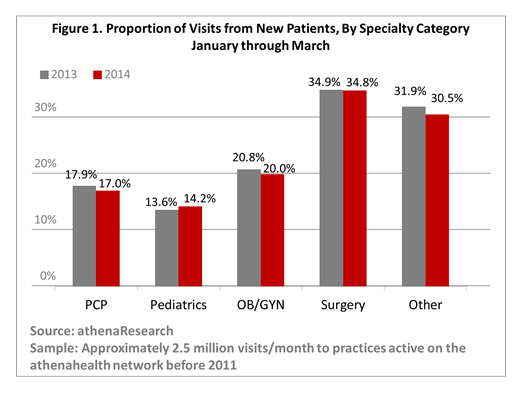
Figure 1 acaview

With this post, we are pleased to introduce ACAView, a joint initiative between the Robert Wood Johnson Foundation (RWJF) and athenahealth.

2014 marks the launch of the Affordable Care Act’s (ACA) most important coverage expansion provisions, designed to dramatically reduce the number of uninsured Americans. Between now and the end of 2016, millions of individuals are expected to sign up for subsidized insurance coverage through newly established health care exchanges, or marketplaces.

Other tracking initiatives are closely monitoring the number of individuals that sign up for this coverage as well as those that take advantage of expanding Medicaid coverage in some states.

With ACAView, we will take a different approach. We will focus on the provider perspective; more specifically, how the ACA affects the practice patterns and economics of physicians and other care team members around the country. This is also part of a wider effort, Reform by the Numbers, RWJF’s rich source of timely and unique data about the impact of health reform.

ACAView will monitor the impact of coverage expansion on a monthly basis, mining insights from athenahealth’s cloud-based network of more than 50,000 providers and 50 million patients.

athenahealth is a technology and services provider that delivers physicians the tools and support needed to manage the business and clinical aspects of their medical practices. Our cloud-based, centrally hosted software platform provides us with near real-time visibility into practice patterns of physicians around the country.

Our goal is to inform, exchange ideas, and provide a timely, front-row view of how this landmark legislation affects a robust cross-section of providers across the nation. In subsequent reports, we will examine an evolving set of metrics that address a broad range of topics.

We will also share our analyses on the extent to which our providers represent all providers in the US. For more about our data on practices and patients, as well as our preliminary list of metrics, please read our Methodology report.

No Meaningful Change to Date in New Patient Volumes

Among the many unknown questions surrounding coverage expansion is the number of new patients physicians will accommodate. This is a critical issue because one of the goals of health care reform is to allow individuals to form stable physician relationships, rather than seek care in high-acuity settings or forgo care altogether.

If the ACA is working, we would expect physicians to see a higher percentage of new patients over the course of the year. Over the long term, this number should eventually return to historical levels as these new patients become established.

Continue reading…

Will the Uninsured Become Healthier Once They Receive Health Care Coverage?

By DAVID ORENTLICHER

David OrentlicherThe Affordable Care Act might not bend the cost curve or improve the quality of health care, but it will save thousands of lives, as millions of uninsured persons receive the health care they need.

At least that’s the conventional wisdom.

But while observers assume that ACA will improve the health of the uninsured, the link between health insurance and health is not as clear as one may think. Partly because other factors have a bigger impact on health than does health care and partly because the uninsured can rely on the health care safety net, ACA’s impact on the health of the previously uninsured may be less than expected.

To be sure, the insured are healthier than the uninsured. According to one study, the uninsured have a mortality rate 40% higher than that of the insured. However, there are other differences between the insured and the uninsured besides their insurance status, including education, wealth, and other measures of socioeconomic status.

How much does health insurance improve the health of the uninsured? The empirical literature sends a mixed message. On one hand is an important Medicaid study. Researchers compared three states that had expanded their Medicaid programs to include childless adults with neighboring states that were similar demographically but had not undertaken similar expansions of their Medicaid programs.

In the aggregate, the states with the expansions saw significant reductions in mortality rates compared to the neighboring states.

On the other hand is another important Medicaid study. After Oregon added a limited number of slots to its Medicaid program and assigned the new slots by lottery, it effectively created a randomized controlled study of the benefits of Medicaid coverage. When researchers analyzed data from the first two years of the expansion, they found that the coverage resulted in greater utilization of the health care system.

However, coverage did not lead to a reduction in levels of hypertension, high cholesterol or diabetes.

Continue reading…

RAND: Net Gain of 9.3 Million American Adults with Health Insurance

By KATHERINE GRACE CARMAN & CHRISTINE EIBNER

flying cadeuciiUsing a survey fielded by the RAND American Life Panel, we estimate a net gain of 9.3 million in the number of American adults with health insurance coverage from September 2013 to mid-March 2014.

The survey, drawn from a small but nationally representative sample, indicates that this significant uptick in insurance coverage has come not only from enrollment in the new marketplaces established under the Affordable Care Act (ACA), but also from new enrollment in employer coverage and Medicaid.

Put another way, the survey estimates that the share of uninsured American adults has dropped over the measured period from 20.5 percent to 15.8 percent. Among those gaining coverage, most enrolled through employer-sponsored coverage or Medicaid.

Although a total of 3.9 million people enrolled in marketplace plans, only 1.4 million of these individuals were previously uninsured. Our marketplace enrollment numbers are lower than those reported by the federal government at least in part because our data do not fully capture the surge in enrollment that occurred in late March 2014.

Using the RAND American Life Panel, a nationally representative panel of individuals who regularly participate in surveys, we have conducted monthly surveys since November 2013 about insurance choices and public opinion. This particular survey work—which is ongoing—is known as the RAND Health Reform Opinion Study(RHROS).

We match these data with data collected in September 2013 about insurance choices. The results presented here are based on 2,425 adults between the ages of 18 and 64 who responded in both March 2014 and September 2013.

People shift from one type of health insurance to another for a number of reasons, such as job changes or marital status changes. Our survey work can’t say for certain which of these shifts are due to the ACA and which are due to other factors, but we can draw some limited conclusions.

Continue reading…

Cracking the Code on Health Information Exchange. Is It Time to Wipe the Slate Clean and Start Anew?

By BILL CROUNSE

Three related columns in HealthcareITNews caught my attention recently.

The headlines pretty much say it all:

1. Satisfaction with HIE solutions drops.

2.  Vendors missing boat on HIE needs.

3.  CommonWell names 3 biggest HIE hurdles.

Over the years, I’ve written more than a few HealthBlog posts on the topic of health information exchange (HIE) and why I feel so strongly that most of the initiatives currently underway are missing their mark.

As I’ve stated before, during my worldwide travels I haven’t yet come across a country that has accomplished a truly national, interoperable, bi-directional, fully functional HIE.

Those few countries that come close are more like a large American city or small state in size, perhaps mirroring some of the moderately successful regional or state-wide exchanges currently operating in America. Over the years I’ve also watched implosions of national HIE attempts in several countries that have failed miserably despite billions of dollars being spent on the efforts.

Reading each of the articles referenced above, I once again reach the conclusion that what I have been evangelizing as a better model for HIEs still rings true.

Continue reading…

Are We Prepared For The Next Viral Disease Threat?

By Weaver, Gallo & Hrynkow

Robert GalloFred Shaw went to St. Martin and all he got was a painful virus called chikungunya.

On an island stop during his Caribbean cruise vacation, Mr. Shaw was infected with the mosquito-borne virus that causes a severe fever and an arthritis-like condition in people, similar to dengue fever.  After infection, the virus still may cause long periods of fatigue and incapacitating joint pain.

Writing on Facebook, Mr. Shaw said, “The fever, leg rash and swelling were bad enough, but then followed by months of headache, joint pain and malaise, I finally have gotten over it (I think).”

Chikungunya virus was first described during an outbreak in Tanzania in 1952 and was subsequently discovered in other parts of Africa and Asia. The name ‘chikungunya’ is derived from a local phrase that means ‘that which bends up’ and describes the stooped appearance of sufferers with joint pain.

In late 2013, chikungunya was found for the first time in modern history on islands in the Caribbean. Based on our research and the evidence we have observed, it is likely that the virus is on its way to the U.S.

Vector-borne viruses—which are transmitted to people by an animal or insect—threaten half the world’s population and are responsible for millions of human infections annually. Various mosquitoes and ticks transmit a subgroup of these viruses that are called arboviruses.

There are over 100 known arboviruses that infect humans and can cause neuroinvasive diseases like encephalitis, febrile illnesses and hemorrhagic fevers.  Except for yellow fever, tick-born encephalitis and Japanese encephalitis, there are no commercially available vaccines for most arboviral disease.

As the world becomes flatter and the globe opens to new opportunities for international trade and travel, viruses that used to be confined to “over there” are increasingly coming “over here,” and they are arriving sooner rather than later.

Continue reading…

Obamacare Premiums Are Going To “Skyrocket”? Forget About It.

By JOE FLOWER

Being against Obamacare has been the keystone, the capstone, the mighty sledgehammer, the massive metaphor of your choice for the right for five years now. They couldn’t stop it from being passed. They couldn’t stop it at the Supreme Court.

They weren’t able to choke it off by “defunding” it. They rejoiced at the rubber-meets-the-sky rollout of Healthcare.gov, but then the kinks got worked out of that.They railed at the administration using discretionary powers built into the law to help it work better. Every horror story of Obamacare ruining people’s lives they came up with turned out to be false.

Almost all of the people cynically cancelled by the insurance companies as a way to sell them more expensive insurance got insured again fairly quickly. Then 7 million people signed up on the exchanges, and altogether some 10 million formerly uninsured people now have medical coverage.

But the right still needs to call it a “train wreck.” The magic mantra has to work for them. Just this morning, here’s a Republican Congressman saying that we have to cut Food Stamps because: Obamacare. Say that again slowly?

It’s getting harder and harder on the right to come up with new ways to say it isn’t working when it actually seems to be working. I have to hand it to them, though: Those spin factories are filled with hard-working creative people. Get to work early, stay late, trash Obamacare. Hey, it’s a living.

So what’s the latest? This fall, Obamacare premiums are going to “skyrocket”!

Continue reading…

Healthcare.gov and the History of Failed IT Projects

By NIAM YARAGHI

Many years before the creation of Healthcare.gov, President Obama embraced  data analytics during his early years in the Senate.

In 2006, he and senator Tom Coburn (R-Okla.) successfully sponsored the Federal Funding Accountability and Transparency Act, which resulted in creation of  usaspending .gov, “a significant tool that makes it much easier to hold elected officials accountable for the way taxpayer money is spent“.

A History of Failed Federal IT Projects

A considerable amount of taxpayer money is spent on federal IT projects, but in contrast to the aspirations of Obama in his early years in the Senate, it is not spent responsibly.

According to the Standish Group report, from 2003 to 2012 only 6% of the federal IT projects with over 10 million dollars of labor cost were successful.

52% of them were either delayed, went over budget or did not meet user expectations. The remaining 41% of the IT projects were abandoned or started from scratch. Perhaps most troubling is that healthcare.gov is just a one example among many.

Continue reading…

