Categories

Author Archives

matthew holt

Rehash: The Health Assurance SPAC

Not so long ago (August) Jessica DaMassa and I ran a THCB Bookclub interview with Hemant Teneja & Stephen Klasko about their new book UnHealthcare. And, just because, their friend Glen Tullman sat in…..

Fast forward to this week and the three of them plus a cast of characters from General Catalyst & Livongo (Jenny Schneider, Lee Shapiro) have put $500m of their Livongo winnings into a SPAC. The book is based on the idea of Health Assurance and so is the SPAC. So if you are interested in figuring out what they are up to and what they might do or buy, here’s the interview–Matthew Holt

THCB Book Club, October: Mike Magee, Code Blue

Dr. Mike Magee has spent his life inside the medical-industrial complex, eventually working at Pennsylvania Hospital and later becoming the doctor who sold Viagra to the world at Pfizer. He’s also an award winning medical broadcaster and historian who appears regularly on THCB these days. For the October THCB Book Club Jessica DaMassa and Matthew Holt had Mike on to discuss Code Blue — his magnum opus on how the American system become the medical-industrial complex that it is, the part he played, and what we might do to fix it! A fascinating and rich discussion.

THCB Spotlights: Jon Bloom, Podimetrics

By MATTHEW HOLT

This is a fun conversation with Jon Bloom, the CEO of Podimetrics. It’s one of a number of competitors trying to help prevent foot ulcers among people with diabetes. Some use socks, others use insoles, but Podimetrics’ approach is to use a SmartMat which looks like a weight scale and can tell whether a patient might be developing a foot ulcer and is therefore at risk for amputation. Last week Podimetrics and Kaiser Permanente released a study that showed SmartMat and wraparound/care management service showed great success in reducing hospitalization, ER visits and foot amputations. But Bloom thinks that there’s much more to the care of very sick & underprivileged people with diabetes, and we had a great discussion about that that might look like.

Will Trump, Congressional Infections Boost Innovations For Covid-19 Survivors?

By MICHAEL MILLENSON

When powerful politicians confront a life-threatening diagnosis, it can change policy priorities. 

In addition to President Trump and a slew of top aides, five U.S. senators and 15 members of the House of Representatives have now tested positive or been presumed positive in tests for Covid-19 as of Oct. 5, according to a running tally by National Public Radio (NPR).

In that light, the recent burst of coronavirus infections could accelerate three significant innovations affecting every Covid-19 survivor.

1) Post-Covid Clinics

Even seemingly mild encounters with the coronavirus can trigger a cascade of lingering health consequences. While “there is no consensus definition of post-acute Covid-19,” noted an Oct. 5 JAMA commentary, symptoms that have been reported include joint pain, chest pain, fatigue, labored breathing and organ dysfunction “involving primarily the heart, lungs and brain.”

A survey by Survivor Corps, a patient support group, and the Indiana University School of Medicine found that Covid “long haulers” often suffer from “painful symptoms…that some physicians are unable or unwilling to help patients manage.” A similar survey by the Body Politic Covid-19 Support Group concluded that Covid long-haulers face “stigma and lack of understanding [that] compromise access to health care and quality of support.”  

Continue reading…

Value-based care – no progress since 1997?

By MATTHEW HOLT

Humana is out with a report saying that its Medicare Advantage members who are covered by value-based care (VBC) arrangements do better and cost less than either their Medicare Advantage members who aren’t or people in regular Medicare FFS. To us wonks this is motherhood, apple pie, etc, particularly as proportionately Humana is the insurer that relies the most on Medicare Advantage for its business and has one of the larger publicity machines behind its innovation group. Not to mention Humana has decent slugs of ownership of at-home doctors group Heal and the now publicly-traded capitated medical group Oak Street Health.

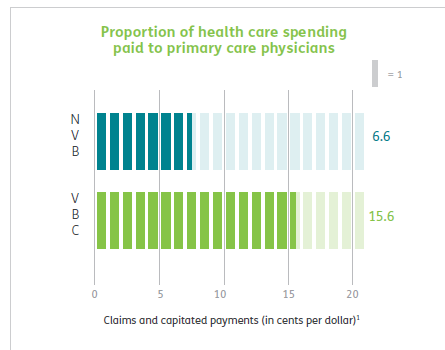
Humana has 4m Medicare advantage members with ~2/3rds of those in value-based care arrangements. The report has lots of data about how Humana makes everything better for those Medicare Advantage members and how VBC shows slightly better outcomes at a lower cost. But that wasn’t really what caught my eye. What did was their chart about how they pay their physicians/medical group

What it says on the surface is that of their Medicare Advantage members, 67% are in VBC arrangements. But that covers a wide range of different payment schemes. The 67% VBC schemes include:

  • Global capitation for everything 19%
  • Global cap for everything but not drugs 5%
  • FFS + care coordination payment + some shared savings 7%
  • FFS + some share savings 36%
  • FFS + some bonus 19%
  • FFS only 14%

What Humana doesn’t say is how much risk the middle group is at. Those are the 7% of PCP groups being paid “FFS + care coordination payment + some shared savings” and the 36% getting “FFS + some share savings.” My guess is not much. So they could have been put in the non-VBC group. But the interesting thing is the results.

Continue reading…

Biden’s Nov 9th speech: “Don’t you force me to pass Medicare 4 All”

By MATTHEW HOLT

The new Supreme Court, in all likelihood including just nominated Justice Amy Coney Barrett, will be hearing the California v Texas suit against the ACA on November 10th, seven days after the election. The lower courts have already ruled the ACA unconstitutional. Some hopeful moderates among my Democratic friends seem to believe that the justices will show cool heads, and not throw out the ACA. But it’s worth remembering that in the NFIB vs. Sebelius decision which confirmed the legitimacy of most of the ACA back in 2011 all the conservative justices with the exception of John Roberts voted to overturn the whole thing. With Ginsburg being replaced by Barrett there’s no reason to suppose that she won’t join Thomas, Alito, Kavanagh & Gorsuch and that Robert’s vote won’t be enough to stop them this time. The betting odds must be that the whole of the ACA will be overturned.

There is nothing the Democrats can realistically do to prevent Barrett filling RBG’s seat on the court, but assuming Biden wins and the Democrats take back the Senate, the incoming Administration can give the Supremes something to think about regarding the ACA. I would not suggest this level of confrontation before the election but, if Biden wins, the gloves must come off.

Assuming he wins and that the Dems win the Senate, this is the speech Biden should give on November 9th. (The TL:DR spoiler is, “Keep the ACA or I’ll extend Medicare to all ages”)

“I’m directing this speech to an extremely select number of people, just the Supreme Court Justices appointed by Republican Presidents. It is obviously no secret that we have political differences on many issues and we find ourselves in the strange situation in which I am the incoming President with an incoming Democratic Senate majority and yet you are considering overturning the signature bill of the administration in which I was Vice-President. You may recall that at the time of its signing I told President Obama that it was a “big f****** deal”  and, although many of my colleagues in the more progressive wing of the Democratic Party have criticized the ACA since its passage, it turns out that I was right. 

I am not referring here to the apoplexy that the ACA created amongst the Republican Party including not only the current and outgoing President but also almost all Republican members of Congress between 2010 and 2018. Instead I’m referring to the ACA’s impact on the nation and its health care system. 

Since 2010 there have been many changes to the way our nation’s health care system operates; almost all of them have their roots in the ACA. 

First, the ACA gave access to health insurance coverage to many people who had great trouble getting it before. That includes young people moving between their parent’s home, college and getting into the workforce; small business owners; freelance workers; the unemployed; people with low incomes; and people with underlying “pre-existing” health conditions. I remind you that due both to the pandemic and changes in our economy, there are many, many more of these people now than there were in 2009. 

Before the ACA these people were either not well served by the private health insurance industry or literally were unable to buy coverage at all. This not only caused extreme personal and financial suffering and in some cases death to the people affected, but also impacted the economy. It restrained innovation and entrepreneurship, and it meant that the participants in the health care system–including very many well meaning clinicians and provider organizations–had to play very inefficient games in order to try to provide those people with much-needed care, which drove up the cost of care to everyone else. Warren Buffet calls that the tapeworm in the US economy.

The ACA changed this in two main ways.

Continue reading…

#COVID19 Symptom Data Challenge

By FARZAD MOSTASHARI & INDU SUBAIYA

Applications for the #COVID19 Symptom Data Challenge close in three weeks! 

Amidst #COVID19, using analytic approaches to maximize available information and data is paramount. Hosted by Margolis Center, sponsored by Facebook Data for Good (@academics), and in partnership with the Joint Program in Survey Methodology, Carnegie Mellon University, and ResolveToSaveLives, the Challenge seeks to analytic approaches that utilize COVID-19 symptom data to develop insights into the trajectory of the novel coronavirus. 

Have a solution? Finalists can win up to $50k and the winning analytic approach will be featured on Facebook’s (@academics) Data For Good website!

Much, much more information is on the Challenge Website. Apply by 11:59:59 pm ET on September 29!

Much more about the Challenge Background in this interview or in this slack channel.

Official rules are here

Farzad Mostashari is CEO of Aledade, former National Coordinator for Health Information technology, and former Deputy Commissioner at the New York City Department of Health and Mental Hygiene. Indu Subaiya is the President at Catalyst @ Health 2.0

The COVID-19 Symptom Data Challenge Webinar

By INDU SUBAIYA & FARZAD MOSTASHARI

Following the launch of the COVID-19 Symptom Data Challenge on September 1st, we are excited to host a dedicated webinar providing further insights into the Challenge directly from key leaders representing our partner organizations at Facebook Data for Good, the Delphi Group at Carnegie Mellon University (CMU), the Joint Program on Survey Methodology at the University of Maryland (UMD), the Duke-Margolis Center for Health Policy, and Resolve to Save Lives, an initiative of Vital Strategies.

A stellar line up of speakers includes a raft of former government officials Mark McClellan (FDA & CMA), Tom Frieden (CDC), Farzad Mostashari (ONC) and many more, including Johns Hopkins’ Professor Caitlin Rivers, Carnegie Mellon’s Alex Reinhart & Facebook’s Head of Health Kang-Xing Jin.

If you are applying to the Challenge or would like to hear more about experts’ responses to COVID-19 and the importance of data during the pandemic, you do not want to miss this conversation! 

  • We will be discussing the following
    • Shortcomings of the existing tools for COVID-19 surveillance in the US
    • The case for better situational awareness of COVID activity
    • Overview of Symptom Data survey methodology
    • Preliminary analyses relating symptom trends to COVID intensity
    • Goals and operation of the Symptom Data Challenge

Tune in on Tuesday, September 8th at 1-2pm ET!

Event Registration Link: https://register.gotowebinar.com/register/6102626394063911951

Indu Subaiya is President of Catalyst @ Health 2.0. Farzad Mostashari is CEO of Aledade and Chair of the COVID-19 Symptom Data Challenge

Don’t want my age revealed…

By LISA SUENNEN & MATTHEW HOLT

Yesterday it was Fortune’s 40 under 40, and a lot of great people, most of whom I thought were much older or at least seem to have been around a while, got listed in the health care section–including Andre Blackman, Ambar Bhattacharyya & Julia Cheek. Lisa Suennen (@venturevalkyrie) and I got into a Twitter exchange about whether we were eligible for the under 40 category or for that matter the category above that. The answer was, amazingly, “no”. Somehow she came out with the line that “we are old”. Knowing her love for 80s pop, I reminded her that this was the inverse of the first line of the Pat Benatar classic “Love is a Battlefield.” Somehow this ended up in us tweeting a new set of lyrics for that song to each other all day. Of course I feel compelled to share them with you. I encourage you to play the video below and sing along!

We are old
Wheelchair to wheelchair we sit….
No Promise ring, yes Depends
Don’t want my age revealed

Before Long
They will all sing our swan song
Scans of our hearts show something wrong
Both of us slowing..
Don’t want my age revealed

Ads begging me to Ro
Then making me pay
Why do my knees hurt so bad?
It would help me to know
Should I stand a different way?
My hip hurts too, I might add

Continue reading…

Health in 2 Point 00, Episode 149: Pong & other video games

On today’s Health in 2 Point 00, Jessica is distracted playing video games, and rants about the unbearable maleness of wearables. Meanwhile Komodo Health raises $50m for more analytics (presumably of patients playing Pong), Picnic Health gets $25m as PHRs will not go away, Hazel Health gets $33 million to take telehealth back to school, and then there’s Amazon Halo — and our stars’ alter egos make an appearance — Matthew Holt

assetto corsa mods