Categories

Tag: Policy/Politics

Health 2.0 Will Benefit from Obama’s HIT Stimulus

The Obama team is talking very seriously about including health information technology in his “main street” stimulus package. While I generally agree with the predictions of doom and gloom for providers saddled with the burden of data entry, this creates a potentially huge opportunity for Health 2.0.

As very publicly warned in this forum and others, a stimulus package focused entirely on existing EMR/HER technology would not only offer no proven health benefits (Linder, et al. Arch Intern Med. 2007) but also would financially harm clinical practice. Kaiser Permanente’s Hawaiian experiment with EMR added approximately an hour a day of data entry work per physician (Scott et al., BMJ 2005).

This impact will fall disproportionately on primary care.

Continue reading…

New NRC Report Finds “Health Care IT Chasm,” Seeks New Course Toward Quality Improvement and Cost Savings

Like the Institute of Medicine’s (IOM) 2001 counterpart report, “Crossing the Quality Chasm,” a new report from the National Research Council of the National Academies is complex, full of new ideas assembled from multiple disciplines, and is likely to have seminal importance in framing public policy from now on. “Computational Technology for Effective Health Care:  Immediate Steps and Strategic Directions” was released last Friday, January 9, 2009 in draft, but there is so much to comment on that I think it’s wise to begin with a quote from the committee that sums up the central conclusion:

In short, the nation faces a health care IT chasm that is analogous to the quality chasm highlighted by the IOM over the past decade. In the quality domain, various improvement efforts have failed to improve health care outcomes, and sometimes even done more harm than good. Similarly, based on an examination of the multiple sources of evidence described above and viewing them through the lens of the committee’s judgment, the committee believes that the nation faces the same risk with health care IT—that current efforts aimed at the nationwide deployment of health care IT will not be sufficient to achieve the vision of 21st century health care, and may even set back the cause if these efforts continue wholly without change from their present course. Success in this regard will require greater emphasis on the goal of improving health care by providing cognitive support for health care providers and even for patients and family caregivers on the part of computer science and health/biomedical informatics researchers. Vendors, health care organizations, and government, too, will also have to pay greater attention to cognitive support. This point is the central conclusion articulated in this report. (emphasis added)

It would be difficult to find a more sober indictment of US health care IT policy and implementation over the past decade than what is contained here.

Continue reading…

Eric Novack has a few questions….

1. In California, where the SEIU is attempting to forcefully merge with the United Healthcare Workers, I can’t seem to find the focus on, you know, health care. “What it does is allows them to have the strongest voice possible in Sacramento,” said Mary Kay Henry, SEIU executive vice president.

2. Should the new administration be looking at Massachusetts as model to follow for health reform, or as a model of what must, at all costs (and they are extremely high), be avoided?3. How can we reconcile the fact that on Thursday the President-elect spoke about the importance of spending more on healthcare while on Sunday explaining that he intends to recommend spending less?4. In 2005, the association health plan bill (aka small business health plan) was killed, in large part, because advocates for specific disease conditions believed that state mandates and state lobbying efforts would be hampered if more people were covered under ERISA (i.e. national mandates—which are much harder to pass)— how will the administration propose to address this issue of state mandates in sweeping health care reform? 5. If health and health care are ultimately the most personal part of our lives, is it possible that more nationalization of health care will result in a greater role of lobbying bureaucrats and elected officials to seek and obtain care?6. How much would Medicare taxes be, and Part B and D premiums be, if the system actually needed to be self supporting, and the government had to keep adequate financial reserves like private insurers?

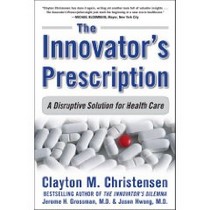
“The Innovator’s Prescription”: Christensen’s Book Offers Insightful Dx, Unrealistic Rx

Ip Being big fans of Clay Christensen and his theory of disruptive innovation (DI), we have been awaiting his just-released book The Innovator’s Prescription: A Disruptive Solution for Healthcare .  The book is co-authored by Dr. Jerome Grossman and Dr. Jason Hwang.

We have mixed reactions.

The book is mistitled. It should have been titled “The Innovator’s Diagnosis”. The book does a fantastic job at diagnosis (Dx) of problems in the U.S. health care system. It presents many new, innovative analytical frameworks and lenses through which to view the U.S. health system.

However, it’s weak on prescription (Rx): many of the proposed solutions are speculative, ungrounded, and/or defy political reality.

We understand that the very nature of disruptive innovation implies inevitable resistance from organizations that benefit economically from the status quo. But at some point a proposed solution becomes so disruptive that you have to suspend reality to believe that it could be adopted or implemented — and many proposed solutions in this book enter that realm.

The book applies Christensen’s general theory of DI specifically to the health care system. It addresses questions such as:

  • What is DI?
  • Why is it important to create an environment in health care where DI can flourish?
  • How can we create the right environment in health care for DI to flourish?

The introductory chapter of the book is available here at no charge (right column under Downloads). It’s a great overview.

Continue reading…

Shocker–Karen Ignagni almost tells the truth

The NY Times’ Robert Pear has an article on the politics of the Obama Administration introducing a public plan as part of FEHBP.

As you might expect a boat load of Republicans who were told in grade school that private is good and public is bad are concerned about this causing the demise of private health plans–even though that would clearly benefit the country. Of course Pete Stark is quite happy to say that it’s not that Medicare underpays (as Charlie Baker said here last week), but it’s that private plans over pay.

So why is that the case? Well you knew that I couldn’t resist the appearance of my favorite lobbyist. Here’s what Karen Ignagni says, and — this is the shocker– it’s half true.

Karen M. Ignagni, president of America’s Health
Insurance Plans, a trade group, said the consolidation of the hospital
industry in the last seven or eight years had increased the market
power of hospitals, thereby reducing the ability of insurers to
negotiate discounts.

Actually it’s been more
like twelve to fifteen years since big players started merging (IFTF’s
Ellen Morrison wrote a great report about that in 1994 called "The Six Americas").
By the late 1990s Sutter, for example, was facing down Blue Cross of
California on price and winning. And of course in Boston Partners was
getting bigger and bigger, and facing down Blue Cross and the other plans. (Leading occasional THCB contributor and Beth Israel Deaconess CEO Paul Levy to become a big whiner, according to Partners Chairman Jack Connors). So Karen is telling the truth.

Continue reading…

Poizner: talks tough, wimps out WITH UPDATE

Previously in the long running retroactive insurance cancellation story I’d accused Steve Poizner (yes, the only Republican I’ve ever voted for and) California state insurance commissioner of being a bit soft. Now he really needs calling out.

Saint Lisa Girion reports in the LA Times today that to make up for cancelling 678 policies, Blue Shield, yes the warm cuddly pro-universal care loving non-profit insurer that’s not Wellpoint, has to reinstate them. Which means they have to reinstate the policies and pay the bills that they’d previously decided not to pay.

Now Blue Shield has been the most aggressive of all the insurers in the state in claiming that it had the right to retroactively cancel policies. Most of the others settled ages before. Meanwhile Poizner last year said this about Blue Shield:

Continue reading…

Confusing ‘Standards’ With ‘Interoperability’–Lessons For The 111th Congress From HIPAA

As we debate whether or not the Obama Administration and the 111th Congress should work towards directly funding EHRs, one of the key questions seems to be whether or not EHRs and interoperability standards are mature enough.

My colleague, John Halamka, Chair of the Healthcare Information Technology Standards Panel (HITSP), made an rational and impassioned plea last week that we have reached a state of interoperability that is at least good enough not to delay allocating Federal funds for investments in EHRs. Dr. Halamka had earlier in December advocated direct grants from the Federal government of $50,000 per U.S. clinician to states to fund the purchase of CCHIT compliant commercial EHR products.

In the ideal world, I agree with John’s position, but have spent perhaps too much time in the real EHR world and in health care standards to truly believe we are where we think we are.  We have been here before and our best intentions were subverted.

Continue reading…

The demise of Medicare Health Support

I guess we knew it, but here’s the confirmation in the analysis of the first 18 months from CMS.

The summary: DM companies in Medicare Health Support enrolled healthier than average populations; they had limited to no impact on improving their patients’ care, satisfaction or outcomes; and didn’t save any money.

I wonder how Disease Management is going to fare in the future. It’s clear that this "occasional remote intervention" model needs to change.

Viciously Vladeck

The new Health Affairs is out and with it a lovely piece of vintage Vladeck.

In a review of a new book on Medicare  by old Brookings warhorse Henry Aaron and fast rising UT Longhorn star Jeanne Lambrew, Bruce Vladeck soon turns off the main topic (their book) and onto his favorite–the inevitability of the outcome when Medicare tries to do something about health care costs, and the inability of the political system to do much about it.

Policy analysts make fun of politicians who claim they can balance the budget by eliminating "waste, fraud, and abuse," but with a straight face they then propose to control health care costs by making the system more efficient. Efficiency has hardly anything to do with it. What health care costs are all about is market power and the distribution of monopoly rents. Every other industrialized nation understands that and does something about it. U.S. providers and insurers understand it, too, which is why the more sophisticated providers resist any efforts to aggregate power on the buyers’ side. But the mainstream of U.S. policy analysis just doesn’t seem capable of even framing the question, let alone solving it.

Of course despite me convening panels with Valdeck on them a couple of times, he probably doesn’t think THCB is mainstream policy analysis 🙂

But just last week I said:

As I’ve been saying for a long time, to rationally rationalize the
health care system, we need to make cardiologists in Miami behave like
cardiologists in Minnesota with a consequent impact on the incomes of
doctors, hospitals and stent & speedboat salesman in high cost
areas (Yes, Jeff, I do mean Louisiana, New York, Los Angeles and Boston
too). If the Federal Health Board has teeth, that’s what it’ll do, and
the AMA, AHA, AdvaMed, PhRMA et al know it. Which is why the PhRMA front organizations have been railing against cost-effectiveness for so long.

We know the question. Sadly we also probably know the answer. Vladceck’s short piece is great fun, nonetheless.

Let’s Reboot America’s HIT Conversation Part 1: Putting EHRs in Context

Kibbe & Klepper are back with an update to their pre-Christmas piece on EHRs and the forthcoming Obama Administration’s investment policy towards them. Lest you think that this is just a small group here on THCB and fellow traveler blogs shouting to each other, I’d point you towards the Boston Globe article about their previous "Open Letter," which shows that this discussion (and a similar piece on THCB from Rick Peters) appears to be being taken very seriously. As it should–Matthew Holt

On Dec. 19, we published an Open Letter to the Obama Health Team,
cautioning the incoming Administration against limiting its Health
Information Technology (IT) investments to Electronic Health Records
(EHRs). Instead, we recommended that their health IT plan be rethought
to favor a large array of innovative applications that can be easily
adopted to result in more effective, less expensive care.

The
response to that post was vigorous. We received many comments and
inquiries from the health care vendor, professional and policy
communities – urging us to provide more clarity. One prominent
commentator called to ask whether we, in fact, supported the use of
EHRs. We both have been active EMR and health IT supporters for many
years. Dr. Kibbe was a developer of the Continuity of Care Record
(CCR), a de facto standard format for Electronic Medical Records
(EMRs), and has assisted hundreds of medical practices to adopt EHRs.
Dr. Klepper has been involved in EMR projects for the last 15 years,
and the onsite clinic firm he works with provides every clinician with
a range of health IT tools, including EMRs.

Continue reading…

assetto corsa mods

