Categories

Tag: EHR

Regina Holliday: Fred’s life & death at 73 cents a page

If you ever wonder why the efforts to make it easier for patients and families to get information and be treated as equals in their care by the medical care system matter….

If you need convincing that the concept of participatory medicine is important enough for its own society, advocates & journal….

If you wonder whether it’s OK to wait to phase in the possibility of patients actually having rights to their own data….

Read Regina Holliday’s story about Fred’s illness and the way she and he were treated.

A Remedy for Healthcare Organizations

The switch to electronic health records can be a daunting task. To make the shift less painful, healthcare organizations should first consider taking control the number of documents flowing through the organization – and the costs associated with printing, sharing and updating them. Developing proactive ways to better manage both hard copy and electronic documents will better equip these organizations for the 2014 EHR deadline.

A recent survey of healthcare professionals found that nearly half (46 percent) of respondents chose document and records management as the most inefficient area within healthcare organizations.1 In fact, the survey revealed that document inefficiencies trump traffic woes – 58 percent said that searching for information at work is worse than being stuck in traffic.

Continue reading…

Commentology: Improving Cost-Containment

Stephen J. Motew writes:

Surgical specialists practice under a slightly more regimented reimbursement model predominantly due to the global period payment for surgical procedures. The total care of the surgical patient for any procedure, including pre-op evaluation, the procedure itself, and all related care post-operatively including most complications is covered under a 90 day global pay period. This system has worked relatively well by containing costs to a specific 'disease' (or procedure) state. In addition, many surgical sub-specialties such as vascular surgery and oncologic surgery for example invest a large amount of time in overall disease-state management that may not even include a procedure. I believe this has allowed many surgeons to understand the concept of cost-containment and efficiency, disease management as well as outcomes-based practices.

A recent experience with a referral patient however, highlights the incredible gaps in cost-containment and disease management that can occur prior to surgical intervention. I have annotated each step in the process to demonstrate points where potential intervention may have occurred. I will leave it to the comments to discuss the reasons and realities of such a case!

Continue reading…

CCHIT’s Latest Gambit

Glenn

Many of us have enjoyed a few good minutes of fun having our fortunes told by soothsayers who claim they can predict our future based on patterns of tea leaves in a cup or the playing cards we’ve pulled from a deck.

We pay a few dollars for the entertainment and if the fortune teller is skilled, we are temporarily impressed by his “insight.” But once we leave the carnival, we come back to our senses. Fortune-tellers can’t predict the future.

With its latest announcement, the Certification Commission for Healthcare Information Technology (CCHIT) appears to have entered the fortune telling business.

And if information provided on blogs published by its founders is to be believed, some EHR vendors plan to have their fortunes told by the former EHR certification monopolist.

Background
In June, ONC’s HIT Policy Committee released a Meaningful Use Matrix and proposed that it should serve as the basis for EHR certification as mandated by ARRA, the economic stimulus program signed into law last winter.

The Matrix consisted of five “Health Outcomes Policy Priorities” and associated Care Goals, Objectives and Measures. The Committee anticipated that the latter would be transformed into EHR certification criteria.

After a 2-month public comment period, the Committee tweaked the Matrix, essentially pushing back time-frames for implementing computerized order entry, and accelerating time-frames for implementing personal health records.

By mid-August, the Committee had approved a final version of the Matrix.

This document includes the very latest information on ARRA-mandated EHR certification criteria. It is in the public domain, there for all to see. ONC is expected to finalize these criteria next spring.

The criteria are not consistent with those used by CCHIT to certify EHRs. They are outcomes-oriented (CCHIT’s are feature, structure and process-oriented), and they do not require that any particular technology (such as the client-server applications used by the legacy vendors who sit on the board of CCHIT) be used to achieve the results.

Subsequently, HHS announced that it planned to assume responsibility for deciding which EHR systems qualified for bonus payouts under Medicare, and shortly thereafter, ONC’s HIT Policy Committee said that it planned to recommend that several entities should certify EHR systems.

In its announcement, the Committee envisioned the establishment of 10 to 12 such agencies.

The upshot of these moves by the Federal government are that (1)CCHIT no longer decides what criteria will be used to certify EHRs, and (2)its days as the exclusive provider of EHR certification services are numbered.

What has CCHIT decided to do in response to these setbacks?

It’s decided to become a fortune-teller!

New Role for CCHIT

Last week, CCHIT announced it will begin offering “streamlined,” or “modular” certification options, in which EHR vendors can apply to the agency for approval of distinct EHR modules like e-prescribing or electronic patient registries.

But as mentioned above, ONC won’t sign-off on its “meaningful use” criteria until the spring of 2010. In effect, CCHIT is asking EHR vendors to gamble that CCHIT can, like a fortune teller at a carnival, predict what those final recommendations will be.

“Choose the risk you want to take,” CCHIT Chairman Mark Leavitt recently challenged vendors. “Go ahead now (with a CCHIT review) and have an extra year to implement, with a small risk that there will be some gap in which EHR systems would have to be updated to receive final certification…” or risk the consequences of sitting on your hands, he presumably would add.

Never mind that the latest information is in the public domain, and that any vendor can compare it against their current capabilities and development plans! Disregard the fact that CCHIT has no track-record in promulgating outcomes-oriented certification criteria or in certifying against them!
What is CCHIT charging for its fortune-telling expertise? According to Government HealthIT, a HIMSS sponsored publication, prices for modular certification begin at $6,000 for up to 2 modules. They rise to $24,000 for up to 20 modules and to $33,000 for more than 20.

As always, fees for CCHIT’s comprehensive certification are $37,000 for ambulatory systems and $49,000 for hospital systems. Annual renewal costs are $9,000 for each.

That’s chump-change for the legacy vendors whose top executives sit on the board of CCHIT, but it guarantees nothing.

Conclusions and Recommendations

EHR vendors should perform their own analyses against the published HIT Policy Committee criteria and follow the HHS Web site for announcements regarding meaningful use criteria and the process by which EHRs will be certified.

If a vendor insists on having its fortunes told, it should consult with a reader of tea leaves next time the carnival is in town.

Glenn Laffel is a physician with a PhD in Health Policy from MIT and serves as Practice Fusion’s Senior VP, Clinical Affairs.  He is a frequent writer for EHR Bloggers, where this post first appeared.

Getting Rid of “Friction” in Health Care

Main Friction occurs when an object moving through space encounters resistance, slows down and has its forward energy diverted. In the world of health care, friction is a term that has become synonymous with paperwork.Today, the U.S. spends $2.3 trillion on health care, and the U.S. Health Care Efficiency Index estimates that we could reduce this cost by $30 billion if we could eliminate the friction of phone-based and paper-based systems.1 This is a significant savings, and the American Recovery and Reinvestment Act is an attempt to realize that savings with a very targeted focus on Electronic Medical Records (EMRs). If all of the physicians in the country used EMRs, the argument goes, we would dramatically improve the efficiency of our health care system. The only problem is that only 17 percent of physicians are using EMRs today, so we’re talking about converting 83 percent of physicians to a computerized system for maintaining patient records, and while we absolutely must move in that direction, it is going to be a long and time-consuming process.2

“Low-hanging Fruit” Meanwhile, there’s a much quicker fix that is not getting much attention in the current debate, and that is the savings that could be realized by full conversion to electronic health care claims.  Unlike EMRs, electronic claims aren’t slowed down by privacy issues and other barriers that arise with business-to-human transactions. They offer billions of dollars of savings. According to the Center for Health Transformation, 90 percent of claim payments are still made in the form of a paper check. By eliminating these paper-based checks, the U.S. could reduce the overall cost of health care by $11 billion.3 Every paper check that is eliminated and replaced with a wire transfer saves the payer $.78, according to a study by Yoo and Harner.4 And given the fact that a few large payers – United, Aetna, Cigna and BlueCross BlueShield – are responsible for a majority of claims checks written in this country, making the switch to electronic health care claims may be easier than you think.  Continue reading…

Tweaking Medical Education to Leverage EHRs

Tweaking Medical Education to Leverage EHRs

By GLENN LAFFEL

Glenn

Author’s Note:The purpose of this 5-part series is to make the case for implementing a widespread, systematic approach to HIT education in medical schools and continuing medical education programs for physicians. Previous posts reviewed challenges posed by the HIT Deluge and the Impact of EHRs on Medical Education.

EHRs have begun an inevitable march into the lives of all physicians. The US government has established an ambitious plan for their deployment, and providers seem both eager to comply and anxious to avoid financial penalties associated with not doing so.

But as described in Part II of this series, EHRs can have deleterious effects on the education of medical students and residents. These include disrupting interactive sessions involving educators and trainees and complicating patient-physician communication.

Jay Morrow and Alison Dobbie of Texas Southwestern Medical Center argue that much of this negative impact derives from a mistaken perception that EHRs are a health care delivery method rather than a medium through which physicians deliver care. It follows from this argument that the quality-improving, cost-reducing benefits of EHRs can only be realized if multiple systems and user-based factors are aligned to optimize utilization of the new medium.

Medical educators can begin the alignment process by developing answers these 3 questions:

When Should EHR Education Begin?
Arguably, the process should begin as early as possible. Since the 1970s, medical curricula have included non-science oriented courses such as “Introduction to the Patient,” “Communication Skills” and the like. These courses present ideal opportunities to introduce the new medium.

Students in such courses should be taught to navigate through and use basic EHR functions such as order entry, lab look-up, messaging and charting. Ideally, this exposure should occur outside the clinical setting so trainees can focus on mastering the EHR interface itself. At this time, it should be possible to identify those in need of extra help with keyboard skills, and to provide assistance as necessary.

Keyboarding skills should not be assumed, even for the current generation of physician-trainees. In a 2007 focus group of first-year students at Texas Southwestern for example, 62% of the participants expressed concerns about such skills, and many claimed to have better texting than typing abilities.

If students master keyboarding and EHR navigation skills before starting their clinical rotations, they can focus the latter time on traditional learning exercises, such as clinical reasoning, diagnosis, acquiring medical procedure skills and interacting with ancillary caregivers and patients.

Continue reading…

Advice For State REC Planners

By DAVID C. KIBBE & BRIAN KLEPPERKathleen-sebelius

On August 20th, HHS Secretary Kathleen Sebelius and ONC head David Blumenthal announced $598 million in grants to set up about 70 “regional extension centers” (RECs) that will help physicians select and implement EHR technologies. Another $564 million will be dedicated to developing a nationwide system of health information networks.

The RECs are based on the example of agricultural extension offices, established over 100 years ago by Congress, which offered rural outreach and educational services across the country. These extension services made America’s agricultural revolution possible, dramatically increasing farm productivity. By analogy, the Administration hopes that on-the-ground health IT trainers and implementation experts can facilitate small medical practices’ adoption of EHR technologies, especially in rural and under-served areas, enhancing care quality and efficiency around the US.

The comparison between RECs and agricultural extension offices is probably a good one, and we applaud this effort. But there are some striking differences between agriculture and health IT. For one thing, many best farming practices were well known by the early days of agricultural extension services. The road map under ARRA/HITECH for successful small medical practice health IT acquisition and use is still under development, and remains full of tough questions and unknowns.

In fact, under Dr. Blumenthal’s leadership, the government is now crafting specifications for Meaningful Use, HHS Certification, security, and interoperability. It’s not yet clear what “meaningful use of certified EHR technology” means. So we could be in a cart-before-the-horse situation. It might be a little premature to set up technical assistance programs if we can’t provide specific guidance on how to assist. Even fully CCHIT-certified comprehensive EHRs can’t meet the Meaningful Use criteria today, so the REC’s geek squads will have their work cut out for them.

However, a body of knowledge and experience already exists about successful health IT system implementation in small primary care and specialty practices. For several years, one of us (DCK) worked under the auspices of the American Academy of Family Physicians (AAFP), helping family physicians’ practices prepare, select, implement, and maintain information technology offered by EMR and EHR vendors. The AAFP’s current Center for HIT staff has expanded this effort, assembling an impressive body of resources and tools. It was augmented as well by the work of the Quality Improvement Organizations (QIOs) that participated in the Doctors Office Quality-Information Technology (DOQ-IT) programs between 2006-2008.

Some of this knowledge is anecdotal, and should certainly be revised in light of the definitions and specifications that the ONC will issue later this year and likely finalize by spring of 2010, according to Dr. Blumenthal. But the AAFP’s and QIO’s hard-won lessons may be useful to those who are planning the new effort.

Here’s some broad guidance for state planners who are applying for these grants and who hope to set up their RECs by early 2010.

  1. Keep your advisory services simple and targeted on solving actual problems. Hire people with hands-on medical practice experience, who will carefully listen to what physicians and practice managers want the EHR technology to do for them and their patients. Physicians in small practices generally will use EHRs in caring for patients and for managing office accounts. Overwhelming change won’t be welcomed. Instead, focus on incremental implementations that try to solve information management problems without interrupting work flows.Start with one system or workflow area, gaining success and then moving on to another. For example, some practices may be ready to implement ePrescribing, but are not ready to replace paper records with an electronic documentation system. Many practices have found that  Web portals facilitating patient communications are a good EHR starting point, because they let doctors and patients exchange information online and asynchronously, easing telephone line congestion.
  1. One size does not fit all. General IT skills are useful. New rules will soon specify how physicians and hospitals can qualify for the HITECH incentive payments and which products will be certified. Even so, there may be many different routes to successful EHR use. A flexible perspective is paramount. Favor advisers with generalized health IT system knowledge, rather than expertise with a particular vendor’s product.Some medical practices will choose a single-vendor EHR with all the added features, but others will mix and match modular applications that together create can minimum system capability needed for HITECH meaningful user status and incentive payments.

    Similarly, some practices will prefer to locate data servers inside their practices or at the community hospital. Others will opt for Clinical Groupware, web-based and remote services EHR technologies that offer less hassle and expense for maintenance and security. Recognizing and differentiating between EHR technology offerings is going to be a major challenge for REC personnel in the near future.

  1. Skate to where the puck will be. The old paradigm of health data management tried to collect a patient’s complete data in a single database application, owned, maintained and controlled by a particular organization. However, throughout other disciplines, information management has become Web-centric and based on meta-data searches augmented by real-time communications and shared group activities.  Think Wikipedia, Google docs, Microsoft Sharepoint, the Apple iPhone, and, yes, even Facebook, as representative of where health IT is migrating over the next few years.Eric Schmidt, CEO of Google, and a member of the President’s Council on Science and Technology, PCAST, recently urged President Obama and David Blumenthal to consider Web-based technologies as the basis of the national health information network.  He warned that “the current national health IT system planned by the administration will result in hospitals and doctors using an outdated system of databases in what is becoming an increasingly Web-focused world. The approach will stifle innovation.” Mr. Schmidt’s advice, and similar advice from Craig Mundie of Microsoft, is coming from within the Administration, not from outside it. In other words, it’s much more likely to be heeded than if were it coming from the opposition.

    We hope that ONC’s specifications, issued as guidance to the RECs by mid-2010, reflect market-driven innovations that can reduce the cost and complexity of EHR technology acquisition and use. Otherwise we’re in for a national exercise in chaos.

  1. Don’t waste time re-inventing the wheel. Every REC should network with every other REC, regardless of location or stage of development, to share lessons and experience, and to avoid wasted effort. In the past, for example, regional helper organizations – some QIOs and medical societies – independently formed exclusive contracts with one or two EHRs vendors, hoping these arrangements would simplify choices and implementation. These proprietary relationships were invariably unsuccessful for the helper organization and for the practices.Physicians and their organizations want to make health IT selections based on their own situations and needs. But almost always, they will seek the same kinds of IT support during implementation: e.g. networking, set up, Internet connectivity, security, and basic computer skills training for staff and physicians alike.

    RECs should collaborate on tools and instruction kits where ever possible: each REC doesn’t need to develop its own HIPAA privacy and security guide book, for instance. Remember that peripheral devices, such as printers, fax machines, and modems, are part of every office’s set up, and that these items can be troublesome to set up and use.

  1. Come to the task understanding that successful HIT implementation requires fundamental process re-design. We’ve learned this the hard way. Unless health IT helps re-design practice work and information flow processes so they can be more efficient and quality-promoting, then the IT is simply an expensive appliance. Process re-design also can determine whether the EHR technology deployment produces a return on investment (ROI). For example, re-designing the documentation process to reduce or eliminate dictation transcription services, relying instead on EHR data entry by office staff and the physicians themselves, can save money and lead to an ROI within 12-24 months. We have seen this occur frequently. On the other hand, practices that continue dictation at the old levels are simply adding new data capture expense, making it harder to justify the investment.

States are hurrying to get access to this stimulus money. Many organizations aspiring to be RECs are focused on the rapid grant/award cycles. But its critical for planners to focus on what it will take to get the job done, and setting the groundwork for effective regional centers that can offer thousands of practices the help they need.

David C. Kibbe MD MBA is a Family Physician and Senior Advisor to the American Academy of Family Physicians who consults on healthcare professional and consumer technologies. Brian Klepper PhD is a health care market analyst.

Impact of EHRs on Medical Education

By GLENN LAFFEL

Glenn

Author’s Note: This the second of a 5-part series whose purpose it is to make the case for implementing a widespread, systematic approach to HIT education in medical schools and continuing medical education programs for physicians. A previous post reviewed challenges posed by the HIT Deluge.

Countries around the world are racing to digitize patient medical records. In the US for example, the American Recovery and Reinvestment Act allocated $21 billion to an incentive program designed to encourage the “meaningful use” of such systems.

The Federal government’s largesse is based on the premise that EHRs will improve the quality of care and reduce its costs, but the move will impact the health care system in many other ways as well. One area sure to be impacted is the education and training process for new physicians.

What kind of impact can we expect? In some ways, EHRs appear to enhance medical education, but there are as many or more instances in which the impact appears to be negative. Thankfully, careful planning can mitigate most of the collateral damage, a topic to be covered in this series’ next installment. For now, we’ll settle for a review of the good, the bad and the ugly.

Continue reading…

“Meaningful Use” Criteria as a Unifying Force

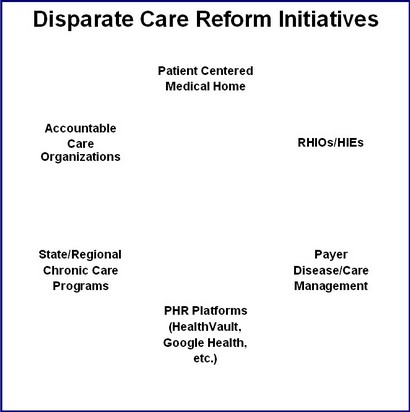
Over the past several years, many diverse initiatives have arisen offering partial solutions to systemic problems in the U.S. health care non-system.

We see Meaningful Use Criteria recommended by the HIT Policy Committee as a unifying force for these previously disparate initiatives. These initiatives have included:

  • Patient Centered Medical Homes (PCMHs)
  • Regional Health Information Organizations (RHIOs)/Health Information Exchanges (HIEs)
  • Payer Disease/Care Management Programs
  • Personal Health Record Platforms — Google Health, Microsoft HealthVault, Dossia, health banks, more to come
  • State/Regional Chronic Care Programs (e.g., Colorado, Pennsylvania, Improving Performance in Practice)
  • Accountable Care Organizations — the newest model being proposed as part of national reform efforts

Today

While there are some commonalities and overlap, to-date these initiatives have mostly arisen in isolation and are highly fragmented — they’re all over the map. Here’s a graphic representation of the fragmentation that exists today:

Continue reading…

“Meaningful Use” Criteria as a Unifying Force

Vince-20kuraitis09-small

Over the past several years, many diverse initiatives have arisen offering partial solutions to systemic problems in the U.S. health care non-system.

We see Meaningful Use Criteria recommended by the HIT Policy Committee as a unifying force for these previously disparate initiatives. These initiatives have included:

  • Patient Centered Medical Homes (PCMHs)
  • Regional Health Information Organizations (RHIOs)/Health Information Exchanges (HIEs)
  • Payer Disease/Care Management Programs
  • Personal Health Record Platforms — Google Health, Microsoft HealthVault, Dossia, health banks, more to come
  • State/Regional Chronic Care Programs (e.g., Colorado, Pennsylvania, Improving Performance in Practice)
  • Accountable Care Organizations — the newest model being proposed as part of national reform efforts

Today

While there are some commonalities and overlap, to-date these initiatives have mostly arisen in isolation and are highly fragmented — they’re all over the map. Here’s a graphic representation of the fragmentation that exists today:

MU1

Tomorrow

The HIT Policy Committee recently recommended highly detailed Meaningful Use criteria for certified EHRs.  Doctors and hospitals who hope to receive HITECH Act stimulus funds will have to demonstrate that they are meeting these criteria; the criteria are not yet finalized.

The Committee website describes the central role of the Meaningful Use criteria:

The focus on meaningful use is a recognition that better health care does not come solely from the adoption of technology itself, but through the exchange and use of health information to best inform clinical decisions at the point of care.

The HIT Policy Committee also is recognizing that there are multiple routes to achieving Meaningful Use beyond the traditional EMR 1.0, e.g., modular Clinical Groupware software.

While some might view the Meaningful Use criteria as limited to the world of health IT — something happening “over there” — we see much more going on. We believe the Meaningful Use criteria are becoming a powerful unifying force across the health system, with potential to converge previously disparate initiatives.  Here’s our conceptual representation:

MU2

Let’s consider a couple examples to demonstrate how convergence is occurring.

RHIOs were formed primarily with a mission of developing health IT infrastructure for local data exchange; they had little need to think about how care providers, health plans and others would actually use the data.

Patient Centered Medical Homes have been built around seven principles (e.g., physician directed medical practice, care coordination) — none of which directly relate to a need to develop health IT infrastructure; the fact that IT infrastructure is necessary to implement these principles has been assumed but not defined.

RHIOs focused on health IT with little thought about objectives, while PCMHs had grand objectives with little thought about needs for health IT.

All this is changing.

RHIOs are recognizing that achieving meaningful use of data is essential; PCMH initiatives are recognizing the need for a robust IT infrastructure and the need to match their efforts to Meaningful Use criteria.

Here are some broader implications about Meaningful Use criteria becoming a unifying force:

  • These diverse initiatives will have more commonalities and will look more and more alike
  • Expect previously disconnected regional initiatives to start talking to one another about collaboration.
  • A common phrase we are hearing is “We need to do a crosswalk of Meaningful Use criteria with our initiative/organization/application functionality.”
  • Vendors must ask: “What are we doing to contribute to Meaningful Use of EHRs”
  • Care providers (doctors and hospitals) must ask: “How are vendor offerings helping us to achieve Meaningful Use of EHRs?”

These are positive developments.  Meaningful Use criteria are becoming a powerful unifying force toward integrating our fragmented health system.

Vince Kuraitis JD, MBA is a health care consultant and primary author of the e-CareManagement blog where this post first appeared. David C. Kibbe MD MBA is a Family Physician and Senior Advisor to the American Academy of Family Physicians who consults on healthcare professional and consumer technologies.  Steve Adams is Founder and CEO of RMD Networks, a Denver, Colorado based company.

assetto corsa mods