Categories

Category: Medical Practice

How Doctors Die

By KEN MURRAY

Years ago, Charlie, a highly respected orthopedist and a mentor of mine, found a lump in his stomach. He had a surgeon explore the area, and the diagnosis was pancreatic cancer. This surgeon was one of the best in the country. He had even invented a new procedure for this exact cancer that could triple a patient’s five-year-survival odds—from 5 percent to 15 percent—albeit with a poor quality of life. Charlie was uninterested. He went home the next day, closed his practice, and never set foot in a hospital again. He focused on spending time with family and feeling as good as possible. Several months later, he died at home. He got no chemotherapy, radiation, or surgical treatment. Medicare didn’t spend much on him.

It’s not a frequent topic of discussion, but doctors die, too. And they don’t die like the rest of us. What’s unusual about them is not how much treatment they get compared to most Americans, but how little. For all the time they spend fending off the deaths of others, they tend to be fairly serene when faced with death themselves. They know exactly what is going to happen, they know the choices, and they generally have access to any sort of medical care they could want. But they go gently.

Of course, doctors don’t want to die; they want to live. But they know enough about modern medicine to know its limits. And they know enough about death to know what all people fear most: dying in pain, and dying alone. They’ve talked about this with their families. They want to be sure, when the time comes, that no heroic measures will happen—that they will never experience, during their last moments on earth, someone breaking their ribs in an attempt to resuscitate them with CPR (that’s what happens if CPR is done right).
Continue reading…

Lessons from MinuteClinic

By JOHN GOODMAN

After entering the clinic a thought occurred to me: why do we need doctors? Then a second thought: why do we need nurses?

Ah, but I’m getting ahead of myself.

About a decade before the Obama administration started touting electronic medical records and evidence-based protocols there was MinuteClinic. The entity came into existence primarily to cater to patients paying out of pocket.

There was no need for a law requiring price transparency. In every market where the dominant buyers are patients spending their own money, prices are always transparent. MinuteClinic posts its prices on a computer screen and on readily available pamphlets. Clearly, the organization is competing on price. Entities that compete for patients based on price usually compete on quality as well. One study found that MinuteClinic nurses following computerized protocols follow best practice medicine more consistently than conventional primary care physicians. They also do a pretty good job of knowing what kind of medical problems they are competent to handle and which problems need referral to a physician.

Wherever you find price competition you usually also find that providers are respectful of your time. As the name “MinuteClinic” implies, this is an organization that knows you value your time as well as your pocketbook. I couldn’t help but wonder if the entire health care system might be this user friendly, if only the third-party payers weren’t around.

For the first 15 minutes of my 20 minute visit, the nurse barely looked at me. She was sitting in front of a computer screen typing in my answers to her questions, as she went through the required decision tree. I didn’t mind. Mine was a minor problem and I did not want to pay for more sophisticated service.

Continue reading…

Et tu Dr. Gupta?

By PAUL LEVY

As well intentioned and thoughtful as he is, Sanjay Gupta nonetheless misses the point in his recent New York Times op-ed “More treatment, more mistakes.”  The theme of the chief medical correspondent for the Health, Medical & Wellness unit at CNN is:

Certainly many procedures, tests and prescriptions are based on legitimate need. But many are not…. This kind of treatment is a form of defensive medicine, meant less to protect the patient than to protect the doctor or hospital against potential lawsuits.

Herein lies a stunning irony. Defensive medicine is rooted in the goal of avoiding mistakes. But each additional procedure or test, no matter how cautiously performed, injects a fresh possibility of error.

With a quick aside in admiration of Peter Pronovost’s approach to harm reduction and some other process improvements, he then says:

What may be even more important is remembering the limits of our power. More — more procedures, more testing, more treatment — is not always better.

And then, remarkably, he presents M&M conferences as a remedy:

One place where I have seen these issues addressed is in Morbidity and Mortality, or M and M — a weekly gathering of doctors, off limits to the public, which serves in most hospitals as a forum for the discussion of mistakes, complications, deaths and unusual cases. It is a sort of quality-assurance conference where doctors hold one another accountable and learn from one another’s mistakes. They are some of the most candid and indelible meetings I have ever attended.

Continue reading…

It Doesn’t Have to Be This Way …

By EVAN FALCHUK

I was struck by the recent story in the New York Times about a young boy who was misdiagnosed, and lost his life.

The boy, Rory Staunton, was a healthy, active 12-year old, until one day he ended up in the middle of our time-strapped, broken healthcare system.  He was treated by good, well-intentioned doctors, at a leading medical center, but something went terribly wrong.  What started out as a minor cut suffered in a basketball game turned into a major infection that took his life.

Yet nowhere along Rory’s journey, from boy with a bellyache on Thursday to gravely ill boy on Friday night, did anyone act on strong indications that he might be fighting for his life. Critical information gathered by his family doctor and during his first visit to NYU Langone was not used, was not at hand or was not viewed as important when decisions were made about his care, records show.

Story’s like Rory’s happen far too often, and in far too familiar ways.  Scientific studies show that patients are misdiagnosed between 15% and 44% of the time.  Researchers have found that the combination of fragmented medical information and not enough time between doctor and patient are the leading causes of this problem.  And yet, much of America is still unaware how often misdiagnosis happens.  Lost in all the politics of healthcare is a recognition that, at its core, healthcare must be about making sure each and every patient gets the right care.

Continue reading…

In God We Trust. All Others Must Bring Data.

By BOB WACHTER

I knew it would happen sooner or later, and earlier this week it finally did.

In 2003 US News & World Report pronounced my hospital, UCSF Medical Center, the 7th best in the nation. That same year, Medicare launched its Hospital Compare website. For the first time, quality measures for patients with pneumonia, heart failure, and heart attack were now instantly available on the Internet. While we performed well on many of the Medicare measures, we were mediocre on some. And on one of them – the percent of hospitalized pneumonia patients who received pneumococcal vaccination prior to discharge – we were abysmal, getting it right only 10% of the time.

Here we were, a billion dollar university hospital, one of healthcare’s true Meccas, and we couldn’t figure out how to give patients a simple vaccine. Trying to inspire my colleagues to tackle this and other QI projects with the passion they require, I appealed to both physicians’ duty to patients and our innate competitiveness. US News & World Report might now consider us one of the top ten hospitals in the country, I said, but that was largely a reputational contest. How long do you think it’ll be before these publicly reported quality measures factor heavily into the US News rankings? Or that our reputation will actually be determined by real performance data?

Continue reading…

ONC Launches the Reporting Safety Events Challenge

By ARIANA GODLES & HEMALI THAKKAR

This challenge addresses a stark reality centered on hospitals struggling to increase internal incident reporting — a major reason being the busyness of care providers. Daily, hospital workers fight to create effective systems for the quality and risk management staff to complete root cause analyses and follow-ups, which are required by both the Centers for Medicare & Medicaid Services and the Joint Commission. However, their efforts are not always effective.

On top of that, it is said that quality and risk management staff suffer from reporting fatigue in a paper-based reporting system, which affects reporting frequency and quality. All of their energy is exuded in trying to convince physicians and nurses to report incidents (not just talk about them in the halls), and asking that they do a thorough investigation to fill out the appropriate forms to fax them to the appropriate agencies.

To allow progression of our understanding of patient safety issues, it is vital to innovate beyond the existing tools so that a fresh system will collect and analyze information that characterizes patient safety events in a standardized, discrete, and measurable way.

Continue reading…

Things Are About to Get Interesting

By DR. WES

It was a chance encounter.

After all it’s not every day you see an internist who still frequents a hospital.  We’ve known each other for years and he’s been watching the changes in health care, too.

“Boy, they’re really not happy Over There.  Seems they’ve contracted with Big Boy insurance as part of their new ACO model.  Everyone’s going to get their piece before the doctors: Over There hospital, their four million administrators,  lawyers, grounds crews, parking staff….  Then, after everyone else is paid, the doctors might get a few scraps if there’s some left over.  No guarantees.  All risk, no certainty of reward.  There was no way I could still go there.  I joined them, but had to leave when I saw how unworkable that was.”

“Isn’t this our new way forward?” I asked.

“I guess so.  Scary.  But I’ve got just a few more years.  Just have to get the kids through college.”

Continue reading…

The Olympics, Doctors, NHS, Transformation, and Heroes: Why the Difference between USA and UK?

By KENT BOTTLES

I was surprised when the Opening Ceremonies of the Olympics in London honored two of my favorite institutions:  the National Health Service and the World Wide Web.  I was not surprised when LA Times sports writer Diane Pucin posted the following tweet: “For the life of me, though, am still baffled by NHS tribute at opening ceremonies.  Like a tribute to United Health Care or something in US.” @swaldman responded to the sports writer with “Well, maybe, if United Health Care were government-run and a source of national pride.”

I was not surprised when Meredith Vieira and Matt Lauer of NBC admitted they had no idea why Tim Berners-Lee was being honored by sending out a tweet.  Ever since I read his book Weaving the Web:  The Original Design and Ultimate Destiny of the World Wide Web by Its Inventor (HarperSanFrancisco, 1999), Berners-Lee has been one of my heroes.  Finally locating my hard copy of the book in the guest bedroom where my son Colin used to sleep, I quickly located the marked passage I was looking for:

“People have sometimes asked me whether I am upset that I have not made a lot of money from the Web.  In fact, I made some quite conscious decisions about which way to take my life. These I would not change…. What does distress me, though, is how important a question it seems to be to some.

Continue reading…

Doctors, Patients, or Insurers? Who Will Shape Health Care?

By DAVIS LIU

At a conference for America’s Health Insurance Plans, Gladwell argued that patients or consumers have been unable to be more empowered because doctors, as the intermediary, held the power of knowledge much the same way chauffeurs did for the early days of the automobile and Xerox technicians did in the early days of photocopying. A person was needed to guide and assist the individual to get the job done. At some point, however, the technology became simpler. People began to drive their own cars and make their own photocopies. The mystique of the chauffeur and technician was lifted. Now everyone could drive. Everyone could make photocopies.

Is it possible that for health care and the health care system, which for many people is a system they interact with rarely and in an area (health / illness) where the uncertainty and stakes many be too “high”, that individuals willingly  defer the responsibility to someone else? Gladwell hints that might be a possibility:

“A key step in any kind of technological transition is the acceptance of a temporary deficit in performance at the beginning in exchange for something else,” said Gladwell. That something else can eventually include increased convenience and lower cost. He offered a number of examples, including the shift to digital cameras where early pictures were not as good as film and the advent of the digital compression of music, which he contends has made the quality of music worse….

Continue reading…

How the iPhone Might Disrupt The Medical Device Industry

By DR. WES

Doctors wanting to determine a patient’s atrial fibrillation burden have a myriad of technologies at their disposal: 24-hour Holter monitors, 30-day event monitors that are triggered by an abnormal heart rhythm or by the patient themselves, a 7-14 day patch monitor that records every heart beat and is later processed offlineto quanitate the arrhythmia, or perhaps an surgically-implanted event recorder that automatically stores extremes of heart rate or the surface ECG when symptoms are felt by the patient. The cost of these devices ranges from the hundreds to thousands of dollars to use.

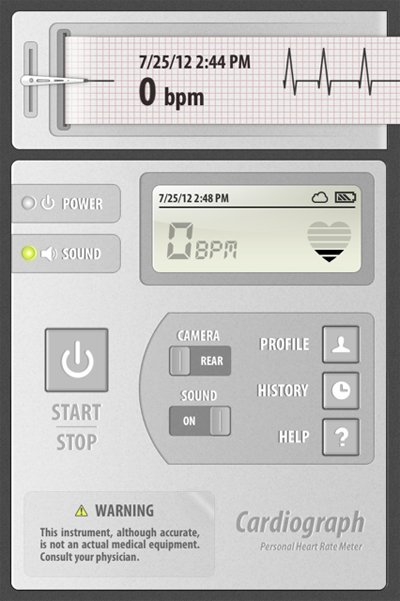
Today in my clinic, a patient brought me her atrial fibrillation burden history on her iPhone and it cost her less than a $10 co-pay.  For $1.99 US, she downloaded the iPhone app Cardiograph to her iPhone.

Every time she feels a symptom, she places her index finder over the camera on the phone, waits a bit, and records a make-believe rhythm strip representing each heart rhythm. With it, comes the date and time.

Continue reading…