Categories

Category: Medical Practice

Health IT and Dad

By ROB CRONIN

Health information technology has, in many ways, been a calling for me. I passionately believe in the ability of technology and information to reduce costs, improve quality and transform healthcare. For the last seven years (I won’t say the “better part” as my wife and kids would probably not appreciate that characterization…on the other hand, they would quickly confirm that it has consumed most of my waking hours), I have collaborated with hundreds organizations in healthcare and technology across the public sector and the private sector to try and positively influence the adoption and use of health information technology. By many measures, this work has been successful.

Awareness levels and perceived value of health IT among doctors, hospitals, policymakers and many other audiences has improved dramatically. A wide majority of physicians in the U.S. have by now adopted technologies such as electronic health records and e-prescribing. Playing a small part in this progress to date has been the most gratifying work of my career.

But then came Dad and his own personal experience with health IT. My father’s experience as a patient has left me questioning the level of progress that has been achieved.

Continue reading…

Risks and the Benefits: What Health Policy Can Learn from Clinical Medicine

By ASHISH JHA

A few months back, we admitted a patient we’ll call Mr. Jones to the hospital for a severe gastrointestinal bleed.  We had discharged him two weeks earlier after he had come in with a heart attack and made sure he was on aspirin to prevent future cardiac events.  He dutifully took his aspirin and on the day of the readmission, had a massive bleed.  He made it to the hospital barely alive and an endoscopy in the ICU showed an active bleeding gastric ulcer.  For Mr. Jones, the gastrointestinal bleed, likely brought on by the aspirin, was an “unintended consequence” that almost killed him. Yet no one questioned whether we should have given him aspirin in the first place.  I felt terrible about what had happened but found solace in knowing that while for some patients the risks of aspirin are worse than the benefits, for the general population of people like Mr. Jones, the benefits are clearly worth the side-effects.

We do risk-benefit analyses every day in clinical care, knowing that for some patients, the benefits will be outweighed by the harm.  We try to be thoughtful about who might be hurt or not, but most of the time, we just can’t predict.  So, when the benefits appear to outweigh the risks, we move forward and try to learn from cases like Mr. Jones.

While this kind of risk-benefit analysis is common in clinical practice, it’s unfortunately not how we discuss health policy interventions.  No policy intervention is ever without risks, and it is rare that a new policy will have no side-effects at all.  Yet, every time policymakers put in a new initiative, they sell it as a panacea. Critics, upon finding an unintended consequence, then declare the whole thing a failure.

An excellent example of this is health information technology, a topic that I have blogged about in the past.  Proponents only talk about its benefits, allowing critics to highlight every shortcoming and failure.  Thank goodness I don’t have to deal with proponents and critics like that every time I consider prescribing aspirin to my patients.

Continue reading…

Transforming Care Through Transparency

By ANNE WEISS


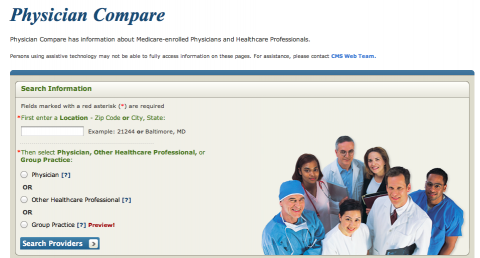
By year’s end, the Department of Health and Human Services will announce plans for making its Physician Compare website into a consumer-friendly source of information for Medicare patients about the quality of care provided by doctors and other health care providers. In doing so, Physician Compare will take its place alongside Hospital Compare and more than 250 other websites that offer information about the quality and cost of health care. More importantly, perhaps, it will send an important signal that transparency in health care is the new normal.

To look at these 250-plus online reports is to see the good, the bad, and the ugly of the public reporting aspect of the transparency movement. Some make it easy for people to make choices among physicians and hospitals, and just as notably, let providers see where they fall short and need to improve care. But others ask too much, forcing users to sort through rows and rows of eye-glazing data and jargon that requires a medical degree to fathom.

The Affordable Care Act calls for Physician Compare to offer information about the quality of care, including what physicians and their practices did and the outcome for patients, as well as care coordination; efficiency and resource use; patient experience and engagement; and safety, effectiveness, and timeliness. That’s a lot of information, and it demonstrates the tall order facing the federal government to make the reports meaningful and accessible, so that physicians and patients will both be more apt to use them.Continue reading…

3 in 5 Physicians Would Quit Today If They Could

JANE SARASOHN-KAHN

By JANE SARASOHN-KAHN

Being a doctor isn’t a happy profession in 2012: 3 in 5 doctors say that, if they could, they’d retire this year. Over three-fourths of physicians are pessimistic about the future of their profession. 84% of doctors feel that the medical profession is in decline. And, over 1 in 3 doctors would choose a different professional if they had it all to do over again.

The Physicians Foundation, a nonprofit organization that represents the interests of doctors, sent a survey to 630,000 physicians — every physician in the U.S. that’s registered with the AMA’s Physician Master File — in March-June 2012. The Foundation received over 13,000 completed surveys back. Findings from these data are summarized in the Foundations report, A Survey of America’s Physicians, published in September 2012.

Morale among physicians is much lower than it was in 2008, as shown in the first chart. Five years ago, less than 1 in 2 doctors would opt to retire; that’s up by over one-third. What’s driving doctors toward pessimism are the least satisfying aspects of practicing medicine in 2012, including:

Concerns about liability, 40%
The hassle of dealing with Medicare, Medicaid and government regulations, 27%. Over 52% of doctors said they’ve limited access to Medicare patients to their practices, or they’re planning to do so.
Lack of work/life balance, 25%
Uncertainty about health reform, 22%
Paperwork, 18%. The survey found that physicians spend over 22% of their time on non-clinical paperwork, resulting in a huge clinical productivity loss.
EMR implementation as a “least satisfying” aspect of work is quite low on the roster of concerns, with only 9% of doctors noting that as a prime concern in 2012.

As a result of uncertainty due to health reform, regulation and finance/reimbursement, the percent of physicians who remain independent will drop to 33% in 2013, Accenture forecasts, from 57% in 2000, 49% in 2005, and 43% in 2009. Aligning with a health system/hospital gives doctors more economic security and fewer administrative hassles.

Continue reading…

How the Rest of the World Does It: New Delhi’s Safdarjung Hospital

By ASHISH JHA

I visited Safdarjung Hospital in New Delhi today – an institution with  1,531 beds and 145% occupancy rate.  Yes, 145%.  You do the math.  A lot of bed sharing and asking families to bring in cots.  It’s right across the street from the All India Institute of Medical Sciences (AIIMS), the premier public healthcare institution in India.  While both AIIMS and Safdarjung are run by the federal government, only AIIMS is renowned for famous specialists, world class facilities, and an international reputation to boot.  Safdarjung doesn’t suffer such burdens – its specialists are not well known, facilities are dilapidated, and you probably have never heard of it.

I spent several hours walking around, talking to lots of physicians, visiting ICUs and cath labs.  I visited the outpatient department where 7,000 people show up every day, many lining up the night before, to get a ticket by 11 a.m., when registration closes and those who haven’t gotten a ticket are out of luck.  In the ER, there was a line of between 50 and 100 people waiting to get rabies shots.  This is the hospital where every poor person in Delhi unfortunate enough to get a dog bite is sent.  They have the rabies serum.  Most other public hospitals do not.

Safdarjung has “efficiency” baked in.  In a typical year, they do 800 cardiac surgeries, 2,000 angioplasties, 3,000 echocardiograms, and 100,000 EKGs.  They see tens of thousands of patients in the cardiology clinic.  They have 4 (yes, four) full-time cardiologists on staff.  The rest of the work is done by medical residents, who call when they get into trouble.  Brigham and Women’s Hospital, which probably doesn’t have one quarter the volume of this place, has 140 cardiologists.  The patients at Safdarjung pay essentially nothing.  Even their medications are free.  For those who are not extremely poor (and I doubt there are many non-poor patients who go to Safdarjung), you do have to pay for your own devices.  Need a stent?  Bare metal ones cost $200 to $1000.  Drug eluting stents are $1500 to $2500.  You get to decide which one you want.  They have a chart with pictures and prices that looks a lot like a dinner menu. Continue reading…

The Data Entry Paradox

By WILLIAM HERSH

Everyone, including this blog writer, has been touting the virtues of the vast troves of data already or soon to be available in the electronic health record (EHR), which will usher in the learning healthcare system [1, 2]. There is sometimes unbridled enthusiasm that the data captured in clinical systems, perhaps combined with research data such as gene sequencing, will effortlessly provide us knowledge of what works in healthcare and how new treatments can be developed [3, 4]. The data is unstructured? No problem, just apply natural language processing [5].

I honestly share in this enthusiasm, but I also realize that it needs to be tempered, or at least given a dose of reality. In particular, we must remember that our great data analytics and algorithms will only get us so far. If we have poor underlying data, the analyses may end up misleading us. We must be careful for problems of data incompleteness and incorrectness.

There are all sorts of reasons for inadequate data in EHR systems. Probably the main one is that those who enter data, i.e., physicians and other clinicians, are usually doing so for reasons other than data analysis. I have often said that clinical documentation can be what stands between a busy clinician and going home for dinner, i.e., he or she has to finish charting before ending the work day.

I also know of many clinicians whose enthusiasm for entering correct and complete data is tempered by their view of the entry of it as a data blackhole. That is, they enter data in but never derive out its benefits. I like to think that most clinicians would relish the opportunity to look at aggregate views of their patients in their practices and/or be able to identify patients who are outliers in one measure or another. Yet a common complaint I hear from clinicians is that data capture priorities are more driven by the hospital or clinic trying to maximize their reimbursement than to aid clinicians in providing better patient care.

Continue reading…

Rethinking the Provider Certification Game

By DAVID SHAYWITZ

Quality is the new watchword in healthcare; it’s what we seek – and increasingly, what we try to measure.  Medications, devices, care delivery, hospital services – all are now scrutinized as we seek to gauge their benefit, and justify their cost.

The idea of using metrics to evaluate quality make sense, but only if we can trust the metrics themselves.  Otherwise, we risk becoming party to an updated version of craniometry, systematized false-precision that focuses on easily-measurable parameters (such as head circumference) that may not represent meaningful proxies for the assessments we’re really after (i.e. intelligence).

The good news is that the science of testing, of developing evaluation instruments, has improved over time.  We’re now better able to recognize the qualities and properties of good tests – and to identify where they’re likely to fall short.

We’re also getting more comfortable with demanding robust evaluation instruments.  For example, the FDA’s approach to patient-reported outcomes places exceptional (and appropriate) emphasis on the assessment tool chosen, and requires that it demonstrates the appropriate properties before relying on its results.

Unfortunately, one critically important area within our healthcare system that seems to have escaped such careful review is the way the competence of care providers is typically assessed and certified.

Whether you are an X-ray technician, a physical therapist, a registered nurse, or a transplant surgeon, you are required to pass through a gauntlet of costly certification exams.  These tests, already significant, are assuming an even greater importance as the healthcare system increasingly looks to them as proxies for quality.  Certification can be required for employment and for admission privileges, and frequently impacts the reimbursement rate for healthcare providers.

All this makes complete sense – provided the certification tests themselves are sound.

Unfortunately, the world of healthcare worker certification remains a bit like the wild west, as medical organizations and professional societies approach certification testing with profoundly different degrees of rigor — and generally little-to-no transparency.

Continue reading…

The Art of Diagnosis

By MAGGIE MAHAR & CLIFTON MEADOR

A young doctor and his wife had just moved to the mountains of eastern Kentucky, near the border of West Virginia. The small town was nestled among the coal mines of the region. Nearly all of his patients would be coal miners or family members of a miner. Bill would practice family medicine. His wife, a veterinarian, hoped to build a small-animal practice.

Liz McWherther, the forty-seven-year-old wife of a miner, came to see the young doctor. Over several weeks, she had developed a curious set of complaints. Each morning she woke with a dry mouth and slurred speech. She also noted blurred vision and difficulty urinating. Within a couple of hours of waking, she was completely free of any symptoms. These symptoms had been occurring each morning and going away by afternoon.

Liz had had a series of tests done by the previous physician, but none of these tests were abnormal. The physical examination by Dr. Hueston was entirely normal. She denied drinking alcoholic beverages or using illicit drugs. Hueston had briefly considered some unusual response to marijuana or other drugs that were prevalent in the area. Liz had not been down in the mines, nor did her husband bring back anything unusual into the house.

Continue reading…

Vinod Khosla Thinks I’m Narrow-Minded

By MARGARET POLANECZKY

There’s a (tiny) bit of a discussion going on in Twitter about a post I wrote responding to Vinod Khosla’s statement that 80% of the work that doctors do will one day be replaced by computer algorithms.

In my post, I talked a bit about the marketplace-driven IT innovations in healthcare, and medicine as seen through the eyes of the IT entrepeneurs. I questioned just how much of what doctors do today can really be replaced by algorithms, particularly the doctor-patient relationship.

I then asked if Khosla was right and answered myself – Maybe. I stated that we were in the midst of a huge disruption in healthcare, and reflected on how I was already seeing signs of that disruption in my current practice.  And while I still did not see anything changing too much just yet, as far as the future Khosla predicted? I wasn’t so sure.

I then stated that if there is a revolution in healthcare, we docs needed to make ourselves a part of it now. I urged my fellow physicians to become involved, in order to be sure that what happens in the IT-driven healthcare future actually improves our patients’ health beyond what we are doing today.

It’s a completely legitimate concern, and, I believe, an extremely important one.  As an example, I cited the evolution of the EMR – a system that has created high hopes and caused huge disruption at enormous cost, even as we continue to struggle to find conclusive evidence that EMR use actually improves patient outcomes.

Continue reading…

OpenNotes: Great News for Patient Engagement!!

By DAVE DEBRONKART

Regular readers know that we’ve long anticipated the result of the OpenNotes project. Our first post about it was in June 2010: OpenNotes project begins: what happens when patients can see the physician’s visit notes? It tied the issue all the way back to the birth of the Web, in 1994:

The opening anecdote of the e-patient white paper 20th page of this PDF; 23rd page in the Spanish edition tells of a patient who impersonated a doctor in 1994, to get his hands on an article about an operation he was about to have. He got busted.

Two years later episode 139 of Seinfeld had something similar. Kramer impersonates a doctor to try to get Elaine’s medical record.

Now, the Robert Wood Johnson Foundation (RWJF) is funding a study called OpenNotes to explore taking it a big step further: what happens if patients can see, online, every last bit of what their doctors wrote?Do doctors get overwhelmed with questions? Do patients freak out when they read the yucky medical words that doctors write? Does the world go to hell in a handbasket, as some have worried aloud?

The results were released yesterday, in a new article in the Annals of Internal Medicine. (See the OpenNotes website.) Co-lead authors Tom Delbanco MD and Jan Walker, RN, MBA shared a pre-release copy with e-patients.net. They describe the study’s intent:

Drawing on existing literature, including small studiesĸof patients with chronic illness, we developed 3 principalĸhypotheses.

Continue reading…