On this episode of HTD, Jess and I check out Akili Interactive: at least it’s still worth more than Pear Therapeutics. And by the way, what do we think will happen between Amazon and Signify? Tune in to find out! We also look at some new deals in health tech: Happy Ring raises $60 million; Upfront buys PatientBond, raising $20 million; Nitra raises $62 million; Digital Diagnostic raises $75 million; Ubie raises $26.2 million.
Apparently, the US Food and Drug Administration (FDA), that has long been charged with the safety and efficacy of drugs and devices now also controls who can prescribe drugs.
I was under the mistaken impression that in our highly rule based society you would need to pass a law to allow that to happen. Passing laws , of course, can be a long, messy, process that involves having to convince constituencies, and ruling by executive order is just way more efficient apparently.
So by decree of the FDA patients can now get Paxlovid, an anti-viral for the virus that causes COVID19, “directly from their state licensed pharmacist” if they so choose. Apparently, someone in government decided that there wasn’t enough Paxlovid being prescribed, and the major rate limiting step for many patients is not having access to a provider to prescribe the drug. I have to say provider now because physicians long ago lost the monopoly they enjoyed for prescribing medications to nurses with advanced degrees and physician assistants. The next obvious step is to cut out the ‘clinicians’ completely by allowing patients to get medications from a pharmacist without a prescription.
The NIH recently announced $1.2 billion dollars in funding for research on Long COVID. This is in part because of a faction of scientists that have mined electronic health record databases to find evidence that the long term impacts of COVID on a variety of different organ systems is significant.
I have some concerns when it comes to the cardiac complications discussed related to Long COVID.
It’s a tale of two markets: on one side we have layoffs, sinking stock prices, and all sorts of trouble, but on the other side we’ve got some good bills passed and some pretty great fundraising! In this episode, Jess and I dive more into the dual nature of the state of health tech. Is it the best of times and the worst of times? We find out, and talk through some recent multimillion-dollar deals: Cera raises $320 million; Birdie raises $30 million; Theator raises $24 million; Tebra raises $72 million; Diagnostic Robotics raises $45 million.
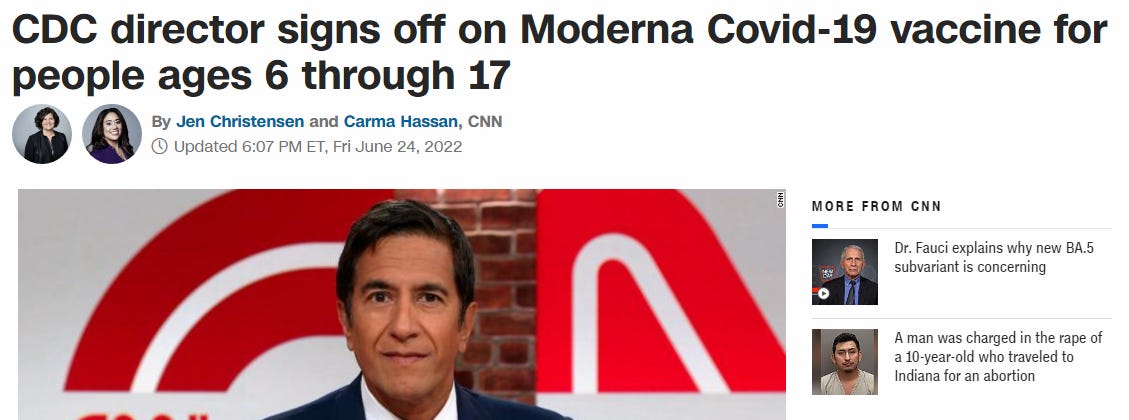
A recent CNN article discusses approval of the Moderna Covid-19 vaccine for people ages 6-17. The CDC director acted after its vaccine advisers on the Advisory Committee on Immunization Practices voted unanimously to support the two dose Moderna COVID-19 vaccine for kids in this age group. The goal per CDC director Walensky was to “protect our children and teens from the complications of severe COVID-19 disease”
It’s been a while but Anish Koka, a one time regular writer on THCB and occasional THCB Gang member, is back publishing up a storm on his Substack channel. You may recall that his political and clinical views don’t always mesh with some of the wooly liberals we feature on THCB (cough, cough, me), but we are delighted to be back publishing some of his pieces–this one is on reimbursement.–Matthew Holt
The subspecialty of Cardiology known as electrophysiology has seen explosive growth over the last few decades in large part because of a massive expansion in the suite of procedures now offered to patients. It used to be that electrophysiologists would spend the majority of their careers implanting pacemakers and defibrillators, but the last 2 decades saw an explosion in electrophysiology procedures known as ablations. Ablations essentially involve burning cardiac tissue in a strategic manner to get rid of arrhythmias that may be afflicting a particular patient. The path humans took from first taking an electrical picture of the heart with a surface ECG to putting catheters into the heart to map and treat dangerous arrhythmias is one of the great achievements of the modern era.
Giants of the field like the recently deceased Mark Josephson essentially created a field by going where no humans had gone before. Dr. Josephson did much of his work in Philadelphia at the University of Pennsylvania publishing seminal papers that lead to a greater understanding and eventual treatment of previously incurable malignant arrhythmias. As is true of all trailblazing work in medicine , there were no reimbursement codes in the beginning , just desperate patients with no place to turn.
The procedures being embarked on were rare and the patients were very complex. The renumeration that was awarded from Medicare was reflective of this. But two things almost always happen once a highly reimbursed procedure code comes on line – technological advances makes the procedure easier, and the population that the procedure is intended for massively balloons.
This was a special early in the day edition of #THCBGang. It was at 9.15am PT/ 12.15 pm ET (so if you are coming at 1pm it won’t be live today at the normal time as it’s already happened!). It was part of the Primary Care Transformation Summit which has been running since Monday and continues to the end of Friday. It’s a who’s who of everyone in primary care. You can check out the wider agenda but we were on immediately before the day 3 keynote from head of CMS Innovation, Liz Fowler.
Joining Matthew Holt (@boltyboy) to discuss primary care and more were are WTF Health host & Health IT girl Jessica DaMassa (@jessdamassa); futurist Jeff Goldsmith; & Dan O’Neill (@dp_oneill) who is now at primary care group Pine Park Health.
You can see the video below & if you’d rather listen than watch, the audio is preserved as a weekly podcast available on our iTunes & Spotify channels.
It’s been a while but Anish Koka, a one time regular writer on THCB and occasional THCB Gang member, is back publishing up a storm on his Substack channel. You may recall that his political and clinical views don’t always mesh with some of the wooly liberals we feature on THCB (cough, cough, me), but we are delighted to be back publishing some of his pieces–starting with a look at a tweet from one of America’s most prominent cardiologists.–Matthew Holt
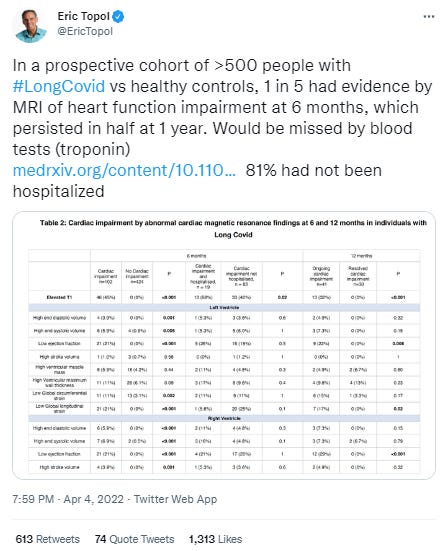
Given Twitter’s commitment to the truth in Medicine, I thought I would try to give them a hand by analyzing a semi-viral tweet about COVID and the heart.
Earlier this year (April 2022), the most influential cardiologist in the world tweeted about a study on the long term cardiac effects of COVID (LongCOVID).
Medical trainees who trained in the early 2000s like I did know Dr. Topol as an absolute legend in the field of Cardiology. He was responsible for seminal work in Cardiology in the 1980’s on the use of clot busting drugs for patients having heart attacks, and became head of cardiology for the famed Cleveland Clinic at the age of 36! (I vaguely recall feeling like I was starting to understand Cardiology at the age of 36.) He’s since moved on to do many other things, and is a potent voice that may have been instrumental in the FDA delaying approval of the mrna vaccines until after the 2020 election.
Nonetheless, this paper that he is giving his significant stamp of approval to has significant issues. As far as I can tell individuals with LongCOVID were recruited by advertising in LongCOVID support groups. No independent assessment carried out as far as I can tell clinically. If you say you have it—> you’re in.
Butterfly Network (NYSE: $BFLY) is working to make its pocket-sized, smartphone-directed ultrasound as “ubiquitous as the stethoscope” – hoping to give docs and nurses at the point-of-care the ability to easily perform any type of scan and instantly see the results. Dr. John Martin, Butterfly’s Chief Medical Officer, talks us through the technology behind the $2,400 hand-held device and how the company is working with healthcare orgs to integrate ultrasound into their workflows — completely shifting the paradigm for where-and-when scans are performed and able to be utilized.
What does this paradigm shift toward on-demand, point-of-care ultrasound really mean for the practice of medicine? Is this over-medicalization and unnecessary, or the key to higher-quality care? And, what about the risk involved in taking ultrasound out of the specialized-and-certified arena of the radiology department and democratizing it for front-line practitioners?
John lets us ask all the tough questions, talks through what’s being learned as Butterfly scales-up and builds its body of use cases, and gives us some insight on how the business itself is doing after going public via SPAC last year. Fun fact on the diversity of those use cases: Beyond human healthcare and the very important work of helping improve maternal and fetal health in Africa via a $5 million dollar grant from the Bill & Melinda Gates Foundation, Butterfly is also being rolled-out across 200 Petco care centers to help veterinarians use point-of-care scans to treat our pets.
A study eight years ago, published in Nature, was titled “Study revives bird origin for 1918 flu pandemic.” The study, which analyzed more than 80,000 gene sequences from flu viruses from humans., birds, horses, pigs, and bats, concluded the 1918 pandemic disaster “probably sprang from North American domestic and wild birds, not from the mixing of human and swine viruses.”
The search for origin in pandemics is not simply an esoteric academic exercise. It is practical, pragmatic, and hopefully preventive. The origin of our very own pandemic, now in its third year and claiming more than 1 million American lives, remains up in the air. Whether occurring “naturally” from an animal reservoir, or the progeny of an experimental lab engaged in U.S. funded “gain-of-function” research, we may never know. What we do know is that viruses move at the speed of light, or more accurately, at the speed of birds.