Categories

Category: Medical Practice

Sexism vs. Cultural Imperialism

By SARAH HEARNE

As I was getting ready for bed last night a friend shared a tweet that immediately caught my attention.

https://twitter.com/sbattrawden/status/1143465003409915905

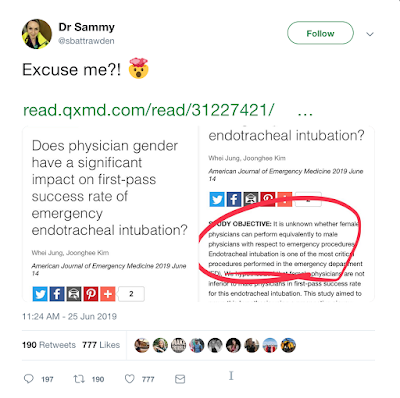
The tweet was of a paper that has just been published online, titled “Does physician gender have a significant impact on first-pass success rate of emergency endotracheal intubation?” and showed the abstract which began,

It is unknown whether female physicians can perform equivalently to male physicians with respect to emergency procedures.

Understandably, this got the backs up of a lot of people, myself included. Who on earth thinks that’s a valid question to be researching in this day and age? Are we really still having to battle assumptions of female inferiority when it comes to things like this? Who on earth gave this ethics approval, let alone got it though peer review?

I then took a deep breath and asked myself why a respected journal, The American Journal of Emergency Medicine, would publish such idiocy. Maybe there was something else going on. The best way to find out is to read the paper so I got a copy and started reading. The first thing that struck me was the author affiliations – both are associated with hospitals in Seoul, South Korea. The second author had an online profile, he is a Clinical Professor of Emergency Medicine. I couldn’t find the first author anywhere which made me think they are probably quite early in their career. The subject matter wasn’t something I could imagine a male early career researcher being interested in so figured they are probably female (not knowing Korean names I couldn’t work out if the name was feminine or masculine).

Continue reading…

What’s Wrong With American Doctors?

It is February of 2005, and my grandpa is lying in an Intensive Care Unit bed at Beth Israel Deaconess Medical Center in Boston, critically ill from a renal artery rupture that planted him face-first in his parlor. As a functioning alcoholic who has already been in the hospital for a day, he is beginning to shake periodically, a sign of his withdrawals.

Still, it will take another twelve hours and exasperations from both my mother and grandmother (both nurses themselves) before the physicians get him the Ativan he needs to combat this symptom, which is small potatoes compared to his emergent reason for admission.

While he would eventually make a full recovery, in those few hours my grandpa had tremors he was also the unintended victim of “tunnel vision” exhibited by many physicians: they see the most prominent problem and address it, often losing grasp of a holistic view of the patient and neglecting his humanity in their attempt to treat him. In short, they see the medical problem as opposed to the entire person.

Of course, this doesn’t mean that doctors are heartless: the number one reason doctors choose the profession is to help people, and the grueling work it takes to become an MD is clear evidence of their devotion to their career. So how did we end up here, with doctors overlooking the humanistic nature of their work?

Continue reading…

Have Doctors Joined the Working Class?

Marx und Engels Alexsander Platz Berlin

By

On September 28, 1864, exactly 150 years ago this weekend, the first meeting of the International Workingmen’s Association (IWA) was convened at St. Martin’s Hall, London.  Among the attendees was a relatively obscure German journalist by the name of Karl Marx.  Though Marx did not speak during the meeting, he soon began playing a crucial role in the life of the organization, in part because he was assigned the task of drafting its founding documents.

The work of the IWA and Marx is increasingly relevant to the practice of medicine today, largely because of the rapidly shrinking percentage of US physicians who own their own practices.  This moves physicians into the category of what Marx and his associates called, “working people.”  According to data from the American Medical Association, in 1983 76% of physicians were self-employed, a number that had fallen in 2012 to 53%.  And the trend is accelerating.  It is estimated that in 2014, 3 in 4 newly hired physicians will go to work for hospitals and health systems.

To put this change in Marx’s terms, the rapid fall in physician self-employment means that a shrinking percentage of physicians own what he called the means of production.  In his view, this alienates workers – in this case physicians – from other physicians, themselves, the work they do, and from patients.  Whether we agree with Marx on every point, his writings on this topic provides a provocative perspective from which to survey the changing landscape of contemporary medicine.

Continue reading…

Why Calculators Are the Future of Healthcare

Thomas goetz

By THOMAS GOETZ

Want to know the future of medicine and healthcare in one sentence?

For my money, it goes like this: The real opportunity in healthcare is to combine our personal data with the huge amount of general biomedical and public health research, in order to create customized information that’s specific to our person and our circumstance. We need relevance, and the right information at the right time will help us make better choices for prevention, helping us stay healthier longer, it’ll help us navigate diagnosis, letting us select screening tests that are useful and not unnecessarily fearful, and it’ll let us make better decisions on care and treatment – when we’re trying to choose among various treatments to find our way back to health.

It’s in the last category – care and treatment – that I wrote a recent post at the Huffington Post about one man’s story with prostate cancer. Tom Neville got a diagnosis and then had to struggle to find information to help him make sense of what to do. Ultimately, he chose surgery, but the difficulty of the choice led him to create Soar Biodynamics, a company that offers decision-making support for men assessing their prostate health.Continue reading…

Transparency Works!!! (And better than you can imagine)

Timeout_poster_3By PAUL LEVY

I just saw clear evidence of the importance of transparency with regard
to the reporting of important adverse events and medical errors. Bear with me through the details, but I will not keep you in suspense regarding the conclusion: The wide disclosure of a “never” event in a blame-free manner resulted in an intensity of focus and communal effort to solve an important systemic problem, resulting in redesign of clinical procedures, buy-in from hundreds of relevant staff people, and an audit system that will monitor the effectiveness of the new approach and leave open the possibility for ongoing improvement.

If you ever needed a clear example of the power of transparency, here it is.

Back in early July, a patient experienced a wrong-side surgery in our hospital because the staff failed to carry out the required time-out. We disseminated the story of this event to all staff in the hospital.  There was a full investigation of the matter, both internally and by the state DPH, and some immediate improvements were made in our procedures. But the more important work was being done by a Safety Culture Operational Task Force co-chaired by a nurse, a surgeon, and an anesthesiologist, and engaging almost two dozen other people from a variety of disciplines and positions in the hospital.

Its charge and mission: To implement and embed the Culture of Safety at the point of care in Perioperative Services, with an emphasis on teamwork and enhanced communications.

Continue reading…

assetto corsa mods