“Next-gen” healthcare might just be getting its start in primary care. So says Crossover Health’s CEO, Scott Shreeve, who laughingly channels Justin Timberlake and says he’s “bringing sexy back” to it too. With Walmart launching its own Healthcare Super Centers, Walgreens partnering with VillageMD in a $1-billion-dollar three-year deal, and some soaring post-IPO stock prices for OneMedical and Oak Street Health — it appears he’s onto something. And, hopefully, it’s something big that’s borne from Crossover’s recent partnership deal with Amazon. Will this be the tech giant’s next foray into healthcare? We’ve got the analysis on Amazon, Scott’s insider insights on what’s next for the primary care market, AND some phenomenal perspective on the “rise of the ‘Health Activist Employer’” as healthcare’s “most innovative payer.”
Episode 21 of “The THCB Gang” was live-streamed on Thursday, August 13th! Watch it below.
Joining Matthew Holt (@boltyboy) today are some of our regulars: policy & tech expert Vince Kuraitis (@VinceKuraitis), MD turned leadership coach Maggi Cary (@MargaretCaryMD), patient advocate Grace Cordovano (@GraceCordovano), and Consumer advocate & CTO of Carium Health Lygeia Ricciardi (@Lygeia). It was a great conversation surrounding the patients’ role in all the technology being deployed, how providers can work to close the gap in care, and whose duty is it really to ensure a person is “healthy”. Give it a listen below if you missed the live show
If you’d rather listen to the episode, the audio is preserved as a weekly podcast available on our iTunes & Spotify channels — Zoya Khan
JUST before the Teladoc-Livongo merger was announced, I had a chance to catch up with Doctor on Demand’s CEO, Hill Ferguson. The future for telehealth, he said, is “bright green” — and I’m pretty sure it’s looking even greener now! Doctor On Demand has stood out among telehealth companies for being particularly early on virtual primary care and it sounds like they’re going to continue developing that line of business — in which they have key partnerships with Humana and Walmart — with the $75M series D funding they just received.
Add to that a brand-new, first-of-its-kind telehealth program for the Medicare Part B population, and crazy consumer-focused type UX features like same-day scheduling for behavioral mental health care (yes, that’s right, dynamic scheduling for healthcare is here, folks!) and you can start to see how DOD is strategizing to pull away from the pack.
With the competitive landscape shifting, especially after Teladoc-Livongo, how does Hill view the onslaught of new entrants like digital health companies who added telehealth in reaction to the COVID-19 pandemic, or potential unicorns like Ro or HIMS, who are focused on tying the prescription drug business into virtual care delivery? It’s the insider insight you’ve been waiting for in this era of ‘tele-everything’ healthcare.
Even before Covid19, virtual care for chronic conditions was a hot and competitive area, with the heat turned up by Livongo Health’s IPO last year and big funding rounds for companies like Omada Health, Virta Health, and One Drop. Another contender in the space, Vida Health, has been best known for taking a “platform” approach to chronic condition management before “platforming out” became the-move-to-make for scaling health tech companies. Their digital health biz actually started out with a “whole health approach” to helping patients manage all their conditions at once, integrating care for diabetes, hypertension, COPD, high cholesterol, mental health conditions, and more from the get-go. Contrast that to some of their biggest competitors, who have adapted to that approach by adding on treatments for co-morbidities as their core businesses evolved.
Is there a benefit to starting out with a holistic care model that those who build it along the way can’t capture? We caught up with Vida Health’s founder & CEO, Stephanie Tilenius, to find out what advantage starting out as a platform play has brought to her business, which just closed a $25M funding round in April and is now available to more than 1.5 million people through employers and health plans.
How will the company scale from here? How will they remain competitive in such a crowded space? Stephanie talks through some of Vida Health’s post-pandemic plans AND how lessons learned from her “previous life” as an exec in Big Tech during that industry’s growth era of the 2000s & 2010s has shaped her thinking about the uptake of technology in healthcare. Not only did Stephanie work at eBay, PayPal, and Google during the birth of the online payment era, BUT she also helped take an online pharmacy company (Planet Rx) public during the dotcom boom.
A startup PBM? Partnered up with Walmart to bring “everyday low prices” to prescription drug pricing? Is this too good to be true? A.J. Loiacono, founder & CEO at Capital Rx, gives us a quick primer on “Pharmacy Benefit Managers” (PBMs) and why they’ve become known for the element of mystery they bring to prescription drug pricing. With three big PBMs (CVS’s Caremark, Express Scripts, and UnitedHealth’s OptumRx) controlling three quarters of the total market, it’s no surprise that VC-backed challenger companies in this space are rare. So, how does A.J. believe Capital Rx will shake things up? Learning about this new kind of tech-enabled, customer-focused PBM not only inspires hope for a clear future of prescription drug price transparency, but also makes one wonder about the new vision for American healthcare unfolding at Walmart.
There are few better positioned to speculate on what’s next for telehealth than Roy Schoenberg, co-CEO & President, of Amwell. After 15 years, more than $710M in total funding, and probably the best analogies out there for describing telehealth’s potential as a disruptive technology, Roy weighs in on just how unprecedented COVID19 has been for the uptake and evolution of virtual care.
“Historically, people thought, could telehealth be as good as a physical visit? The reality of COVID,” says Roy, “has literally opened the door to the question, can telehealth be better?”
From the near-term “new wave” of telehealth that has already begun to “eclipse the urgent care telehealth” to how Amwell’s clientele of clinicians, healthcare delivery systems, and payers are shifting to accept the idea of the technology as “the start of healthcare,” Roy talks of a future of telehealth that is “entrenched inside the system.” And how Amwell is meant to act as “facilitator.”
“When we start thinking about telehealth as a switchboard — not as a product, but as an infrastructure for the redistribution of healthcare — we’re talking about a completely different experience for us as Americans on what healthcare is available to us and how we can consume it.”
“To me, and I’ll fast forward to the end here, we want to get to the point that telehealth changes our expectation when we grow old as to where we can grow old. We want to be in a place where we can stay at home…where we don’t have to be in the ‘belly of the beast’ to get healthcare.”
How far away is this future that Roy describes, midway through telehealth’s biggest year yet? Is the appetite there among incumbents? And what of those Amwell IPO rumors? How might that kind of funding help rush things along? Tune in to this episode of ‘WTF Health – What’s the Future, Health?’ with Jessica DaMassa to find out.
Episode 18 of “The THCB Gang” was live-streamed on Thursday, July 16tth! Watch it below.
Joining Matthew Holt were some of our regulars: writer Kim Bellard (@kimbbellard), policy & tech expert Vince Kuraitis (@VinceKuraitis), MD turned leadership coach Maggi Cary (@MargaretCaryMD), and guest Suneel Ratan, GM of Collective Medical Technologies (@CollectiveMed)! We discussed ACOs & fee-for-service problems, what the future of care looks like as a result of the November elections, and how to serve communities that are socioeconomically disadvantaged with calls to #DEFUNDHealthcare. Give it a watch below if you missed the live version
If you’d rather listen, the audio is preserved as a weekly podcast available on our iTunes & Spotify channels — Zoya Khan
Episode 17 of “The THCB Gang” was live-streamed on Thursday, July 9th! Watch it below!
Joining me were some of our regulars: patient advocate Grace Cordovano (@GraceCordovano), health economist Jane Sarasohn-Kahn (@healthythinker), WTF Health Host Jessica DaMassa (@jessdamassa), and guests: Tina Park, partner at Diagram (@diagramoffice) & Shannon Brownlee, Senior VP at the Lown Institute (@ShannonBrownlee). The conversation focused on asynchronous care, the gap between patients & technology, and the Supreme Court ruling on employers’ ability to limit women’s access to birth control coverage. It was a great and engaging conversation with some of the top health care experts in the field.
If you’d rather listen, the audio is preserved as a weekly podcast available on our iTunes & Spotify channels — Zoya Khan
Episode 16 of “The THCB Gang” was on Thursday, July 2nd! You can see the video below!
Joining Matthew Holt were some of our regulars: patient safety expert Michael Millenson (MLMillenson), MD & hospital system exec Rajesh Aggarwal (@docaggarwal), health care consultant Daniel O’Neill (@dp_oneill), and our guest Marcus Whitney (@MarcusWhitney), CEO ofHealth Further & author of the new book Create and Orchestrate (You can email Matthew for a free signed copy, or get it on Kindle for 99 cents) We talked about the current rise in cases, how we get changes around race (and a lot more) moving in health care and what the future of care will potentially look like if we do.
If you’d rather listen, the audio is preserved as a weekly podcast available on our iTunes & Spotify channels — Zoya Khan
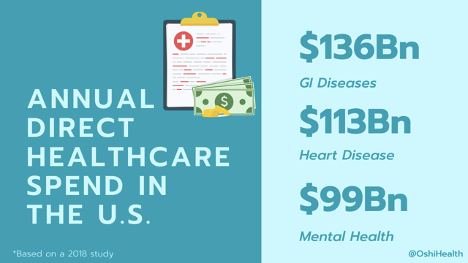
Gastrointestinal diseases like inflammatory bowel disease (IBD), gastroesophageal reflux disease (GERD), and irritable bowel syndrome (IBS) are more prevalent—and costlier—than many employers realize. Up to 70 million Americans are affected by gastrointestinal (GI) diseases each year—twice as many people as those living with diabetes (34.2 million).[1],[2] Overall direct healthcare costs for GI diseases are estimated to be $136 billion each year in the U.S., more than heart disease ($113bn) and mental health disorders ($99bn) [Figure 1][3]. However, GI conditions are often overlooked by employers as they consider their benefit offerings, even though a large proportion of their workforce is likely living and struggling with these conditions.
The Rising Direct Cost of GI Conditions
Irritable bowel syndrome, characterized by symptoms like recurring abdominal pain, constipation and diarrhea, affects as many as 15% of people worldwide[4]—though only 5 to 7% of people receive a diagnosis.[5] While this low diagnosis rate limits the value of cost estimates, the direct medical costs of IBS, excluding prescriptions and over-the-counter medicines, have been estimated to be $10 billion (or nearly $14 billion in today’s dollars) in the US.[6] Medication spend is another cost driver as IBS patients receive an average of 3 to 7 medications annually.[7] That’s 2 to 3 more prescriptions than a person without IBS would receive over a year.
Another important financial consideration for IBS is out-of-pocket (OOP) spend incurred by patients on over-the-counter medications, probiotics and functional medicine providers. One survey of about 600 people with IBS found that patients spent an average of $288 (2020 equivalent: $693) during a three-month period on over-the-counter and alternative therapies for IBS symptoms.[8] A 2007 study published in the journal Alimentary Pharmacology and Therapeutics looked at the OOP spend among people with IBS and found that individuals incurred an annual average of $406 OOP costs for the treatment of IBS symptoms.[9]