
With .health‘s Jennifer Lannon again running the camera and with guest appearances from Bayer’s Aline Noizet and Health 2.0’s Emily Hagermen, Jessica DaMassa asked me about Health 2.0 Europe, DCtoVC, the other goings on in Stiges, Spain. And yes, filmed in a nice Spanish restaurant over a Rioja or 2–Matthew Holt
Above the Fold
Health in 2 point 00 — Episode 26
This week we’re on location in Europe! Sitges near Barcelona to be exact, the site of the 2018 HIMSS Europe & Health 2.0 Conference. There, with our friend Jennifer Lannon from .health acting as emergency camera crew, Jessica DaMassa pins me down about HHS CTO Bruce Greenstein, Bayer & cannabis, Entraprenurses and where HIMSS/Health 2.0 is going next in Europe. It’s all in a day’s work (well 2 minutes) in Health in 2 point 00! — Matthew Holt
Bad Blood & Mad Love at Theranos—Psychopaths at Work

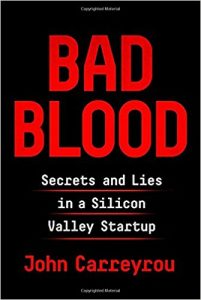
I’ve been kidding John Carreyrou on Twitter that I was going to give Bad Blood, his tale about the Theranos fraud, a one star review because he never sent me a preview copy. But it’s a barn burner, and I can’t recommend it enough, even though I spent my own $13.95 on the Kindle version!
By now the story is well known. The young blonde Stanford drop out with the baritone voice says she’s going to change lab testing forever, then hides in stealth in Silicon Valley. I caught a few whispers over the years that this company was doing something but as lab testing was a little away from the mainstream of health tech, I didn’t ever bother to look for more. And then in 2014 Holmes gets into Fortune and from a distance we are all cheering her on because she’s figured out a new way to disrupt a stodgy industry. The first Carreyrou piece is published in the WSJ in late 2015—even though Murdoch was a huge investor–and over the next 2 years massive fraud is exposed.
About when Holmes was starting to talk about stuff, and after the Walgreens deal eventually went live (mid 2014) there was the very odd series of events when Holmes appeared to agree to come talk at Health 2.0 but shortly afterwards she and her PR team went totally radio silent on us. I was told by one PR flack that he’d heard that another conference had told her to choose between us and them (TedMed? I’m guessing) but who knows. She appeared at TechCrunch in September 2014 and had the interviewer Jon Shieber’s blood drawn with his results coming back while she was on stage—clearly faked we now know. I saw her interviewed by a fawning Toby Cosgrove at Cleveland Clinic, where she said that Carreyrou was lying. I stood at the end of a receiving line full of people asking her to sign things for their daughters as she was such an inspiration. When I got to the front I asked her why she didn’t come to Health 2.0 and invited her to come the next time. With me in line was Medcity News Editor Chris Seper who asked for an interview. After about 15 seconds of her not saying anything, a PR flack jumped in, pulled us away from her, got our cards and said she’d get back to us. I’m still waiting
But what is just remarkable about this whole thing is how little due diligence was done by investors who plunked down hundreds of millions.Continue reading…
WTF Health | Scaling Up NLP with Simon Beaulah of Linguamatics
WTF Health – ‘What’s the Future’ Health? is a new interview series about the future of the health industry and how we love to hate WTF is wrong with it right now. Can’t get enough? Check out more interviews at www.wtf.health.
What can you find diving into the black hole of healthcare’s unstructured data? Natural Language Processing (NLP) seems to be the ‘tech du jour’ this year, so I spoke to early-entrant Simon Beaulah of Linguamatics about the big picture of NLP-plus-AI and the tech’s evolving role in improving care by putting together a more complete ‘patient narrative’ in the EMR.
Wanna hear his thoughts on what’s next for NLP in terms of scaling? Jump in at 2:15 mark.
Double Standards, Trojan Style

 By NIRAN AL-AGBA, MD
The University of Southern California (USC) appears to look the other way when male physicians harass or assault women. In reality, sexual violence spares no occupation, including medicine, but the way an organization responds to crime against women indicates a certain level of integrity. The World Health Organization estimates sexual violence affects one-third of all women worldwide. In a nation where women make up 50% or more of each incoming medical school class, only sixteen percent of medical school deans are female, making gender imbalance in leadership positions nearly impossible to overcome.
For the second time in less than a year, USC President C.L. Max Nikias is grappling with sexual misconduct allegations against a physician faculty member. Complaints go back to the early 1990s from staff and patients about inappropriate comments and aggressive pelvic exams done by Dr. George Tyndall, the only full-time gynecologist for the past three decades at the campus clinic. USC ignored complaints until a nurse contacted the campus rape crisis center.
Dr. Tyndall was initially suspended pending inquiry and forced to resign shortly thereafter. More than 100 complaints have been received and five are suing USC.Continue reading…
A Picture is Worth a Thousand Words

These days I’m spending a lot of time getting in depth with many tech companies. From time to time I’ll be asking those innovators to tell their story on THCB, and suggest what problems they are solving. First up is Meghan Conroy from Captureproof—Matthew Holt
Today’s doctors are communicating with their patients less than ever before, even as their days grow longer and busier. Physicians are pressured to see more patients in shorter encounters, while at the same time shouldering more of the administrative and documentation tasks associated with electronic medical records (EMR). The result is physicians who are spending more time looking at patients’ EMRs than looking at – or interacting with – the patients themselves.
Research bears this out. A recent RAND study shows that providers are frustrated by the high volume of clerical work, and the implementation of poorly designed technology, that hamper their efforts to deliver effective, efficient care. Primary care physicians spend nearly two hours on EMR tasks for every hour of direct patient care, with an average of six hours – more than half their workday – interacting with the EMR during and after clinic hours. The same study found that U.S. physicians’ clinical notes are, on average, four times as long as those in other countries.
No wonder the country is facing an epidemic of physician burnout. Doctors have become high paid data entry workers rather than caregivers. They are tethered to their screens, filling out countless forms and responding to multiple messages, eating into their face-to-face time with patients. With more patients to see, they have less time to prep for each encounter, leading to sub-optimal patient experiences and poorer outcomes.
Ironically, while technology helped create this problem, it also could provide the solution. Continue reading…
Health in 2 point 00, Episode 25
It’s late late at #hin2pt00 central. But somehow Jessica DaMassa wakes me up enough to get my views on Redbrick & Virgin Pulse, the VA finally inking the Cerner deal and Iora Health getting another $100m to build out their primary care model. Be warned, Jessica thinks I’m not full of cheer about any of it!–Matthew Holt
The Ethics of Keeping Alfie Alive

By SAURABH JHA
Of my time arguing with doctors, 30 % is spent convincing British doctors that their American counterparts aren’t idiots, 30 % convincing American doctors that British doctors aren’t idiots, and 40 % convincing both that I’m not an idiot.
A British doctor once earnestly asked whether American physicians carry credit card reading machines inside their white coats. Myths about the NHS can be equally comical. British doctors don’t prostate every morning in deference to the NHS, like the citizens of Oceania sang to Big Brother in Orwell’s dystopia. Nor, in their daily rounds, do they calculate opportunity costs for keeping patients alive on ventilators.
Conversations such as this are vanishingly rare.
Administrator: “It’s costing an arm and leg keeping this sick baby alive – to balance the annual budget we need to stop dialyzing a granny.”
ICU doctor: “We’ll have to send poor Ethel to her grave. That’s a shame. She was beginning to grow on me.”
Health Ethicist: “Wait, let me check with National Institute of Clinical Excellence, the rationing experts, who should be relieved of intensive care first. Perhaps it should be Winston, not Ethel – because Winston is an alcoholic. We need to make rationing scientific and fair.”
‘Immigrants’ Bring Patient Engagement Energy

An Irish software expert who’d been helping companies sell on eBay walks into a room with a Slovenian inventor who’d built a world-class company in the “accelerator beam diagnostics market.” (Don’t ask.) What they share is not just foreign birth, but “immigration” to health care from other fields. Both have come to the MedCity Invest conference in Chicago seeking funding for start-ups focused on patient engagement. They’re not alone in their “immigrant” status, and their experience holds some important lessons.
Eamonn Costello, chief executive officer of patientMpower, works out of a rehabbed brick building in Dublin next to the famed Guinness brewery at St. James Gate. An electronic engineer who’s worked at companies like Tellabs, Costello became interested in healthcare in 2012 when his father was in and out of the hospital with pancreatic cancer. What struck him was the lack of any monitoring on how patients fared between doctor appointments or hospitalizations.
When in 2014 a friend working in healthcare approached him, they looked at building an app for different illnesses.Continue reading…
SMACK.Health–Getting Clear on the Concept
I’m going to be announcing some big changes on THCB and with my overall services in the next little bit. So to prepare for this, here’s a rather good explanation I did last year in Australia of what I mean by SMACK.health — randomly the interviewer was Jessica DaMassa with whom I now do #Healthin2pt00 — Matthew Holt






