By COLIN KONSCHAK, FACHE and DAVE LEVIN, MD
The opioid crisis in the United States is having a devastating impact on individuals, their families, and the health care industry. This multi-part series will focus on the role technology can play in addressing this crisis. In this article, we propose a strategic framework for evaluating and pursuing technical solutions. Future articles will explore specific areas and solutions within this framework.
A Full-Blown Crisis
One of the authors recently had the opportunity to participate in a multi-stakeholder workshop in Cleveland, OH dedicated to finding new, collaborative approaches to addressing the nation’s opioid abuse epidemic. While Ohio might be considered ground zero for this epidemic, the evidence is clear that this is a national crisis and it is getting worse. The numbers are frightening, especially the 2016 estimate that 2.1 million people misused opioids for the first time.
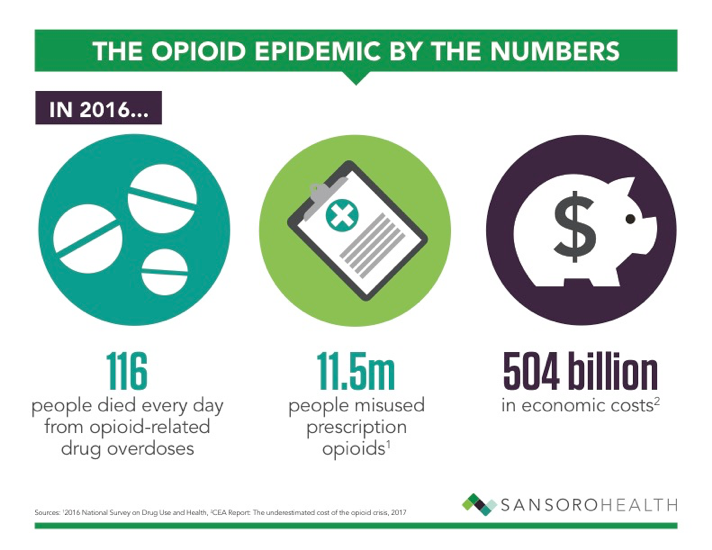
Given the statistics, it is likely that many of you have been personally touched by the epidemic.
In our experience, successful improvement efforts in health care almost always address the role of people, process and technology. Strategic innovations aimed at the opioid abuse crisis should account for all three of these in a holistic manner. Innovation should be pursued as a series of practical experiments that address current gaps, result in near-term improvement, provide insights for future tests of change, and lead to a set of sustainable and scalable solutions that will be essential to ensuring long-term success in addressing this enormous problem.