Categories

Tag: Jeff Goldsmith

Managed Care History Part III: The Rise of Machine-Driven Managed Care

This is part 3 of Jeff Goldsmith’s history of managed care. If you missed it read Part 1 & Part 2

By JEFF GOLDSMITH

Two major changes in health insurance ensued as the US health system entered the 21st century- a strategic shift of health cost risk from providers to patients and the emergence of machine driven managed care.

Insurers Shift Strategy from Sharing Risk with Hospitals and Doctors to Markedly Implicating their “Patients’.

After the 2008 recession, employers and their health plans shifted strategy from putting physicians and hospitals at risk through delegated risk capitation to putting patients at risk through higher patient cost sharing. In the wake of the recession, the number of patients with high deductible health plans nearly quintupled–to over sixty million lives. By 2024, 32% of the lives in employer-based plans (50% among small employers’) were in high deductible plans regardless of patient economic circumstances.   

The stated intention of the High Deductible Health Plan movement was to encourage patients to “shop” for care. In real care situations, however, patients found it difficult or impossible to determine exactly what their share of the cost would be or which providers did the best job of taking care of them. For an extensive review of the literature on how healthcare “consumers” struggle to manage their financial risk, read Peter Ubel’s 2019 Sick to Debt: How Smarter Markets Lead to Better Care.

Employers and insurers,  working together to “empower consumers”,  rapidly shifted “self-pay”  bad debts onto their provider networks. Some 60% of hospital bad debts are now from patients with insurance. Instead of “shopping for care”, consumers found themselves saddled with almost $200 billion in medical bills they could not pay, and hospitals and physicians ended up eating most of it.    

This escalating “insured bad debt” problem forced providers to hire revenue cycle management (RCM) consultants to revise and strengthen their policies regarding patient financial responsibility, “revenue integrity” (meaning crossing all the “t’s” and dotting all the “I’s” in each medical claim and making sure care is coded properly) and rigorously monitoring the flow of claims to and from their major insurance carriers. As a result many providers found themselves spending 10-15% of their total operating expenses on RCM! 

Medicare Advantage Enables Insurer Market Dominance

The movement from Ellwood’s vision of regionally-based provider sponsored health plans to market dominance by huge national carriers was cemented by the emergence of Medicare Advantage as the most significant and profitable health insurance market segment. In 2013, Medicare Advantage accounted for 29% of total Medicare spending. A decade later, in 2024, it was 54% (of roughly a trillion dollar program). And until a federal crackdown on MA coding and payment policies by the carriers, it was a 5% margin business, significantly more profitable than commercial insurance, ObamaCare Exchange or managed Medicaid businesses.

As Medicare Advantage emerged as the largest health insurance market, it was dominated by a cartel of large publicly traded carriers. 

Continue reading…

Managed Care History Part II- HMOs Give Way to Managed Care “Lite”

This is part 2 of Jeff Goldsmith’s history of managed care. If you missed it read Part 1

By JEFF GOLDSMITH

The late 1990s crash of HMOs opened the door to a major consolidation of the health insurance market controlled largely by national and super-regional health plans. While HMOs by no means disappeared post-backlash, the “movement” begun by Ellwood and Nixon fell far short of national reach. HMOs never established a meaningful presence in the most rapidly growing parts of the US- the Southwest, South and Mid-Atlantic regions, as well as the Northeast.

The exemplar, Kaiser Permanente, damaged its financial position with an ill-considered 1990’s (McKinsey-inspired) push to become a “national brand”. Today, over 80% of Kaiser’s 13 million enrollment is still in the West Coast markets where it began 80 years ago! 

HMOs Go Public and Roll Up

Two little noticed developments accelerated the shift in power from providers to payers. One was the movement of provider sponsored health plans into the public markets. PacifiCare, the most significant hospital sponsored health plan owned by the Lutheran Hospital Society of Southern California, was taken public in 1995. A subsequent merger with FHP health plan destabilized the newly public company. 

After PacifiCare crashed post the 1998 Balanced Budget Act cuts, and struggled to refinance its debt, it was acquired by United Healthcare in 2005, bringing with it a huge sophisticated, delegated risk contracting network. United then bought Sierra Health Plan based in Nevada in 2007, including its large captive medical group, its first medical group acquisition. Following these acquisitions, United rolled up PacifiCare’s southern California based at-risk physician groups in the late 00’s, and then capped off with its purchase of HealthCare Partners, the largest of all, 2017 from DaVita in forming the backbone of today’s $110 billion Optum Health.    

United’s buying BOTH sides of the delegated risk networks-plan and docs-in high penetration managed care markets is not fully appreciated by most analysts even today. 

It has meant that as much as 40% of Optum Health’s revenues, including almost $24 billion in capitated health insurance premiums, come from competitors of United’s health insurance business.  

However, of greater strategic significance was Humana’s decision in 1993 to exit the hospital business by spinning its 90 hospitals off as Galen. 

Continue reading…

Managed Care History: From HMOs to AI Assisted Claims Management Part 1

By JEFF GOLDSMITH

Healthcare payment in the US has evolved in decades-long sweeps over the past fifty years, as both public programs and employers attempted to contain the rise in health costs. Managed care in the United States has gone through three distinct phases in that time- from physician- and hospital-led HMOs to PPOs and “shadow” capitation via virtual networks like ACOs to machine-governed payment systems, where intelligent agents (AI) using machine learning are managing the flow of  healthcare dollars.  This series will explore the evolution of managed care in 3 phases.  

Phase I- Health Maintenance Organizations and Delegated Risk Capitation

In response to a long run of double-digit health cost inflation following the passage of Medicare in 1965, the Nixon administration launched a bold health policy initiative- the HMO Act of 1973- to attempt to tame health costs. The Nixon Administration intended this Act to provide an alternative to nationalizing healthcare provision under a single payer system, as supported by Senator Ted Kennedy and other Democrats. 

 The goal of this legislation was to restructure healthcare financing in the US into risk-bearing entities modeled on the Kaiser Foundation Health plans- a successful group-model “pre-paid”  health plan founded in the 1940s and based on the Pacific Coast. These plans would accept and manage fixed payments for a defined population of subscribers, and offer an alternative to what was perceived as an inflationary, open-ended fee for service payment system. In varying forms, this has been the central objective of “progressive” health policy for the succeeding fifty years. 

The HMO Act of 1973 provided federal start-up loans and grants for HMOs, much of which went to community-based healthcare organizations and multi-hospital systems. It also compelled employers to offer HMOs as an alternative to Blue Cross and indemnity insurance. While a few HMOs either employed physicians directly on salary (staff models like the Group Health Co-Operatives), or contracted on an exclusive basis with an affiliated physician group (like Kaiser’s Permanente Medical Groups), many more delegated capitated risk to special purpose physician networks- Independent Practice Associations (IPAs)- whose physicians continued in private medical practice. 

By 1996, according to the Kaiser/HRET Employee Benefits Survey, HMOs covered 31% of the employer market (roughly 160 million employees and dependents), and the federal government had begun experimenting with opening the Medicare program to HMO coverage. The impact of HMO growth on overall US health spending remains uncertain, because health spending as a percentage of US GDP continued growing aggressively during the next fifteen years,  before levelling off during the mid-1990’s around the Clinton Health Reform debate.

Two things brought the HMO movement to a crashing halt in the late 1990’s. 

Continue reading…

THCB Gang Episode 147, Thursday December 5

Joining Matthew Holt (@boltyboy) on #THCBGang on Thursday December 5 at 1pm PST 4pm EST are patient safety expert Michael Millenson, patient advocate & entrepreneur Robin Farmanfarmaian; futurist Jeff Goldsmith; and employer & care consultant Brian Klepper.

You can see the video below live (and later archived) & if you’d rather listen than watch, the audio is preserved as a weekly podcast available on our iTunes & Spotify channels.

THCB Gang Episode 142, Thursday October 31

Joining Matthew Holt (@boltyboy) on #THCBGang on Thursday October 31 at 1pm PST 4pm EST are patient advocate Robin Farmanfarmaian (@Robinff3); health economist Jane Sarasohn-Kahn (@healthythinker); futurist Jeff Goldsmith: and digital health guru Fard Johnmar (@fardj). Yes, it’s the pre-election special on Halloween!

You can see the video below live (and later archived) & if you’d rather listen than watch, the audio is preserved as a weekly podcast available on our iTunes & Spotify channels.

By the way the photo below was THCBGang Halloween 2020. When we all dressed up and Zoya Khan came as me!

The Clinical Enterprise is the Beating Heart of Health Systems

By JEFF GOLDSMITH

As health systems struggle to emerge from the post-COVID financial crisis, the importance of the clinical enterprise to these systems has dramatically increased.  Healthcare organizations are getting larger, as failing enterprises are absorbed into growing systems. 

Yet clinicians of all stripes but particularly physicians feel a deepening sense of alienation from the expanding care systems in which they work.   In many “wanna-be” health systems, the clinical “enterprise”  is a loosely connected roll-up of independent practices held together by RVU-based compensation plans and a common corporate logo on the door. 

A roll-up is not a credible foundation for a system, but merely a holding action.  If you have lost your clinicians, you do not have a franchise!    

In an age when clinician burnout and moral injury threaten the well-being of care givers, how care systems foster caregivers’ commitment to their enterprise has become the central strategic challenge.  When one looks at the leading enterprises in healthcare- from the Mayo Clinic to Johns Hopkins Medicine – they have one thing in common.  They are not only led by clinicians, but the clinicians there work together both to maintain high clinical standards and develop and propagate clinical innovation.  

This commitment has a direct financial consequence for health systems.  In an environment where an increase percentage of health care revenues are “risk” revenues, having affirmative control over the cost of delivering care is the key to the organization having a future. Ultimately, that control comes not from clever compensation schemes, but from how clinicians behave in working together to manage their patients. 

To be clear, the clinical enterprise does not mean that all clinicians are salaried employees.  In some organizations like Kaiser Permanente, for example, clinicians are employees of the Permanente Medical Groups, a closed panel entity which provides most of Kaiser’s clinical care.   

But in many organizations, clinicians may be independent practitioners or members of affiliated medical groups, but are still actively involved in the governance of the clinical enterprise.  In academic institutions, not all members of the clinical enterprise are full time faculty.  And not all of them have MDs after their names, but are advance practice nurses and other clinicians with post-graduate degrees.  

Continue reading…

Can Someone Actually Be Responsible?

By MATTHEW HOLT

I was having a fight on Twitter this week and it hit me. America 2024 is Japan 1989. 

The topic of the fight was right-wing VC Peter Thiel. In 2001 he put a ton of Paypal stock allegedly worth less than $2,000 into a Roth IRA. The Roth IRA was designed so that working stiffs could put post tax cash into an IRA, grow it slowly and take out money tax-free. (For traditional IRAs you put in pre-tax money and get taxed when you take it out). You may have read the story in ProPublica. Magically Thiel earned less that year than the max allowable income limit (around $100K) to contribute to a Roth IRA, and magically that stock was within weeks worth much more and then, later, hundreds of millions more. Since then Thiel has invested those Paypal returns in Facebook, Palantir and much more, and that Roth IRA has billions of dollars in it that can never be taxed.

My twitter adversary was saying that Thiel obeyed the law. I doubt it, but that’s not really the point. When the Roth was introduced it wasn’t meant to be a loophole that Silicon Valley types could use to hide billions from tax. But neither my twitter “friend” nor Peter Thiel want to take responsibility or pay their fair share.

Japan in 1989 was wealthy and successful and heading off a speculative cliff which it’s since taken 3 decades to dig out of. There were numerous academics pointing this out, but the most interesting analysis was The Enigma of Japanese Power written by a Dutch journalist named Karel van Wolferen. Here’s a summary from wikipedia with my emphasis added

Van Wolferen creates an image of a state where a complicated political-corporate relationship retards progress, and where the citizens forgo the social rights enjoyed in other developed countries out of a collective fear of foreign domination….Japanese power is described as being held by a loose group of unaccountable elites who operate behind the scenes. Because this power is loosely held, those who wield it escape responsibility for the consequences when things go wrong as there is no one who can be held accountable.

In Thiel’s case a collective network of tax accountants, junk philosophers, and purchased politicians like JD Vance ensure that no one has to be accountable. Ultimately Thiel doesn’t feel responsible for paying what he owes. Of course the exposure of Trump’s tax cheating shows that he doesn’t either. And many people find this OK.

Meanwhile I got into it a little with Jeff Goldsmith on last week’s THCB Gang about why hospitals are still paid per transaction when it would be much better for them to be paid some kind of global budget for the services they provide and for doctors to be paid a salary to exercise their best judgment rather than be tempted into providing care just because they get paid for it. Both COVID and the recent Change Healthcare outage put health care providers in a terrible situation financially because they depend on being paid fee-for-service via claims for individual transactions. Did the leadership of America’s hospitals and doctors come out asking for a change to the system? No, they just got a government hand out and begged for a return to standard operating procedure. No one can rationally look at how we pay for health care in America and say “give us more of the same” but there’s no leadership to change it at all.

Talking about lack of leadership, Amber Thurman died in Piedmont Henry Hospital because no-one on the medical team was prepared to give her the D&C that she desperately needed. They were scared of going to jail under Georgia’s draconian anti-abortion law. There are many, many guilty parties here.

Continue reading…

THCB Gang Episode 140, Thursday October 3

OK we are really back.! Following last weeks special with the Women Healthcare Leaders for Progress, the “regular” THCBGang is coming back for the Fall, mostly but not always at the 1pm PT 4pm ET timeslot on Thursdays.

Joining Matthew Holt (@boltyboy) on #THCBGang on Thursday October 3 at 1pm PST 4pm EST are futurist Jeff Goldsmith: delivery & platform expert Vince Kuraitis (@VinceKuraitis); author & ponderer of odd juxtapositions Kim Bellard (@kimbbellard);

You can see the video below & if you’d rather listen than watch, the audio is preserved as a weekly podcast available on our iTunes & Spotify channels

What the Health System Can Expect from a Second Trump Term

By JEFF GOLDSMITH

Though the results of the November election are by no means a foregone conclusion, it is worth thinking about how a second Trump administration might affect the nation’s $4.7 trillion health system. People were not the problem with the first Trump term; his healthcare team was strong and capable: Alex Azar, Scott Gottlieb, Seema Verma,. Bret Giroir, Brad Smith etc.  

After the embarrassing political failure of Repealing and Replacing ObamaCare in 2017 (for which blame look to his White House staff), his healthcare team settled in to a quiet and unremarkable term until the COVID wave broke over them and helped drive them out of office. It was not merely ironic but deeply disturbing that MAGA politics prevented Trump from claiming credit for the Operation Warp Speed vaccine miracle his team produced. 

A second Trump term would likely be very different- both more ideologically driven but also fiscally constrained. The people part is completely unreadable at this early hour. But health policy will almost certainly be a second tier priority because trade and tariffs, conflicts with our traditional allies and trading partners, and inflamed social issues like illegal immigration, wokeness, and abortion will crowd out changes in health coverage, costs and payment policy.   

Show Me the Money! 

However, fiscal pressures will force a second Trump administration to confront federal health spending and set him on a collision course with the hospital and pharmaceutical industries, two of the three largest organized actors in healthcare. Trump inherits a 2024 $5 trillion federal budget with a $1.7 trillion deficit, an anomalous degree of fiscal stimulus at the height of an economic boom. That deficit is also a major driver of the inflation Trump has promised to conquer.   

Trump is committed to reauthorizing the individual tax cuts from his 2017 Tax Cuts and Jobs Act which are scheduled to expire in 2025, which would add $3.3 trillion to the deficit over the next ten years. He also wants to reduce the corporate tax rate from 21% to 15%. If Trump does nothing meaningful about federal spending, his FY 26 budget, due shortly after he arrives in the White House, would harbor immense out year deficits and completely gross out both the bond and currency markets–a “Liz Truss” moment for the new regime. The promise of immediately reducing inflation which Trump made in his RNC acceptance speech goes sailing out the window.  

Savaging Medicaid Spending  (or Trying to)

Trump has tied his budgetary hands by committing to not cutting a single penny from Medicare and Social Security, which are forty percent (!) of the federal budget. This commitment appears both in the Republican platform and in Agenda47, which is the Trump campaign’s compilation of commitments made in his speeches. Trump has also committed to not reducing the $850 billion spent on Defense.

Ringfencing Social Security, Medicare and Defense leaves the more than trillion dollar Medicaid program (state and federal combined) as the largest single potential source of potential budgetary savings to avoid inflationary blow-out growth in the federal deficit. At its peak in March of 2023, Medicaid/CHIP enrolled 94 million people, or 28% of the US population. Expect an incoming Trump administration to attack Medicaid spending, both by accelerating the decline in enrollment that began in 2023 with the expiration of the COVID Public Health Emergency and by cutting rates and payments to Medicaid Managed Care providers. Some 24 million Medicaid beneficiaries have been “redetermined” and over 15 million have lost coverage. KFF says present Medicaid enrollment is about 80 million in mid-2024 but that number is certainly moving down 

While Trump has distanced himself from the Heritage Foundation’s Project 2025, that policy blueprint characterized the ObamaCare Medicaid expansion as “inappropriate” and the program itself as a “cumbersome, complicated and unaffordable burden on nearly every state”. It advocated ending what it called “financing loopholes” (e.g. provider taxes that have trued up Medicaid rates to hospitals and physicians vs. Medicare), tightening Medicaid eligibility, and imposing both work requirements and cost sharing, “reforming” disproportionate share payments, time limits and lifetime caps on Medicaid benefits and ending coverage for “middle and upper income beneficiaries”! We can certainly expect inflammatory publicity from a Trump White House on states that have expanded Medicaid eligibility to  “undocumented aliens”, followed by pressure on Congress to prohibit this coverage by statute.   

When former Trump press secretary and present Arkansas Governor Sarah Huckabee Sanders, announced her removal of 400 thousand Arkansans from Medicaid enrollment, she said she was “liberating them from dependency”.  It is likely that that millions more Americans will be “liberated from dependency” on Medicaid during the first two years of a second Trump Administration. There will be work requirements (with politically damaging pressure on the 11 million very poor or disabled “dual eligibles” eg. Medicare plus Medicaid) population), as well as cost sharing and an voucher option to purchase private insurance (!?) for Medicaid beneficiaries. An aggressive effort to “re-welfare-ize” the Medicaid program will raise numerous bureaucratic barriers to Medicaid enrollment, scaring off a lot of otherwise eligible beneficiaries. 

Continue reading…

The Real Red Wave: Why the Biden Presidency is in Peril

By JEFF GOLDSMITH

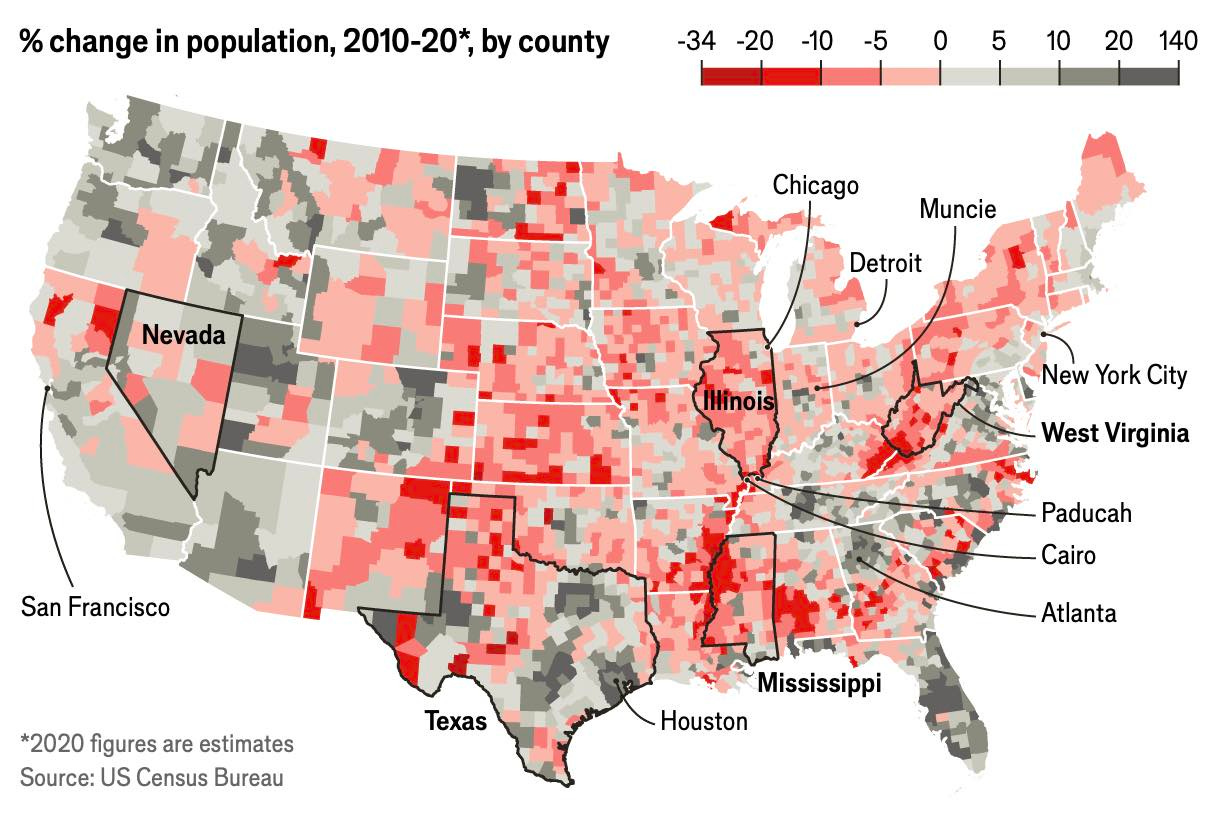
Democrats’ despair after Joe Biden’s pallid and halting debate performance stems from the realization  that the uphill climb needed to prevent the return of Donald Trump might be too steep. What is less obvious is the awareness of the urban intelligentsia of the root causes of the adverse political climate, which can be seen in this map, taken from the Economist’s April 20 feature on declining US population.

A map of the united states

Description automatically generated

America’s economy is booming, and the gap between its economic performance and that of the rest of the world is widening. The on-the-ground political reality is very different depending crucially on where you live. People who live in the red parts of this map do not need convincing that all that wealth, and the power that goes with it, has eluded them. Many of them believe that it has been stolen from them by corrupt leaders and the oligarchs and corporate interests that finance their campaigns.

That is the underlying reality of MAGA.  Ninety percent of those red counties voted for Donald Trump in 2020. People in metro Austin, Manhattan or the suburbs of Houston do not resonate with the need to make America great again. It’s already great for many of them.

For folks living in the abandoned parts of the US, the on-the-ground reality is absurd gas prices, unaffordable mortgages, a mountain of forever debt, deteriorating public services, dreams cruelly out of reach and the despair that goes with all of it-alcohol and drug dependency, depression and anxiety, obesity, domestic violence. There is an almost perfect correspondence between the above map and that of the epidemic of “deaths of despair” suicide, drug overdoses and alcohol poisoning. This phenomenon is rooted in middle-aged whites, the overwhelming demographic of the red parts of this map, but affects all demographic segments including black and Hispanic folks who traditionally supported Democrats.     

After 2016, political analysts believed that the prevalence of non-college educated whites in a local electorate was the single best predictor of Donald Trump’s shocking victory. That was not the case. A post-election analysis by the Economist revealed that a better predictor of Trump’s victory was a composite measure of health/life expectancy, specifically “county-level data on life expectancy and the prevalence of obesity, diabetes, heavy drinking and regular physical activity (or lack thereof)”, the mapping of which again correlates remarkably with the map of population decline above.

The very same forces of outmigration and economic stagnation are destroying these communities’ local health systems, as well as their schools, commercial businesses and churches. The same red areas are also areas where local physicians have retired and were not replaced, and whose hospitals closed or merged with larger regional conglomerates. A recent scurrilous analysis by Yale and University of Chicago economists blamed the rising deaths of despair and  local business’s economic struggles on hospital mergers, an absolutely “from central casting” example of blaming the victim. 

The bitter irony of this political season is that the Biden Administration’s remarkable roster of Congressional achievements in 2021 and 2022- the American Rescue Plan, the American Infrastructure and Jobs Act, the Chips and Science Act and the Inflation Reduction Act showered many tens of billions in temporary relief spending and capital investment for manufacturing and infrastructure on these red areas. Because many of these investments take years to execute, credit for them will be claimed by future administrations.

Yet due to the arrogance and isolation of the progressive policy advocates that shaped this legislation, it was simply self-evidently obvious that the most ambitious domestic reconstruction program in the ninety years since Roosevelt will help many of the most economically challenged areas in the country. Proud and sparsely attended ribbon cutting ceremonies made the local newspaper, if there still is one. News of these investments never arrived via the partisan news channels and hyper-targeted social media venues on which most ordinary Americans rely these days. That attitude of “self-evident good works”  is of a piece with the “Why Bother Visiting Wisconsin” arrogance that let Trump into the White House in the first place. 

If post-debate polling is any guide, all these trillions of dollars of good works, funded with money borrowed from our grandchildren, will not be enough to turn the red tide, which could well leave the Republicans firmly in control of all three branches of the federal government. As they go to their cushy post-administration redoubts at the Brookings Institution, Yale, Hopkins and Harvard’s Kennedy School of Government, and hobnob at Aspen Institute and Martha’s Vineyard cocktail parties, the executors of all these good works, for the unforgiveable political sin of failing to communicate effectively with the struggling working class they used to champion, will have fully earned their retirement. 

Jeff Goldsmith is a veteran health care futurist, President of Health Futures Inc and regular THCB Contributor. This comes from his personal substack