Categories

Category: Uncategorized

Welcome To Health Wonk Review – 1/09/09

Well, here we are at the beginning of 2009. On TV we’ve learned that the unlimited spending and brilliant, if socially pathological, heroics of Dr. Gregory House, unfailingly saves his patients from unknowable complexity and the abyss of death.

Meanwhile, the rest of health care, aided largely by really excellent lobbying, continues to be buoyed, defying the relentlessly corrosive gravitational pull of waste, corruption, and a tanking economy.

Still, health care’s troops are beginning to feel, in Tom Lehrer’s words, like a Christian Scientist with an appendicitis. Things definitely are not going well, and this longstanding run of great good fortune could be on the downswing. Is it possible that exorbitant pricing and massive waste are NOT entitlements!

Which brings us to the far-ranging insights, jabs, diatribes, rants and enthusiasms of this edition of Health Wonk Review, which features analysis and exegesis as entertainment.

Continue reading…

Should the FDA relax in the search for new cures?

Over at DiabetesMine #1 health blogger Amy Tenderich has very important post. She and several fellow travelers are appealing to the FDA to strike a balance between safety and progress in allowing new diabetes treatments.

The FDA of course has been beaten to a pulp these last few years because it’s played footsie with the drug industry and ignored several potentially damning studies, with the result that the number of drugs withdrawn from the market has been much higher than in previous years.(Vioxx, Phen-Fen, Baycol, et al).

I’ve always felt that the FDA’s role should not to be a black/white (dangerous/safe) stamp of approval, but instead it should be the honest broker of getting all the data out there. As Amy and her crew point out, some diabetics may be prepared to take a risk of higher long-term cardiac complications in return for a medium term gain from a new medication. Something similar is certainly true in terms of hormone replacement therapy.

Continue reading…

Persistent Nondiagnosis

Brad Kittredge is an MBA/MPH student at the Haas Business School at UC, Berkeley. He is working to build an online tool to assist with complex and difficult diagnoses, which, as you’ll see, he considers among the biggest problems in medical care. He blogs more about these issues at Hyoumanity.

Every day, thousands of Americans are desperately seeking answers to complex medical conditions that doctors are unable to diagnose. Consider one example: Jenny T. is a 14 year old girl with a progressively debilitating neuro-degenerative condition that has taken her from healthy and active to nearly paralyzed in less than one year. Her parents have taken her to some of the best academic medical centers in the US, including Stanford, UCSF, and the University of Pennsylvania, but doctors have been unable to diagnose her condition, leaving Jenny and her parents desperate for answers and short on options.

Continue reading…

“The Innovator’s Prescription”: Christensen’s Book Offers Insightful Dx, Unrealistic Rx

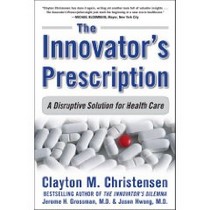
Ip Being big fans of Clay Christensen and his theory of disruptive innovation (DI), we have been awaiting his just-released book The Innovator’s Prescription: A Disruptive Solution for Healthcare .  The book is co-authored by Dr. Jerome Grossman and Dr. Jason Hwang.

We have mixed reactions.

The book is mistitled. It should have been titled “The Innovator’s Diagnosis”. The book does a fantastic job at diagnosis (Dx) of problems in the U.S. health care system. It presents many new, innovative analytical frameworks and lenses through which to view the U.S. health system.

However, it’s weak on prescription (Rx): many of the proposed solutions are speculative, ungrounded, and/or defy political reality.

We understand that the very nature of disruptive innovation implies inevitable resistance from organizations that benefit economically from the status quo. But at some point a proposed solution becomes so disruptive that you have to suspend reality to believe that it could be adopted or implemented — and many proposed solutions in this book enter that realm.

The book applies Christensen’s general theory of DI specifically to the health care system. It addresses questions such as:

  • What is DI?
  • Why is it important to create an environment in health care where DI can flourish?
  • How can we create the right environment in health care for DI to flourish?

The introductory chapter of the book is available here at no charge (right column under Downloads). It’s a great overview.

Continue reading…

The Five Myths of Healthcare Reform

The arguments that the widespread use of health information technology (HIT), improving health status, expanding outcomes research, implementing pay-for-performance systems, and covering everyone will make it possible for us to afford comprehensive health care reform are commonly cited by people on both sides of the political aisle. It’s all a myth.

Undoubtedly, these ideas will be at the core of any number of health care reform proposals as we begin the 2009 health care reform effort.There is nothing wrong with any of these things and all can make a positive contribution toward improving both the cost of and especially the quality in our health care system. All should be part of a reform proposal.The problem is that none of them would make more than a modest dent in what a reformed system would cost us and not come anywhere near close to
accomplishing the objective of stabilizing our health care costs much less reducing them.

Continue reading…

Commentology

Longtime THCB reader Barry Carol writes in on Matthew’s "Shocker …"

"Most hospital CEO’s, especially those who oversee academic medical centers, would probably tell you that their profit margins are quite low and that they could not make ends meet or continue to provide the quality of care they do now if they had to accept Medicare rates from all comers, even with no uncompensated care …"

David Kibbe continued the ongoing dialogue on the thread on the "Rebooting Health IT" series he is co-authoring with Brian Klepper.  

"Having thoughtful physicians like yourself enter the debate and
discussion is one of the primary reasons that Brian Klepper and I are
doing these blogs on re-thinking health IT! Thanks for your input,
which I think is brilliant … Let’s not forget the story of John Snow and the removal of the Broad
Street pump handle, during the deadly cholera outbreak in London in
1854. While all the experts were debating the causes of the infection
and what to do about it, Dr. Snow had the simplest and most direct
answer of all: remove access to the offending source of the calamity."

Continue reading…

Shocker–Karen Ignagni almost tells the truth

The NY Times’ Robert Pear has an article on the politics of the Obama Administration introducing a public plan as part of FEHBP.

As you might expect a boat load of Republicans who were told in grade school that private is good and public is bad are concerned about this causing the demise of private health plans–even though that would clearly benefit the country. Of course Pete Stark is quite happy to say that it’s not that Medicare underpays (as Charlie Baker said here last week), but it’s that private plans over pay.

So why is that the case? Well you knew that I couldn’t resist the appearance of my favorite lobbyist. Here’s what Karen Ignagni says, and — this is the shocker– it’s half true.

Karen M. Ignagni, president of America’s Health
Insurance Plans, a trade group, said the consolidation of the hospital
industry in the last seven or eight years had increased the market
power of hospitals, thereby reducing the ability of insurers to
negotiate discounts.

Actually it’s been more
like twelve to fifteen years since big players started merging (IFTF’s
Ellen Morrison wrote a great report about that in 1994 called "The Six Americas").
By the late 1990s Sutter, for example, was facing down Blue Cross of
California on price and winning. And of course in Boston Partners was
getting bigger and bigger, and facing down Blue Cross and the other plans. (Leading occasional THCB contributor and Beth Israel Deaconess CEO Paul Levy to become a big whiner, according to Partners Chairman Jack Connors). So Karen is telling the truth.

Continue reading…

Confusing ‘Standards’ With ‘Interoperability’–Lessons For The 111th Congress From HIPAA

As we debate whether or not the Obama Administration and the 111th Congress should work towards directly funding EHRs, one of the key questions seems to be whether or not EHRs and interoperability standards are mature enough.

My colleague, John Halamka, Chair of the Healthcare Information Technology Standards Panel (HITSP), made an rational and impassioned plea last week that we have reached a state of interoperability that is at least good enough not to delay allocating Federal funds for investments in EHRs. Dr. Halamka had earlier in December advocated direct grants from the Federal government of $50,000 per U.S. clinician to states to fund the purchase of CCHIT compliant commercial EHR products.

In the ideal world, I agree with John’s position, but have spent perhaps too much time in the real EHR world and in health care standards to truly believe we are where we think we are.  We have been here before and our best intentions were subverted.

Continue reading…

Cool Technology of the Week

Community_map_2As part of the Harvard Clinical and Translational Science Awards, we’ve built a number of social
networking tools while also leveraging components built by others such as NetAge. These tools typically work by analyzing collaborators on publications, co-PIs on grant funding, and subject matter interests.

A possibly more precise way to identify networks and communities is by analyzing email traffic patterns – senders, receivers and subjects. A novel social networking tool from Metasight called Morphix, does this.

MetaSight Communities of Interest and Communities of Relationships are web applications which can be implemented as standalone applications or integrated with a corporate portal or intranet.

The tools work by automatically analysing e-mail subject titles and recipients. Personal, private and confidential e-mails are excluded.

Per the Metasight website, social networking applications of this analysis include:

Continue reading…

Whata Gupta Fuss

Mostly because he went off erroneously at Michael Moore in what I remember as two amateur policy analysts being unable to either get their facts straight or explain what was important, Sanjay Gupta’s floated appointment as surgeon general has got the left in a tizzy. And I agree that a neurosurgeon is not exactly who I’d go to for information about public health. But part of the amusement/confusion is that via a now contrite Merril Goozner, CNN’s Sanjay Gupta was confused with another Sanjay Gupta who was a big time recipient of drug company funding.

But does any of this this matter? I know that the rumor is that he’ll have input into health reform, but then again so does anyone who went to a Daschle house party. And if this position is so important, answer me this: who is the current Surgeon General and what notable thing has he or she done?

I knew you couldn’t do it sans Google….

If you really care, Val Jones has recently interviewed the last but one surgeon-general Richard Carmona. In your piece of trivia for today Carmona knows about Health 2.0, or at least is on the board of Healthline.

Anyway we may not have enough general surgeons according to their trade group, but why should the head of public health for the nation be a surgeon. Shouldn’t they be an epidemiologist? And why are they a general? Don’t we waste enough money on the military as it is?

assetto corsa mods

