Categories

Category: Uncategorized

Evaluating President-Elect Biden’s Healthcare Plan | Part 1

By TAYLOR J. CHRISTENSEN

Without the full support of congress behind him, President-Elect Joe Biden will probably not have an opportunity to sign any major system-altering healthcare legislation. But, if Democrats can gain a majority in the senate–either this election cycle or next—healthcare reform will be high on the agenda. Let’s take a critical look at what Joe Biden would push to accomplish.

For this evaluation, I am relying solely on information that Joe Biden has committed to on his official campaign website. He has many pages talking about a variety healthcare issues, such as the pandemic, gun violence, and the opioid epidemic. But the main page that reviews his plans for the healthcare system as a whole is here. Consider giving it a read through first, because what follows will only be summarizing and evaluating the key big-picture components of his plan.

Joe Biden is not pushing for Medicare for All. He instead wants to keep the Affordable Care Act (i.e., the ACA, or “Obamacare”) and fix the parts of it that are not working so well. To understand the rationale of his proposed changes, we first need to review where we are at now with the ACA.

There are many parts to the ACA, but its main thrust was to increase insurance coverage. What kind of numbers are we working with? Below are some 2019 data, rounded for simplicity. And note that I am excluding the 60,000,000 people who are over age 65 and therefore on Medicare.

The under-age-65 people fall into one of four insurance groups . . .

Employer-sponsored insurance (160,000,000 people) if they are lucky enough to work for an employer that provides benefits.

Medicaid (70,000,000 people) if their income is low enough to qualify.

Private insurance from the “private market” (10,000,000 people) if they make too much money to qualify for Medicaid and do not have an employer that provides benefits.

Uninsured (30,000,000 people) if they do not get insurance from their employer, their income is too high to qualify for Medicaid, and they do not want to pay for insurance from the private market.

Remember, those are from 2019, so they are post-ACA numbers. Prior to the implementation of the ACA, the uninsured number hovered around 45,000,000 people. What did it do to reduce the number of uninsured people? There were many ways, but here are the two biggest ways:

Continue reading…

Health in 2 Point 00 — with no video!

By MATTHEW HOLT (without JESS DAMASSA!)

Due to @jessdamassa being lost in America and my totally crap internet in the Sierras, there is no #HealthIn2Point00 this week.

So I’m going to write out a few things we would have said:

1. @OscarHealth raises another $140m and files to IPO. SPAC or no SPAC, a bunch of these startup health plans are going to try to get out the door while the window is open! 420,000 members ain’t a lot–I mean there are 5-6 Medicaid plans bigger than that in CA alone! I still predict someone big buys them but whether pre- or post crash I don’t know.

2. @LyraHealth is raising another $175m (apparently). That’s the 3rd trip to the well THIS YEAR! Mental health is sexy these days. Just how many online mental health cos can make it? I think Lyra needs to use these $$ for automated self-service tech, cos psychiatrists don’t scale, and they currently sell themselves as having a better network than anyone else.

3. @kyruus buys @HealthSparq (from @Cambia). No $$ announced. Unclear why a company that makes $$ routing patients to doctors within systems (& prevents “leakage”) needs a transparency tool that explains who’s charging what. But maybe an overall pivot to serving health plans?

4. @h1insights raises $58m (total is over $70m). It’s a database of doctors sold to drug companies to help them better target their marketing. Good to know that in the new world of health tech, helping big pharma push pills is a reliable way to make bank.

OK, so that’s what I would normally have covered in 2 mins on #HealthIn2Point00 yes, it’s much better with @jessdamassa on video and running the show while poking fun at me. Hopefully the internet works next week! #MerryChristmas2020


Olive CEO Sean Lane on 2020’s Big Numbers: 3 Funding Rounds, $450M, & a 5-Point Plan for the Future

By JESSICA DaMASSA, WTF HEALTH

Arguably 2020’s hottest health tech startup, Olive (olive.ai) closed THREE funding rounds this year, totaling $450M and valuing the company at $1.5B. Backed by a “who’s who” of technology, healthcare, and health tech venture capital, Sean Lane, CEO, clues us in about just what makes Olive so damn fund-able. The company boasts a “healthcare AI workforce” that tackles all the back-office processes hospitals use to run their organizations. This is not sexy stuff — filing and tracking insurance claims, ordering inventory, managing suppliers, etc. What’s hot, though, is how Olive is able to automate these tasks (according to Sean, currently many of these processes are handled by spreadsheets and faxes), “learn” as she’s doing it, and create efficiencies and cost savings across all of Olive’s 600+ hospital client-base as she does. Could this be the end of “admin expense” in healthcare? If what Olive is currently doing isn’t enough, we dive deep into Olive’s strategic plan — ALL FIVE POINTS OF IT (!) — to learn what’s next. My favorite? Number 3. The one where Olive starts to INSTANT PAY CLAIMS to completely disrupt hospital cash flow.

3 Patient Lessons: What Cancer Patients Teach Me

By YASMIN ASVAT

An estimated 1.8 million people in this country may face a cancer diagnosis this year, in what has already been a bleak year of isolation and loss.  

While news of the COVID-19 vaccine rolling out across the U.S. offers hope in a year of 311,000 deaths,  11 million  people face the financial pressure of unemployment, and, approximately 43 percent of the nation reports some symptoms of anxiety or depression.  

It is understandable that a cancer diagnosis now may be too much to bear. And yet, somehow, many patients cope with the diagnosis and the associated uncertainty, fragility, and the threat of mortality with remarkable resilience.  

As a clinical psychologist in the Supportive Oncology program at a major Midwestern cancer center, I witness these quiet heroics every day. 

Since the beginning of the pandemic earlier this year, I have been striving to listen, empathize, support, and help cancer patients cope as their lives have been disrupted by both a cancer diagnosis and COVID-19. These are lessons these patients have taught me. 

Courage is being faced with doing something that utterly terrifies you, and you do it anyway. One of my patients described that leading up to the day of chemotherapy treatment, she is highly anxious, has racing thoughts and worries, and has trouble concentrating and sleeping. The morning of treatment, she vents to her partner about how she doesn’t want to go to the clinic. During the drive, she braces herself repeating, “I don’t want to do this” over and over again. 

Once in the clinic, she tells some of her nurses that she doesn’t want to be there because she worries about COVID-19 exposure, despite all the precautions the clinics have in place. She tells another set of nurses that she is scared of the side-effects of treatment – the disabling fatigue, the nausea, the suppressed immune system. 

Continue reading…

A Christmas Message to All Physicians From a Swedish-American Country Doctor in Maine

By HANS DUVEFELT, MD

Growing up in Sweden without a Thanksgiving holiday, Christmas has been a time for me to reflect on where I am and where I have been and New Year’s is when I look forward.

I have written different kinds of Christmas reflections before: sometimes in jest, asking Santa for a better EMR; sometimes filled with compassion for physicians or patients who struggle during the holidays. I have also borrowed original sentences from Osler’s writings to imagine how he would address physicians in the present time.

This year, with the pandemic changing both medicine and so many aspects of life in general, and with a gut wrenching political battle that threatens to erupt in anarchy or civil war within the next few weeks or months, my thoughts run deep toward the soul of medicine, the purpose of being a good doctor, even being a good human being.

We live in ideological silos, protected from dissenting opinions. News is not news if it is unpopular. Fake news and fake science are concepts that seemed marginal before but have now entered the mainstream.

As a physician, I serve whoever comes to see me to the best of my ability. But this year I have had to pay extra attention to the fact that so many people have already made up their minds about the nature and severity of the pandemic we are living with. If they don’t believe the country’s top experts, they are not likely to believe in me. Still, I try to gently state that we are still trying to figure this thing out and until we do, it’s better to be cautious.

I am starting to read about what some are now calling the Fourth Wave of the pandemic, the mental health crisis this winter may see in the wake of the physical illness we are surrounded by.

Continue reading…

Two Surgeons—a Veteran and a Newcomer—Talk Fighting COVID Burnout

By MICHAEL E. LIPKIN and RUSSELL S. TERRY, JR.

Burnout has always been a concern in medicine, and that concern has been amplified by the added stress of COVID-19. Many months into an unpredictable and distressing situation, we have both hung on to our mental health and professional passion by seeking out strategies that work for us. We offer them in two perspectives: veteran and relative newcomer.  

Dr. Lipkin: A Veteran’s Perspective

When lockdown began in March, we slowed down my practice for about 6 to 8 weeks, and then returned to full pre-COVID levels. It feels like the uncertainty has affected me most, since it has not been clear if and when things will get substantially better. Everyone is both experiencing and projecting persistent anxiety, stress and uncertainty. Isolation is a problem as well. I no longer have the time or ability to sit down with colleagues and vent over a beer, which was an outlet I counted on to mitigate burnout. At the same time, on a more concrete level, the pandemic has made everything we do incrementally more difficult, which is grindingly stressful. These tips are helping me cope and avoid burnout.

There are so many changes—just accept them. As COVID affects so many areas of practice, there’s a kind of low-grade stress that fluctuates with events. It seems like everything is a little bit harder. We have to shift some patient visits to telehealth and make sure they get COVID tests before surgery. We’re all looking over our shoulders, wondering who’s going to get us sick. There’s always the specter of more shutdowns and how they might affect our livelihoods. Budgets have been cut back, so hiring is frozen and there’s virtually no incremental spending. Everything will stay this way for now, so the best thing to do is accept that we’re going through a tough period and focus on the big picture, rather than the list of irritations.

Continue reading…

#Healthin2Point00, Episode 174 | Cityblock, Elation, Modern Health, LeanTaaS & Well

Today on Health in 2 Point 00, Jess has me weigh in on Cityblock Health’s big raise of $160 million bringing their total up to 300 million to improve health for low-income patients. On Episode 174, Elation, which is Cityblock’s EMR as well as that for some other independent primary care clinics, raises $40 million and working their way into a tough market. Modern Health raises $50 million for the “fourth” pillar of care, providing another mental health platform. LeanTaaS raises $130 million, providing a digital front end for hospitals and smooth out patient access, in contrast to companies like Olive working on the backend. Finally, Well gets $40 million in a Series A using AI and behavioral economics to provide health information and coaching. —Matthew Holt

The Pathway to Health Leads Through Clean Energy Technology

By MIKE MAGEE

Health reporting this week is rightly dominated by the challenging worldwide distribution of the Pfizer vaccine for Covid-19. Bringing the virus to bay is job #1, not only to preserve human life but also our global economy. But this week, on the 5th anniversary of the Paris Agreement, we are reminded that our long term human health, including clean air and water, mitigation of weather-related human disasters, and regulations that lessen our chronic burden of disease, depend as much on energy policy as they do health policy.

Nowhere is this more evident (though largely hidden from sight) than in our planet’s positioning to address global warming. The Paris Agreement, the climate accord signed by 195 nations, was abuptly dismantled by Trump four years ago. But President-elect Biden has signaled that his first order on January 20, 2021, will be to rejoin the agreement.

As Trump patronized his fossil fuel funders, and promised that “we’re going to have clean coal and we’re going to have plenty of it,” the oil and gas industry wrote down the value of its assets $170 billion in the first 6 months of 2020.

Acknowledging as much this past week, a cabal of energy investors, with combined assets of $9 trillion, signaled a shift in their strategy with a pledge to harmonize their investments with net-zero carbon emissions by 2050.

Those investors haven’t suddenly “discovered religion.” No. They’re looking at the numbers.

Clean energy options like solar and wind, combined with the latest battery technology, are now 79% cheaper to produce than US coal production. Investors realize that 90% of the new energy capacity generated worldwide in 2020, as reported by the International Energy Agency, has come from clean energy.

Continue reading…

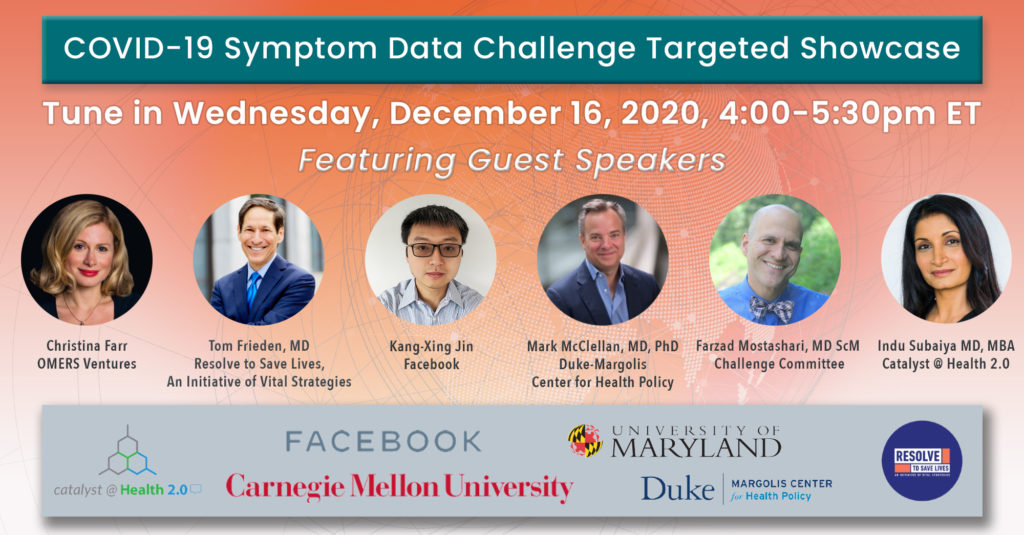
COVID-19 Symptom Data Challenge Showcase Event — WEDNESDAY 4pm ET!

After receiving applications from 115 people (across every continent except Antarctica!) and 50 organizations, including 35 academic institutions, the judges have declared DeepOutbreak, a team with members from Georgia Tech, the University of Iowa, and Virginia Tech as the winner of COVID-19 Symptom Data Challenge.

Second place was awarded to K&A, a Russia-based team working with the World Bank and the Higher School of Economics. $75,000 in prizes will be awarded to the winners.

The winners and the other three finalists will present their prototypes at the COVID-19 Symptom Data Challenge Showcase on Wednesday, December 16th, from 4-5:30pm ET. Register here!

The program’s distinguished speakers include

  • Dr. Tom Frieden, President & CEO of Resolve to Save Lives, an initiative of Vital Strategies & former director of the CDC
  • Dr. Mark McClellan, director of the Duke Margolis Center for Health Policy
  • Dr. Farzad Mostashari, CEO of Aledade & former National Coordinator for Health IT at the Department of Health and Human Services, and
  • Kang-Xing Jin, Facebook’s Head of Health.

Chrissy Farr, Principal and Health-Tech Lead at OMERS Ventures and former technology and health reporter for CNBC.com, will serve as emcee.

Register for the COVID-19 Symptom Data Challenge Showcase on Wednesday, December 16th, from 4-5:30pm ET here

The Year When Everything Changed: Covid, Self Care and High Tech Innovation In Medicine

By HANS DUVEFELT

Life as we knew it and medicine as we had viewed it shapeshifted so dramatically in the past year that it is still hard to believe.

Medicine has started to move from an in-person only profession to one that finally recognizes that clinical assessment and treatment have fewer boundaries than people assumed. A patient of mine with newly diagnosed mastocytosis had a productive first consultation with an immunologist hundreds of miles away right from her own living room.

Efficiency increased when we could handle straightforward clinical issues electronically, even over the telephone, and still get paid. We were liberated from the perverted and miserly view by insurers that services not delivered in person should be free, as if fast food restaurants couldn’t charge for food at the drive through.

We delivered more virtual services to allow patients the safety of staying at home and avoiding lobbies, waiting rooms and exam rooms where airborne particles might linger.

Yet, when a primary care or mental health patient is in crisis or a person with new symptoms needs to be evaluated, a video visit is sometimes not enough. Step by step, we improvised screening protocols, not knowing which would be efficient or relevant as we didn’t know quite how the coronavirus behaved and transmitted.

Continue reading…
assetto corsa mods