Categories

Category: Medical Practice

Like Uber for Health Care With Sherpas?

By ROB LAMBERTS

Optimized-roblambertsnew2015 was a hard year for my father.  He’s a remarkably healthy 89 year-old, with no diabetes, no hypertension, and (most importantly) he’s got a sharper mind than I do on most days.  Perhaps that’s a low bar to cross, but it’s pretty good for him.  I think this is from all the crossword puzzles he’s done over the years.

Dad’s troubles started around the middle of the year when he started having low back pain. This pain progressed from mild pain to being so severe that he required a wheelchair to get around the house.  This is the man who, a year after breaking a hip, was impossible to keep off of a stepladder to fix something on his roof.  It was a big change.  After trials of conservative treatment, he was eventually diagnosed with a compression fracture of his lumbar spine (presumably from steroids he took for an inflammatory problem).

Given the severity of his pain, he ended up going to a back specialist to get a procedure to fix the compression fractures and, presumably, reduce his pain.  Unfortunately, his pain increased and changed after the procedure.  It got so bad, in fact, that he ended up being hospitalized in November for pain control.

The hospitalization was confusing for both him and me.  It wasn’t clear if his pain was from a problem in his back, as it had moved to his leg.  Yet while in the hospital he didn’t get any radiological study to determine the source.  Plus, he’s quite resistant to the effects of narcotic pain medications.  I really don’t like to intervene on behalf of family members unless it’s absolutely necessary, but I finally ended up talking to the hospitalist who was quite nice, but not much help.  Dad was being discharged to rehab the next day and I still wasn’t clear on what was wrong after a week in the hospital.


Continue reading…

False Positive Mammograms and Cancer Risk: An Epidemiological Whodunit

By SAURABH JHA

I enjoyed Agatha Christie’s Hercule Poirot. Not only did the ingenious Belgian solve the murder so artfully. But someone identifiable is killed and someone identifiable is the killer.

Epidemiological studies are whodunits, too. Except you don’t know who has been killed, what the murder weapon is, or  who the killer is. You only know that a murder may have happened.

A study found a higher incidence of breast cancer with false positive than true negative mammograms. Meaning false positive findings – findings thought to be cancer but aren’t – should lead to vigilance, not celebration.

Here’s an image to help put the absolute difference in perspective: If in the right aisle of a hall there are 600 women with false positive and in the left aisle 600 women with true negative mammograms, one extra woman in the right aisle will develop cancer over 10 years. Once we factor lead time and overdiagnosis, the extra cancer will probably not reduce longevity.

Whether it is the tiny benefit of statins or a tiny absolute risk increase in epidemiological studies, no effect is too small to fret about. The authors, to their credit, handled the results modestly and merely suggested that a false positive status be used in predicting risk of cancer — not that the false-positive result itself somehow causes an increase in cancer risk.

Effect size correlates poorly with media sensationalism. Media coverage was extensive, partly because false positives increasing cancer risk is Twilight Zonish – just when you thought it was safe to go outside.

Continue reading…

What the Wall Street Journal Tells Us About Complications After Surgery: Not Much

ANISH KOKA

By ANISH KOKA

The Wall Street Journal published an article on Christmas day that told the story of an 83 year old woman who suffered a heart attack after a joint replacement at a rural hospital.  The story serves as an introduction to a piece about the higher cost and poorer care delivered at rural hospitals.  There are certainly some very interesting points I was not aware of with regards to financial incentives provided by the government to do procedures at rural ‘critical access’ hospitals, as well as higher 30 day mortality after joint replacement surgery at these rural hospitals.

The Wall Street Journal article does provide this nugget from a Harvard public health researcher: “Patients are getting bad outcomes, probably because they are getting procedures at hospitals without the experience to do it well.”  

This certainly may be true, but no data exists in the article to back-up this assertion.  Are there more infectious complications of the surgery?  Are there more re-operations? Are the surgeons that operate at these centers less experienced?

Continue reading…

How Should Errors In the Patient Medical Record Be Addressed?

By PETER ELIAS

This summer an article in USA Today talked about Regina Holliday’s efforts to make the medical record more easily and promptly available to patients so it becomes as a tool patients use as they engage in co-managing their own care. Her cause is just and her story is compelling, so I was dismayed at the pushback saying: Not so fast. There are lots of errors and ambiguities in the record, so it is in everyone’s best interest to make the record hard for patients to obtain.

What a concept.

The commonest examples listed  by opponents of patient access to patient information reflected a combination of poor communication with patients and concern about the extra work that transparency might require for institutions and clinicians. For example:

“…the majority of patients don’t understand differential or provisional diagnoses and want those removed, because they say they are an error. The majority of patients don’t understand trade versus generic drug names, and want those removed because they are an error. The majority of patient’s don’t understand autopopulation of fields (when you click normal) and say the doctor didn’t ask me those things, and want them removed because they are an error; the majority of patients don’t understand spontaneous abortion, and definitely want that removed it, because they never had an abortion; the majority of patients don’t want “dependence on” anything included in their records, and want it removed because it’s an error…. they are very unhappy with all the errors in their medical record. And then, there are the legitimate errors due to poor documentation on admission, hospitalists who see the patient once and don’t review the record adequately, and nursing staff who just want to get their charting done and go home.”

Wow! Everyone who works with medical records knows that the record is full of both errors and ambiguity.  The question is what to do about it. There are two general categories of response.

Continue reading…

The Quest For Zero Infections: A Fool’s Mission?

By ANISH KOKA

flying cadeuciiJoyce is sick.  I am in the intensive care unit, peering at vital parameters that glow on the screen above her bed.  My eyes linger on those numbers because it is easier than looking at her.  A fever rages, her core temperature reads 103.4 degrees.  Her white hair is plastered on her forehead with sweat, and a tube to help her breathe emerges from her mouth and heads to a ventilator that angrily tweets a musical alarm every few minutes.  Her breathing is painfully obvious.  Her stomach moves paradoxically inward on every breath, and I can see the muscles in her neck tense with the effort of every breath.  Mercifully, her eyes are closed.  A nurse walks in and starts to change a bag of fluids that is hanging by her bed.  I follow the flexible plastic tubing that arises from the bag to an infusion pump, and then to a catheter that snakes under a see-through dressing underneath Joyce’s left collarbone.  I ask the nurse about how long the catheter has been in place…’3 days’…I’m told.  I mutter about the possibility of a central line infection – the dreaded central line-associated blood stream infection (CLABSI).  The nurse shakes her head, and tells me – “we don’t get those anymore”.

CLABSIs are ground zero in the war on preventing patient harm.  The story entered the mainstream consciousness in the lyrical words of Atul Gawande in the New Yorker in 2007.  There he told a story of an unlikely Superman in the form of a critical care intensivist named Peter Pronovost. Dr. Pronovost was waging war against infections from these nefarious central lines that were saving and killing patients at the same time.  He published a landmark study in the New England Journal of Medicine that used an evidence-based intervention to dramatically reduce infection rates in the intensive care unit.  Some form of the implementation bundle that worked for Dr. Pronovost soon found itself in ICUs everywhere.  Dramatic reductions in CLABSI rates followed.

Continue reading…

Thirty Events That Really Did Very Little to Change Health Care’s World

By PAUL LEVY

Paul Levy 1It was with some dismay that I read Modern Healthcare’s article called, “The 30 events that rocked healthcare’s world in 2015.” I jumped into the piece, confident that I would, indeed, find some developments that have made a difference in the quality and safety of patient care, that would introduce transparency, and that would encourage a greater partnership between clinicians and patients and families.

What I found instead was a version of The Nightly Business Report–a series of stories mainly about the corporate and financial interests of pharma, insurance companies, big hospitals, and big government. These stories have nothing to do with what actually happens on the floors and units of America’s hospitals or in the offices of local physician practices. There is nothing in the stories that is motivational to the doctors, nurses, and other health care professionals who have devoted their lives to taking care of us. There is nothing in the stories that presents an empathetic view of what happens to us when we interact with the health care system as patients or families.

Continue reading…

This Year Give The Gift of the Health Care System

By NATHAN MOORE & ELISABETH ASKIN

Screen Shot 2015-12-26 at 5.36.34 AMThe United States health care system is a big, expensive mess, and the people working in the system today often don’t even know how to start learning about the system, and it’s problems.  My own frustration with the health care system – and lack of teaching about it during medical school – lead me to write The Health Care Handbook: A Clear and Concise Guide to the US Health Care System with my colleague Elisabeth Askin.  The goal was to create an understandable primer on the health care system for providers so that we can all work together to improve the system and help our patients.

We have partnered with THCB to provide excerpts from the 2nd edition of the Handbook, which will provide background and insight on important health care issues that we face today.  We would love your questions, comments and feedback.  Today’s excerpt provides a brief overview of the state of the US health care system today.

Cost 

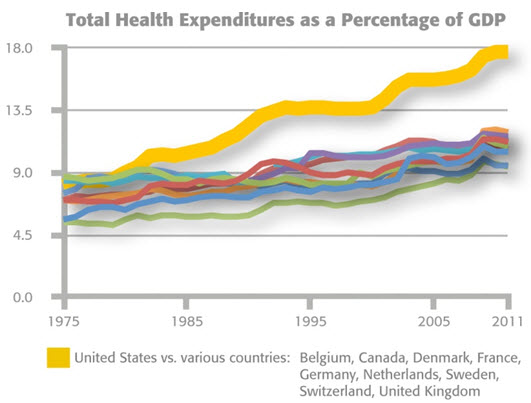
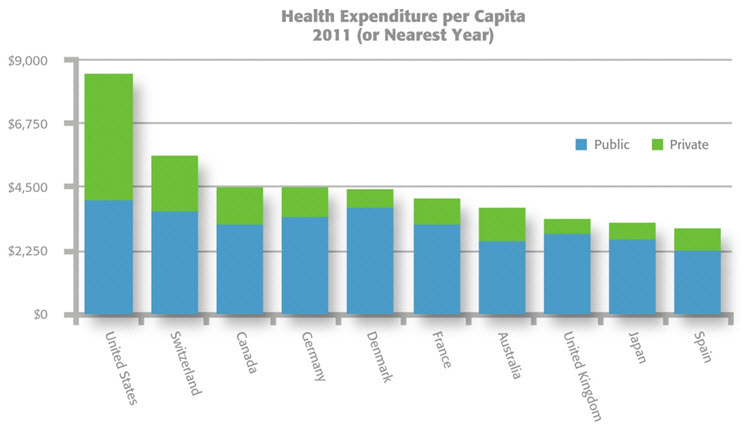
The U.S. currently spends more than 17% of its national gross domestic product (GDP) on health care, far more than any other country in the world. Health care spending now averages almost $9,000 per American,1and health care is the fastest growing industry in the country.2Private (nongovernmental)health care spending accounts for a large portion of the difference between spending in the U.S. and in other industrialized countries.

Img1

Img2Organisation for Economic Co-operation and Development, “Health Statistics2013,” June 2013. Note: Values in U.S. $ Purchasing Power Parity. Data for Japan and Australia refers to 2008.

Access

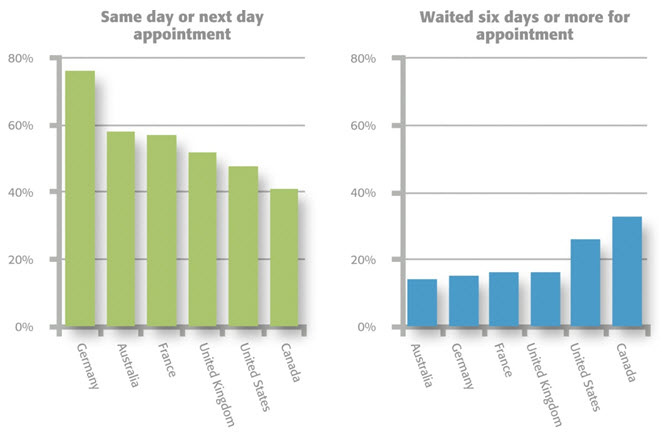
The U.S. has fewer physicians,hospital beds, physician visits,and hospitalizations per capita than most other industrialized countries.3 Eighty-five percent of Americans report having a regular source of ongoing care, but more than a quarter encounter difficulty accessing the healthcare system.4 There are large disparities in access by type of health insurance coverage.

Img3Continue reading…

This Visit May Be Recorded

By ALAN SCHWARTZ & SAUL WEINER

flying cadeuciiIn their 1993 book, Reinventing Government, David Osborne and Ted Gaebler entitled a section “what gets measured gets done.” Unfortunately, when it comes to improving health care quality, safety, and costs, we often fail to observe the real work of care, and miss the chance to get it done better. To make a real difference, we need to begin measuring care when and where it happens – behind the curtain.

Why We Must Directly Observe Patient Care

For the last 10 years, our work in research and quality improvement has used concealed audiorecorders to capture what actually happens during patient-physician encounters, and to provide feedback to physicians about their performance. Much of our focus has been on demonstrating the importance of appreciating the patient’s life context and showing how encounters in which physicians elicit patient context and incorporate it into care planning have better health care outcomes and lower costs from inappropriate care. We’ve found such contextual factors are relevant to health care in two-thirds of encounters, that physicians ask about them less than a third of the time, and when they are discovered, they are incorporated into the plan less than 60% of the time. Contextual errors—inappropriate care due to failure to contextualize—are pervasive.

Records Don’t Record

Only direct observation of care reveals these errors. The medical record, currently the source of most data in performance improvement, does not and cannot identify mistakes that the physician doesn’t already recognize. The medical record, at best, shows that the physician rendered the care they believe the patient needed, which can be the “right” care for the wrong patient.

Continue reading…

Saving Normal

By SAURABH JHA

Screen Shot 2015-12-16 at 1.39.02 PMThe iconoclastic psychiatrist Thomas Szasz said that mental illness was metaphorical, not real, because mental diseases lacked biological substrates. The absence of a substrate predisposes psychiatry to overdiagnosis and avoiding overdiagnosis is psychiatry’s biggest challenge. This challenge has been taken up by Allen Frances in Saving Normal. Like Szasz, Frances writes in cultured, erudite prose. Unlike Szasz, Frances believes that psychiatric illnesses are real. To save the mentally ill, to save psychiatry from itself, Frances says we must save normal.

Six years ago, Frances was enjoying retirement after a distinguished career, minding his business sipping cocktails at the annual meeting of the American Psychiatric Association (APA). Psychiatrists were excited about updating the Diagnostic and Statistical Manual of Mental Disorders (the soon to be DSM-V). Frances had chaired the previous edition of DSM, but in the zeal of the latest edition, he saw diagnostic hyperinflation of a frightening scale.

Continue reading…

Why Doctors should Recommend Quantified Self Technologies for Their Patients

By MOLLY MALOOF

Screen Shot 2015-12-18 at 12.01.55 PM


The United States population suffers from staggering numbers of lifestyle related diseases. We know the situation is not improving. Recent research found that over half of the country has prediabetes or diabetes. The facts don’t lie—the vast majority of the US burden of disease are due to lifestyle.

Img1

Photo Credit: Dr. DArriush Mozzafarian

People know they should eat less and exercise more, but they don’t. They don’t because without the right knowledge and direction, behavioral change is really hard. Doctors also know they should be advising their patients on lifestyle, but they don’t.

Continue reading…