Categories

Category: Medical Practice

The Effectiveness of Online Health Intervention Programs

By GLENN LAFFEL

In recent posts on Web-based and mobile behavioral intervention programs, we reviewed evidence suggesting that social support, in one form or another, can improve participants’ adherence and engagement with the program. That didn’t always mean however, that participants achieved better outcomes as a result. In one study for example, an online community increased engagement with and utilization of a Web-based activity program, but it did not increase participants’ actual activity levels.

Another study, slightly older than the ones reviewed above, did show that a Web-based program improved outcomes. In this case, the intervention was an online videogame known as Re-Mission. Since I haven’t touched previously on outcome studies for automated lifestyle intervention tools or videogames as an example of such programs, I’ll do that here.

Re-Mission is intended improve medication compliance in teens and young adults with a history of cancer. In the game, players control a nanobot within a 3-dimensional body of a young person that has cancer. Play involves destroying cancer cells and managing chemotherapy-related adverse effects like vomiting and bacterial infections by using antiemetics and antibiotics. The game purports to help users understand their disease and its treatment and improve their sense of self-efficacy: they can take control of their disease.

Continue reading…

The Super Mobile Doctor Uses Smartphones and Tablets in Patient Care

Jane Sarasohn-Kahn

By JANE SARASOHN-KAHN

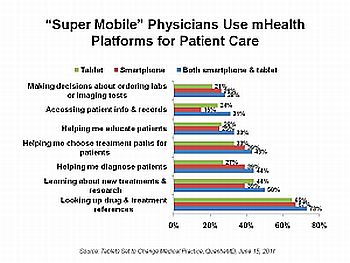
Physicians who have adopted smartphones and tablet devices access online resources for health more than less mobile physicians. Furthermore, these “Super Mobile” doctors are using mobile platforms at the point of care.

Physicians adoption and use of mobile platforms in health will continue to grow, according to a survey from Quantia Communications, an online physician community. This poll was taken among 3,798 physician members of QuantiaMD’s community in May 2011. Thus, the sample is taken from the community’s 125,000 physicians who are already digitally-savvy doctors. QuantiaMD calls physicians with both mobile and tablet devices “Super Mobile” physicians.

The most common mobile devices among the Super Mobile doctors in QuantiaMD are iPhones, used by 59%; iPads, used by 29%; and, Android smartphones, used by 20% of the physicians surveyed. Blackberry devices are used by 14% of the doctors in the poll.

Just under one-half of these doctors plan to purchase a mobile device in 2011, notably an iPhone, an iPad, or an Android.


Continue reading…

Do Kaiser Cardiologists Need More Pharmacist Consults to Keep Their Patients Alive?

By AL LEWIS

A study by a team consisting mostly of Kaiser clinical pharmacists published in Pharmacotherapy[1] finds that a very inexpensive pharmacist consult for cardiac patients reduces the cardiac death rate by more than 80% and — even though it’s a cardiac-specific drug regimen consult — also reduces the non-cardiac death rate by more than 95% vs. what Kaiser’s doctors achieved with usual care.  Plus, even though it increases drug use, it earns a 56:1 ROI while reducing drug costs.

The implication: Kaiser’s doctors need Kaiser’s pharmacists to prevent their cardiac patients from dying, in general, but especially from non-cardiac causes…and that Kaiser is losing huge amounts of money if they don’t do this.

However, the study’s conclusions violate every “rule of plausibility” and are invalid. This study, unless its invalidity becomes more widely recognized, could also be used to justify expanded reimbursements for clinical pharmacist consults.   Clinical pharmacists may or may not deserve expanded reimbursement, but justification for that reimbursement cannot be made based on studies like this one.

Quite a number of findings deserve mention. First, not getting the $1/patient-day of clinical pharmacist support given to the study group had apparently cost 30% of the retrospective control group patients their lives, vs. 3% of the intervention group.


Continue reading…

Health Reform: Evidence-Based Medicine and the Real World

By RICHARD REECE

The July 7 edition of the New England Journal of Medicine just arrived. It contains two back-to-back articles that illustrate the problems of transforming medicine into an evidence-based format.

• The first is “Lessons from the Trenches – A High Functioning Primary Clinic.” Its author, Thomas Bodenheimer, MD, a well-known University of California academic, describes the workings and make-up of Clinica Family Health Services, a Denver-based primary care community health clinic. The clinic serves 40,000 patients at 4 sites. Fifty percent of these patients are uninsured; 40% are on Medicaid. Clinica aspires to be one of the first Accountable Care Organizations. Each of its locations includes three primary care practitioners, three medical assistants, a RN, a case manager, a behavioral health professional, and medical-records and front-desk staff. The clinic “has moved boldly from a doctor-based model to a team-based model.” Patients are never turned away, and most are seen on the day they call. The 4 clinics have a linking EMR, and they concentrate on assembling data that show progress. These data includes time it takes to see a primary care doctor or to meet with “the team,” entry to care during 1st trimester, number of low birth rate infants and % of Cesareans, Pap test within last 3 years, number of patients with diabetes and their glycated hemoglobin levels, and number of patients with hypertension. The goal is to improve all these measures. The basic idea is to serve patients while retaining loyal clinicians. The next step will be to reduce ER visits and hospital admissions. This step “awaits a new funding stream, which requires participation in which Clinica will share savings from reduced downstream costs.” To which I say, “ Good luck.” Many observers, including myself, say Accountable Care Organizations are DOA.

Continue reading…

Why Do Doctors Offer Credit Cards?

By DAVID E. WILLIAMS

Yesterday’s Wall Street Journal (When Your Doctor Sells Credit Cards) documented the growth in credit cards issued to finance elective procedures such as LASIK, plastic surgery and dental implants. The article covered the usual points but missed one important but little-known aspect of the industry.

Briefly, physicians offer the cards for procedures not covered by insurance. The cards have a zero percent interest rate and no fees, usually for the first 12 months. After that the interest rates spike and to make matters worse customers are also charged retroactive interest on their first year’s balance. Ouch! The article details the pitfalls you’d expect from cards like these, and of course there have been some abuses.

A card company spokesman quoted in the article says, “the vast majority of account holders pay off their balances before the promotion ends.” That statement doesn’t surprise me, because most people who have these elective procedures are relatively well off.

Continue reading…

The Usefulness and Uselessness of Electronic Medical Records

By RICHARD REECE

Nothing is so useless as a general maxim.

Lord MacCaulay (1800-1859), On Machiavelli (1827)

I dare say that I have worked off my fundamental formula on you that the chief end of man is to frame general propositions and that no general proposition is worth a damn.

O.W Holmes, Jr. (1809-1904), as quoted in The Practical Cogitator, 1962


The general maxim and general proposition behind the rationale of a national interoperative electronic medical record system in every physician’s office is that you can never get too much information and that government can use digital data to cut costs and improve care.

The Problem

Sounds good, doesn’t it? The problem is that so far, after nearly a decade of advancing this maxim and proposition, perhaps 80% of physicians in independent practice aren’t buying. And this, in face of the reality, that government has proposing spending $27 billion to get EHRs off the ground. And beginning this year, CMS will start offering as much as $44,000 per physician over a staggered five years if physicians make “meaningful” use of “certified” medical records. Many doctors regard such rhetoric as empty talk that will accompanied by unreasonable bureaucratic requirements, as surely as dawn following night.

Why no “buy-in” among doctors? Why have two national IT coordinators appointed by Obama, David Brailer,ND, in 2005 and David Blumenthal, MD, in 2011, resigned in frustration over the failure to persuade doctors that gathering electronic data and measuring care is a good thing? If universal EHRs are such a good thing, why have physicians and hospitals not raced to embrace EHRs?

As Steve Lohr of the New York Times, a leading thinker in health care innovation, says in yesterday’s Times (“Seeing Promise and Peril in Digital Records,”

“What is beyond doubt is that the promise of digital records will be unfulfilled if doctors refuse to adopt them, because they regard the technology as cumbersome, time consuming, and possibly dangerous.”

To date, most doctors, except for enthusiastic early adopters, IT nerds, and those in large organizations, have found EHRs “useless” in their daily work. EHRs cost excess money, show little return on investment, change the very nature of practice, slow productivity, tell no narrative tales, cause conflicts among staff and colleagues, require extensive record keeping, are subject to hacking, and, more often than not, are useless as a tool for communicating to colleagues, hospitals, and other doctors outside your practice.

When the government establishes “usability standards” that work, maybe doctors will come on board the electronic train. Until then, says Dr. Edward H. Shortliffe , a professor at the University of Texas Health Science Center in Houston, “Usability is going to be the single greatest impediment to physician acceptance. “

If EHRs are not made more useful and soon, universal digital records may turn out to be a giant boondoggle rather than a scientific bonanza.

Richard L. Reece, MD, is pathologist, editor, author, speaker, innovator, and believer in abilities of practicing doctors and their patients to control and improve their health destinies through innovation. He is author of eleven books. Dr. Reece posts frequently at his blog, Medinnovation.


Rhetoric Ahead of Reality: Doctor Ratings Not Useful Yet

By JESSIE GRUMAN

“Most physicians are competent and able to take care of most of the problems patients present with.  The standards for getting into medical school are high and for getting out are higher.  I think this call for patients to become experts in picking their doctors is overstated.”  – David Rovner, MD, Professor Emeritus, Michigan State University

Most?  What does “most” mean?  Can most doctors treat me for the flu?  How about pancreatic cancer? Must I conduct the same type of research to choose a doctor to set my broken arm that I do to find one to treat my mom’s congestive heart failure?   Is the same level and type of research necessary to find a good surgeon as for a primary care clinician?

There are no easy answers to these questions.  The steady stream of media messages and articlesurging us to thoroughly check out any new physician we might consult stand in stark contrast to my colleague David’s opinion.  The release of the latest “Top Doctors” from the US News and World Report’s“Best” series is surely a sign that, in a declining print media market, lists of superlatives still boost magazine sales.  But reports like these do little to help us understand what is at stake in doing so or to figure out under what circumstances it is important.  Rather, they assume that we are sufficiently anxious or cautious to dive into conducting research prior to making any and all doctor choices.

Continue reading…

More About Balancing Business, Humanity, and Restraint in Cancer Care

By HAROLD POLLACK

I published a column in Kaiser Health News about the challenge of cost control in cancer care. KHN needed to cut one section for space, which notes that oncology has become an ecosystem of multi-billion-dollar public, private, and nonprofit ventures in pharmaceutical development, imaging, acute care, and more. This ecosystem draws upon and then reinforces broader cultural biases that promote overly aggressive approaches to diagnosis and care. I wanted to add some more discussion, and one revealing advertising table….

Consider the issue of routine mammography for younger women. In questioning the benefits of such screening, the United States Preventive Services Task Force ran afoul of Americans’ powerful draw to the notion of early detection in confronting an especially frightening disease. The USPSTF committed some political blunders in its approach to this freighted and genuinely complicated issue. It should have anticipated the powerful political, cultural, and commercial resistance it was likely to encounter.

In American popular culture–though not in the epidemiological data–breast cancer is often depicted as a young woman’s disease. A terrific 1998 paper by Paula Lantz and Karen Booth examined magazine depictions of breast cancer. Lantz and Booth concluded that “the increase in incidence is commonly portrayed as a mysterious, unexplained epidemic occurring primarily among young, professional women in their prime years.” Public service announcements concerning mammography and breast cancer show similar patterns. These announcements, with their myriad images of beautiful young swimmers, emphasize that one in nine women will be diagnosed with breast cancer. The PSAs do not emphasize that only about 12 percent of breast cancer patients are diagnosed before age 45.

Continue reading…

Why Medical Specialists Should Want to End the Reign of the RUC

By PAUL M. FISCHER

The old doctors know.  The practice of medicine has changed in a very basic way over the last 20 years.  Physician relationships have lost their civility and have been replaced by a level of tension that takes the fun out of collegial interactions.  I remember my first year of family medicine as the only doctor in Weeping Water, Nebraska.  My personal medical community had gone from an entire medical school campus with limitless lectures and many physicians to share in “interesting cases” to an occasional phone call with a consultant in Omaha.  These contacts became my primary source for medical education and updates for Weeping Water’s health care.  The phone calls were collegial, respectful, and focused on what was best for my patients.

What happened?

The RUC is the secretive committee of the AMA that has been CMS’s primary source of physician payment data over the past 20 years.  It has elaborately articulated the complexity of medical procedures but ignores and confuses the cognitive work involved in patient care – collapsing it into a few evaluation and management codes. As a result, many medical specialties have found that their financial success is tied primarily to doing things TO patients, rather than caring FOR patients.

The RUC has shifted these physicians’ attention away from the hard work of knowing patients over time and fine-tuning their treatments based on subtle changes discovered by history and physical toward focusing on which procedure can be done to a patient and legitimized to an insurance company.  Let the “primary” do that other stuff.

Continue reading…

The CSI Effect Hits Medicine

By EVAN FALCHUK

I’m in Israel, home to some of the most innovative care in the world.  Doctors here wanted to know if the high-tech tests that are an increasing part of their work helps.  A couple of weeks ago, they published their results.

It turns out that in about 90% of cases, it didn’t matter.

A physical exam, the patient’s history, and the basic set of tests that doctors have done for decades was almost always all that was needed to get a diagnosis.  As one of the doctors in the study put it, “ basic clinical skills remain a powerful tool, sufficient for achieving an accurate diagnosis in most cases.”

The conventional wisdom is that doctors – at least in the U.S. – order extra tests to protect themselves from getting sued.  But this study was done in Israel, where the problem of medical malpractice is nothing like it is in the U.S.  American-style defensive medicine can’t be the reason doctors in Israel use so many diagnostic tests.

Continue reading…