Categories

Category: Medical Practice

Was the IOM estimate of medical errors correct?

By SAURABH JHA

In 1999, the Institute of Medicine (IOM) in their landmark report – To Err is Human – estimated that the number of deaths from medical errors is 44 ,000 to 98, 000. The report ushered the Quality and Safety Movement, which became a dominant force in all hospitals. Yet the number of deaths from medical errors climbed. It is now touted to be the 3rd leading cause of death. How easy is it to precisely quantify the number of deaths from medical errors? Not many physicians challenged the methodologies of the IOM report. Some feared that they’d be accused of “making excuses for doctors.” Many simply didn’t have a sufficient grip on statistics of measurement sciences. One exception was Rodney Hayward – who was then an early career researcher, a measurement scientist, who studied how sensitive the estimates of medical errors were to a range of assumptions.

Saurabh Jha (aka @RogueRad) speaks with Professor Hayward for the Firing Line Podcast about his research in JAMA published in 2001 – Estimating Hospital Deaths Due to Medical Errors: Preventability Is in the Eye of the Reviewer. It was a landmark publication of the time, and its objective methods have stood the test of time.

Rod Hayward a Professor of Public Health and Internal Medicine at the University of Michigan and Co-Director of the Center for Practice Management and Outcomes Research at the Ann Arbor VA HSR&D. He received his training in health services research as a Robert Wood Johnson Clinical Scholar at UCLA and at the RAND Corporation, Santa Monica. His current and past work includes studies examining measurement of quality, costs and health status, environmental and educational factors affecting physician practice patterns, quality improvement, and physician decision making. His current work focuses on quality measurement and improvement for chronic diseases, such as diabetes, hypertension and heart disease.

Listen to their conversation on Radiology Firing Line Podcast here.

What Oncology’s Figured Out About the EHR | Dr. Ed Kim of Atrium Health

By JESSICA DAMASSA

Is there a silver bullet for making EHRs more useful to doctors? The Oncology team at Atrium Health thinks they’ve figured it out. From better integrating new info on FDA approved cancer treatments to just working with doctors and patients more intuitively, Dr. Ed Kim talks about how the underlying challenges health technologists need to address is figuring out what info is important to care delivery teams in the first place.

Filmed at Health Datapalooza in Washington DC, March 2019.

Jessica DaMassa is the host of the WTF Health show & stars in Health in 2 Point 00 with Matthew Holt. Get a glimpse of the future of healthcare by meeting the people who are going to change it. Find more WTF Health interviews here or check out www.wtf.health.

THCB Spotlights: Brooke LeVasseur, CEO of AristaMD

Today on THCB Spotlights, Matthew talks to Brooke LeVasseur, who is the CEO of AristaMD. AristaMD provides eConsults to empower providers to get patients faster access to care. The average wait time to see a specialist is one to two months, and the proportion of referrals to specialists that never happen can be incredibly high, at 40% in Medicare populations for instance. AristaMD aims to provide an efficient way for primary care providers to tap into the expertise of specialists to immediately start executing on a treatment plan without the patient having to wait or travel. Tune in to find out how AristaMD is actually rolling this out and get a demo of the platform.

Sexism vs. Cultural Imperialism

By SARAH HEARNE

As I was getting ready for bed last night a friend shared a tweet that immediately caught my attention.

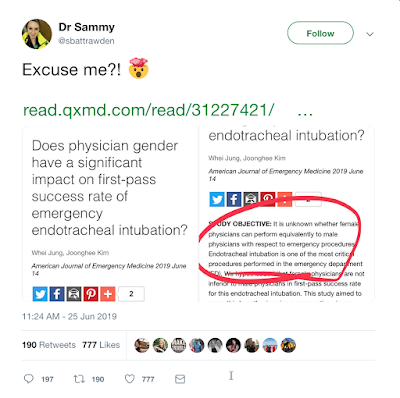
https://twitter.com/sbattrawden/status/1143465003409915905

The tweet was of a paper that has just been published online, titled “Does physician gender have a significant impact on first-pass success rate of emergency endotracheal intubation?” and showed the abstract which began,

It is unknown whether female physicians can perform equivalently to male physicians with respect to emergency procedures.

Understandably, this got the backs up of a lot of people, myself included. Who on earth thinks that’s a valid question to be researching in this day and age? Are we really still having to battle assumptions of female inferiority when it comes to things like this? Who on earth gave this ethics approval, let alone got it though peer review?

I then took a deep breath and asked myself why a respected journal, The American Journal of Emergency Medicine, would publish such idiocy. Maybe there was something else going on. The best way to find out is to read the paper so I got a copy and started reading. The first thing that struck me was the author affiliations – both are associated with hospitals in Seoul, South Korea. The second author had an online profile, he is a Clinical Professor of Emergency Medicine. I couldn’t find the first author anywhere which made me think they are probably quite early in their career. The subject matter wasn’t something I could imagine a male early career researcher being interested in so figured they are probably female (not knowing Korean names I couldn’t work out if the name was feminine or masculine).

Continue reading…

Psychiatrist: My Medicine Raised Our Patient’s Blood Sugar, Can You Help? PCP: That’s a Dump!

By HANS DUVEFELT

If my hypertensive patient develops orthostatism and falls and breaks her hip, I fully expect the orthopedic surgeon on call to treat her. I may kick myself that this happened but I’m not qualified to treat a broken hip.

If my anticoagulated patient hits his head and suffers a subdural hematoma, I expect the local neurosurgeon to graciously treat him even though it was my decision and not his to start the patient on his blood thinner. After all, brain surgery is tricky stuff.

Why is it then that primary care docs, sometimes myself included, feel a little annoyed when we have to deal with the consequences of psychiatric medication prescribing?

My psychiatry colleagues diligently order the blood work that is more or less required when prescribing atypical antipsychotics, for example. But when the results are abnormal I get a fax with a scribble indicating that the PCP needs to handle this.

We need to just deal with that and appreciate that there has been communication between treating providers. Because that doesn’t always happen. Particularly with medication prescribing, we don’t always get a notification from our psychiatry colleagues when a patient is started on something new because their records are so much more secret than ours.

The other day I sat in my monthly conference with staff from the Behavioral Health Home that I serve as the medical director for. I consult on clinical and policy matters.

Continue reading…

Can we move on?

By CHADI NABHAN

Every so often, my cynical self emerges from the dead. Maybe it’s a byproduct of social media, or from following Saurabh Jha, who pontificates about everything from Indian elections to the Brexit fiasco. Regardless, there are times when my attempts at refraining from being opinionated are successful, but there are rare occasions when they are not. Have I earned the right to opine freely about moving on from financial toxicity, anti-vaxers, who has ‘skin in the game’ when it comes to the health care system, the patient & their data, and if we should call patients “consumers”? You’ll have to decide.

I endorse academic publications; they can be stimulating and may delve into more research and are essential if you crave academic recognition. I also enjoy listening to live debates and podcasts, as well as reading, social media rants, but some of the debates and publications are annoying me. I have tried to address some of them in my own podcast series “Outspoken Oncology” as a remedy, but my remedy was no cure. Instead, I find myself typing away these words as a last therapeutic intervention.

Here are my random thoughts on the topics that have been rehashed & restated all over social media outlets (think: Twitter feeds, LinkedIn posts, Pubmed articles, the list goes on), that you will simply find no way out. Disclaimer, these are NOT organized by level of importance but simply based on what struck me over the past week as grossly overstated issues in health care.  Forgive my blunt honesty.

Continue reading…

The rAIdiologist will see you now

By RIZWAN MALIK

The year is 2019 and Imaging By Machines have fulfilled their prophesy and control all Radiology Departments, making their organic predecessors obsolete.

One such lost soul tries to decide how he might reprovision the diagnostic equipment he has set up on his narrow boat on the Manchester Ship Canal, musing at the extent of the digital take over during his supper (cod of course).

What I seek to do in this short paper is not to revisit the well-trodden road of what Artificial Intelligence, deep learning, machine learning or natural language processing might be, the data-science that underpins them nor limit myself to what specific products or algorithms are currently available or pending. Instead I look to share my views on what and where in the patient journey I perceive there may be uses for “AI” in the pathway.

Continue reading…

A Rose by Another Name

By SAURABH JHA

Can we reduce over diagnosis by re-naming disease to less anxiety-provoking makes? For example, if we call a 4.1 cm ascending aorta “ecstasia” instead of “aneurysm” will there be less over-treatment? In this episode of Radiology Firing Line Podcast, Saurabh Jha (aka @RogueRad) discusses over diagnosis with Ian Amber, a musculoskeletal radiologist at Georgetown University, Washington.

Today’s Doctors: Colleagues or Free Agents?

By HANS DUVEFELT

My first job after residency was in a small mill town in central Maine. I joined two fifty something family doctors, one of whom was the son of the former town doctor. I felt like I was Dr. Kiley on “Marcus Welby, MD.” I didn’t have a motorcycle, but I did have a snazzy SAAB 900.

Will was a John Deere man, wore a flannel shirt and listened to A Prairie Home Companion. He was kind and methodical. Joe didn’t seem quite as rural, moved quicker and wore more formal clothes. I never could read his handwriting.

They each had their own patients, but covered seamlessly for each other. They were like a pair of spouses in the sense that they answered to each other as much as to their patients. They had to make everything work for the benefit of their shared practice, their shared livelihood. Their mutual loyalty was essential and obvious, although allowing for their differences in temperament and personalities.

Invited to stay on and enter into a partnership, I hesitated. How did I fit in? Could I follow in their footsteps and become an equal partner, covering for them and doing things similarly enough to fit in for the long haul?

Continue reading…

The best medical AI research (that you probably haven’t heard of)

By LUKE OAKDEN-RAYNER

I’ve been talking in recent posts about how our typical methods of testing AI systems are inadequate and potentially unsafe. In particular, I’ve complainedthat all of the headline-grabbing papers so far only do controlled experiments, so we don’t how the AI systems will perform on real patients.

Today I am going to highlight a piece of work that has not received much attention, but actually went “all the way” and tested an AI system in clinical practice, assessing clinical outcomes. They did an actual clinical trial!

Big news … so why haven’t you heard about it?


The Great Wall of the West

Tragically, this paper has been mostly ignored. 89 tweets*, which when you compare it to many other papers with hundreds or thousands of tweets and news articles is pretty sad. There is an obvious reason why though; the article I will be talking about today comes from China (there are a few US co-authors too, not sure what the relative contributions were, but the study was performed in China).

China is interesting. They appear to be rapidly becoming the world leader in applied AI, including in medicine, but we rarely hear anything about what is happening there in the media. When I go to conferences and talk to people working in China, they always tell me about numerous companies applying mature AI products to patients, but in the media we mostly see headline grabbing news stories about Western research projects that are still years away from clinical practice.

This shouldn’t be unexpected. Western journalists have very little access to China**, and Chinese medical AI companies have no need to solicit Western media coverage. They already have access to a large market, expertise, data, funding, and strong support both from medical governance and from the government more broadly. They don’t need us. But for us in the West, this means that our view of medical AI is narrow, like a frog looking at the sky from the bottom of a well^.

Continue reading…